
A quality complaint arriving from one of your customers is a sourcing problem before it is a service problem. What if the unit that came back was never positively identified? What if the runtime complaint cannot be matched against any published figure, because the catalogue does not say whether a runtime number refers to standby or to continuous use? What if the customer says water got into it, and the model has no ingress rating to argue with? In each of those cases the complaint cannot be answered on the merits, because the evidence that would support a decision was never captured. This article is about the order in which that evidence has to be frozen, and about which parts of it exist in published form before a single unit is even built.
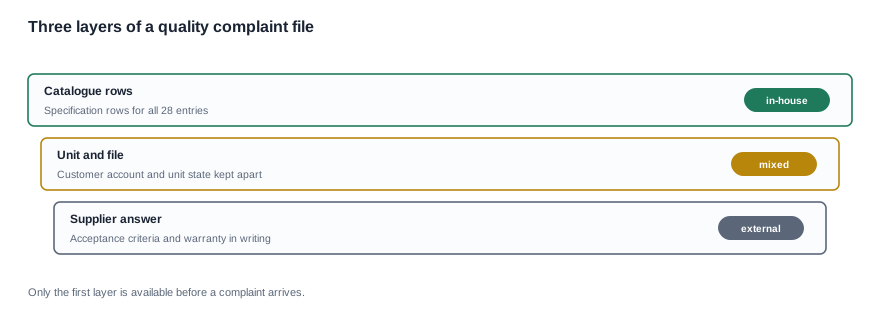
The range makes the point sharply. The catalogue carries 28 entries across seven categories, and for most of them it publishes specification rows and nothing else: no unit price, no minimum order quantity, no lead time, no warranty period, no certificate numbers, no weights, no dimensions, no sensor models, no field of view, no frame rates, no storage figures, no microphone or speaker models, and no acoustic measurements at all. A procurement team reading that list has the ingredients for a specification argument and very little else. The rows that do exist are enough to identify a unit and to describe what it was sold as; they are not enough to adjudicate a failure. Deciding where to stand on a complaint therefore depends less on goodwill and more on whether the file was opened correctly.
What if a customer complains: the four items to fix first
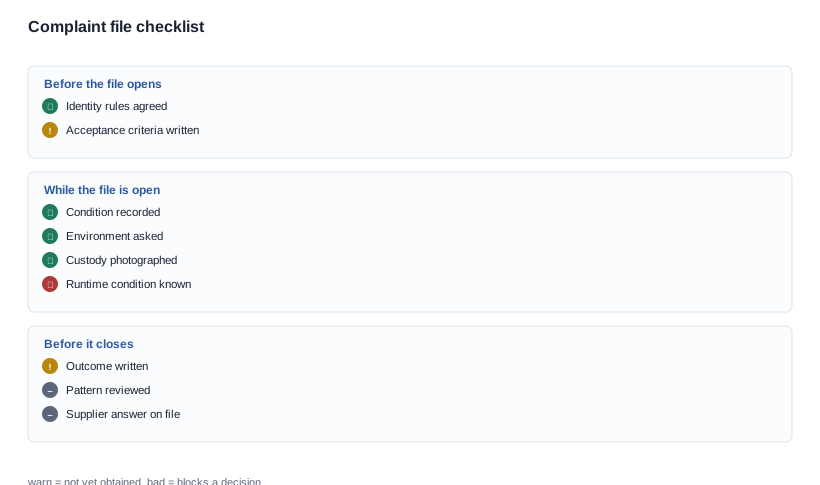
Freezing evidence is a sequence, not a checklist, because each item changes the meaning of the ones after it. Fixing them out of order produces a file that looks complete and answers nothing.
Item one is product identity. Until the returned unit is tied to a catalogue entry, no other evidence can be read against a specification, because the range contains entries that differ on the very rows a complaint depends on. Among the eleven camera entries the cell value takes only four forms — 220, 260, 265 and 290 mAh — so a battery reading narrows the field quickly, and the 265 mAh value identifies the MT6 within that group. Charging method separates the group further: magnetic charging appears on five camera entries, a Type-C port appears on two, and four entries publish no charging-method row at all. Only two camera entries publish a colour row, the V03 Pro with three colours and the V06 with four, so a colour photograph is corroboration on those two models and no evidence at all on the other twenty-six entries in the range. Identity has to be established from something physical in the unit, not from the order record alone.
Item two is condition at failure. This is where most complaint files are lost, because the customer's account and the unit's observable state are recorded together as one narrative. Separate them. The customer's account of what happened is testimony; the unit's observable state is a measurement. The catalogue publishes runtime figures for the camera entries in three bands — 5~8 h for the V06, the S7 and the V03 Pro, and the V03, 6~8 h for the KY06 and the MT5, and about 7 h for the L1 Pro and the L2 Utral, the CY05 and the MT6, and the CY03 — and it publishes runtime figures for the other categories as well. What it does not publish, anywhere, is the condition under which those figures were taken. Without that, a complaint that says the battery died early cannot be tested against a published number, because the published number describes an unknown test condition.
Item three is environment. Ingress, temperature, humidity, dust and mechanical stress all belong here, and the catalogue's position on ingress is narrow and specific. An IP54 marking appears on the V06 and the S7 and on no other entry; the catalogue publishes no ingress rating for the other 26 entries, and it publishes no third-party test report number for the two that carry a marking. Weight is narrower still: the catalogue publishes one weight in the entire range, the 158 g of the MT6 glasses body, which excludes its folding charging case. A complaint about a product feeling heavier than expected therefore has nothing to be measured against on twenty-seven entries, and the 158 g figure cannot be carried across to any other model or described as a frame weight.
Item four is chain of custody. This records what came back, in what condition, and with what attached. It matters because the catalogue's charging-case position is not uniform, and a missing case changes what a returned unit proves. Five camera entries publish a case capacity — 1400 mAh on the L1 Pro and the CY03, and the CY05, 900 or 1400 mAh on the L2 Utral, and 1200 mAh on the MT6 folding case — two more publish a case without a figure, the KY06 and the MT5, and four publish no charging-case row whatsoever, the V03 and the V03 Pro, and the S7 and the V06. Whether a case was in the box for those four is not stated either way in the catalogue, which makes it a question to settle at the point of sample approval rather than a fact to reconstruct later.
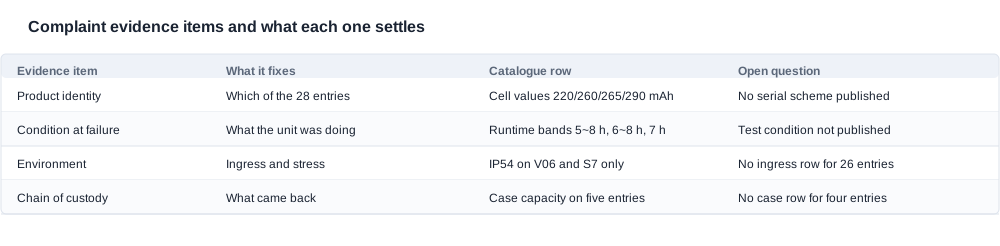
| Evidence item | What it fixes | What the catalogue can confirm | What it cannot |
|---|---|---|---|
| Product identity | Which of the 28 entries the unit is | Cell value from four camera values: 220, 260, 265, 290 mAh | Serial or batch marking; no serial scheme is published |
| Condition at failure | What the unit was doing when it failed | Runtime bands of 5~8 h, 6~8 h and about 7 h for camera entries | The test condition behind a runtime figure, standby or continuous use |
| Environment | Whether ingress or stress was a factor | IP54 on the V06 and the S7 only | An ingress rating for the other 26 entries |
| Chain of custody | What actually came back | Case capacity on five camera entries, a case without a figure on two | Whether the V03 and V06, and V03 Pro or S7 were shipped with a case |
What the catalogue can support, and where it runs out
The useful way to think about a published catalogue is as a set of rows that answer identity and specification questions and are silent on everything else. That distinction decides what a complaint file can and cannot contain.
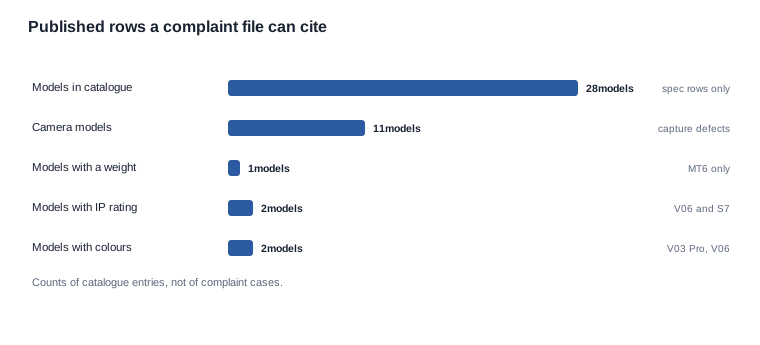
Rows that a complaint file can cite are concentrated in a handful of places. There is a cell value for every entry, a charge time for every entry, a runtime figure for every entry, a charging method for most entries, a Bluetooth version for the eight audio entries and for the sport, children's, AR and electrochromic entries, but not for the eleven camera entries, and a resolution class for the eleven camera entries — eight megapixels across eight of them and thirteen megapixels across three. There is an ingress marking on two entries, a weight on one, colours on two, a remote shutter on two, and a removable inner frame on the V06 and the S7.
Everything else in a complaint file has to come from somewhere else: from the customer, from the unit, from the courier, or from the supplier in writing. That includes warranty terms, defect rates, repair capability, replacement policy, spare part availability and the acceptance criteria for a return. The catalogue publishes no warranty period at all, so a complaint workflow has to define its own acceptance rule and have it agreed before volume arrives. It includes any acoustic or imaging measurement, because the range publishes no microphone model, no pickup specification, no speaker model, no sound pressure figure, no analogue-to-digital or digital-to-analogue conversion values and no signal-to-noise value for any entry. It includes any serial or lot marking scheme, because none is published.
Two of those absences deserve emphasis for a procurement reader. The first is the runtime condition. Every entry publishes a runtime, and the end conditions of that runtime are not published anywhere in the range, which means a battery complaint cannot be adjudicated against the catalogue even when the model is unambiguous. The second is ingress. With a marking on only two entries, a water complaint against any other model has no published benchmark at all, and the absence of a marking does not mean the absence of a rating in the supplier's own test records — it means the catalogue does not carry one. A buyer who needs ingress evidence for a specific model has to request it, and a supplier who answers that request with a catalogue extract has not answered it.
What the file looks like from the moment the complaint lands
The practical sequence is short, and every step exists to stop a later step from being contaminated by a later assumption. It is worth writing into the supplier agreement, because the first step happens inside a customer's inbox and the last one happens in a factory, and the two are usually governed by different people.
- Acknowledge without attributing. Confirm receipt, state that the file is open, and give the customer a named contact. Do not name a cause, do not name a model fault, and do not describe the product as defective or as working normally. Any of those statements, made before identity is fixed, becomes the position that has to be defended later.
- Freeze the identity. Ask for photographs of the unit, the case, the packaging, the paperwork and any label or marking visible on the device or the box. Ask for the order reference and the date of purchase. Reconcile those against the order record. If the unit cannot be tied to an entry, say so in the file at that point; an unresolved identity is a fact of the case, not a gap to be filled later from memory.
- Separate the testimony from the observable state. Record what the customer reports in their own words, and record separately what the unit shows. A customer's account of a wet environment and a unit's photograph showing a dry interior are two pieces of information, and the file should not merge them.
- Record the environment. Ask where the unit was used, in what conditions, and whether it was connected to a charger or a case at the time. Ingress questions have to be asked while the customer still remembers, because the answer rarely appears in a photograph.
- Secure the physical unit. Agree the return route, who pays it, and what must travel with it. Record the packaging state at the point of dispatch, because transit damage and use damage are different claims and the same scuff is read differently depending on when it was photographed.
- Do not diagnose on the catalogue. Because the catalogue is silent on the rows a diagnosis would need, any conclusion drawn from it is a conclusion drawn from absence. If the defect involves acoustics, imaging, ingress beyond the two marked entries, or a runtime, the catalogue cannot decide it.
- Escalate with the file attached. Send the supplier the four fixed items rather than a summary of the complaint. A summary loses exactly the detail that makes a case, which is the difference between "it stopped working" and "the unit no longer produced a runtime consistent with the published band, the environment was a swimming pool, and the returned case was the folding type".
- Write the outcome down. When the case closes, record what was decided and on what evidence, and keep it. A repeat complaint on the same model with the same symptom is a pattern, and a pattern is only visible if the earlier files are still readable.

Two paths that are often confused
The most common error in complaint handling is treating every complaint as a defect claim. It is not, and the two paths need different evidence, different timing and different people. A transit claim is about a condition observed at the point of receipt, and it lives or dies on photographs taken at that moment. A defect claim is about a condition that developed, and it lives or dies on the identity, condition, environment and custody items above. A claim that starts as one and is handled as the other tends to stall: the transit evidence decays quickly, because packaging condition is not recorded once the box is opened, while the defect evidence is available indefinitely.
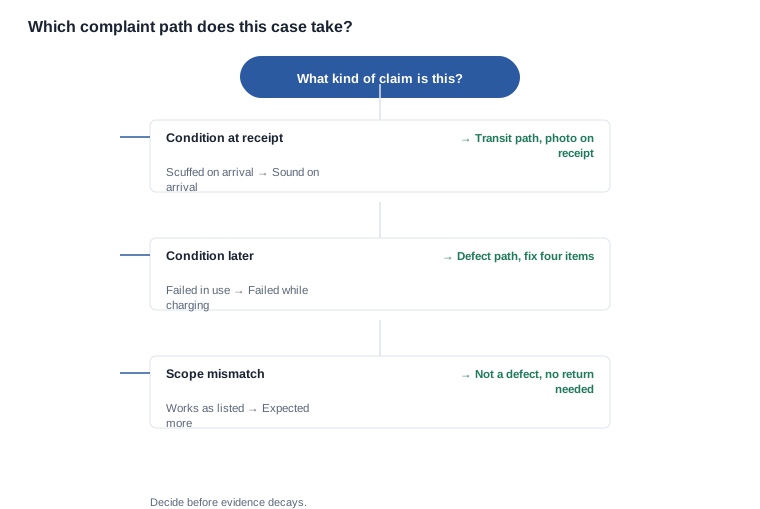
A second confusion is between a quality complaint and a mismatch against the listing. A unit that is exactly as the catalogue describes it and does not do what a customer expected is not a defect. The catalogue publishes a technology list for the camera family that includes a camera module and an AI voice assistant, and it publishes a technology list for the audio family that includes open-ear acoustics, directional audio, smart noise reduction, low-power Bluetooth and magnetic or Type-C charging. It publishes nothing further about assistant models, offline behaviour, subscriptions, translation languages, storage, or what the assistant can and cannot do. When a complaint is actually a misunderstanding of the published scope, no return is required, and a return that is arranged anyway produces a defect record that will later be read as a quality trend.
The questions to put to a supplier while the file is open
These are the questions a buyer should have answered in writing, and they are answerable without any figure the catalogue does not carry. They are written as questions because the catalogue does not publish the answers, and because an answer given in writing is the part of a quality file that survives a contract dispute.
- Which serial or lot marking scheme applies to the units we receive, and what does each part of it identify? The catalogue publishes no serial scheme, so a returned unit cannot be traced to a production batch unless the supplier states one.
- What acceptance criteria do you apply to a returned unit, and on what published or measured basis? Without a stated rule, the acceptance of a return is a negotiation and the outcome depends on whoever is more patient.
- What defect evidence do you hold for each model — inspection records, test results, batch retention — and how long are they kept? A buyer who cannot see the supplier's own quality control record cannot assess a trend in its own field data.
- Which measurement methods back the runtime figures on the specification rows, and under what conditions were they taken? This is the question that makes a battery complaint adjudicable, and it is the one the catalogue leaves open.
- What ingress evidence exists for models other than the V06 and the S7, and is there a test report number for the two marked entries? The catalogue carries a marking on two models only, which is a statement about the catalogue and not about the supplier's testing.
- What is the warranty scope, the claim window, the remedy and the replacement lead time, and where is it written? No warranty period appears anywhere in the catalogue, so this has to be a contractual term rather than an inference.
- Who owns the return logistics and the cost of a unit that is not accepted? A complaint path without a named owner is a path where the customer waits and the supplier waits.
A complaint file is a quality record, not a customer-service log, and we do not treat a file as complete until the identity, condition, environment and custody items are written down separately. That is a process position rather than a product claim: it says nothing about whether any entry in this range is good or bad, and it holds whatever the supplier's answer turns out to be. It is also the part of the process a buyer can copy into its own supplier agreement without relying on anything the catalogue does or does not publish.
Where the catalogue leaves the decision open
Three questions sit outside the published rows entirely, and each of them has to be answered before a complaint process is worth having. Whether the returned unit can be traced to a batch depends on a marking scheme that is not published. Whether a defect claim can be settled on evidence depends on acceptance criteria that are not published. Whether the complaint is a defect at all depends on the runtime condition and the ingress evidence for that particular model, neither of which is published for the entries where it matters.
Those three gaps are not a reason to avoid a complaint process; they are a reason to write one that asks for what it needs. A buyer who has asked for the marking scheme, the acceptance criteria, the measurement method, the ingress evidence, the warranty terms and the logistics ownership in advance has already closed most of the risk that a complaint file carries, because the answers arrive before the complaint does.
There is a fourth gap that belongs to the buyer rather than to the supplier, and it is easy to miss. A procurement team that has never decided which models it will accept complaints on has no basis for the acceptance criteria it requests, because the criteria are a function of what the product is being sold to do. The catalogue gives a buyer the raw material for that decision even though it publishes no verdict: the eleven camera entries differ from the eight audio entries in whether they carry a camera module at all, and the audio entries differ among themselves in that five of the eight publish an acoustic descriptor — surround sound on the D11 and the YK12, and the YKC02 and the D17, and a stereo surround descriptor on the ZH12 — while the D12 publishes none, and the LC-105 pair, the K01 and the K02 publish no feature rows at all. A product sold on capture and a product sold on audio raise different complaint questions, and a buyer who has decided which one it is selling can specify the acceptance criteria that suit it. Shortlisting the models on published rows before the process is written is what makes the criteria specific rather than generic.
The same reasoning applies to the audit question. A buyer who wants to verify the supplier's own quality control record asks for it as part of the due diligence, at the point where the supply agreement is being drafted, not at the point where a customer's email arrives. What that record should contain is arguable — inspection plans, test results against the published rows, batch retention, and the criteria used to accept or reject incoming components — and the catalogue supports none of it in published form. The published rows are enough to tell a supplier precisely which specifications are being contracted, which means the supplier's inspection record can be checked against them for consistency even when no internal document is disclosed. That is a weaker check than a full audit, and it is the check available, and it is worth doing before the volume arrives rather than after the first escalation.
One further discipline is worth setting down while the file format is being designed. Complaint data is only useful in aggregate if the units in it can be traced, and traceability depends on the marking scheme and on the retention of the batch, both of which are supplier-side answers. A buyer who asks for both can build a defect rate against a model and a batch, which is what makes it possible to compare one supplier's quality record against another's, and what turns a complaint process from a cost centre into a sourcing input. Without those answers the same data can only be counted, never attributed.
Related reading
- How a return is handled and who carries the cost — after-sales claims
- What a warranty claim actually requires — warranty claims
- The return label and evidence that travel with a unit — returns and RMA
- Transit damage handled separately from use damage — shipping damage claims
Before the first complaint arrives, have the identity rules and the acceptance criteria agreed in writing — the catalogue rows settle what a unit is, and nothing else settles what a failed unit proves.


