
An urgent sample request usually arrives with a deadline attached — a trade show, a launch date, a customer waiting on a decision — and the instinct is to ask for everything to be expedited. That instinct is where most urgent sample requests lose their time. A request for general speed is answered with a general answer, because the supplier cannot compress a step without knowing which step is the constraint. What if the delay is not in production at all but in the quotation that has not been returned? What if the sample that was requested is the wrong sample, and the useful one is a different entry in the range? What if the bottleneck is a question about the specification that the catalogue leaves open and that nobody has asked yet?
This article separates the steps in a sample order that a buyer can genuinely compress from the steps that no request will move, and it sets out which published rows let a buyer compress the first group before placing the order at all. The one thing to keep in mind while reading it is that the catalogue publishes no sample fee, no sample lead time and no minimum order quantity, so the schedule itself is not a documented fact anywhere in the range. What can be documented is the structure of the process, and the structure is where the time is.
What if I need samples urgently: which steps actually move
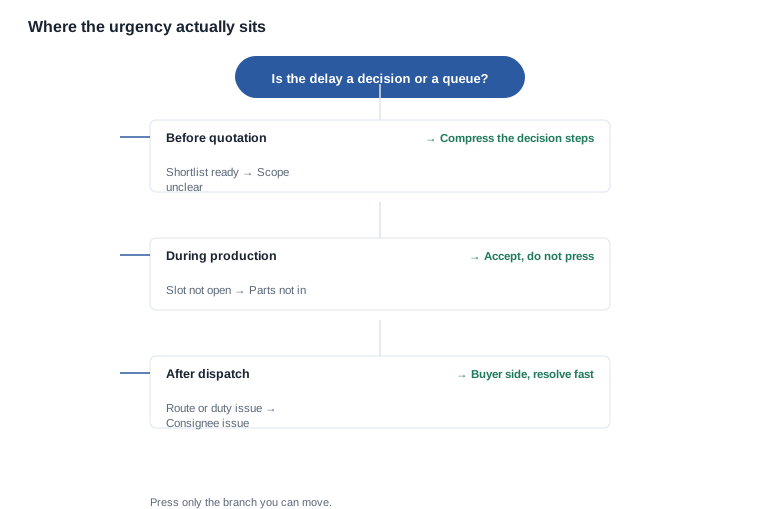
A sample order has roughly eight stages, and urgency applied evenly across them is urgency applied to the wrong places. The stages are: define the use case, shortlist models, request and agree a quotation, agree what is being sampled and on what terms, pay, build or assemble, inspect, ship, and finally clear and receive. Stages three and four are administrative and compress well. Stage five is a payment step and compresses only as far as the supplier's own payment terms allow. Stages six to nine are physical and largely do not compress, no matter how the request is phrased.
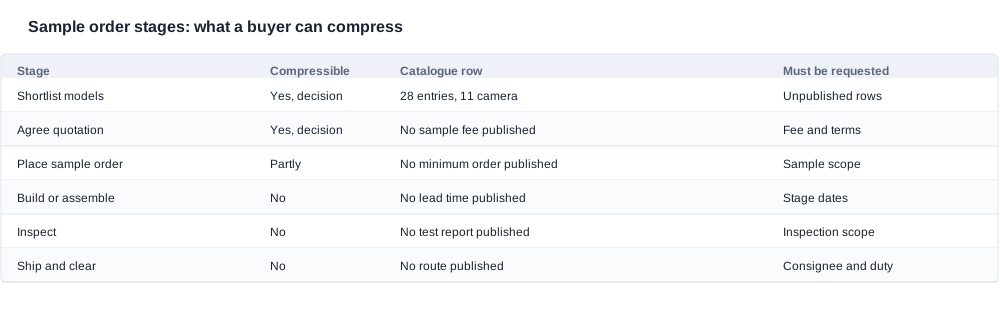
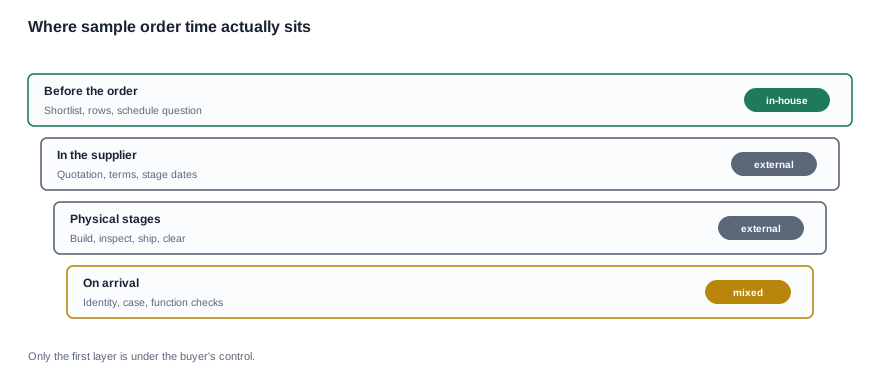
The compressible stages share a property: they depend on decisions rather than on production. A shortlist is a decision. A quotation request is a decision. The decision about whether to sample one model or several is a decision. A decision that is waiting on someone who has not made it yet can be made today, and making it removes a stage from the schedule without asking anyone to work faster. The stages that resist compression all depend on something physical: units that have to be assembled, inspected, packed, handed to a carrier, cleared and delivered. Those stages are also the ones a buyer is least able to verify from the outside, which is why an urgent request that focuses on them tends to produce a supplier who is willing but unable to help.
The third compressible factor is information. Many sample orders lose days to a specification question that nobody framed as a question. The catalogue is explicit about what it publishes and what it does not, and that clarity is directly useful here: a buyer who reads the published rows before writing to a supplier can convert an open question into a short list of specific requests, and can remove from the request every item the catalogue already answers. The sample conversation then starts at the actual gap, which is where the real time was hiding.

The steps a buyer can compress before the order is placed
Four of the stages respond to preparation rather than to pressure.
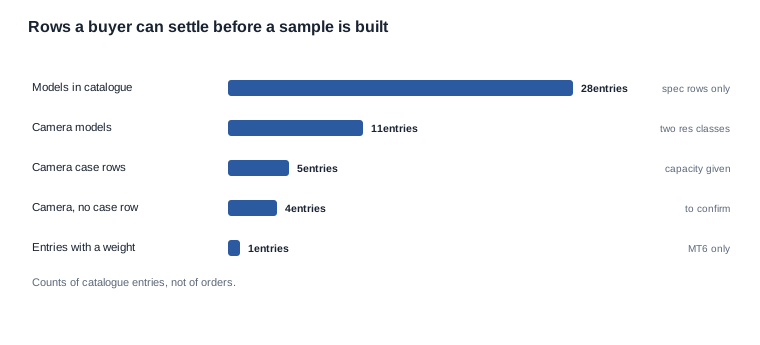
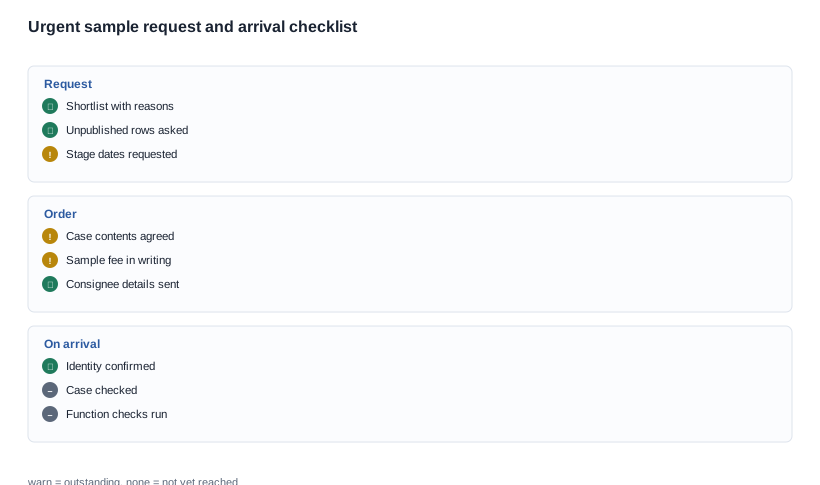
Shortlisting against published rows. The catalogue publishes enough structure to cut a long list down without a single sample, and the size of that cut is what decides whether a sample order can move quickly. The camera entries divide into two resolution classes, one covering eight of the eleven entries and the other covering three, and which class an application needs is settled by the application rather than by preference, so that filter costs a decision and nothing else. The audio entries divide just as cleanly: two of the eight publish one radio version and six publish another, the cell configurations fall into three groups, the charging method divides the family in two, and three runtime bands are published across it. Each of those splits removes entries without a conversation, and each one is a line in a document rather than a question in an email. A buyer who sends three models with a written rationale for each is a harder request to slow down than a buyer who sends eight and asks the supplier to choose.
Asking for the unpublished rows in one message. The catalogue publishes the specification rows and nothing else, so a request that only asks the supplier to restate those rows returns nothing new. The rows a sample decision actually turns on are the ones the catalogue leaves open: the microphone and speaker specifications, the acoustic measurements, the assistant behaviour and whether it works without a connection, the ingress evidence for models other than the V06 and the S7, the serial marking scheme, and the warranty terms. Sending these as a single numbered request, at the same time as the shortlist, collapses what would otherwise become three rounds of email.
Fixing the sample order's contents before it is placed. Two questions decide whether the samples themselves are useful, and neither depends on speed. The first is whether a case is included, because the camera entries differ here: five publish a charging-case capacity, two publish a case without a capacity figure, and four publish no charging-case row at all, so whether a case is in the box for the V03 and the V03 Pro, and the V06 or the S7 has to be established rather than assumed. The second is what the samples have to prove, which for most buyers means identity, runtime and function — three claims that a sample can settle on arrival and a catalogue extract cannot.
Deciding who signs off. A sample order stalls when the approval sits with a committee that meets on a fixed cadence. Naming one person who will accept or reject a sample against stated criteria removes a scheduling dependency that no amount of urgency on the supplier's side can touch.
The steps that cannot be compressed by any request
Being clear about this is as useful as being clear about what does compress, because it stops a buyer from spending goodwill on a request that cannot work.
Production and assembly are the obvious case, and the catalogue does not pretend otherwise — it publishes no production lead time for any entry, no capacity figure and no weekly output number. Anything that needs new tooling or a new mould is longer still, and is a different conversation from sampling an existing entry. Inspection is physical work with a defined scope; the scope can be agreed in advance, and the duration cannot be removed. Carrier transit and customs clearance are governed by the route, the consignee and the paperwork, not by the urgency of the request.
Three subtler ones cost more time than buyers expect. The first is anything that depends on a document the supplier has not yet produced — a batch marking description, an ingress test report for a model the catalogue does not mark, a warranty term sheet. Until that document exists, the step is not waiting, it is blocked. The second is a change of scope late in the process: adding a model to the sample order after it has been assembled restarts the inspection and the shipping steps, so it is usually faster to place a second order than to amend the first. The third is the arrival itself, which depends on a destination, a consignee who can receive it and a duty or clearance position that the buyer controls.
One figure in the catalogue is regularly mistaken for a schedule figure, and it is worth naming. Every entry publishes a charge time, twenty-six of them at a ceiling of two hours or less and the D17 and the ZH12 at about one hour. A charge time is the duration of a charge cycle on the unit, not the duration of an order, a shipment or a sample evaluation. It has no starting state of charge and no completion criterion attached to it in the catalogue, so it cannot be turned into an interruption budget for a shift or into a turnaround estimate. Reading a schedule into it is a mistake that produces a plan with no evidence in it.

A compressed sequence with the checkpoints attached
The following sequence is written for a buyer who has a date and a limited amount of supplier goodwill. Each step names the checkpoint that has to be passed before the next one is worth starting, because the compression comes from running steps in parallel where they are independent, not from running them faster.
- Fix the date and the consequence. Write down which date is immovable and what happens if it moves. This determines whether the request is about a sample arriving or about a decision being made, and the two need different orders.
- Shortlist against the published rows, and put the reason in writing. Two or three models with a stated reason each. A shortlist with reasons attached is harder to delay than one with options attached.
- Send one consolidated request. The shortlist, the unpublished rows you need, the sample contents, the case question, the delivery destination and the payment question, all in one message. Keep a numbered list so the reply can be numbered back.
- Ask the supplier to state the schedule in writing, per stage. Not a total, but the stages. A schedule that shows which stage is long tells a buyer where to apply pressure and which stage to accept.
- Separate what can be parallelised from what cannot. The request for unpublished rows, the shipping route, the inspection scope and the consignee details can all move while production is under way; the production slot cannot.
- Agree the arrival criteria in advance. Write down what will be checked on the unit, so that the evaluation on arrival is a comparison against a list rather than an open discussion.
- Keep a written record of every date. Urgent requests produce a lot of verbal agreement, and the record is what lets the buyer see where the time actually went.
The sequence works because each step produces something the next step consumes. A shortlist without a reason cannot be quoted against. A quotation without a stated schedule cannot be planned against. A sample without arrival criteria cannot be accepted or rejected cleanly. The usual failure mode is the opposite: a sample arrives, everyone looks at it, and the discussion starts from scratch because no one wrote down what the sample was supposed to prove.

What a sample has to settle when it arrives
An urgent sample is often treated as a formality on the way to a bulk order, which wastes the one occasion on which the unpublished rows can actually be observed. There is a short list of things worth checking in the first ten minutes, and each of them maps to a row the catalogue publishes or to a row it does not.
Identity comes first, and the camera entries make it easy: the cell value across the eleven camera entries takes only four forms, 220, 260, 265 and 290 mAh, so the reading identifies a group and the 265 mAh value identifies the MT6. Then the case, because four camera entries publish no charging-case row at all and two publish a case without a figure, so the contents of the box are a finding rather than a detail. Then the markings that the catalogue does publish: the V03 Pro publishes three colours and the V06 publishes four, so colour is a check on those two entries and is nothing on the others; the V06 and the S7 are the only entries carrying an ingress marking, so that marking is visible on arrival for them; and the D17 and the ZH12 are the only two entries publishing a remote shutter, so a sports sample from any other entry will not have one. The MT6 is the only entry with a published weight at all, 158 g for the glasses body, which excludes its folding case, so a weight comparison is available on that entry and nowhere else.
Then the functional checks that the catalogue cannot pre-answer: how the microphones behave in a real environment, what the assistant does without a connection, how long the unit runs in the condition the buyer cares about, whether the published charge time holds, and whether the packaging and the unit arrive in a state the buyer is prepared to ship. Those checks take ten minutes on arrival and are the reason an urgent sample is worth requesting at all. A sample order that arrives without them has bought a photograph.
The remaining checks belong in the second stage, after the sample has been used for a week: how it behaves after repeated handling, how the firmware and the companion application behave across a software update, and whether the supplier's answers to the unpublished rows survive contact with a working unit. That last point is where a sample earns its cost, because it is the only point at which a written answer can be compared against an observed behaviour.
A buyer who wants to judge a supplier on the quality of its sample handling rather than on its production speed should look at three things in the returned paperwork. The first is whether the unit that arrived matches the entry that was quoted, which is settled by the identity checks above. The second is whether the inspection that was performed covers the rows that were published, or whether it covers only the assembly. The third is whether the box contents match the answer given about the case, which for four camera entries is an answer the catalogue cannot supply. None of these three is a quality certificate and none of them is presented as one; they are the observable trace of how a supplier works when a buyer is watching, and they are often more informative than a warranty undertaking, because a warranty is a promise about the future and these are facts about the past.
There is one more practical point about urgent requests that deserves stating plainly, because it is where buyers lose the most. Splitting an urgent sample order into a rush order and a normal order is usually slower than a single order, because it splits the inspection, the shipping and the arrival at the same time. If a deadline is immovable, the better trade is to reduce the scope of what the samples must prove rather than to split the order: sample fewer models, agree that a single unit per model is enough for the decision, and move the questions that need a working unit into a second stage. The published rows carry a lot of the decision already, which means a narrow sample order that answers a narrow question is a good outcome rather than a compromise.
Questions that protect the schedule
These are the questions worth asking before the order is placed, in the order that removes the most time. Each of them asks for something the catalogue does not publish, which is why they have to be asked at all.
- What is the schedule for each stage of our sample order, in writing? Stage dates, not a total, so a delay can be located rather than described.
- What is the sample fee and how is it settled, and does it come off the bulk order? The catalogue publishes no sample fee, no bulk order price and no minimum order quantity, so all three are commercial terms that belong to the quotation rather than to a specification.
- Which unpublished rows can you supply with the sample, and which require a separate process? The microphone, speaker and acoustic specifications, the ingress evidence for models beyond the V06 and the S7, and the assistant behaviour are the three most common reasons a sample order stalls.
- Is a charging case included with each camera sample, and if so which capacity? Five camera entries publish a case capacity, two publish a case without a figure, and four publish no case row, so this has to be answered for the specific entry.
- What is the acceptance criteria for the sample, and who signs it off? A sample with no criteria is a sample with no verdict, and the follow-on order then restarts the evaluation.
- What happens to the sample order if the bulk specification changes afterwards? A change at that point restarts the inspection and the shipping steps, and knowing that in advance is what stops a late amendment.
Urgency is a question about sequencing rather than about pressure, and we do not treat a general request for speed as an instruction to compress a production slot. What we can do is make the shortlist short, the request specific and the checkpoints explicit, so that a supplier who is willing to prioritise has something concrete to prioritise. The catalogue's published rows do most of that work already, because the rows that exist remove most of the questions and the rows that do not exist are precisely the ones worth asking about.
Related reading
- The order of steps behind a sample request — requesting smart glasses samples
- Choosing which entries to put on the shortlist — which models to sample
- The checks that matter once the units land — what to check on arrival
- How a sample turns into a bulk order — moving from sample to bulk
Send the shortlist, the unpublished rows and the schedule question in one message — the time saved at that step is the only time in a sample order that nobody else has to give up.


