
Every hardware programme has a development process, whether or not anybody has written one down. The written version is better, and the difference is not documentation for its own sake — it is that a written process converts a series of hopeful conversations into a sequence of dated decisions with names attached.
The thing that goes wrong in smart glasses programmes specifically is rarely a technical failure. It is a stage where nobody was clearly responsible, so the decision was made by default, and then made again three weeks later by somebody with a different assumption. A frame geometry drifts by half a millimetre because nobody owned the acoustic seal. A firmware baseline changes after the file is closed because nobody owned the closed file. Neither of these is an engineering failure; both of them are ownership failures that engineering then has to undo.
Two questions settle most of the ownership before any stage list does. Who owns the drawings and the firmware source, and who signs the written specification. Get those two wrong and the rest of the process becomes a negotiation about facts instead of a plan.
Development process: the eight stages and their owners
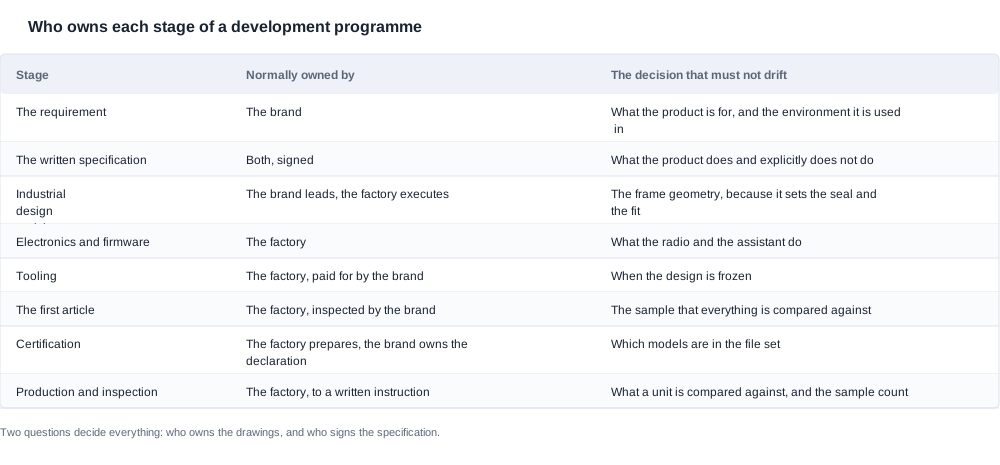
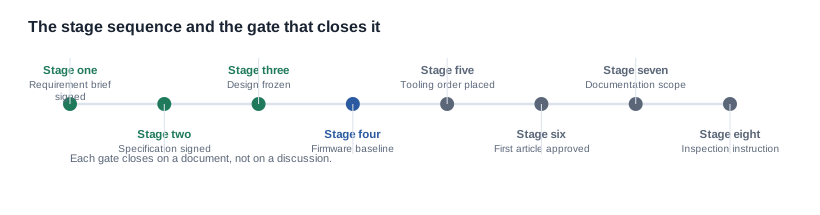
The eight stages below are described by the decision each one has to produce, because a stage with no decision attached is not a stage.
1. The requirement. Owned by the brand, and the stage most often under-specified. What the product is for, what environment it will be used in, who wears it, what the customer expects it to do. The environment matters more than most buyers expect: it decides the ingress expectation, the battery target, the acoustic scenario and the market-access scope, and all four constrain the design before anybody draws anything. A requirement that does not state the environment produces a product that is technically correct and unusable.
The requirement brief that works is short and concrete. It names the wearing context rather than describing a persona, because "outdoor walking, continuous use, one hand, in rain and in bright sun" constrains the design in ways that "an active lifestyle user" does not. It names the use duration, because a product worn for an hour and a product worn for a full shift have different battery and comfort requirements. It names the markets, because the market-access scope has to be known before the model list is fixed rather than after. And it states the volume band, because the manufacturing route — a standard programme, a hybrid or a full development programme — is chosen against the volume, not against the product idea.
2. The written specification. Owned by both parties, and signed by both. What the product does, and — the part that gets left out — what it explicitly does not do. The second half is what prevents the three months of drift in which everyone assumes a different feature set. This is also the stage at which the model designation is fixed in writing, because a designation that is paraphrased later cannot be matched against a model-specific document. One entry in our range appears as "L2 Utral" plus an additional variant designation whose meaning has never been published, which makes the exact string a reasonable thing to insist on.
3. Industrial design and the frame. The brand leads because the frame is the customer-facing object; the factory executes because the frame has to carry the electronics. The decision that must not drift is the geometry, because it sets the acoustic seal, the fit and the battery position at once. The published customisation scope tells you where the boundary sits: temple styling and colour are within standard scope on the camera tier, while frame styling is listed for the sport tier.
4. Electronics and firmware. The factory owns execution; the brand owns the requirements it has written. The radio behaviour, the assistant chain, the wake word, the pairing identity and the Bluetooth name all live here, and the Bluetooth name functions as a firmware identifier rather than a label, which makes it a decision that belongs in the specification rather than in a packaging conversation. The boundary of what may change without re-opening the specification is what stages three and four agree in writing.
5. Tooling. The factory cuts it; the brand pays for it and should own the asset. The decision that must not drift is when the design is frozen, because tooling is the most irreversible spend in the programme. This is also the stage where the question of who owns the mould has to be answered in writing rather than in a meeting, because it is the question that determines whether you can make a second order in three years.
6. The first article. Built by the factory, inspected by the brand. This is the most valuable document in the whole process, because it becomes the approved sample that every production unit is compared against — and if it is not captured properly, every later dispute is about what was agreed. The first article is where the gaps in the published specification get closed: the runtime is a range with no stated test condition, the charge time is a ceiling on twenty-six of twenty-eight entries, and the frame weight is published for one model only. The approved sample is what turns those into numbers your product page can use.
The inspection of the first article is a measuring exercise rather than a pass-or-fail exercise, and it should be budgeted as one. Measure the runtime under the condition you will actually claim, time the charge from flat, record the weight of the glasses without the case, note the ambient temperature, and photograph the finish against the approved reference in daylight rather than under office lighting. Then write the measured values down and compare them with the published rows. Where the measurement sits at the bottom of a published range rather than the top, that is the number the product page should carry. Finding this on the bench costs a day; finding it in a customer return costs the channel relationship.
7. Certification and market-access documentation. The factory prepares the file; the brand owns the declaration it makes. The decision that must not drift is the model list, because each model is an entry and each new entry is work. It is also the stage where our own published position is thinnest: the catalogue publishes no certification row for a single model, and the export-certification page carries ten patents on a picture, eight of them designs and two of them utility models. A programme that reaches this stage expecting a per-model document will discover that the work has to be scheduled rather than collected.
8. Production and inspection. The factory, to a written instruction. What the units are compared against, the sample count, the acceptance criteria, and the point at which the balance is paid. An inspection instruction agreed late is an inspection that cannot be enforced.

The three development process failure patterns
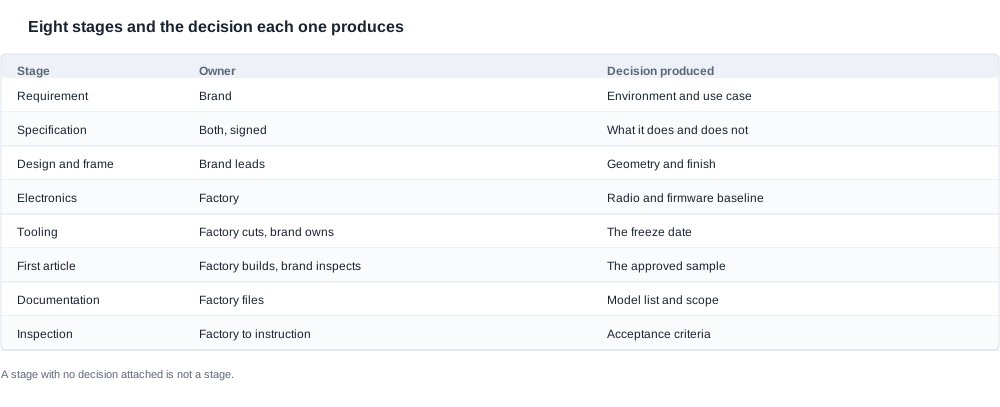
Ownership gaps. A stage with two possible owners has no owner. In practice this appears as a decision that gets made in a corridor and revisited three weeks later, usually by somebody who was not in the corridor. The fix is not more meetings; it is naming one owner per decision and accepting that some decisions genuinely have two parties, in which case the stage needs an explicit rule for which one has the final say.
Decisions taken after the point of no return. The pattern is predictable: a decision described as pending while a production slot is already booked. The schedule always wins, because the schedule is committed and the decision is not. This one is visible to buyers who watch the tooling invoice, because the tooling order is usually the moment the design was frozen whether or not anyone said so.
The specification drifting after the file is closed. A firmware change, a lens configuration or a new colour that alters the technical description. These are the changes that are cheapest to make and most expensive to accept, and the habit that prevents them is a rule: any proposed change is checked against the technical description before it is accepted, while the file is still open. The alternative — accepting changes against a closed file — means the inspection instruction and the approved sample describe a product that no longer exists.
Development process gates and the document behind each one
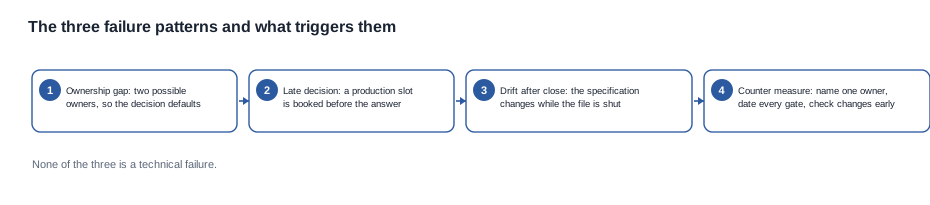
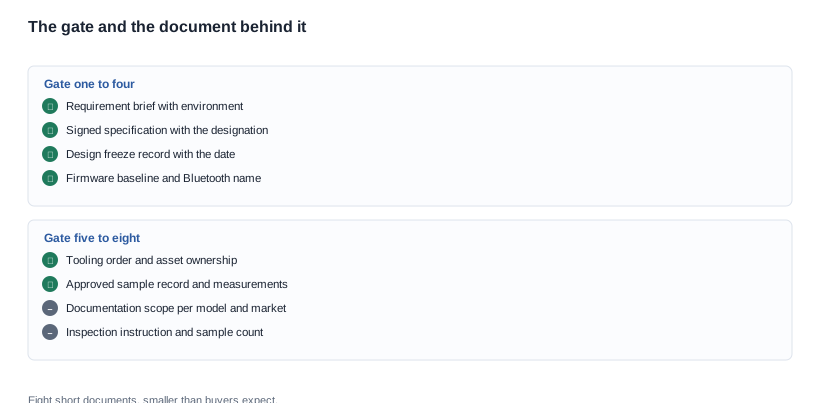
A gate is a point in the process where work cannot continue until a document exists. The gate and the document are the same thing, which is why they are easy to skip: the process looks like it is progressing while the evidence that it progressed is being written later, retrospectively, from memory.
Eight stages, eight documents, and each document is short:
- The requirement brief — environment, user, use case, markets, quantities.
- The signed specification — what the product does, what it explicitly does not do, the model designation string, the configuration options selected.
- The design freeze record — the geometry, the finish, the colour references, and the date.
- The firmware baseline record — the version, the Bluetooth name, the pairing behaviour, the build identifier.
- The tooling order and the asset record — the asset number, the ownership, and the maintenance or storage arrangement.
- The approved sample record — the unit, its serial, the measured values, the photographs, the approval signature.
- The documentation scope — which models, which markets, and what exists for each.
- The inspection instruction — the approved sample reference, the sample count, the acceptance criteria, the payment milestone.
The pattern is that each document is a page, and the whole set is smaller than most buyers expect. That is the point. A document set that takes two weeks to assemble has been written as an audit rather than as a control, and a control that takes two weeks is a control that will not be consulted at the moment it matters.
There is a discipline that makes the set work, and it is about who holds the documents rather than about what is in them. The buyer should hold the whole set, not just the signature page. In a programme where the supplier holds the specification, the freeze record and the inspection instruction, the buyer owns the process by name and nothing else — the documents become a channel for the supplier's version of events. The cost of holding them is a shared folder and the discipline to send a copy, and the benefit is that at the moment of a dispute, both sides are arguing about the same page rather than about what somebody remembers being agreed in a meeting.

Deciding ownership before the development process starts
Two decisions settle the ownership map, and both are better made in week one than in week six.
Who owns the drawings and the firmware source. If the design belongs to the supplier, then your product is not your product and the brand's differentiation lives in somebody else's building. If it belongs to you, then the useful questions are where the files are held, in what format, whether there is a source repository rather than a folder of emails, and what you receive if the relationship ends. The intellectual property discussion covers the same ground in more detail. In practice, the answer tends to be split — the mechanical drawings may be the factory's while the firmware source is yours — and a split answer is fine provided both halves are written down.
Who signs the written specification. Not who drafts it, and not who requests it. The signature is what makes the document a control rather than a suggestion, and it is the moment where the buyer has to accept that a document it has signed will be used to reject something it later wants.
There is a third question that is easier to answer early than late: who owns the decision to change. In any programme the changes are what consume the schedule, and a programme where every change needs the buyer's written approval will simply stop making changes, which is worse. The workable rule is to set a threshold — a change below a defined value is made and logged, a change above it is escalated — and to write the threshold down while everyone is still on good terms.
A fourth and less obvious question is worth answering at the same time: who owns the schedule estimate? Lead times in this category are not published, because each of them turns on the quantity, the documentation scope, today's schedule and the configuration, and a lead time quoted without those four is an average rather than a plan. The stage sequence and its gates are in odm development stages, and the risk side is in odm development risk factors. Whoever owns the estimate owns the question of which stage is the long pole, and in a smart glasses programme the long pole is rarely the one people watch — it is usually the first-article approval or the documentation scope, not the production line.

Development process decisions the buyer must own personally
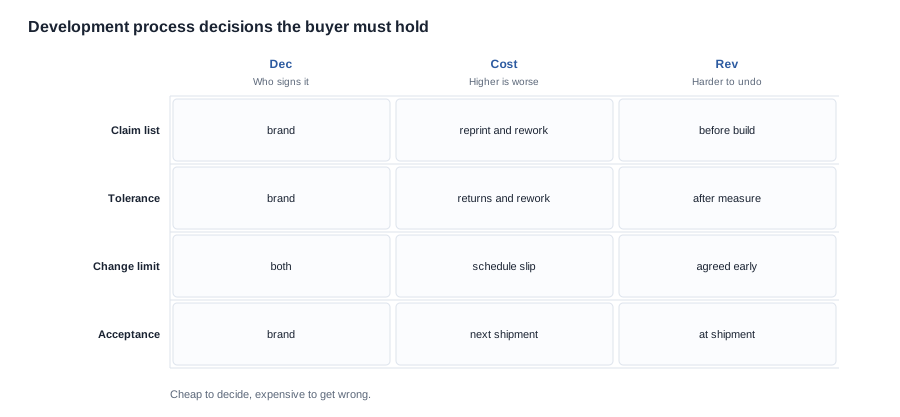
Some decisions in a programme cannot be delegated, not because they require specialist knowledge but because they are the ones where being wrong is expensive and being absent is fatal. Four of them sit with the buyer, and a buyer who recognises this in advance protects the schedule better than one who tries to attend every stage.
The claim list. Every statement the product will make, mapped to a published row or marked as requiring separate evidence. This decision determines what the specification has to deliver, so it has to exist before the specification is signed. Once the product page is written from a claim nobody approved, the cost of changing it is a packaging reprint and a channel conversation.
The tolerance. What counts as acceptable for each measurable characteristic — the runtime band, the charge time, the finish, the weight — decided before the first article is measured. Tolerance set after the measurement is not a tolerance; it is a justification. This is the decision that converts a first article from a demonstration into a measurement, and it is the one most often left implicit.
The change threshold. What may be changed without escalation, and what must be escalated. Set early, set in writing, and set while nobody is annoyed about it. A threshold set during a crisis is a threshold nobody will apply to the next change.
The acceptance decision. Whether a shipment is accepted. This one sounds procedural and is in fact the most valuable decision a buyer makes in a hardware programme, because it is the only leverage the buyer has over the quality of the next shipment. Once a shipment is accepted without an inspection instruction, the same defect arrives in the next container, and the second time it is no longer a defect but the standard.
These four decisions share a property: they are cheap to make and expensive to get wrong, and none of them requires the buyer to understand how the product is built. That is the point of listing them separately from the stage ownership — the buyer who holds the stage ownership but delegates the claim list and the tolerance has delegated the two decisions that determine whether the programme succeeded.
Running a development process with no dedicated team
Most programmes at this scale are run by one or two people on the buyer's side who also have other jobs. That is normal, and it changes the process in ways worth planning for rather than discovering.
The gates have to be scheduled, not triggered by attention. A gate that waits for somebody to notice it will wait indefinitely. Put the dates in a shared calendar at the start, with the document due on the date rather than the discussion.
The document set is the memory. With no team, the written specification and the approved sample record are the only things that will still describe the product in six months. This is the strongest argument for the document discipline and it costs nothing extra.
One person cannot approve and inspect. The first article needs to be approved by somebody who is not the person who built it, and the inspection needs the same independence. With a one-person buyer team, the honest solution is to bring in a second pair of eyes — a colleague, an external engineer, a consultant — for the two stages where independence matters most.
The commercial pressure lands on the same person. A buyer running a programme alone is simultaneously negotiating the price, chasing the schedule and inspecting the goods, and the inspection is the job that gets dropped when the schedule is late. Deciding in advance which of those three will be deprioritised under pressure is a small decision with a large effect on the outcome.
There is one more adjustment worth making deliberately, and it is about externalising the programme so that it survives the people in it. A one-person buyer team has a single point of failure, and the failure mode is not competence — it is that the knowledge is in one mailbox, one notebook and one person's memory of a telephone call in March. Moving the programme into a shared folder with the document set, a stage table with dates, and a single contact list at the supplier reduces the risk of a key-person problem without adding a headcount. It also makes the programme easier to hand over when the person running it leaves, which in a programme with a twelve-month schedule is more likely than a buyer expects.
We publish the customisable lines our catalogue lists and the capability gaps in the same plain terms as the capabilities, and no non-recurring cost, no engineering schedule and no intellectual property position, because those are terms rather than facts and we have not settled our internal position on them. We will not quote a development cost we have not scoped.
What that means in practice is that the ownership questions in this article can be answered against a real capability record rather than a promise. That record is counted per category: seven axes on the camera tier, five on the sport tier, three on the photochromic entry and two on the children's tier, where two further capabilities are marked as awaiting verification. The bone conduction entry lists nothing at all. Counting the axes tells you which stages sit inside standard customisation rather than development, and therefore who owns them; what each counted line actually covers is the question to put to the supplier.
What we can do is take a programme plan and mark the stages where the ownership is unclear, and tell you which of the two deciding questions has to be answered before the process can start. The programme structure is under development process, the risk side is in odm development risk factors, and the stage sequence is in odm development stages.
Related reading
- The stage sequence — odm development stages
- The risks worth naming early — odm development risk factors
- The intellectual property question — odm development ip ownership
Send us your programme plan and we will mark the stages where the ownership is unclear.


