

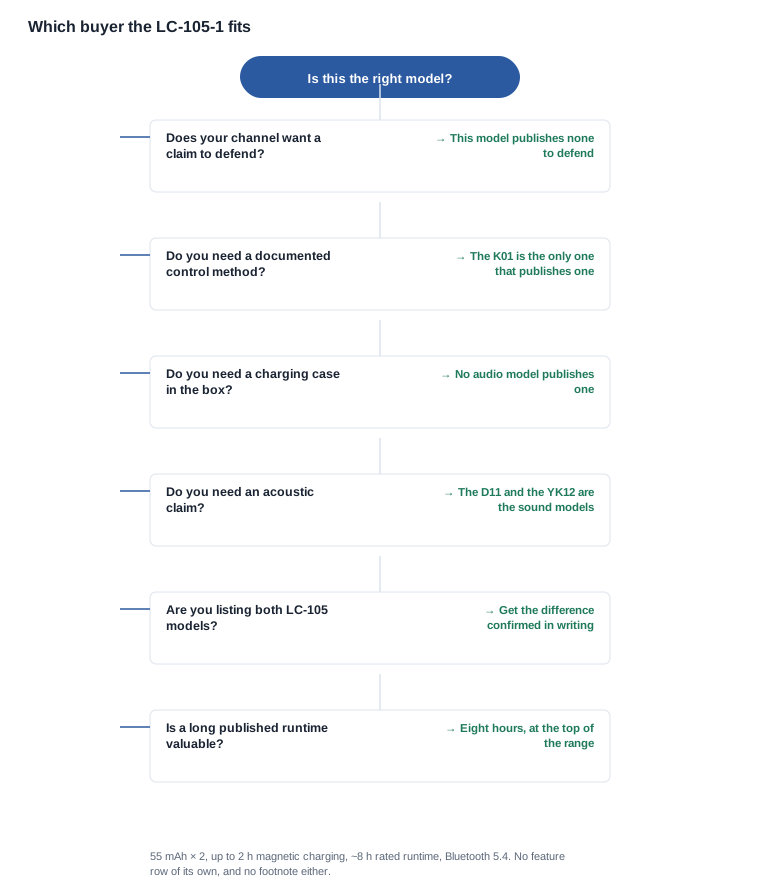
There is an unusual buyer profile that this model fits better than any other in the Bluetooth audio range, and it is not the buyer who is looking for a feature. The LC-105-1 publishes no feature of its own at all — no touch control, no translation capability, no surround sound, no temple description — and it publishes approximately eight hours of rated runtime on a 55 mAh × 2 cell, which is the longest published figure in the range.
A product with nothing to claim is a very different proposition from a product with a lot to defend. For some channels that is exactly the appeal, and for others it is the whole problem. This article is about telling the two apart.
Lc-105-1 smart glasses: the model for a brand that wants a defensible number
The published row is Bluetooth V5.4, 55 mAh × 2, magnetic charging in up to two hours, and a rated runtime of approximately eight hours. Four rows, all of them electrical, none of them requiring a footnote.
That is a genuinely unusual shape in this category, where most models publish something that requires a qualification. A four-row electrical specification with no footnotes is a specification that does not need a legal review, and in a category where claims are the usual source of trouble, that is a commercial asset rather than a limitation.
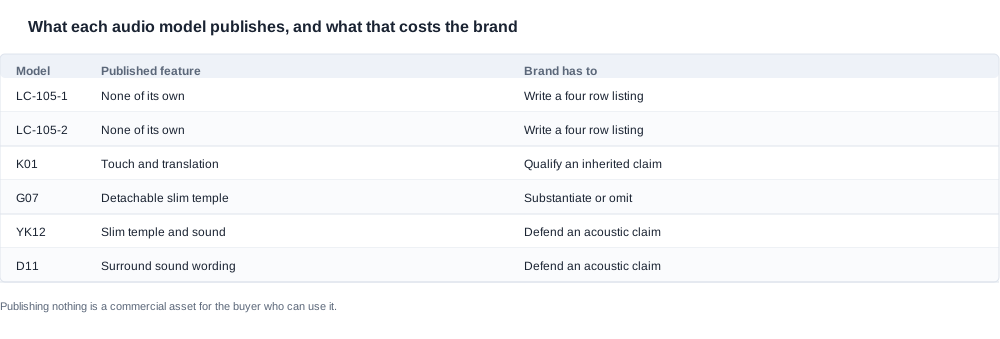
Compare the family and the difference in work becomes obvious. The K01 carries an AI translation capability that our own documentation records at a lower evidence level than the parameters, so a brand listing it has to write around it, and it publishes no touch control row to describe. The D11 and the YK12 carry a surround sound claim with no acoustic figures behind it. The G07 carries a detachable temple described as ultra-slim but not measured. The LC-105-1 carries none of those, and a brand whose listing style is one paragraph and a table will find that refreshing.
The second reason to choose it is that the number is the best available one. The eight-hour figure is the longest published runtime in the audio range, and it is reached on 110 mAh. That is a stronger claim than a larger cell with a shorter runtime, because the customer reading a listing will assume the two go together and will be pleasantly surprised by the combination.
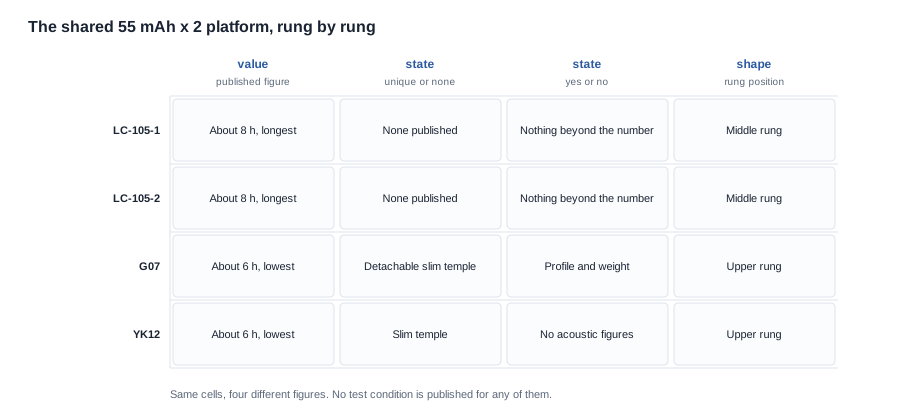
There is one condition attached to that number that has to be stated before anybody builds a chart on it. The G07 and the YK12 reach six hours on the same cells. Same 55 mAh × 2 configuration, two hours apart, no test condition for either. That tells you the figures were not taken under one protocol rather than that the LC-105-1 is physically better, and it decides whether the two numbers can sit in the same comparison chart. The battery specification guidance covers the questions to ask, and the practical advice is to publish the eight hours with the note that no test condition has been stated rather than presenting it as a clean superiority.
The buyer it fits best: a channel with no appetite for claims
A brand that sells on price, on plainness and on a number it can actually defend is the ideal home for this model. The listing writes itself, it translates into every market language at low cost, and there is nothing in it that a customer's lawyer can pick apart.
That last point is worth expanding, because it is the one most often under-rated. In a category where most products publish something inherited from a supplier's marketing page, the absence of that is a differentiator. It is not a feature a customer will pay more for, but it is a property a retailer's compliance team will notice, and in some channels that is the gate the product has to pass.
The other property is operational. A product with no feature generates fewer support contacts, because every feature is a set of behaviours that a customer can get wrong, and the wrong produces a contact. No translation means no question about why it does not work offline. No sound claim means no question about audio quality. No documented control means fewer questions about accidental activation. That is a genuine reduction in the cost of being in the category, and it is a cost most buyers do not count until they look at their support ticket volume.
A channel that sells through comparison charts is another good fit, with one condition. The eight-hour figure is at the top of the published audio range, so it can carry a chart position. The condition is the note: because the same platform reaches six hours on two other models, a chart that puts eight next to six needs a qualifier, and the qualifier is easier to write now than after a customer has noticed.
Two buyer profiles sit inside this one and are worth naming. A distributor entering a new market with limited local compliance support benefits most from the short specification, because there is less to translate, less to check and less to defend. And a brand with a legal function that reviews consumer claims will move faster on this model than on any other in the family, because the review has nothing to review.
The buyer it fits: a brand building a tier structure
The LC-105-1 is a natural middle rung in a good-better-best ladder built on the 55 mAh × 2 platform. Below it, a lower-cost model; above it, the G07 with its detachable temple or the YK12 with its sound claim. The LC-105-1 is the one that publishes the longest runtime of the three and asks the least of the customer in exchange.
That is a coherent tier argument rather than an arbitrary one. The rung above it earns its price on something visible — a mechanism on the G07, a claim on the YK12 — while the middle rung earns its place on the number the customer can actually check. A tier structure where each rung is differentiated by a different kind of evidence is more defensible than one where every rung differs only by a number, because the customer can tell which kind of difference they are paying for.
The same platform, and this is the part that matters commercially, means one set of documentation for the whole tier. The LC-105-2, the G07 and the YK12 all share the cell configuration, the charge time and the charging method, so a brand stocking more than one of them is not running four technical files. That is a real saving on a launch schedule, and it is a saving that does not show up in any product comparison.
The same argument runs in reverse for a buyer who owns nothing. If this is the only model from this platform in your range, the shared-documentation advantage is largely theoretical, and what remains is a four-row specification that is excellent but not distinctive. In that situation the deciding factor is usually whether the endurance figure is worth building a listing around on its own, and that is a channel question rather than a product one.
And there is a version of this that goes wrong quietly. A brand builds a three-rung ladder on this platform, prices the middle rung against the bottom one and the top one, and discovers at launch that the customer cannot tell the difference between the rungs from the listing alone. That happens when the differentiating features sit above the rung and the numbers sit below it, and nothing in the middle is visible. The mitigation is not a better product; it is a listing that says explicitly what the rung above adds, and that sentence is a marketing decision rather than a supply decision, so it is worth making before the artwork rather than after the first campaign.
A second caution on the tier argument. A shared platform means shared weaknesses as well as shared strengths. If the platform's cell configuration or charging approach turns out to be a problem in one model, it will be a problem in all of them, because they are the same hardware. A brand running three models on this platform has concentrated its supply risk rather than diversified it, and that is a deliberate choice worth making consciously rather than discovering.

The condition attached to all of it
Our documentation does not publish what separates the LC-105-1 from the LC-105-2. The two models publish identical rows in every respect, and we are not going to invent a difference to make a range look better organised.
A buyer who is listing both needs that answered in writing before the packaging is designed. If the answer is a colour, a fit, a shell or a firmware revision, that is workable and normal. If the answer is that they are the same product under two designations, then the catalogue, the product pages and the inventory should say so — and that is a simplification, not a problem, and arguably a better outcome because it halves the documentation load for that tier.
Either way it is a question with a one-line answer, and it is the first question to ask about this model. The cost of asking is one email. The cost of not asking is two SKUs that a customer can compare and find identical, which is a support contact, a returns reason and eventually a duplicate-listing problem on a marketplace.
There is a second condition, less structural and more commercial. Eight hours is a ceiling, not a promise, and no test condition is published. If your channel writes "all day battery" on the strength of it, you are making a claim the data cannot support and the customer will test it on their own longest day. Write the number, note the absence of a condition, and let the customer decide.
The briefs it does not fit
If the product needs a documented input method, this model has none published. The K01 is the only model in the audio range with capacitive touch published, and for a brand whose listing centres on "tap to answer", that is a different product. The control scheme for the LC-105-1 is not published, and a product with no documented control has no documented user experience.
If the product needs a charging case, no model in the audio range publishes one. Every camera platform in the range does; no audio platform does. A brand whose retail story is built on a case in the box has to look at the camera family, and our entry level analysis sets out how to choose there.
If the product needs an acoustic claim, there is nothing to claim here. No leakage figure, no driver size, no frequency response, no microphone count, no pickup distance is published for this model or any other in the audio range. The family-level description covers an open-ear acoustic structure, directional audio and intelligent noise reduction, and that is the extent of it. Those are descriptions of an approach rather than measurements of an outcome, and a listing that turns them into a performance claim has crossed a line the documentation does not support. The open-ear audio guidance covers what an open-ear frame actually does and why leakage is the number that matters.
If the product needs to be worn with prescription lenses, the fit data does not exist. No frame weight, no temple length, no lens dimension and no head-size range are published. For an eyewear channel this is not a detail, it is the whole evaluation, and it is a sample question rather than an email question. Our materials and ergonomics guidance covers the measurements worth taking.
And if the product is going near water, there is no ingress rating published for this model or for any other in the audio range. That is not a gap you can write around; it is a claim you cannot make.
Two exclusions are worth separating from the rest, because they are frequently mistaken for product problems when they are channel problems. A brand with a very short launch window should look elsewhere, because every gap on this model closes through questions and sample measurements rather than through documentation, and that takes weeks rather than days. A brand that intends to lead on a feature has the wrong model entirely and should not try to manufacture a feature around a product that publishes none.
And one exclusion that catches experienced buyers out. A brand that has already bought a different model from this platform does not need to be told this one is not distinctive, but it does need to be told that the real decision is whether to consolidate. Two models on one platform is a reasonable position; four is a supply concentration. The question to ask before adding a fifth is whether the documentation saving still exceeds the risk, and that is a portfolio decision rather than a product one.
How to evaluate a product with nothing to test
A featureless product is easy to buy and awkward to evaluate, because the sample programme tends to collapse into "it arrived and it works". Treat the missing rows as the acceptance criteria instead, which is the only test programme that works when the specification is four rows long.

Measure the frame weight and the temple length on the sample. These are the two rows that decide whether the product stays on a head, and they take ninety seconds with a scale and a calliper. Until they exist there is no fit claim and no size guide, and those two artefacts are the ones every eyewear channel asks for first.
Measure the runtime yourself, on a stated workload. Record the volume, the content and the duration, and write it next to the figure. This is the single most valuable thing a buyer can do on this model, because it converts an unconditioned eight hours into a conditioned number that a listing can defend and a customer can predict.
Establish how the frame is operated at all, and get it in writing. A product with no published control method almost certainly has one. Ask, record the answer, and treat the answer as the user experience — because it is the only description of it that will exist.
Confirm the accessories against the packing list, and record what is actually in the carton rather than what was expected. On a model with no case and no documented extras, this is a short check, and it is the one that catches the delivery problems.
Then test wear for a full day, because that is the claim. Put it on for the length of time the listing implies and notice when the wearer takes it off. The moment a customer removes a pair of glasses is the moment the product either worked or did not, and it happens well before any specification is relevant.
What we will and will not confirm for the LC-105-1
This is the model for a brand that wants a defensible number rather than a feature, and the value of publishing nothing extra is easy to underestimate. A specification sheet with four electrical rows and no footnotes is a specification sheet that does not need a legal review, and in a category where the claims are the usual source of trouble, that is a real commercial asset.
We will not fill an unlisted feature, estimate a weight or an ingress rating, or describe a difference between the two LC-105 models that our documentation has not confirmed. What we will do is tell you which model in the family publishes which feature, so you can place this one deliberately, and which of the open questions we can close for you on request. The published rows are in the LC-105-1 specification list, and the sound-claim alternative is covered in the YK12 analysis.
On the commercial set, the position is the same for every model here: minimum order quantity, lead time, price, incoterms, payment terms and warranty are not published, and the first three belong in a quotation. Ask for the warranty period in writing, because a frame whose endurance is the reason the customer bought it is a warranty conversation within the first hundred returns, and the boundary between underperforming and failed should be defined before that rather than during it.
If you send the channel, the volume and the target market, we will tell you which of these models we would rule out as well as the one we would not. The range is on the Bluetooth audio glasses page.
The most useful thing we can add to that is a shortlist. For this family the shortlist question is not which model has the most rows, it is which model has the fewest rows the brand would have to defend — and on that criterion a plain model and a documented-feature model are often the two worth carrying, with everything between them being a choice about presentation rather than about product. A shortlist of two is easier to execute than a range of eight, and on this platform the two do not compete with each other: they answer different customer questions.
We will also say when the gaps are worth closing and when they are not. A weight and a temple length are always worth closing, because they take minutes and they unlock a fit claim. A cycle life or an acoustic characterisation on a model you are not going to claim anything about is not worth anyone's time. The discipline is to spend diligence on the rows that appear in the listing, and to leave the rest closed — which is only a sensible position if the listing is short to begin with, and that is the argument this model makes better than any other in the family.
Related reading
- The published rows behind this model — LC-105-1 specifications
- A model in the same range with a sound claim — YK12 best for
- How an open-ear frame actually behaves — open-ear audio
Send the channel, the volume and the target market, and we will name the model we would and would not use.


