
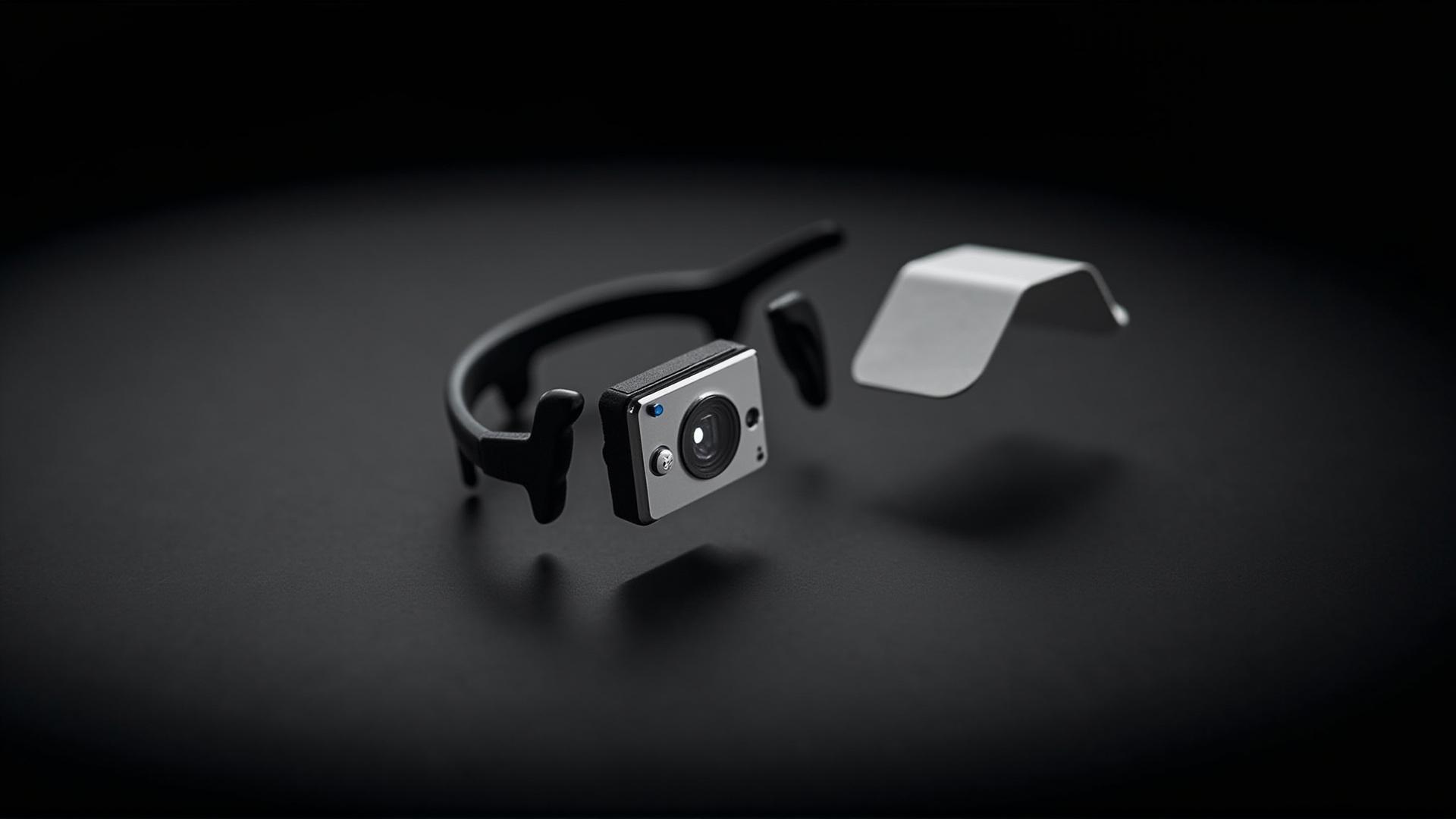
The YKC02 is a sport-category model. It sits in the same small shelf as the D17 and the ZH12, not in the eight-model audio tier, and every comparison you make about it should start from that fact. We will make that position the spine of this article, then walk the published specification rows, then set out the comparison questions worth asking a supplier before you commit to a purchase order.
That matters commercially. Buyers who treat the YKC02 as an audio product end up comparing it against the wrong eight models and drawing the wrong conclusion about who it is for. Buyers who treat it as a camera product end up asking for a resolution that the catalogue never publishes, and then treating the silence as a defect rather than as a missing field. The YKC02 is neither of those things. It is a sport-category smart glasses model with two battery cells, a roughly eight-hour runtime ceiling, and a charging approach that the catalogue ties to its category rather than to its individual nameplate.
YKC02 published rows, read one at a time
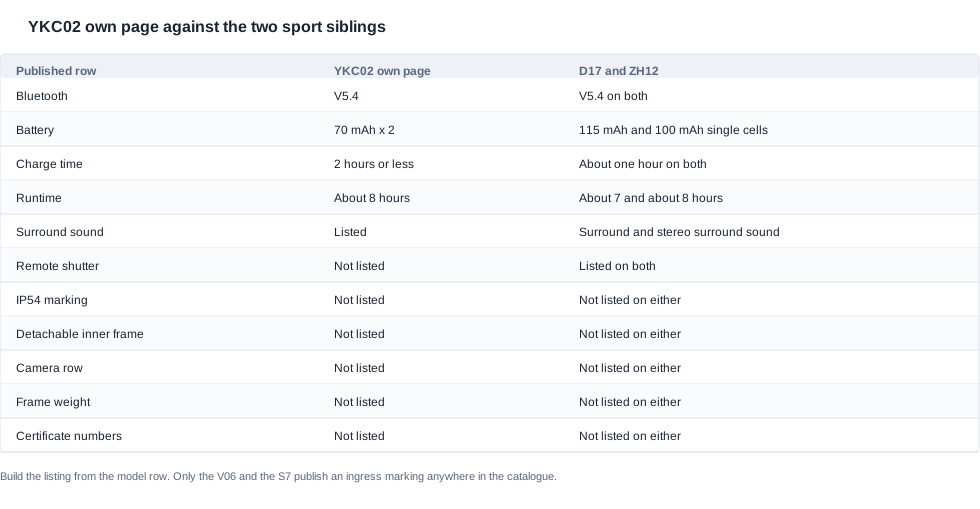
Here is the whole of what the YKC02 publishes, laid out row by row. We will keep the catalogue naming intact, because the catalogue labels this product as YKC02 Sport Glasses, and that word is the single most commercially useful piece of information attached to the model. It decides which competitor set applies, which comparison pages are relevant, and which claims you are allowed to write in your own listing copy.
| Published row | What the catalogue states |
|---|---|
| Product class | Sport category, labelled YKC02 Sport Glasses in the catalogue |
| Battery | 70 mAh x 2, i.e. two separate 70 mAh cells |
| Runtime | about 8 hours |
| Charge time | 2 hours or less (ceiling figure, not a typical measured value) |
| Charging method | Magnetic charging |
| Bluetooth | V5.4 |
| Remote control | Not published as a YKC02 feature |
| Sound descriptor | Surround sound, listed alongside a long-endurance row |
| Camera | Not published — the YKC02 has no camera row in the catalogue |
| Audio class membership | Not a member of the eight-model audio tier |
That is the entire sheet. There is no weight figure, no dimension, no lens material, no colour count, no ingress rating, no certification line, and no commercial terms attached to this model in the catalogue. We will treat every one of those as not published rather than inferring a value, because a buyer who accepts an inferred value will later be unable to defend the purchase when a customer opens the box and finds a different number, and because a channel listing built on an inferred figure is a listing you eventually have to pull.
The two-cell arrangement is the most interesting published fact and it is worth pausing on. A 70 mAh x 2 configuration means the pack is split across two cells rather than concentrated in one. In practice, buyers tend to read that as a design choice rather than a performance class: it spreads the thermal load, it removes the single-point constraint on cell supply, and it can make partial charging less punishing because each cell can be brought up independently under a magnetic pad. None of those are published claims, so we will present them as engineering interpretations rather than facts — but they are exactly the questions a supplier should be asked to confirm before you rely on them in a marketing claim.
The magnetic charging point is where the YKC02 sits alongside the camera models rather than beside the D17 and the ZH12, which both publish USB-C. If your distribution channel is already set up for magnetic pads, that is an argument for the YKC02. If your channel is already set up for USB-C cables and wall sockets, that is an argument against it unless you are prepared to change the in-box charging story and budget for the extra pads. We will come back to this trade-off in the supplier question section, because it is the kind of item that has to be settled inside a quotation rather than discovered after the first shipment arrives.
On the runtime and charge-time pairing: about 8 hours of runtime with a charge time of two hours or less gives a charge-to-use ratio of roughly four to one in the best case. That is a good ratio for a product meant to be worn through a full day of a sport session, a long outdoor event, or a run of shifts. Compare that with the D17, which publishes about 7 hours of runtime and about one hour of charge time, and you can see the design trade-off being made explicitly: the D17 buys back an hour of charging time, and it buys it by giving up roughly an hour of runtime. Neither figure comes with a published measurement methodology, so we will treat them as catalogue positions rather than as test results you can quote to a customer.
The Bluetooth V5.4 line sits in a specific place in the catalogue, and it is worth knowing exactly where. Bluetooth version is published for 14 of the 28 models. It is not published for the 11 camera models, nor for the A05, nor for the A06, nor for the bone conduction model. So the YKC02's V5.4 is a real published specification rather than a market assumption, and it belongs to the same data set as the D17 and the ZH12, both of which also publish V5.4. If a competitor listing for this model claims a newer Bluetooth version, you can check that against a source that actually publishes it, and the YKC02's V5.4 is documented rather than inferred.
One last row-level note, because it changes how you read the ceiling. Charge time across the entire catalogue is published as two hours or less for 26 of the 28 models, and only the D17 and the ZH12 carry an about-one-hour figure. A ceiling that almost the whole catalogue shares is not a distinguishing specification. It tells you the maximum the vendor is willing to claim, and it tells you that the vendor has not differentiated on recharge speed at the catalogue level. We will not convert two hours or less into a number, and we will not assume the YKC02 sits at the two-hour end of that ceiling, because a supplier who quotes you a typical figure will usually quote you something between one and two hours and the published sheet simply does not say.
YKC02 against the audio and camera blocks
The sport category contains exactly three models: the YKC02, the D17, and the ZH12. That is the entire comparison set. We will say this plainly because most of the confusion in this segment comes from comparing a three-model shelf against a twenty-eight-model catalogue and then trying to find a meaningful ranking inside the noise.
The wider catalogue breaks down as 28 models in total, made up of eight audio models, three sport models, eleven camera models, three kids models, and three entries that carry no model number — the AR glasses entry, the electrochromic entry, and the bone conduction entry. We will use that structure throughout because it is the cleanest way to explain why the YKC02 has no audio-tier standing even though it is frequently grouped with audio products in resale listings, where any smart glasses with speakers gets swept into the same bucket.
The eight-model audio tier is: K02 and LC-105-1, LC-105-2 and D11, G07 and D12, and K01, and YK12. The YKC02 is not among them and does not join them at the margin. The catalogue carries no audio-tier membership row for it and no language that places it in an audio family or audio model group, and the surround sound descriptor on its own page sits outside that group. If a supplier offers you the YKC02 as an audio model, that is a sign their product mapping is loose, and you should ask for the row-level specification behind that claim before you rely on it. You will also find that a substantial part of the comparison material in this segment is written for the audio tier, so using it against the YKC02 produces confident but wrong answers.
By contrast, the eleven camera models are a separate block with their own conventions: eight of the catalogue models publish an 8 MP camera, three publish 13 MP — the L1 Pro, the L2 Utral and the S7 — and none of the eleven publish a Bluetooth version. The YKC02 shares nothing with that block except the broad category of smart glasses and the fact that some camera models also use magnetic charging. We will keep the two blocks separate in any shortlist you build, because a camera model and a sport model are usually sold to different buyers, through different channels, on different claims.
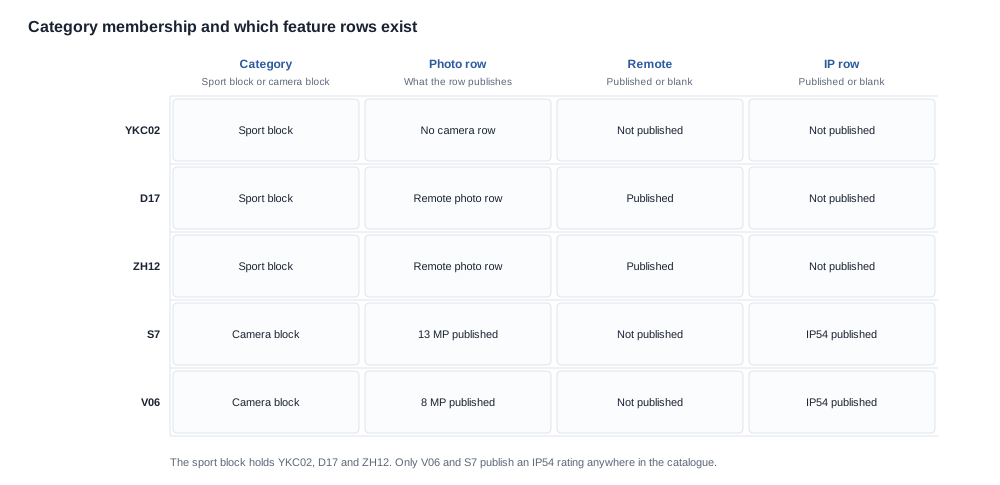
The camera-adjacent models worth naming are the S7 and the V06, both of which are labelled AI Sport Photography Glasses, both of which publish 260 mAh, a 5 to 8 hour runtime, a charge time of two hours or less, and magnetic charging. The S7 publishes 13 MP and the V06 publishes 8 MP. The V06 publishes four colour options. These two models are the closest cousins to the YKC02 in physical form factor, and they are worth a side-by-side look if your channel is sports-led, because their charging story and their ingress story are both stronger than the YKC02's published position. We have covered that comparison separately in the form factor piece, and the practical battery-and-weight considerations that come up when you ship camera glasses are set out in the shipping weight article.
Only two models in the whole catalogue publish an IP54 rating: the V06 and the S7. The YKC02 publishes no ingress rating at all. For a sports product, that is the single most important gap to raise in a supplier conversation, because sports products get used in rain, sweat, and spray, and a buyer cannot write a defensible water-resistance claim on a model that publishes none. The IP ratings reference page covers what the standard means and what a claim would actually require. We will also note the pattern across the catalogue: there is no capacitive-touch row anywhere and no translation row anywhere, so those two features are simply outside the published dataset for every model, including this one.
How the YKC02 compares with the D17 and the ZH12
The D17 and the ZH12 are the only two models that publish a remote control shutter, and both of them publish it alongside a photo-plus-sound feature bundle — the D17 with remote control photo plus surround sound, the ZH12 with remote control photo plus stereo surround sound. The YKC02 publishes no remote control shutter. That is a clean, factual difference and it should drive a clean decision: if remote capture is the reason you are buying smart glasses, the YKC02 does not serve that need on its published specification, and the D17 or the ZH12 do.
We will build the comparison in four passes — power, charging, connectivity, and feature set — because each pass points in a slightly different direction, and collapsing them into a single score is how shortlists get built on data that does not support it.
Battery by battery, the three models are close but not interchangeable.
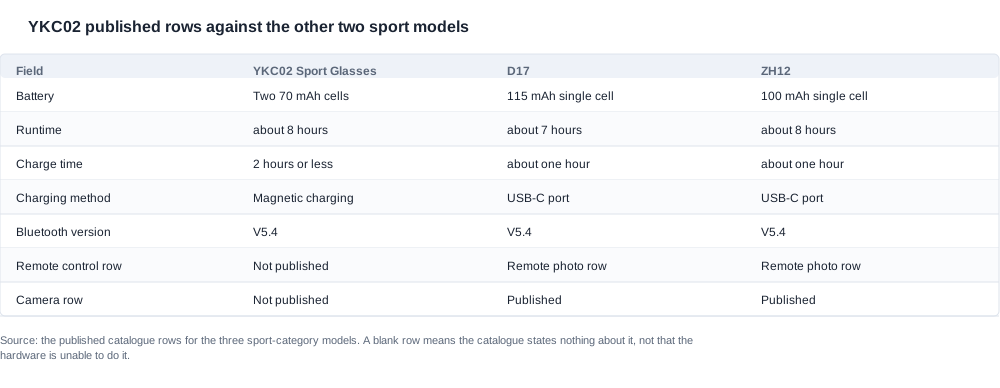
| Model | Cell configuration | Runtime | Charge time | Charging | Bluetooth | Remote control | Published sound row |
|---|---|---|---|---|---|---|---|
| YKC02 Sport Glasses | 70 mAh x 2 | about 8 hours | 2 hours or less | Magnetic | V5.4 | Not published | Surround sound |
| D17 | 115 mAh single | about 7 hours | about one hour | USB-C | V5.4 | Remote photo row | Surround sound |
| ZH12 | 100 mAh single | about 8 hours | about one hour | USB-C | V5.4 | Remote photo row | Stereo surround sound |
Read across the columns and the positioning becomes visible. The YKC02 matches the ZH12 on the highest published runtime in the group, and it is the only one of the three that publishes magnetic charging and the only one built on a two-cell pack. The D17 has the fastest recharge and the largest single cell. The ZH12 matches the YKC02 on runtime but reaches it through a single 100 mAh cell and, like the D17, reaches about one hour of charging. So the YKC02 is not the fastest to recharge in this shelf, despite the ceiling reading; it is in fact the least specific on charge time, because the other two publish a concrete about-one-hour figure while the YKC02 publishes only a two-hours-or-less ceiling.
That is a meaningful distinction for a buyer doing the arithmetic on daily turnaround. A ceiling is a maximum, not a typical, and in a channel where the customer charges overnight and expects the product to be ready by morning, the practical number matters more than the published maximum. The D17 and the ZH12 make a stronger published promise on recharge, and that promise is visible to any channel partner reading the same sheet, which means it will shape the comparison your customers perform without you.
All three models publish a sound descriptor. The D17 publishes surround sound, the ZH12 publishes stereo surround sound, and the YKC02 publishes surround sound next to its long-endurance row. What separates them is the pairing: the D17 and the ZH12 set that descriptor beside a remote photo row, and the YKC02 has no remote row to set it beside. That difference will matter to anyone building a specification around audio behaviour, and the D17 specifications article sets the D17 bundle out in more detail. The catalogue publishes no acoustic measurements behind any of the three descriptors, so all three rows are names rather than performance figures.
A further comparison point for anyone choosing between the D17 and the YKC02 specifically is price positioning, which is covered in its own comparison piece. That article works through what a published specification set does and does not let you conclude about price, and it is the right place to look if your purchase decision is driven by unit economics rather than by feature fit. We will say only this here: neither the YKC02 nor the D17 publishes a price, a minimum order quantity, or a lead time in the catalogue, so a price comparison is a negotiation artefact rather than a catalogue fact, and you need a quotation from each supplier before the comparison is worth anything.
YKC02 supplier questions before you order
We will close with the part that decides whether the purchase is a good one, because the published catalogue sheet is enough to rule the YKC02 in or out of a shortlist, but it is never enough to sign a purchase order against.
-
Confirm the sport classification in writing. Ask for the catalogue row that classifies the YKC02 as a sport model, and ask what the supplier's own product mapping says. If the answer implies audio-class membership, escalate it, because that mapping will surface again in your listing copy and in your channel data, and it is far cheaper to correct now than after a catalogue sync.
-
Get the cell specification behind the 70 mAh x 2 configuration. Ask whether the two cells are wired in series or in parallel, what the combined pack capacity is for airline and shipping documentation, and whether each cell carries its own protection circuit. This is a quotation-stage item, because the answer affects shipping paperwork and, in some jurisdictions, the treatment of the pack in transit.
-
Ask for the measured charge curve. The published figure is two hours or less. Ask what the typical and worst-case full-charge times are from a flat pack at room temperature, and what partial-charge behaviour looks like under the magnetic pad. If the supplier cannot give you a typical figure, that is useful information in itself and should be written into your notes.
-
Clarify the remote-control question. The catalogue publishes no remote control shutter for the YKC02. Ask whether any remote, button, or capture trigger exists in the hardware, whether it ships in the box, and whether it is a separate purchase order item. Do not promise your channel a shutter function before this is answered in writing.
-
Request certification evidence as a document, not as a sentence. The catalogue body contains no CE, FCC, RoHS, RED, or EN 18031 marking for this model. Ask what test reports exist for the exact model number and the exact battery configuration you would be ordering, who holds them, and whether they cover the destination market. Treat a verbal assurance as a no until the report is in hand. The certification status discussion for the V06 sets out the evidence pattern that a serious supplier will be able to reproduce on request.
-
Establish the commercial frame. Ask for the minimum order quantity, lead time in days, tooling or customisation charges if any, packaging format and carton dimensions for freight calculation, incoterms options, samples availability and cost, pilot order minimums, warranty terms, and spares policy for the magnetic charging hardware. We will treat the unit price as the most negotiable term in the deal, and we will treat the certification evidence and the packing list as the least negotiable, because the first changes your margin and the second changes your liability.
-
Ask what the supplier will actually put in the box. Remote control, charging pad, cable, carry case, spare pads, and a printed manual are all separate lines that can be added to a quotation and then quietly omitted from the carton. Ask for a packing list tied to the purchase order, and reconcile it against the carton dimensions you used for your freight model.
-
Get the buyer's checklist as a written confirmation. The buyer review checklist for this model lists the open questions in a form you can send to a supplier and have answered line by line, which is considerably faster than three rounds of unstructured email and gives you a clean record for the next buyer who asks the same questions.
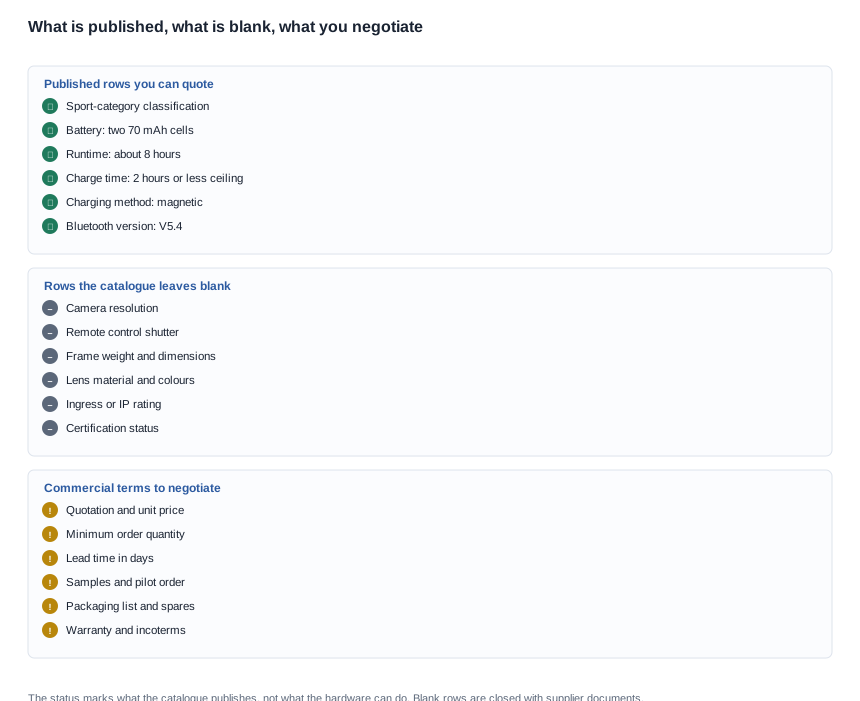
The YKC02's position is clear and we will state it as a conclusion: it is a sport-category model with two 70 mAh cells, about eight hours of runtime, magnetic charging, and Bluetooth V5.4, and it belongs on a shortlist against the D17 and the ZH12 rather than against the eight audio models. What it does not publish is at least as important as what it does — no camera row, no remote control, no weight, no ingress rating, no certification line, no price. We will say plainly which of those gaps can be closed by asking, and which cannot: a missing measurement can be supplied by a supplier, but a missing certification report is a legal exposure that no amount of negotiation resolves.
If you are still deciding whether the YKC02 belongs on your range at all, the best-for article for this model covers the fit from the buyer side, and the limitations article covers the constraints that are already visible from the published sheet. The common questions page for the sport shelf handles the recurring operational questions that come up once a quotation is open, and the sport smart glasses pillar page is the best starting point if you want the whole shelf rather than one model.
We will keep one practical note in view while you read the rest of the range. Across 28 models, charge time is published as a two-hours-or-less ceiling for 26 of them, and only the D17 and the ZH12 carry an about-one-hour figure. Charging method across the catalogue is magnetic on 17 models, USB-C on 7, and not published on 4 — the MT6 and the CY05, and the L1 Pro and the CY03. Only one model in the entire catalogue publishes a weight at all, the MT6 at 158 grams for the glasses body excluding its 1200 mAh folding case. And the catalogue contains no capacitive-touch row and no translation row anywhere, so any claim about touch control or live translation on the YKC02 comes from outside the published sheet and should be treated as unverified until a supplier shows you the evidence.
None of this changes the YKC02's position. It clarifies what you are buying: a sport-category smart glasses model whose published strengths are runtime and charging convenience, and whose published gaps are the exact set of items you will need a supplier to fill in writing before you place a purchase order.


