

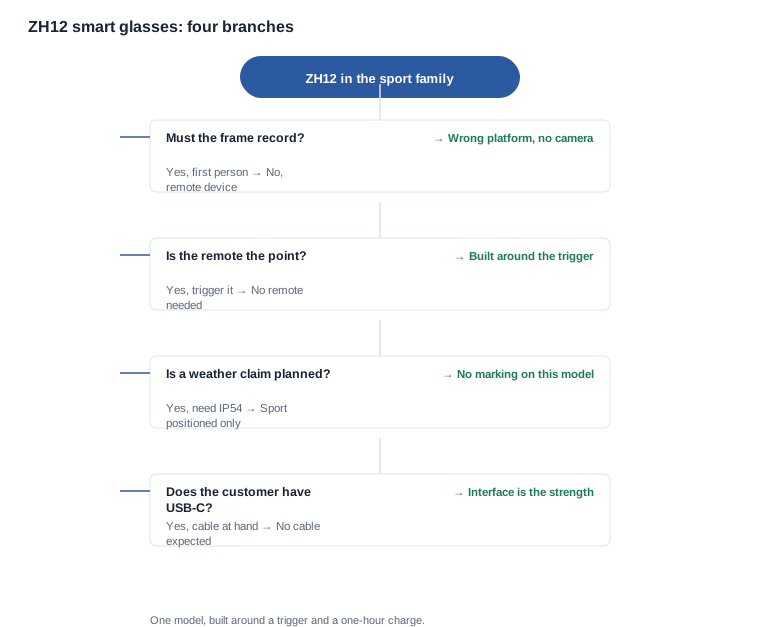
The ZH12 smart glasses suit a buyer whose customer wants hands-free capture triggered from somewhere else — a mounted phone, a bicycle handlebar, a pole — and who values a fast Type-C recharge over an all-day battery in a case. They do not suit a buyer whose product needs the glasses themselves to record, or whose channel needs a water-resistance claim, or whose customer will not have a USB-C cable to hand.
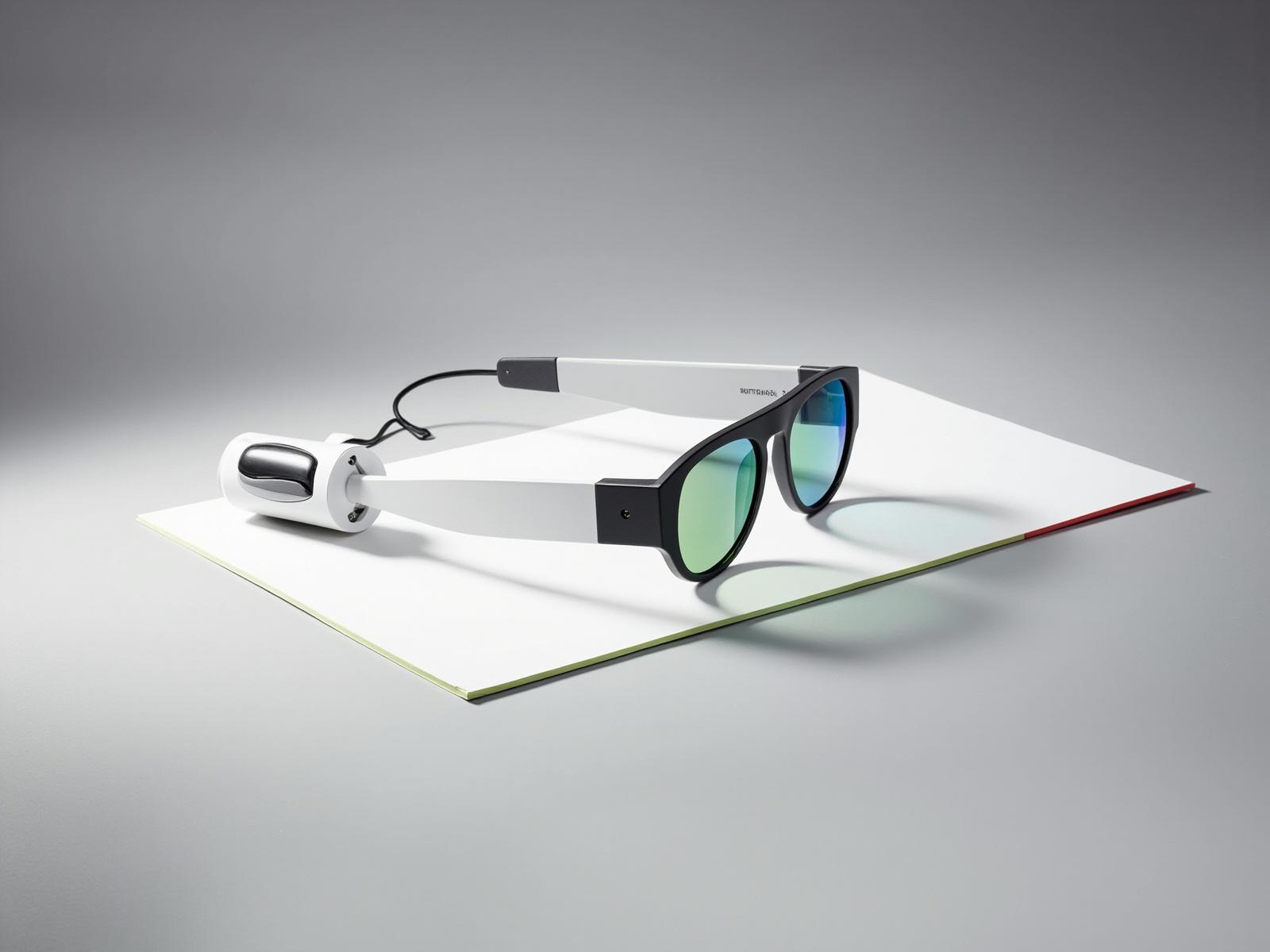
That is a narrow brief with a clear shape, and the model is coherent around it: a light frame, a roughly eight-hour published endurance, a charge time of about one hour over Type-C, and a trigger in the hand while the capture happens on a device that was going to be there anyway. ZH12 smart glasses are worth a place in a range for exactly one application, and the work for a buyer is establishing whether that application is theirs before spending negotiation time on anything else.
ZH12 smart glasses and the four published rows that define the model
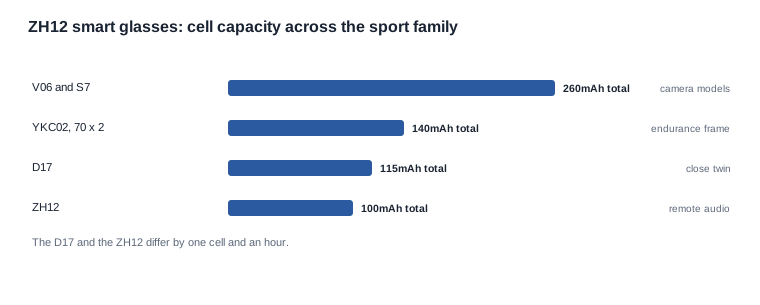
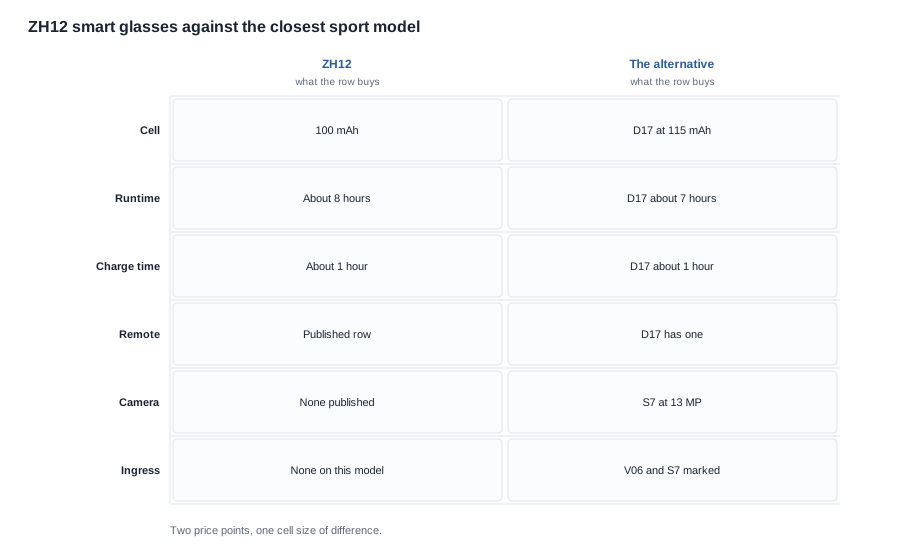
A single 100 mAh cell with a rated runtime of about eight hours. That is a real endurance figure for a frame with no case in the box, and it places this model above the 115 mAh sibling in published runtime despite the smaller cell — which is the kind of discrepancy that tells a careful buyer the figures describe measurement conventions rather than chemistry.
A charge time of about one hour over Type-C. This is the published standout in the sport family and it changes the customer's routine rather than the specification sheet. A product that recharges during a break behaves differently from one that needs a night. It also removes an item from the box, because the customer charges the product with the cable they already own, which means a smaller carton, a lighter parcel and one fewer accessory SKU to manage.
Remote shooting and a stereo surround sound row, published together on this model. That combination is coherent: the frame is light, the trigger is elsewhere, and the sound row gives the product a reason to exist beyond the trigger. Neither row is available on the camera models in the same family, so this is a genuine differentiator rather than a feature shared across a platform.
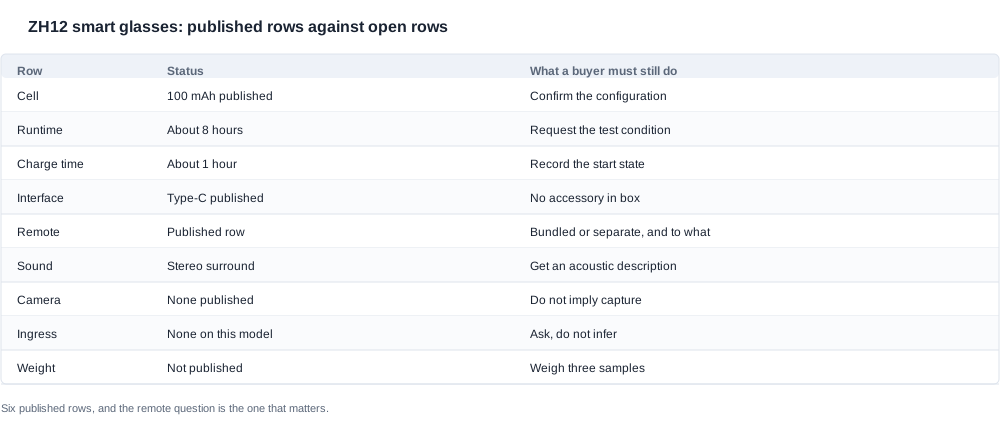
And three absences that are not omissions. No camera. No ingress rating of its own. No detachable inner frame. In this family the IP54 marking, the ergonomic frame description and the removable inner frame belong to the two camera models, and a buyer who assumes the whole sport family shares them will produce a listing the product cannot support.

Why the one-hour charge matters more than the eight-hour figure
The one-hour charge is the row a customer experiences and the eight-hour figure is the row a buyer reads. That distinction should drive the model decision more than it usually does, because the charge time changes behaviour and the endurance figure changes expectations.
What one hour actually buys the customer. A product taken out twice a day — a commute, a walk, a shift — behaves differently when it can be topped up during a break. The competitor product that needs a night creates a routine problem the customer solves by carrying a second unit or by charging at work, and both of those are support conversations for a channel. A fast charge is a retention feature disguised as a specification, and it is the reason the Type-C row is worth more than the endurance row on this particular model.
And the trade-off the charge time creates. A one-hour charge from empty presumes a customer with a USB-C cable and a socket at the moment they need it. In a channel serving customers who travel, work outdoors or buy in a market where the accessory is an afterthought, that assumption fails quietly. Ask what proportion of your channel will have a cable in their pocket, because the answer determines whether the fast charge is a headline feature or a support topic, and that determination belongs in the range plan rather than in the copy.
The endurance figure, handled honestly. About eight hours is a rating on a 100 mAh cell with no case, and no test condition is published for any model in this family. Publish it as a rating with its condition attached, plan the product on the lower end of what your own customer does, and measure it on a sample in the duty cycle they actually keep. A figure you took yourself carries a condition; a figure you copied does not.
What removing the in-box accessory does to the landed cost. A Type-C interface means no charger, no dock and no second lithium cell in the carton. That removes an accessory SKU, a battery transport document line, an accessory packing specification and part of the packed weight — four things that recur on every shipment rather than one-time costs. On a high-volume direct-to-consumer channel those four lines compound, and they compound quietly because none of them appears in a unit price. A buyer comparing this model against a sibling that ships with an accessory should compare the total cost per delivered unit, not the quoted unit price, and should ask for the packed unit weight and the carton dimensions on both configurations before the comparison means anything.
The remote question, which decides three documents at once
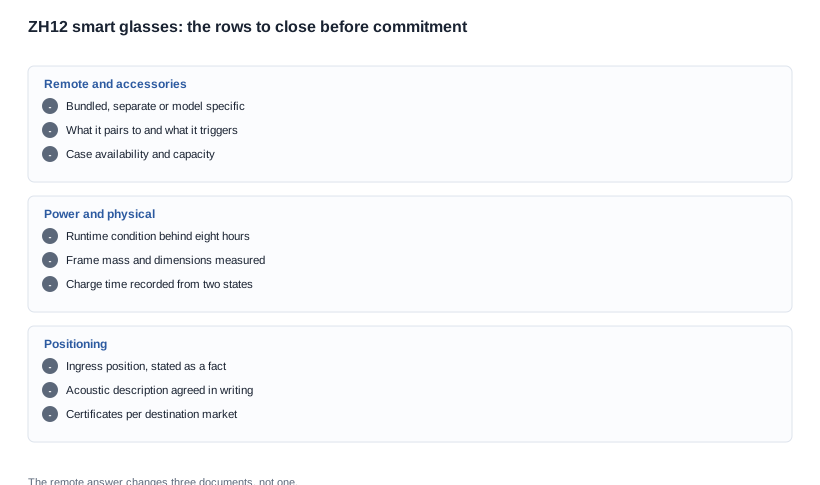
This is the first thing to resolve, and it is unresolved in our own documentation. Is the remote bundled in the box, sold as a separate accessory, or specific to this model? What does it pair to, and what does it trigger — the frame, a mounted device, an application, or some combination? Each of those answers changes a different document, which is why the question is worth asking before the packaging is designed rather than after.
If the remote is bundled, the carton grows, the packing list changes, the minimum order quantity for the accessory disappears, and the customer's first experience includes an item that may need pairing before it works. If it is sold separately, then the accessory line needs its own minimum order quantity, its own packaging specification and its own reorder path — and a channel that runs out of remotes has a product it cannot demonstrate. The two answers produce different cost structures, not different marketing copy.
What it pairs to decides whether the proposition works at all. A remote that triggers a mounted phone, a handlebar-mounted device or a pole is a coherent product with a clear use case. A remote that triggers the frame is a contradiction, because the frame has no camera. A remote that triggers an application is a software dependency with somebody else's release schedule. Ask the question in the form that gets a specification rather than a confirmation — what is the pairing protocol, what is the range, and what does the button do — and the answer will be considerably more useful than a yes.
And the instruction sheet consequence. Whichever answer arrives, the manual has to explain the pairing sequence, and that sequence is the first thing a customer interacts with. Buyers who obtain the written pairing procedure early can build the unboxing experience around it; buyers who discover it at artwork stage get a generic sheet.
The accessory economics of a separate remote, if that is the answer. A separate remote is a second SKU with its own minimum order quantity, its own packaging specification, its own inspection lines at goods-in and its own reorder lead time. It is also the line a channel most reliably runs out of, because it is a low-volume accessory attached to a high-volume product. The practical control is a reorder point rather than a reorder habit: agree the quantity, the trigger level and the lead time in the contract, and put the accessory minimum order quantity on the same purchase order as the frames rather than treating it as a top-up. Buyers who plan the accessory from the start find it is a minor line; buyers who discover it in month four find it is a stock-out on the product they advertise.
The certification consequence, which is smaller than it sounds. A bundled remote and a sold-separately remote can sit differently in the regulatory file for the shipped configuration, and a battery inside a shipped accessory is a separate consideration from a battery inside the frame. None of that is published for this model. Ask for the certification position of the shipped configuration rather than of the model, because a certificate that names the model without naming the configuration is the kind of document that turns into an expensive question at customs rather than at the factory.

Which buyer profile closes, and which one should not
A brand selling to a mounted-capture channel. Cycling, motorsport, action sports, anything where the camera is on a helmet or a bar and the glasses are audio. That is the model designed for it, and the remote row is the whole argument.
A direct-to-consumer channel whose customers own a USB-C cable. This is most channels now, which is why the Type-C row is a commercial strength rather than a technical detail. The carton is smaller, the parcel is lighter, the customer's first-week friction is lower, and there is no accessory in the box to explain.
A brand building a sport range that needs a rung below the camera models. The family has four published positions: a camera platform with colours and a protection marking, a 13 MP version of it, and two remote-and-fast-charge audio frames on different cells. This model and its 115 mAh sibling fill the audio rungs, and between them they give a distributor a three-step shelf without adding a platform.
The buyer that should not buy it: a recording brief. There is no camera on this model, and the two camera models in the family exist for that brief. The buyer that should not buy it: a channel planning a water-resistance claim. No ingress rating is published for this model, and the marking in this family belongs to the two camera models. The buyer that should not buy it: a channel whose customers will not have a USB-C cable to hand, because the fast charge becomes a return driver rather than a feature.
And the case that looks attractive and is not. This model has no published charging case, and the camera family does. A buyer who arrives at this model wanting a case — because the case is the retail story in their channel — should recognise that the case is the reason to look at a different model rather than a gap to fill. The families are separated by more than a specification here: one is built for capture and carries the accessory, the other is built for remote triggering and does not. Treating them as one line with two variants produces a range where neither product has a clear reason to exist.
Verification steps and the criteria before the purchase order
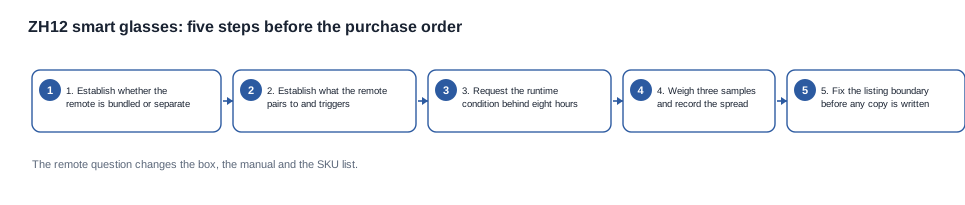
Establish the remote position first, in writing. Bundled, separate or model-specific; what it pairs to; what it triggers; the pairing protocol; and whether it is cross-compatible with any other model in the family. That single answer unblocks the packing list, the instruction sheet, the accessory minimum order quantity and the customer's first ten minutes.
Request the runtime condition behind the eight-hour figure. Whether the Bluetooth link was paired and active throughout, what was playing, and whether the measured sample was the production configuration on a new cell. Ask the same questions of the 115 mAh sibling, because two models differing only in cell size and published runtime is exactly the case where the difference is more likely to be a measurement convention than a product.
Time the charge from two states. About one hour from empty and from a partial state, each recorded with its starting point. A one-hour claim that a customer measures at twenty minutes from partial is a pleasant surprise, and one they measure at ninety minutes from empty is a support topic — and the specification is silent on which of those they will get.
Weigh three samples and record the spread. Frame weight and dimensions are not published, and on a model whose proposition is being light enough to be worn while something else captures, the weight is the number the whole argument rests on.
Set the listing boundary before the copy exists. Published rows you may print: the cell capacity, the rated runtime as a rating, the Type-C interface, the one-hour charge as a charge time, the remote row and the stereo surround sound row. Open rows you may not: the camera, the ingress position, the remote's own specification, the acoustic figures, the case, the weight, the dimensions and the certificate coverage.
Turn the sample into an inspection instrument rather than a demonstration. Decide in advance what the sample is being asked to prove, because a sample used to decide whether the product is impressive answers a question nobody needs answered. What this model needs is: the charge time from two starting states, the measured mass, the frame dimensions, the pairing sequence for the remote written out step by step, and the ingress position confirmed as a fact rather than a hope. Record each result in the form the quality control team will use at goods-in inspection, so the same measurements can be repeated on a production tranche rather than only on the unit in the sample box.
And scale the diligence to the volume, not to the model's importance. At a first order of modest size, the sample and a written listing boundary carry most of the value, and a formal audit adds little. At a volume where the range is being built, a factory audit with a written checklist is what prevents the configuration from drifting — the remote arriving in a carton it was not specified for, the accessory count differing from the packing list, or the charge timing method turning out to be undocumented. What should never scale is the listing boundary, because that is free and it is the difference between a defensible product page and a returns queue.
Terms, red flags and the position we take
What this model's position is worth commercially. It is the cheapest way to put a sport-positioned audio product with a trigger and a fast charge on a shelf, because it has no camera module, no case and no second parcel item. Against its 115 mAh sibling it buys a longer published runtime on a smaller cell — a distinction that is commercially thin and rhetorically useful, which is worth naming because a distributor building a ladder on that difference is building on a measurement convention.
Open to negotiation, and worth the time. Unit price and volume tiers across a bulk order; the remote as a bundled or separate line with its own minimum order quantity, which is the decision that changes the rest of the cost structure; packaging specification; delivery splitting so a first tranche can be validated; payment terms with nodes against inspection rather than against shipment; the warranty period with a stated response time; return terms; and the terms of a pilot order.
Two cost lines behave differently and are usually quoted as one. Certification cost and lead time follow the procedure and the testing body. Tooling is frequently spread across a first order, while certification cost attaches to a product family. Separating the two in the quotation is not pedantry: it tells you which figure scales with your volume and which does not.
Red flags worth naming at the quotation stage. A supplier who describes the remote as included without stating whether it is included per unit or per carton. A supplier who offers a weather claim on a model with no ingress marking. A supplier who implies capture on a model with no camera — the most damaging of the three, because it produces a listing that describes a product the customer does not have. And a supplier who quotes a runtime point figure where a range or an approximation is what the documentation supports.
Where we stand. Our position is that this is a well-chosen product for a remote-shooting sport brief and a poor choice for a recording brief or a wet-environment brief. We will not describe it as recording anything, we will not extend the family's IP54 marking to it, and we will not present the eight-hour figure as a guaranteed day or the surround sound label as an acoustic specification. Where our own documentation is thin — and the remote question is the thinnest part of it — we will name the gap and point to the question that closes it.
Clauses for the agreement. The published rows for the configuration ordered; the remote's bundled or separate status and its pairing specification; the runtime condition; the charge time recorded from two starting states; the measured weight and dimensions; the ingress position stated as a fact; the certification position per market; and the warranty period with a stated response. Clauses to leave out entirely: any capture claim, any weather claim, any runtime point figure drawn from a range, any weight not measured, and any acoustic figure that is not published.
The published ZH12 specification list is the honest baseline to send alongside your request, the certification position for this model covers market access, and the sport model pick guide covers how this model sits against the rest of the family.
Related reading
- The rows published for this model — ZH12 smart glasses specifications and features
- The camera platform it is not — S7 smart glasses common questions
- Choosing across the sport group — sport smart glasses which model to pick
Send us the use case, the channel and the markets, and we will tell you whether the ZH12 matches the brief and which figures remain unpublished.


