
The camera is the most expensive single line in a smart-glasses bill of materials and the one with the longest reach downstream, because it sets the image quality, the file format, the storage policy, the bandwidth, the privacy posture and the size of the box. What a buyer actually has to decide is not which camera is better. It is which resolution tier the programme sits in, because the tier fixes the configuration, the cost, the logistics and the claims, and everything else about the camera is settled later, in the sample, against a written protocol.
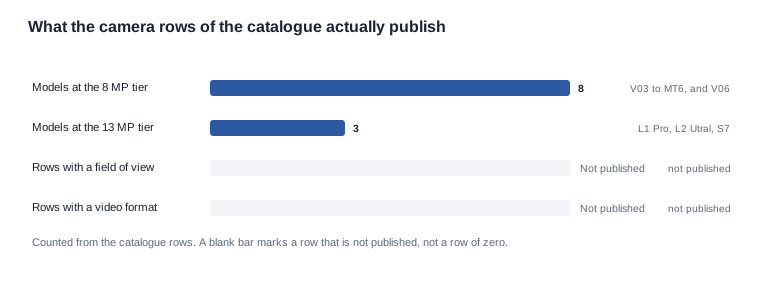
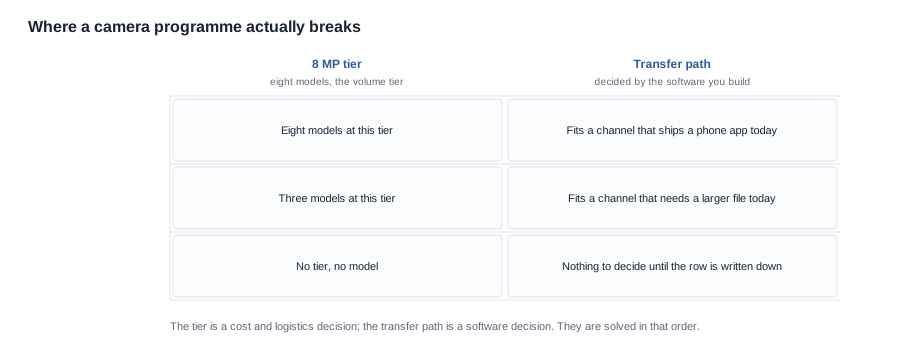
Our published position is narrow and worth stating at the top. Eight of the twenty-eight models in the range publish an 8 MP tier: the CY05 and the MT6, the KY06 and the V06, and the V03 and the V03 Pro, and the MT5 and the CY03. Three publish a 13 MP tier: the L1 Pro and the L2 Utral, and the S7. Not one model publishes a sensor part number, a field of view, a video container, a low-light performance figure or a camera-indicator behaviour. Those rows are open, and a buyer who builds a listing on them is building a claim on nothing.
That leaves a clean decision to make. Fix the tier first, because the tier is a configuration commitment with a price and a schedule attached. Then ask the four questions that actually change the outcome — what the file is, where the file goes, how the product behaves when the light is poor, and how the presence of the camera is made visible. Those four answers cost nothing to obtain in writing and everything to discover after the first shipment.
Smart glasses camera technology: configuration, not quality
The most expensive error in this category is treating a resolution tier as a promise about the picture. A buyer who hears "13 MP" and writes "13 megapixel camera" in a listing has made a claim that our published data cannot support, because a resolution figure describes the number of pixels in the frame and nothing about the sensor that fills them, the optics in front of them, the processing behind them or the light available when the frame is taken. The same 13 MP on a good sensor in poor light and on a poor sensor in good light produce files a customer will describe in the same words: the photos are bad.
This is why the tier has to be treated as a configuration commitment rather than a marketing tier. Choosing the 13 MP tier over the 8 MP tier is not a quality upgrade in a range where both tiers are ours. It is a different bill of materials, a different component lead time, a different file size on a channel's servers, a different storage strategy in the companion application, a different set of claims in the listing, and a different approval route for the model designation. All five of those are decided before the first sample is ordered, and all five of them are reversible only at cost.
A second consequence of the same framing is that the tier does not rank the models within it. The V03 is an 8 MP model with a 220 mAh cell, magnetic charging and a rated runtime of five to eight hours, and no charging case on the row. The MT6 is an 8 MP model with a 265 mAh cell, a rated runtime of about seven hours and a 1200 mAh foldable charging case, and it is the only model in the entire range for which a weight is published: 158 g for the glasses unit itself, excluding the foldable case. Those two products are not an 8 MP product and a better 8 MP product. They are two products that happen to share a published resolution figure, and the other rows are what separates them.
The commercial consequence for a buyer comparing quotations is that a quotation which names a tier and a configuration is comparable, and a quotation which names a pixel count without a configuration is not. Two suppliers can both write "12 MP" and mean a sensor crop, an interpolated output, a burst mode and a downsampled pipeline respectively. A pixel figure with no configuration string behind it is a marketing number, and comparing two of them tells you nothing about which supplier can build what you intend to ship. The question to ask instead is which model and which configuration the quote covers, and a buyer who asks it early avoids comparing quotations that were never about the same thing.
Where the catalogue publishes camera data and where it stays open
The published camera data in our catalogue is a set of configuration rows rather than a set of performance rows. Each camera model states a pixel tier, a cell capacity, a rated runtime and a charge time, seven of them state a charging method, and five state a charging case with its own capacity. That is enough to build a quotation from, to plan a battery story around, and to size the box. It is not enough to build a technical file, and it was never intended to.
| Published row | What it settles | What it does not settle | Where a buyer has to go instead |
|---|---|---|---|
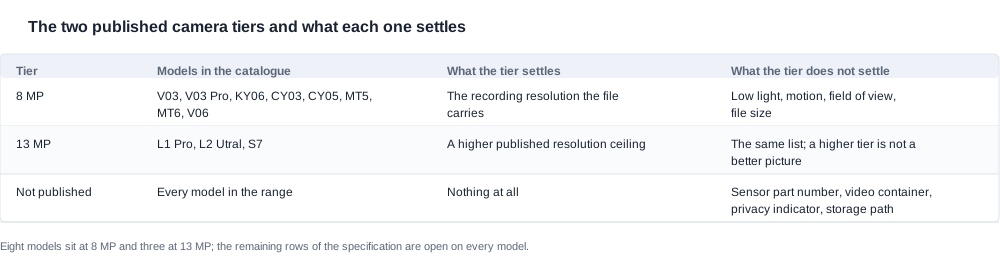
| 8 MP on the MT5, the V03 Pro and the CY05, the MT6, the KY06 and the V06, and the V03 and the CY03 | The recording resolution the file carries | Low light, motion, field of view, file size | The sample, under a written protocol |
| 13 MP on the L1 Pro and the L2 Utral, and the S7 | A higher published resolution ceiling | The same list, and it is not a quality ranking | The sample, under a written protocol |
| Sensor part number | Nothing, on any model | The sensor family, the pixel format, the interface | The supplier's technical file |
| Field of view | Nothing, on any model | The angle the channel will photograph at | The supplier's datasheet, in writing |
| Video container and codec | Nothing, on any model | Whether your software can read the file | The supplier's answer, in writing |
| Storage path and its limit | Nothing, on any model | Where files live and how many can be kept | The supplier's answer, in writing |
| Camera indicator behaviour | Nothing, on any model | Whether the presence of a camera is externally visible | The sample, and the acceptance criteria |
The last two rows in that table are the ones a channel buyer should insist on, and they are the two most often treated as obvious. A camera in a public place carries an obligation that the operator can be observed, and the behaviour that satisfies the obligation is a design decision with a verification method: a light, an indicator, a physical shutter, a combination. Whichever arrangement a programme uses, it should be written into the acceptance criteria, because "the camera is clearly visible" is not a testable statement and "the indicator is visible from the front and the side when the unit is powered" is.
The storage path is the other one, and it is the row that most often breaks a channel. A camera product can hold files on the device, push them to a paired handset, upload them directly, or do some combination, and the four behave differently in a retail environment where the customer has no account, no app and no cloud. Our catalogue does not publish which one any model uses, because the answer in several of our designs is a combination that changes with the companion application. A buyer who needs a single answer has to ask for it per model, and then has to test that the file arrives somewhere the customer can find it.
There is one structural difference across the camera models that does affect logistics and is worth planning around. Five of the eleven camera models carry a charging case with a published capacity: the CY03 and the CY05, and the L1 Pro — each at 1400 mAh, the L2 Utral at either 900 or 1400 mAh, and the MT6 with a 1200 mAh foldable case. The KY06 and the MT5 name a charging case without publishing its capacity, and the V03 Pro has no case on the row at all. A programme that wants a case in the box has to select its model on that basis, because the case changes the box, the shipping weight, the battery transport paperwork and the accessory conversation that a customer has on day one.
What the resolution tier settles and what it leaves to the channel
Once the tier is fixed, the decisions that remain are not technical comparisons. They are the four commercial choices that determine whether the programme works in the channel, and each of them has a decision tree behind it.
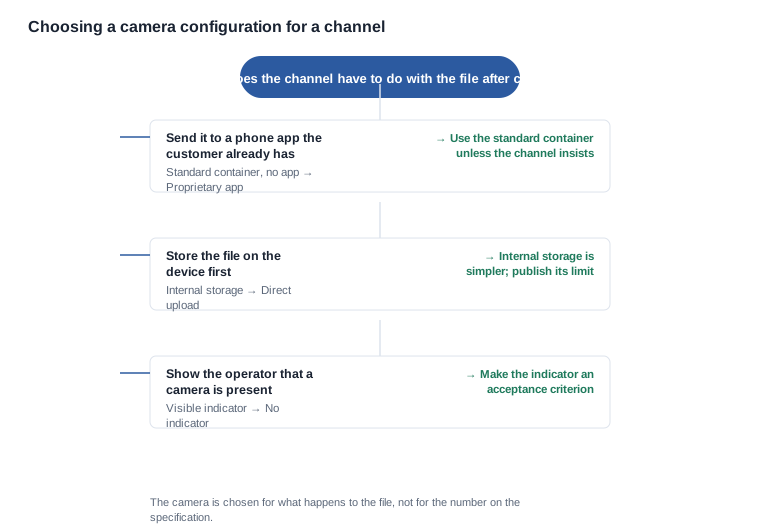
What happens to the file after capture. This is the first decision and it constrains the others. If the customer already has a phone application that reads standard video files, the product should produce standard video files, and the engineering effort goes into the parts that are visible to a customer rather than into a proprietary format. If the channel is building its own application, the file format and the transfer path become part of your own product and need to be specified, versioned and tested as software. A buyer who does not answer this question first will find it answered for them by whichever sample happens to arrive first.
Where the file goes and how long it stays there. A device that stores files needs a stated capacity limit, a stated retention behaviour and a stated way for the customer to empty it. A device that uploads needs the destination, the account model, the failure behaviour when there is no signal, and the answer to what happens to a file that failed to upload. Every one of these is a support obligation, and every one of them is cheaper to specify than to answer.
How the camera behaves in poor light and in motion. No model in our range publishes a low-light figure, and the honest reason is that a low-light figure without a condition is not a specification. A resolution quoted in bright indoor light and the same resolution quoted on an overcast afternoon at dusk are two different measurements of the same camera, and the difference is where the customer complaints come from. The threshold to hold is behavioural rather than numerical: the product should produce a recognisable subject under the lighting conditions the channel actually sells into, and that is a question the sample answers in an afternoon.
How the presence of the camera is made visible. As above. Make it an acceptance criterion with a described viewing condition, and check it on the sample in the condition you have written down.
There is one more commercial decision that belongs at this stage rather than at the approval stage, and it is the one most often deferred: the claim. If the listing says "13 MP AI camera" then the programme is committed to shipping a 13 MP tier, because the copy is the thing the customer and the marketplace reviewer can see. If the programme might ship either tier depending on the batch, the copy has to accommodate both, and the simplest way to do that is to write the copy against the configuration rather than against the headline. A tier named in the configuration string can be managed; a tier named in the headline becomes a dispute the buyer's own marketing has created.
Verifying a camera configuration on a sample you actually paid for
The verification work in this category divides into two halves: the paper, which arrives before the sample, and the room, which arrives with it. Both halves are cheap. What is expensive is discovering a gap in the second half after the packaging artwork has been approved.
On paper, four documents are worth asking for before you order, and they are the questions to ask a supplier about a camera configuration. The configuration string, written out, with the tier named in it. The output resolution, stated separately from the sensor so that a crop or an interpolation cannot be hidden inside a sensor figure. The file format and the transfer path, in the same paragraph. And the camera-indicator behaviour, described rather than named. None of these is unusual to ask for, and a supplier who answers all four in the first round is telling you something about how the rest of the programme will go.
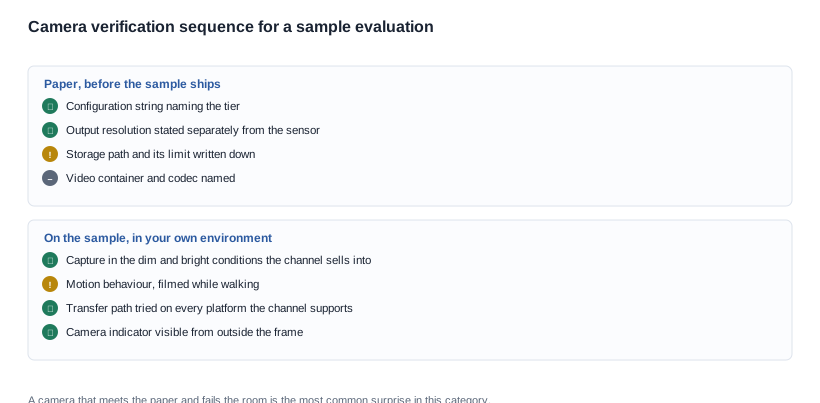
On the sample, the protocol is what turns an opinion into a record. Write it down before the first reading, because a protocol designed afterwards is a description rather than a measurement. In practice it covers four situations. Capture in the brightest environment the channel sells into, to establish the best case the listing will describe. Capture in the dimmest, to establish the case a customer will photograph. Capture while moving, because a camera optimised for a still subject can produce unusable frames in motion, and a channel that sells the product for activity will find that in the first week. And transfer the files on every platform the channel supports, because a transfer path that only works with one companion application creates a support obligation that belongs to the buyer rather than to the supplier.
The indicator gets its own line in the protocol, and it is checked from outside the unit rather than by the person holding it. This is a small thing that costs nothing and has a large failure mode, because an indicator that can only be seen by the operator is not an indicator for anybody else in the room.
Two further checks are worth adding if the channel is going to place the product in volume. Confirm that a second unit from the same production batch behaves the same way, which is a question about process control rather than about the camera. And record the results in a format that another buyer can read, because the next person to evaluate this category will want a comparison and will not have a sample to hand.

Where a camera programme goes wrong, and how each failure is prevented
A camera programme fails in a small number of recurring ways, and each of them has a control that costs nothing at the specification stage and a great deal at the shipment stage.
The sensor quoted as the output. A sensor capability was read as a recording resolution and the listing promised more than the file carries. The prevention is to require the output resolution and the container as separate written items, and to align the listing to the file rather than to the datasheet.
A file format only one platform reads. The transfer path turned out to depend on a single companion application, and the channel's customers do not have it. The prevention is to test the transfer path on the platforms the channel supports, during the sample evaluation, and to require a documented fallback for the ones it does not.
A low-light claim nobody tested. The product was selected on a resolution figure and under-performed in the environment the channel sells into. The prevention is a lighting condition in the sample protocol, stated in the same words the listing will use, and checked on more than one unit.
An indicator that could not be verified. The presence of the camera was not externally visible, and in a market where that is an obligation rather than a preference, the consequence is regulatory rather than commercial. The prevention is an acceptance criterion with a stated viewing condition.
A configuration that quietly changed between the sample and the run. The tier, the case capacity or the charging interface moved, and nobody was required to say so. The prevention is a notice obligation covering the configuration string, and a re-approval route for anything that changes it.
A claim wider than the evidence. A listing claimed a photo or video capability that the shipped configuration does not support, and the correction had to come from the buyer's own side. The prevention is to write the claim against the configuration and to name the model designation the claim was approved for.
None of this is unusual for camera hardware, and nothing on the list would by itself send you to a different supplier. They are reasons to record in the order, and the red flags in a camera quotation are worth naming precisely because they are the ones that repeat.
On the commercial side, the split between what moves and what does not is worth putting in writing before the negotiation rather than during it, because the total cost of a camera programme is settled in the setup lines and the claim lines rather than in the unit price. The parts of a camera programme that genuinely move are the configuration count, the per-configuration minimum, the artwork round count, the sample quantity, the packaging and the accessory set, and the schedule for a split delivery. The parts that do not move are the sensor itself, the resolution tier once fixed, the file format, the indicator behaviour, and the approval route with its cost and its duration. A buyer who knows which side of that line a term sits on does not spend negotiating capital on the wrong line.
The clauses worth having in the agreement are the configuration string as a named attribute of the order, the output resolution and the file format, the storage path and its limit, the camera-indicator behaviour as an acceptance criterion, the notice obligation for any configuration change, and a defect remedy that covers a camera producing unusable files rather than only a camera that does not power on. Where a listing makes a recording claim, the agreement should tie the claim to a specific configuration, because a claim written for one tier and shipped on another is a dispute the buyer's own marketing has created.
The camera claims we can defend, and the ones we will not make
We will say plainly that we publish the rows our documentation holds and mark the rest as open, and we would rather show you six empty fields than six plausible values.
What our published data does settle is the resolution tier for every camera model, the cell capacity, the charge time, the rated runtime with its caveat, the charging interface where one is published, and the charging case configuration where one exists. The V03 Pro and the KY06, the MT6 and the V03, and the CY03 and the V06, and the MT5 and the CY05 publish 8 MP. The L2 Utral and the L1 Pro, and the S7 publish 13 MP.
What we will not do is rank our 13 MP platforms against our 8 MP platforms on image quality, or present a resolution tier as a photography claim. A tier is a number of pixels; a photograph is a sensor, a lens, a processing pipeline and the light in the room. We do not publish sensor part numbers, field of view, video containers, low-light behaviour or indicator behaviour for any model, and we will not fill those rows with a typical figure from a component supplier's general data. A buyer who builds a claim on an estimated number finds the error in the field rather than in the quotation, and the correction costs more than the question would have.
We make no vision, health or eye-protection claim for any camera product in any market. A device that captures images and streams them is not a clinical instrument, and a listing that implies otherwise is a regulatory exposure rather than a marketing decision.
If you send us the models, the quantities and the target market, we will tell you which configurations exist, which of the published rows are open on them, and what has to be established on your own units. The field-by-field camera specification is in camera technology spec sheet explained, the errors that recur are collected in camera technology common mistakes, the approval side is in camera technology certification requirements, and the testing method is in how to test camera technology. The background sits under ai camera glasses imaging and the range itself is at ai camera glasses.
Related reading
- The specification behind it — camera technology spec sheet explained
- The assumptions to avoid — camera technology common mistakes
- The compliance side — camera technology certification requirements
- ai camera glasses imaging
- ai camera glasses
- how to test camera technology
Send the configuration, the quantity and the market, and we will say which parts of the camera specification are settled and which are yours.


