

The YK12 publishes Bluetooth V5.4, two 55 mAh cells, a ceiling of two hours or less, about six hours of endurance, magnetic charging, a slim temple and surround sound. Its certification position is the same as the rest of the range, with one question that is sharper here than elsewhere: the YK12 is electrically identical on paper to three other models, so whether the file names this model is not a formality.
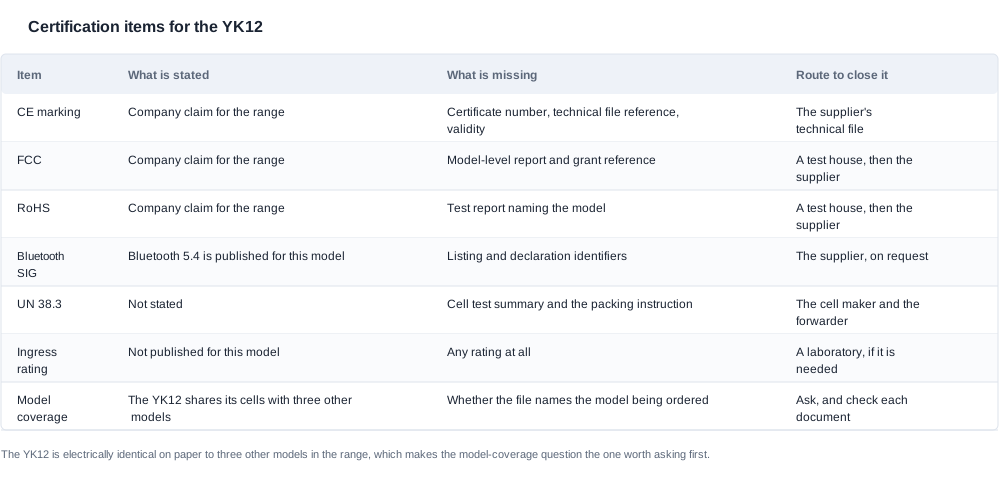
YK12 certification status: what the catalogue does and does not record
The short version is that the catalogue records no certification scope for this model, and that the export page it does contain is a page of images rather than a page of text. What a buyer can take from that is a question to ask, not a certificate to quote.
What the catalogue records, and what it does not
The catalogue is strong on the product and silent on the paperwork. For this model it prints a radio version, a cell configuration, a charge ceiling, a rated runtime, a charging mode and two design markers. On the compliance side it prints an export certification page whose content is ten patent certificate images — eight design rights and two utility models — and no conformity mark appears anywhere in the catalogue text, no test report reference, no certificate number and no expiry date.
Read carefully, that is a specific position rather than an absence of one. The company states a conformity claim at company level, and the model-level evidence behind that claim is not something the catalogue publishes. Both halves of that sentence matter, and neither is the same as a certificate that names the YK12.
What follows from it is equally specific. Nothing in the catalogue can confirm a scope for this designation, and nothing in the catalogue can confirm the absence of one either. A review that tried to settle the question from the catalogue alone would be reading an image page as though it were a table of certificates.
What changes when the destination market changes
The seven items read as a single list because they are written as one, and in practice they are three separate conversations, because the destination market decides which of them apply.
A radio conformity regime and a substance regime are territorial. A battery transport file is territorial in a different way, because it is driven by the carrier and the route rather than by the market the goods are sold in. A radio listing is global, and a Bluetooth listing identifier does not change with the destination, which is why it is the one line on the list that can be closed once and closed for good.
That has a direct effect on how the request should be structured. Asking for the certification file without naming a market produces an answer that is either too broad to use or too narrow to rely on, and it is usually the second. Naming the market and the shipping mode in the first line turns one question into three, each with its own answer, each of which can be filed against the market it belongs to.
The practical instruction is to keep the file per market rather than per model. A programme selling into three territories ends up with three sets of the same seven lines, and the differences between them are the interesting part: the lines that are identical across territories are already closed, and the lines that differ are the ones that need attention.
Why a company-level claim is not a per-model certificate
A company-level statement has a scope that is genuinely wider than a single model, and that is its value. It tells a buyer that conformity work is being done, that a file exists somewhere, and that the supplier is not starting from zero. It is also, by construction, weaker than a per-model certificate in the specific way a buyer cares about: it does not name the designation being ordered.
The gap between the two is where the risk sits. A certificate naming a family does not automatically cover the variant inside that family, and the failure mode is a shipment that arrives with paperwork that an inspector reads as belonging to a different product. That is an expensive failure because it surfaces at the border, when the alternative is a document request sent three months earlier.
So the practical reading of the catalogue is neither "certified" nor "not certified". It is: the claim exists at company level, the per-model file is what has to be requested, and the question of whether the file names this designation is the one that has to be answered in writing before an order is placed.
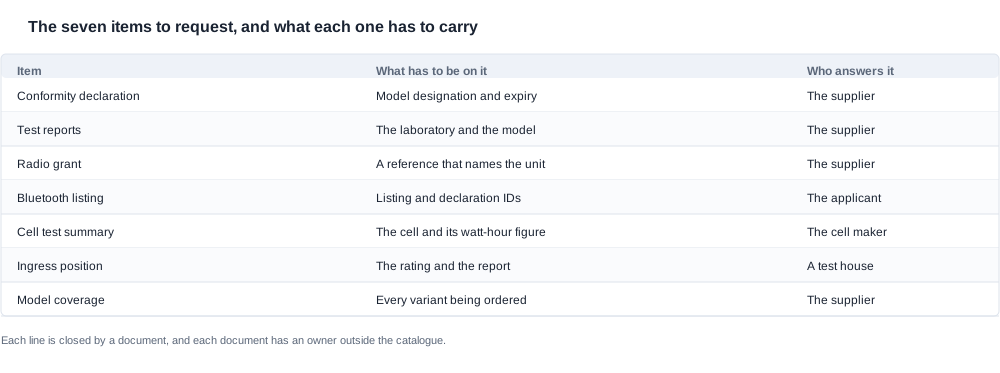

The seven items to ask for, and who answers each
1. A conformity declaration for this designation. The range is claimed compliant at company level. For the YK12 the certificate number, the technical file reference, the notified body where one is used and the expiry date are all missing, and because the product carries both a radio and a cell the file has to answer to both sets of rules.
2. The radio grant. Missing at model level: a test report and a grant reference. A grant issued for a different product does not cover the YK12.
3. The substance declaration. Missing at model level: a test report naming the model, with the substance declarations attached.
4. The Bluetooth SIG listing. Bluetooth V5.4 is published for this model, so a listing exists and the identifiers should be available. Missing: the listing identifier and the declaration identifier. This is the fastest of the seven to obtain and the easiest to verify independently. The Bluetooth SIG certification notes explain what the identifiers are and what to do with them.
5. UN 38.3. Not stated. Two 55 mAh cells in the frame means one test summary for the fitted cell, and a packing instruction that follows from its declared watt-hour rating. If a case ships, its cell needs covering as well, and the catalogue prints no charging case row for this model at all. The battery transport compliance notes set out the chain.
6. Ingress rating. Nothing is published for this model, and the two models in the range that do carry an ingress marking carry it for their own designation only. Anything used outdoors needs this settled through a laboratory rather than through a catalogue page, and the IP rating testing notes set out the standard to request.
7. Model coverage, which is the sharp one here. The YK12 shares its 55 mAh twin-cell configuration with the LC-105 pair and the G07, and all four print the same radio version.
The shared electrical platform and why it makes the designation sharper
Four models on one electrical platform is exactly the situation in which a supplier may reasonably believe one set of reports covers all of them. It may not. A report names a model designation, and a report written for the LC-105-1 does not automatically cover the YK12, even where the two share their radio version, their cell configuration, their charge ceiling and their charging mode.
It is worth being precise about what is shared and what is not, because the precision is what makes the request precise. The electrical rows are the same across all four: Bluetooth V5.4, a pair of 55 mAh cells, a ceiling of two hours or less and magnetic charging. The frames are not the same, and the catalogue says so: the G07 prints an ultra-thin detachable temple, this model prints a surround-sound slim temple, and the LC-105 pair prints no temple marker at all. A document that covers the radio and the cell may therefore be perfectly valid for all four, while a document that covers the frame does not transfer.
That distinction is the single most useful thing a buyer can bring to the request. Ask which rows the report is about. A report that covers the radio and the cell, issued at platform level, is a defensible answer for four models and is entirely compatible with the designation still needing to be stated on the declaration.
The certification coverage notes set out the reasoning, and the LC-105-1 versus LC-105-2 comparison shows the same question in a pair where the answer is more obviously necessary.
Item by item: who answers, and what the answer has to carry
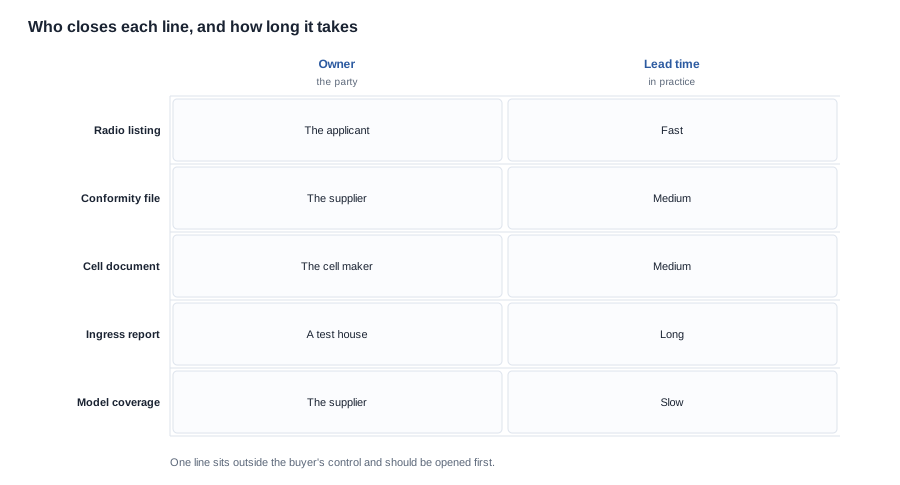
The seven items are not equal in effort, and treating them as one request is how a buyer ends up waiting on the slowest line while the others sit closed.
Three of them come back from the supplier, because they are the supplier's own file: the conformity declaration, the test reports that name the model, and the statement of model coverage. One comes from whoever holds the radio qualification, which is usually the applicant rather than the factory. One comes from the cell maker, in the form of a test summary referenced by the battery marking. One comes from a test house, if an ingress rating is claimed at all.
Only the ingress line sits genuinely outside the buyer's reach, and it is also the one with the longest lead time, which is the practical argument for opening it first even though it will close last. A document that has to be produced by an external body will not move faster because the buyer is busier, and a rating that is claimed on a listing without a report behind it is a claim that has to be withdrawn later.
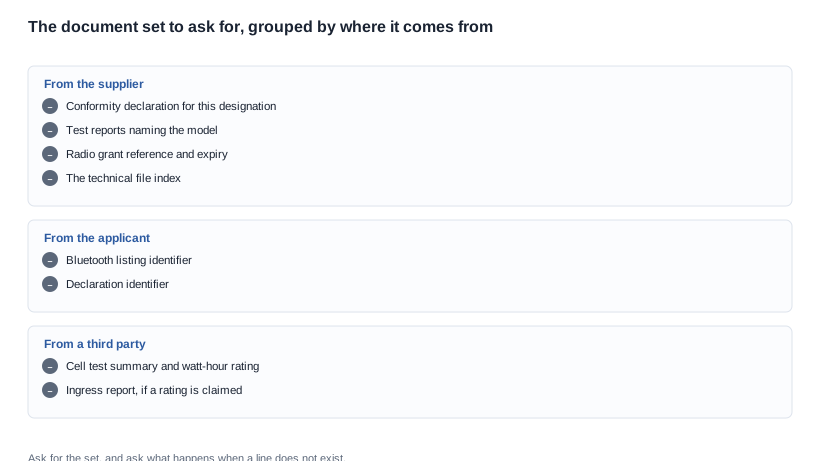
The radio listing, which is the one line you can verify yourself
The Bluetooth listing is the one item on the list that does not need the supplier's cooperation to check, and that makes it disproportionately useful.
Because the radio version is published for this model, the listing exists, and a listing identifier is a searchable public record rather than a document somebody has to send you. The same is true of the declaration identifier. A buyer can confirm both in an afternoon, without a purchase order, without a relationship and without waiting for anything.
That changes the shape of the request. If the radio line is already verified, the supplier is being asked to fill in five remaining gaps rather than to prove six, and that is a much easier conversation to have. It also gives the request a test case: if the supplier cannot produce identifiers that already exist publicly, the conversation about the harder documents has already told you something.
The practical advice is to verify what can be verified before writing to anyone, and to record the result on the file. It costs nothing, it removes one line permanently, and it establishes whether the supplier's documentation is organised or merely promised.

How to phrase the request, and how to read what comes back
Ask for the document set rather than for assurances: send us the complete conformity documentation for the YK12, including the test reports that name the model, the certificate or grant references with issuing body and expiry, the Bluetooth SIG listing and declaration identifiers, the cell test summary referenced by the battery marking, any file covering a case if one ships, and the technical file index. If any of those do not exist for this model, please confirm that in writing.
Both answers are useful. A supplier who assembles the file in a few days has a documentation problem. A supplier who confirms that the reports cover the platform rather than the model has told you something worth knowing before the first shipment rather than at the border.
What a good answer looks like, and what a bad one looks like
A good answer names a designation. Every document in the set carries a string that identifies the model or the variant, and the strings agree with each other and with the purchase order. When those strings line up, the file can be filed, referenced in a shipment and re-checked by somebody who was not in the conversation.
A bad answer sounds like a good answer and is not one. The most common form is a file that is technically correct and practically unusable because it names a family rather than the variant. The second form is an answer that describes the state of the company's compliance function rather than the state of this model's file: work is in progress, the process exists, the file will be assembled. The third is silence, which is not the same as a negative answer and should never be recorded as one.
There is a practical way to tell the three apart without a long correspondence. Ask for the designation inside each document rather than asking whether documents exist. A supplier holding a per-model file can read six strings out of it in a minute. A supplier without one has to go and look, and the time that takes is the answer.
The question that closes the file
One question does more work than the other six combined, and it is not a document request. It is: if the documents for this model do not exist yet, what is the date they will exist, and what happens to an order placed before that date.
That question has three possible answers and each one is actionable. If the date is close and the order can wait, the order waits and the problem is timing. If the date is far away, the configuration changes: the order is placed against a variant whose paperwork already exists, which usually means a different designation in the same family. If there is no date, then the honest conclusion is that this model cannot currently be sold into that market with a defensible file, and the buyer needs to know that before the packaging is printed.
This is the point at which due diligence becomes a commercial decision rather than a documentation exercise. The other six lines tell you what the paperwork says. This one tells you what the business can do with the answer.
The register that keeps the file alive
A certification file assembled for one order and then left in an inbox has cost the buyer the whole effort of assembling it. The second order for the same model starts from nothing, and the third starts from nothing again.
What makes the difference is a register in the same shape as the specification register every programme already keeps: one line per item, the designation as printed on the document, the owner, the date received, and whether the line is closed for this market, this model or this variant. Seven lines take an hour to write the first time and a minute to check the second time, and that ratio is what decides whether the practice survives the first busy quarter.
The register also answers the question that comes up at every review: what has changed since the last order. A new radio version, a different frame, a different destination, a different cell supplier — each of those can invalidate a line that was closed last time, and each of them is easy to miss because nothing in the paperwork announces the change.
Treating certification as a live record rather than a document is the difference between a file that protects the programme and a file that merely satisfies it.

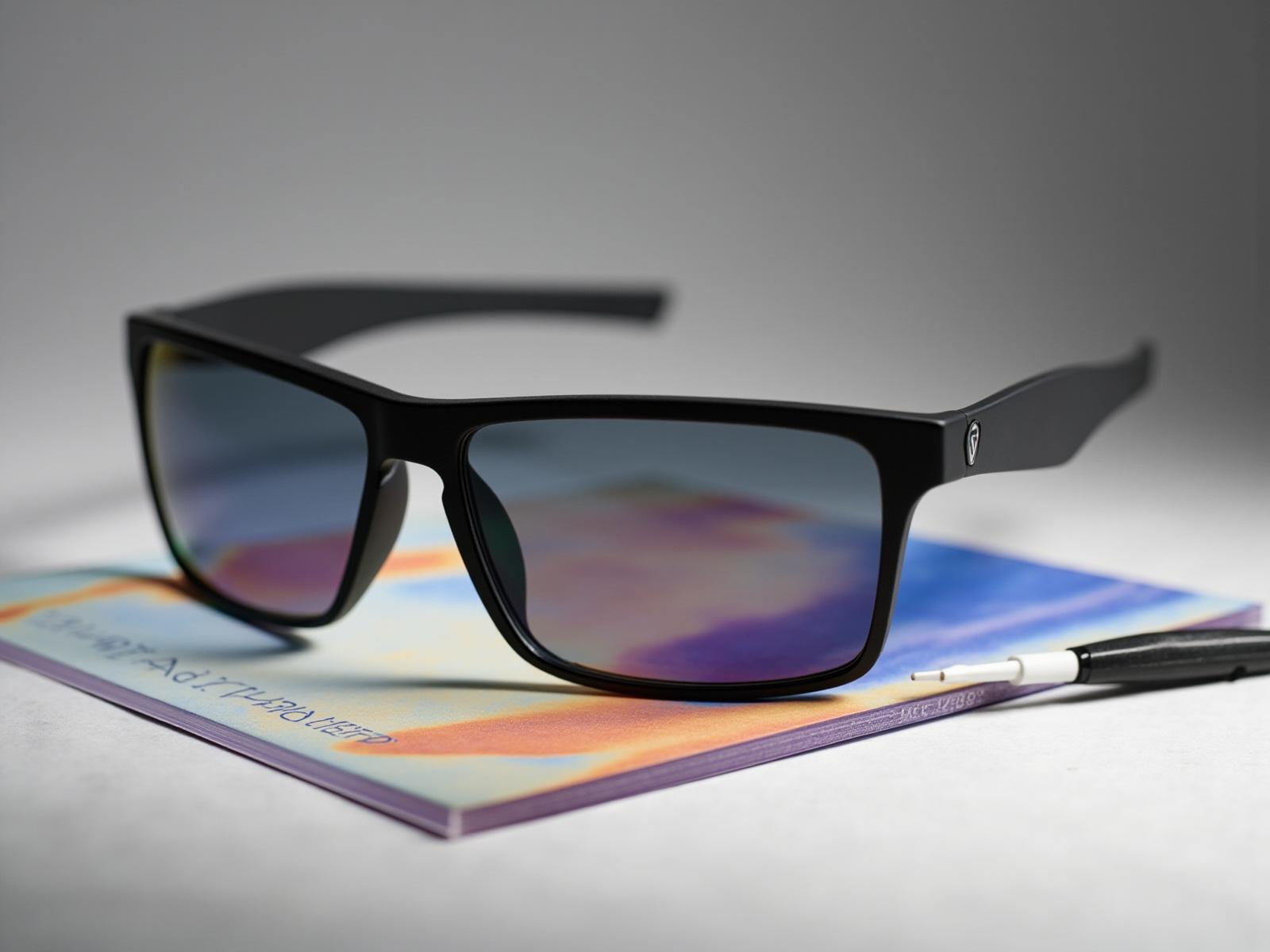
Where CYNRIN stands on the YK12 certification
A company statement of conformity is the start of a conversation, and the only meaningful test of a supplier's readiness is whether it produces documents that name the model. We will not publish a certificate number we have not seen, we will not state a certification status for the YK12 that our documentation does not support, and we will not present a company-level conformity claim as though it were a verified per-model certificate. The published YK12 specification list is the honest baseline for the product, and the export documentation checklist covers the paper that travels with the goods.
What we will put in writing this week
Given a destination market and a shipping mode, we can return the seven items split into three columns: the lines we can close from our own documentation, the lines that require a document from a third party, and the lines that require a date from you. That is the most we can do honestly, and it is more than most buyers expect to get in a first reply.
What we will not do is shorten the list. A request for a single combined certificate is easier to answer and harder to use, because it collapses seven lines into one answer that says nothing about which of them are actually held. The whole point of the seven-item structure is that each line has a different owner and a different lead time, and the list is what lets a buyer plan around that instead of discovering it.
Seven questions to put in writing
- Which test reports name the YK12, and from which laboratory.
- The certificate or grant references, the issuing body and the expiry date.
- The Bluetooth SIG listing and declaration identifiers.
- The cell specification, its test summary and the declared watt-hour rating.
- Whether a case exists for this model, and whether its cell is covered.
- Whether any ingress rating exists, and the evidence behind it.
- Which economic operator details and traceability arrangements will appear on the packaging.
Related reading
- The entries published for this model — YK12 smart glasses specifications and features
- The model coverage question — OEM ready platforms certification coverage
- The document set in general — OEM ready platforms export documentation
Send us the destination market and the shipping mode, and we will tell you which of the seven items are on the critical path for that lane.


