
This model is published as a Bluetooth V5.4 frame with two 55 mAh cells, a charge time of up to two hours, about 6 hours of rated use, magnetic charging, surround sound, and a slim temple configuration. Six questions come up on it more than any others, and three of them have no published answer at all. This page is written for the buyer who has to answer those six questions in a purchase order and in a product page, and it separates the ones you can close with a request from the ones only a sample can close.
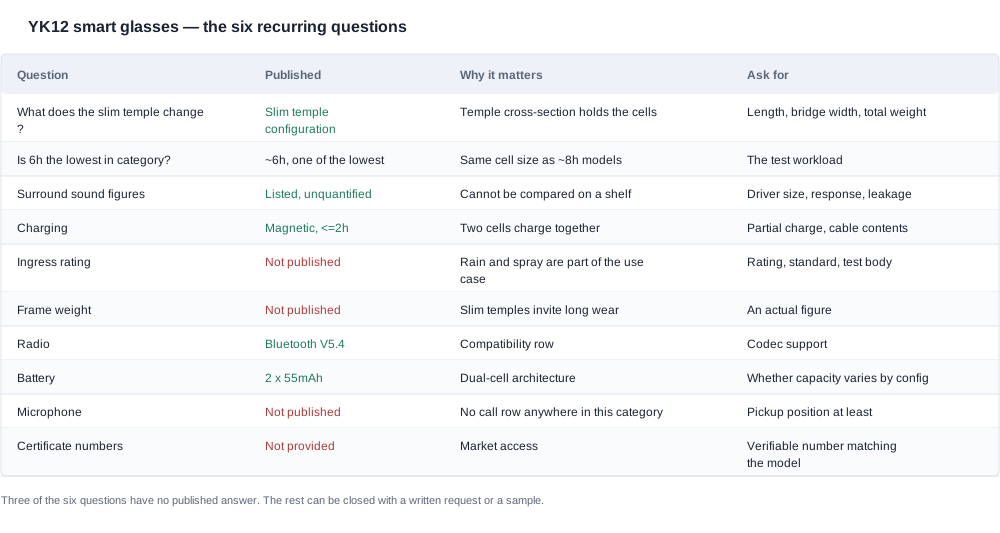
The buying task behind the recurring questions
Who is asking and what they are defending
A procurement manager is putting the specification together and needs to know which of the six questions blocks the order and which is merely open.
A channel buyer is writing the listing and needs to know which claims are publishable today.
A product manager is deciding whether the sound claim can carry the proposition, and the answer is on a shelf, not in a document.
The three that are closed, and the three that are not
Closed: the platform rows. Bluetooth V5.4, two 55 mAh cells, magnetic charging at up to two hours, about six hours rated, surround sound, a slim temple.
Open and closable with one request: the runtime test condition, the charging behaviour in practice, the ingress position and the certificate coverage per configuration and per market.
Open and closable only with a sample: the weight, the dimensions, and the fit across a real team. That is a different kind of gap, and it is worth knowing which of your six questions is which before you chase them in the wrong order.
The order that saves the most time
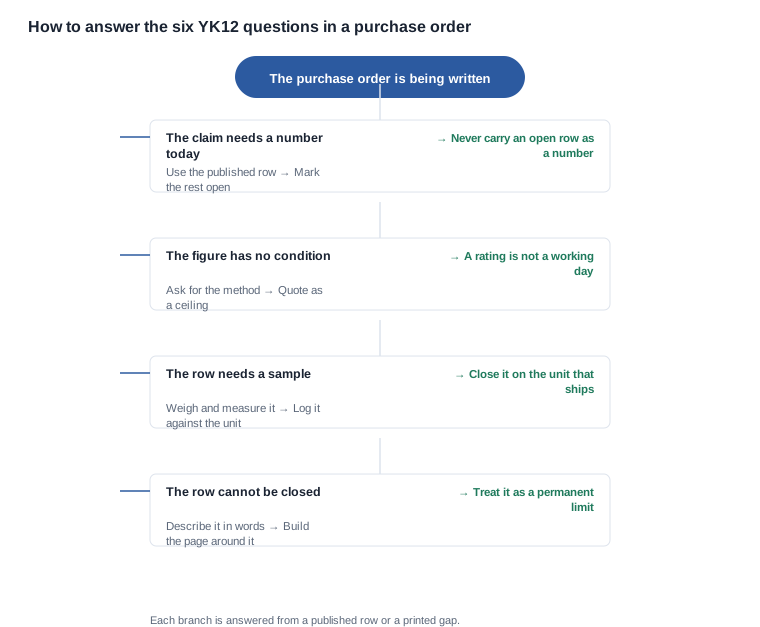
The six questions are not equally urgent, and the order they are chased in decides whether the order is placed this quarter or slips. The sequence below is the one that closes the most risk per unit of effort.
Start with the closed rows. Bluetooth V5.4, two 55 mAh cells, magnetic charging with a ceiling of two hours, a rated use of about six hours, the surround-sound entry and the slim temple. Seven rows are on record, and they are the rows a product page can be built on today. Anything a channel needs beyond these seven is not a specification question, it is a document question.
Then send one written request for the rows a document can close. The runtime test condition, the charging input and the partial-charge behaviour, the indicator, the ingress position, and the certificate coverage for the exact designation and each destination market. One request with one deadline produces one answer; three requests produce three partial answers and a second round of chasing.
Then hold a sample for the rows only a sample can close. The weight, the temple length, the bridge width and the fit across the people who will actually wear it. This is an afternoon with a scale and calipers, and it is the step that closes the row most likely to generate returns.
Keep one question open and label it. The acoustic figures behind the surround-sound row are not closable by a request or by a sample, because no document exists for them. That question does not go on a chasing list; it goes on the page as a deliberate limit, and the listing is written so that nothing depends on it.
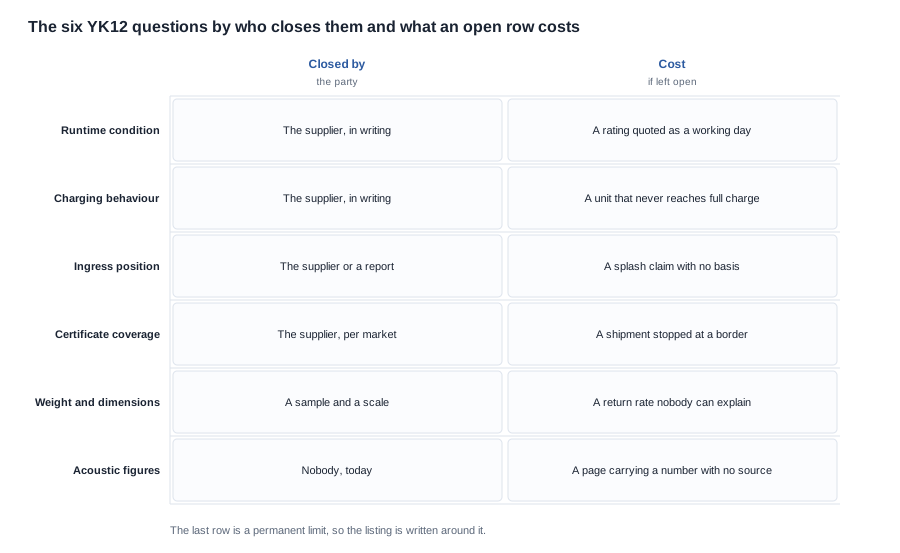
Open and not closable today: the acoustic figures behind the surround sound row. No request produces them, because the document that would hold them was never written for this configuration. That row goes on the page as a deliberate limit rather than onto a chasing list.
The six questions, and what closes each one
| The recurring question | The honest answer | The threshold or the question to ask | How it is closed |
|---|---|---|---|
| Why does the slim temple matter so much? | A slim temple on a dual-cell frame is a mechanical decision, not a cosmetic one — the cells sit in the temples, so their cross-section sets how thin the temple can be. Published as a slim temple configuration, it tells you the frame is at the light end of the dual-cell group | The cell cross-section, and the temple length and bridge width — none published | A measurement on a sample |
| Is 6 hours the lowest runtime in the category? | It is one of the lowest published figures among dual-cell models. Other dual-cell frames in the range publish about 8 hours with the same cell size, which is the same puzzle seen elsewhere in this catalogue: identical cells, different published runtime, different workloads or different measurement conditions | The test condition, the volume, the radio state and whether the sample was a unit or a batch average | A written answer, then a verification on a sample |
| Does the surround sound configuration have published figures? | No. Driver size, frequency response and leakage are not published for this model. You can describe surround sound as a feature because it is listed; you cannot put a number behind it | The acoustic figures, or a descriptive answer on what the customer hears differently with it enabled | A request, and a listening test on a sample |
| What is the charging situation in practice? | Magnetic, up to two hours, two cells. Two cells charging together is why the ceiling is what it is, and partial-charge behaviour, charger output and the cable contents are all unstated | The charging input, the partial-charge behaviour, the indicator, and the case or dock availability | A written answer, before the order |
| What about ingress protection? | Not published for this model. Two frames elsewhere in the range carry an IP54 catalogue marking, and the second digit in that marking covers splashing water rather than rain or immersion — but in any case a marking on a different model is not evidence about this one | The ingress position for this configuration, and the report if one exists | A written answer, before the order |
| What about weight and papers? | Frame weight is not published, and it is the gap most likely to generate returns here, because a slim-temple frame invites long wear and weight is what stops it. Certificate numbers are not provided, so nothing in your listing can be verified from documentation today | The weight and the dimensions, measured; and the certificate coverage per configuration and per market | A sample, and a written answer for the certificates |
The one to watch
The six-hour figure against the eight-hour figures on the same cell size is the puzzle that appears across this catalogue, and it is never explained in the source. With no stated test condition, treat 6 hours as a figure to verify on a sample under your own usage rather than a promise to put in a listing. Do the same with every runtime figure in this category, because the same cell size appears with two different published runtimes elsewhere in the range.
The two figures that look contradictory
Two numbers in this catalogue look like an error and are not. The first is the runtime: this model publishes about six hours on two 55 mAh cells, and another dual-cell frame in the same range publishes about eight hours on two 55 mAh cells. The same cell size, two hours apart, with no stated condition on either.
The honest reading is that the two numbers were produced under different conditions. Volume, the radio state, the content type, whether the figure is a single unit or a batch average, and whether the cells started full — each of those is enough to move a published figure by hours, and none of them is printed. The G07 publishes the same six hours on the same cells, which tells a buyer that the cell format is not what separates the figures. So the two numbers are not evidence that one of the models is better, and they are certainly not evidence that the shorter one is misprinted.
What that means for the buyer is a method, not a verdict. Ask what was playing, at what volume, with the link in what state, and from what start charge. If the answer comes back, the figure becomes a claim with a condition attached and the sample test can confirm it. If it does not, the figure stays a rated ceiling and the listing says so.
The second apparent contradiction is the pair of charging figures. A ceiling of two hours on two cells is not the same claim as a two-hour charge of one cell, and the catalogue prints the ceiling rather than a typical value. Two hours or less is the guarantee; anything longer is a fault to raise, not a variation to absorb.

Closing the six questions before the order
Send the five closable questions in one request. The runtime test condition. The charging input, the partial-charge behaviour and the indicator. The acoustic figures. The ingress position. And the certificate coverage per configuration and per market.
Hold a sample and weigh it. No weight is published for this model, and it is the row that decides whether a slim-temple frame is worn for a full session or a shorter one. Our materials and ergonomics guidance covers what to measure.
Test the seating, because the sound depends on it. The family's technical description includes directional audio, and a slim temple seated differently changes what the wearer hears. Test it at three positions with a fixed content setting, and record what changes. That is the difference between a customer who says the sound is odd and one who says it is good.
Verify the runtime on a sample in your own duty cycle, because the published figure has no condition and the category-wide pattern suggests the same cell size can produce two different published figures.
Draw the publish line before the copy exists. Seven rows are on record for this configuration: the radio, the cells, the charge ceiling, the rated use, the charging method, the surround-sound entry and the temple. The weight, the frame dimensions, the acoustic figures, the ingress position, the runtime condition and the certificate coverage are not on record.
One request, one reply, one register
The document-closable questions are written in a single message with a single named deadline, because the answer to one of them scopes the answer to the others. The destination market comes first, because the certificate coverage that matters is the coverage for the market the shipment is actually going to.
The reply is read in the same order it was asked. Which papers exist for this designation, and which of them are issued across the range rather than for the model itself. What the runtime condition and the measurement method were. What the charging input and the partial-charge behaviour are. What the ingress position is. And then the commercial rows, which need no laboratory and no sample — only a date.
The register is the output that pays for itself, and it is a short document: one line per item, with what was asked, what came back, the date, who owns it, and whether the item can be closed. A register is what makes a repeat order faster than the first one, because what is still open when the second order is placed is exactly what the first register failed to close. In practice those are always the rows nobody answered, and that is a fact about the supplier worth knowing before the volume grows.
The sample work then runs against that register rather than in parallel with it, so the afternoon with the scale and the calipers closes the rows the documents could not, and nothing else in the plan is waiting on a unit that has already been returned.
Six ways these questions get answered badly
The published runtime was read as a full working day. Symptom: a customer in a heavy use pattern is disappointed. Root cause: a rating without a stated condition was treated as a promise. Prevention: quote it as a rating with its condition, and verify it on a sample.
The slim temple was read as a light frame. Symptom: comfort complaints on a product positioned as lightweight. Root cause: a design word was read as a weight claim. Prevention: weigh the sample and quote your own figure.
An IP54 marking was carried across from another model. Symptom: a listing claims splash protection on a model with no ingress position. Root cause: a family-level inference. Prevention: ask for this model's position specifically.
A sound claim was turned into a measurement. Symptom: a competitor's acoustic figure contradicts yours. Root cause: a feature name was turned into a measurement. Prevention: describe the behaviour in words you have observed yourself.
The charging behaviour was assumed. Symptom: the product does not reach full charge from a customer's adapter. Root cause: the accepted input and the partial-charge behaviour were never asked. Prevention: get both in writing before the order.
The certificate coverage was assumed. Symptom: a market question is answered with a document that names a different configuration. Root cause: a family-level assumption. Prevention: check the exact designations on each certificate.
What the YK12 position is worth commercially
A slim temple with a sound claim and a light parcel is a defensible product position, and the cost structure is the light one. No camera module, no case in the parcel, no parcel weight, no ingress claim to defend. At volume that is worth more than the specification difference against a heavier sibling, and it is invisible on a product page.
Open to negotiation. Unit price and volume tiers, the accessory set with its minimum order quantities, packaging specification, delivery splitting, payment nodes against inspection, the warranty period with a stated response, the return terms, and the terms of a pilot order. These are the trade-offs worth the negotiation time, and the return terms are the line that matters in a long-wear channel. Run the six questions as a checklist before the order is placed.
Set by process. Certification cost and lead time, which follow the process and the testing body. Tooling, which is often amortised across the first order while certification cost is per product family — ask which one you are being quoted, because the two are frequently bundled into a single line that hides which is which.
Terms to write into the agreement. The published rows for the configuration ordered; the runtime with its condition; the charging input, the partial-charge behaviour and the indicator behaviour; the acoustic description and the volume condition; the ingress position; the frame weight and dimensions as measured; and the warranty period with a stated response.
Terms to keep out. Any weight not measured, any acoustic figure not published, any ingress claim carried from another model, and any runtime claim without its condition.
Where CYNRIN stands on the YK12 questions
We will not describe a slim temple as lightweight without a published weight, and we will not convert an unpublished acoustic specification into a sound-quality claim. Where the published data answers a question above, we give it; where it does not, we say so plainly. The YK12 specifications page is the published baseline, YK12 best for sets out where the model sits in the range, and the Bluetooth audio glasses page is the range reference.
What we can close, and what nobody can close today
It is worth being exact about which of the six questions this page is asking, because the answer is not the same for all of them.
We hold the platform rows. Bluetooth V5.4, two 55 mAh cells, magnetic charging under a two-hour ceiling, a rated use of about six hours, the surround-sound entry and the slim temple. Those seven rows are on record, and they are what a product page can carry.
We can close the documentary rows on request. The runtime condition and its method, the charging input and the partial-charge behaviour, the indicator behaviour, the ingress position, and the certificate coverage per configuration and per market. Each of those is a written answer from the supplier, and each of them belongs in the same request.
A sample closes the physical rows. The frame weight, the temple length, the bridge width and the seating of a slim temple across the people who will wear it.
One row stays open, and it stays open on purpose. The acoustic figures behind the surround-sound entry are not published for this model, and no request will produce them, because the document that would hold them does not exist for this configuration. What a channel can do is describe the behaviour in the terms a customer recognises, and write the listing so that no claim depends on a number nobody has.
The three answers a support desk has to give
Three of these questions reach a support desk every week, and the useful thing is to have the answer ready before the customer asks, because the customer is asking about a claim the listing made.
How long will it last? The honest answer is the published rating of about six hours, under conditions the catalogue does not state, and a measured figure from a sample if the channel has one. The answer to give is the rated figure with its condition attached, never a working-day promise.
Is it waterproof? No ingress position is published for this model, and the IP54 marking that appears elsewhere in the range belongs to two other frames. The answer is that the position is not published and is being confirmed in writing.
What does the surround sound do? It is a published configuration entry, the acoustic figures behind it are not published, and what a customer hears differently is something the sample demonstration can show and the page cannot measure.
What to do with those three. Put the answers in the listing, in the instruction leaflet and in the support script before the product ships. A question that has a written answer on day one is a question that never becomes a complaint.
What to do next.
- Sort the six questions into document-closable and sample-closable, and chase them in that order.
- Send the five document-closable questions in one request.
- Hold a sample, weigh it, and test the temple seating at three positions.
- Verify the runtime on a sample in your own duty cycle.
- Set the listing boundary before the copy exists, and put the pass lines in the agreement.
Related reading
- Where this model sits in the dual-cell group — YK12 versus D12 use-case fit
- The category fit and comfort view — comfort and fit
- Bluetooth audio glasses range overview — bluetooth audio glasses
Send the target market, the quantity and the required configuration, and we will answer with what is on record and what is not.*


