

The YKC02 publishes a short specification sheet, and the discipline this article applies is to read every published row exactly as written, mark every absent row as absent, and never let the two blur into each other. We will go field by field, then set out what the sheet leaves unpublished, then place the model inside the sport category, then list the questions that turn the missing rows into answers.
This is a sport-category model. The catalogue labels it YKC02 Sport Glasses. It is not one of the eight audio-tier models, it is not one of the eleven camera models, and it has no camera row at all. Everything below follows from that classification, because a spec sheet is only meaningful once you know which shelf it was written for.
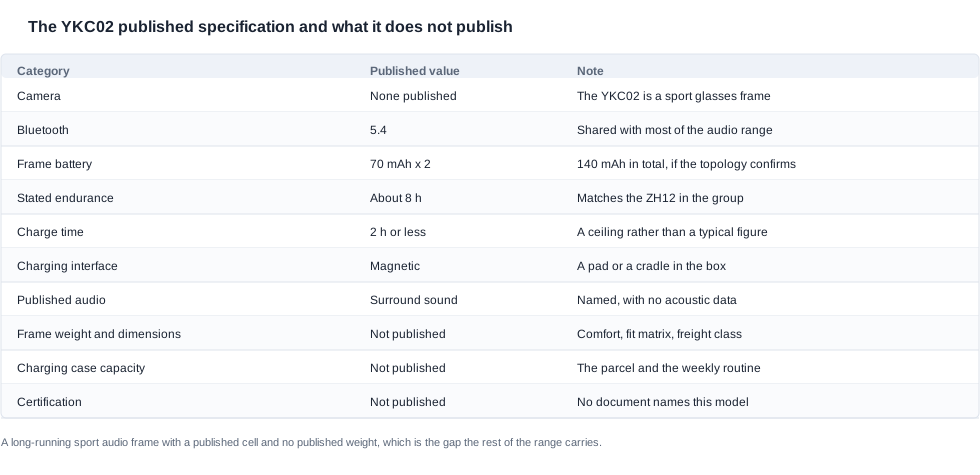
YKC02 published rows, field by field
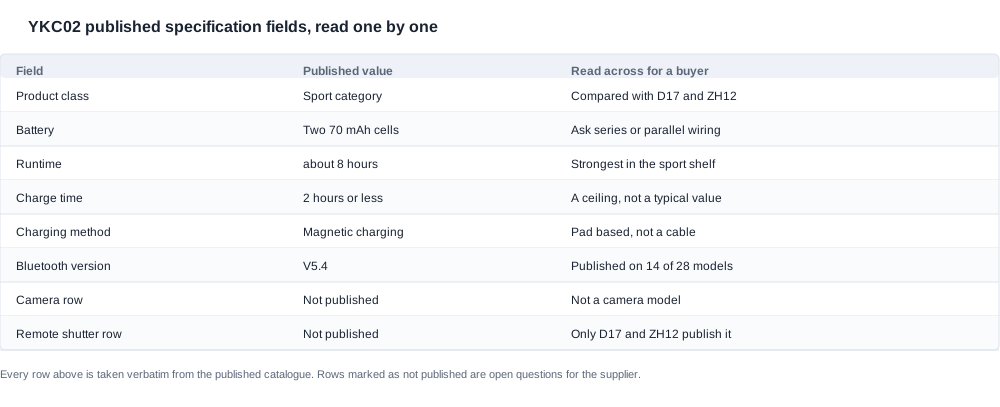
The published record for the YKC02 contains the following rows. We will reproduce them in the order a buyer reads them, and we will add a read-across note to each one so that the number is usable rather than merely transcribed.
| Field | Published value | Read-across for a buyer |
|---|---|---|
| Product class | Sport category | Compared against D17 and ZH12, not the audio tier |
| Battery | 70 mAh x 2 (two 70 mAh cells) | Dual-cell pack; ask series or parallel |
| Runtime | about 8 hours | Matches the ZH12; ahead of the D17's about 7 hours |
| Charge time | 2 hours or less | Ceiling figure, not a typical measured value |
| Charging method | Magnetic | Pad-based; no USB-C row published for this model |
| Bluetooth version | V5.4 | Documented, and comparable to D17 and ZH12 |
| Camera | No row published | Do not market this model as a camera model |
| Remote control shutter | No row published | Not available on the published sheet |
| Sound descriptor | Surround sound | Listed with a long-endurance row, no acoustic data |
Field 1 — Battery. The published row is 70 mAh x 2, which means two 70 mAh cells rather than one 140 mAh cell. We will draw attention to the distinction because it is not cosmetic. A dual-cell pack changes the shipping paperwork, may change how the pack is declared for air freight, and changes what a warranty claim looks like if one cell fails. Buyers who need a single combined capacity figure for a customs declaration cannot derive it from the published sheet, because the topology is not stated. The correct move is to ask, and to record the answer in the quotation rather than in an email thread.
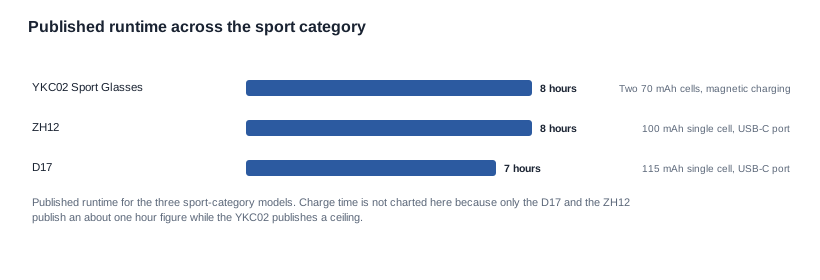
Field 2 — Runtime. The published runtime is about 8 hours. Across the three sport models that is the highest figure published, level with the ZH12's about 8 hours and ahead of the D17's about 7 hours. We will note that no measurement condition is published — no screen state, no volume level, no ambient description — so the figure is best treated as a catalogue position. It is strong enough to support a working-day claim in your listing, and not strong enough to support a test-backed endurance claim. If your channel sells on endurance comparisons, the general battery life comparison guide explains the method questions that decide whether two runtime figures can legitimately be set against each other.
Field 3 — Charge time. The published figure is 2 hours or less. This is a ceiling, and we will keep saying so because it is the row most often misread. Across the whole 28-model catalogue, 26 models publish a two-hours-or-less ceiling and only the D17 and the ZH12 publish an about-one-hour figure. A ceiling shared by almost the entire catalogue is a maximum commitment, not a typical value, and it should not be used to argue that this model charges faster or slower than a sibling. We will also note that this row is where the D17 and the ZH12 look better on paper, which is a real difference in published specificity even though the real-world gap may be much smaller.
Field 4 — Charging method. The YKC02 publishes magnetic charging. This is the row that has the most operational consequences downstream, because a magnetic pad is an accessory decision rather than a cable decision. If your current stock is USB-C cables and wall adapters, the YKC02 requires new pads and a different in-box story, and pads are the kind of item that gets ordered late and then becomes a fulfilment bottleneck. The charging options article for this model covers the accessory and packaging implications in more depth, including the spare-pad question that comes up when a single pad leaves your stock.
Field 5 — Bluetooth version. The published value is V5.4. This is one of the fourteen models in the catalogue that publish a Bluetooth version at all — the 11 camera models, the A05, the A06, and the bone conduction model all leave it blank. So the YKC02's V5.4 is documented rather than assumed, and it sits alongside the same V5.4 published for the D17 and the ZH12. We will treat any listing that claims a newer radio for this model as a claim to verify, because the published sheet supports V5.4 and nothing beyond it.
Field 6 — Feature row. This is the row buyers most often expect to find and most often get wrong. The YKC02 publishes no camera row, so it has no camera resolution, no image sensor, and no photography specification of any kind. It publishes no remote control shutter — that feature is published only on the D17 and the ZH12, and the D17 specifications article sets out that bundle in full. What it does publish is a sound descriptor: the catalogue lists surround sound for this model alongside a long-endurance row. That is a name rather than a measurement. The catalogue publishes no acoustic data, no driver size and no output figure behind any sound descriptor, for this model or any other, so a listing can repeat the name and nothing more. We will not describe the YKC02 as an AI camera glasses model, because the camera models in this catalogue are a different block with their own conventions, including published resolutions of 8 MP on eight models and 13 MP on the L2 Utral, the L1 Pro and the S7.
One practical note on how to read this sheet. Every value in it is a ceiling, a maximum, or a bare figure with no test condition attached, which means the sheet tells you what the vendor is willing to claim and nothing about the variance between units. We will quote these values verbatim in your own product copy, and we will avoid attaching adjectives like "fast", "long lasting", or "lightweight" to them, because none of those adjectives is supported by a published measurement. If your channel needs a claim stronger than the sheet supports, the route to it is a supplier document — a test report, a measured charge curve, a body weight figure — and never a paraphrase.
The one thing we will say positively about the feature row is that its emptiness is consistent across the whole catalogue. There is no capacitive-touch row anywhere and no translation row anywhere, which means those two features sit outside the published dataset for every product, not just this one. That distinction matters when a channel contact tells you a competitor's model has touch control: check whether that competitor's catalogue row publishes it, and if it does not, you are being asked to compete against a claim rather than against a specification.
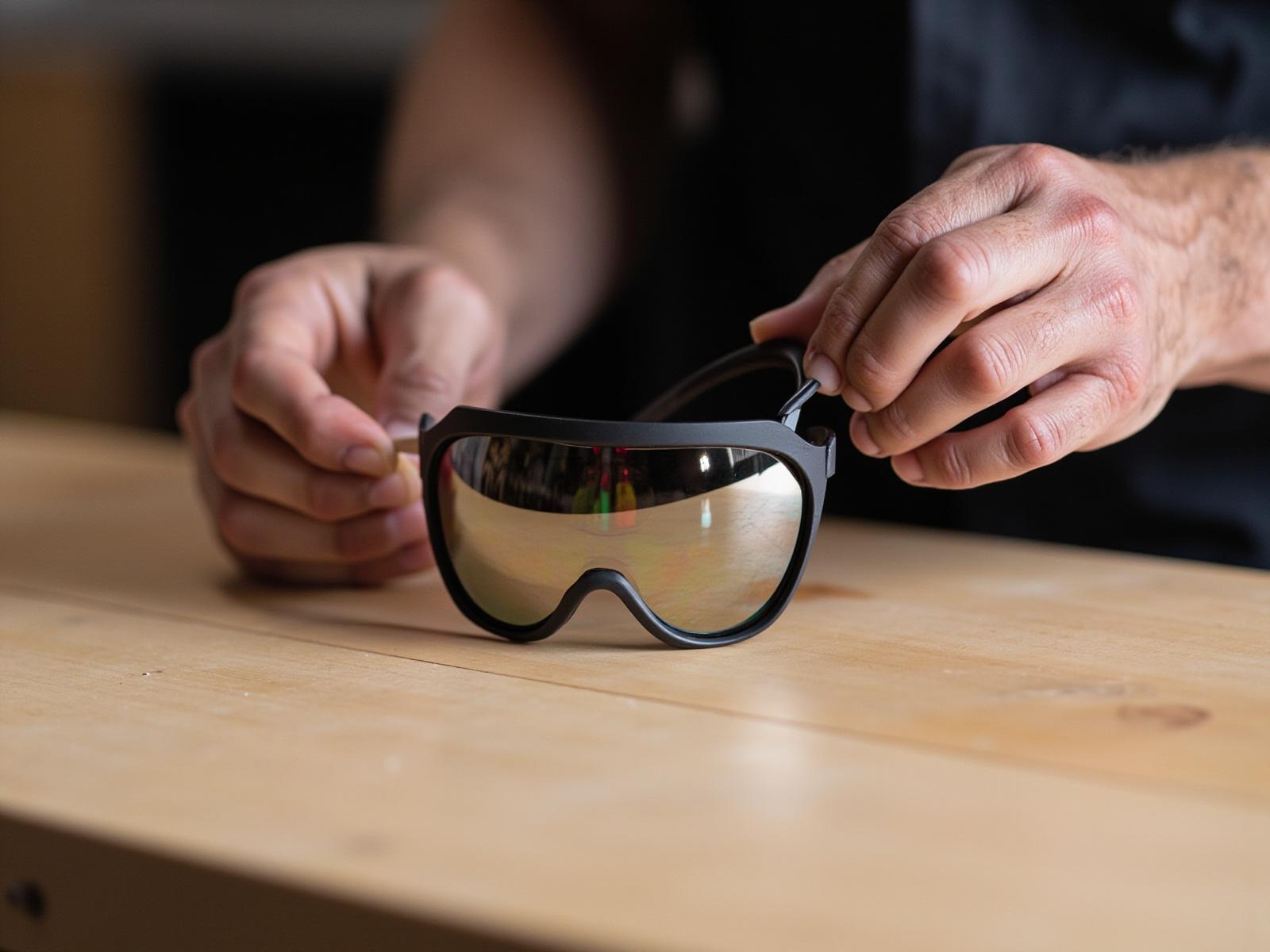
What the YKC02 does not publish
The absent rows are not a weakness of the article; they are the substance of it. A procurement decision made without them is a decision made on assumptions. We will list them as a table with the exact question to put to the supplier, so the list can be sent as-is.
| Not published for the YKC02 | Why it matters commercially | What to ask the supplier |
|---|---|---|
| Camera resolution | Prevents camera-model positioning and spec claims | Confirm whether any sensor exists at all |
| Frame weight | Drives comfort claims and shipping category | Ask for the weight of the glasses body alone |
| Dimensions | Drives case design and fit guidance | Ask for lens frame and temple measurements |
| Lens material | Affects durability and optical claims | Ask for the lens specification sheet |
| Colour options | Affects range planning and listing count | Ask for the available colour count and codes |
| Ingress or IP rating | No defensible water-resistance claim can be written | Ask for a test report or state the rating |
| Certification status | Market access and liability exposure | Ask for CE, FCC, RoHS, RED reports as documents |
| Price | No budget anchor before a quotation | Request a quotation at your target volume |
| Minimum order quantity | Determines whether a launch is viable | Ask for the MOQ for this exact configuration |
| Lead time | Determines the whole channel schedule | Ask for lead time in days, standard and peak |
| Sample policy | Determines how you validate before scaling | Ask for sample cost, timing, and refund terms |
| Warranty | Determines after-sale cost and channel confidence | Ask for the warranty period and what it covers |
| Battery capacity topology | Affects freight documentation | Ask whether the two cells are series or parallel |
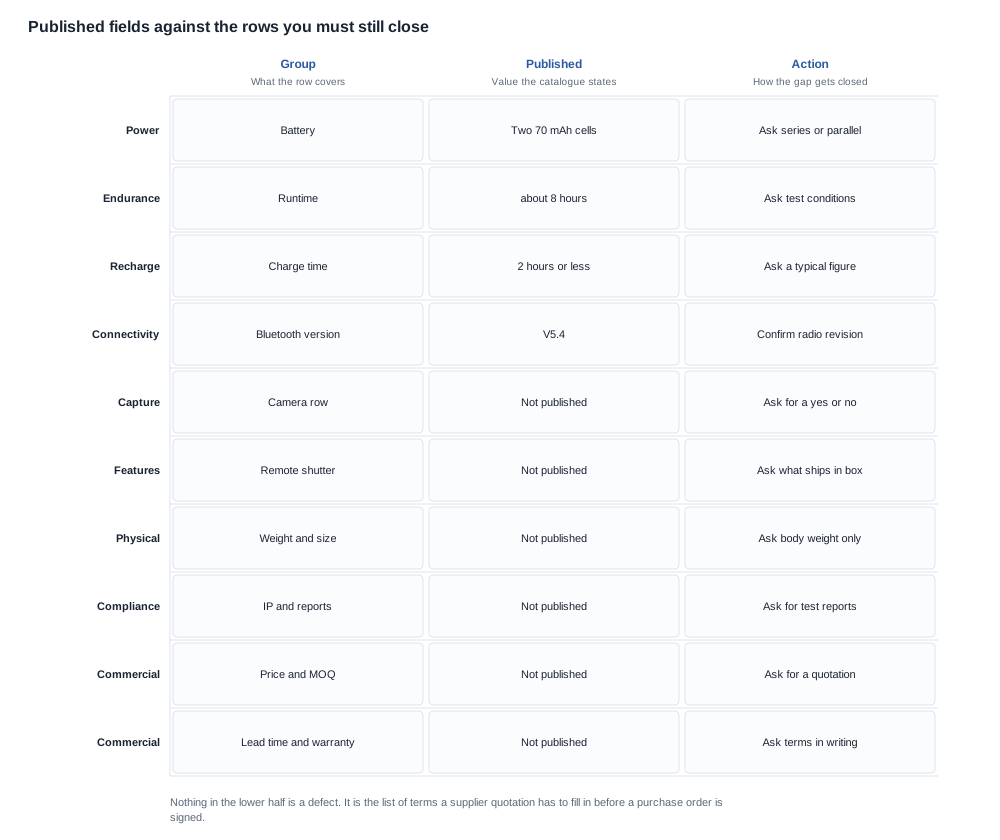
On certification specifically, we will be blunt. The catalogue body contains no CE, FCC, RoHS, RED, or EN 18031 reference for this model or for any other model. Absence in a catalogue is not evidence that the certifications do not exist — plenty of capable factories hold reports they never publish. But absence does mean you cannot cite one, and you should not let a sales conversation turn that absence into a verbal assurance that you then repeat in your own listing. The correct handling is to ask for the report, tie it to the exact model number and the exact battery configuration you are ordering, confirm the issuing body, and check whether it covers your destination market. The V06 certification status article shows what a documented evidence trail looks like in practice.
On weight and dimensions, there is a catalogue-wide caveat worth stating once. Across all 28 models, the only public weight figure is the MT6 at 158 grams, measured for the glasses body and explicitly excluding its 1200 mAh folding case. Every other model is silent, the YKC02 included. If your channel needs a weight for a shipping calculator or a comfort claim, it has to come from a supplier, and it should be taken as the glasses body rather than as the packed unit, because the two numbers differ by however much the case weighs. The shipping weight article for camera glasses works through this distinction with a case in the comparison, and it is worth reading if your freight model is built on published weights.
On price, MOQ, lead time, samples, packaging, spares, warranty, and incoterms, none of these appear in the catalogue for any model. That is normal for a manufacturer catalogue, and it means the commercial frame of the YKC02 is entirely a negotiation artefact. We will recommend treating the unit price as the most negotiable term in the deal and treating the certification evidence and the packing list as the least negotiable, because the first changes your margin and the second changes your liability.
Where the YKC02 sits in the sport category
Three models share the sport shelf: the YKC02, the D17, and the ZH12. We will compare them field by field, because a spec sheet is only meaningful in context and because the YKC02's rows read as advantages only when you can see what the siblings publish in the same columns.
| Model | Cells | Runtime | Charge time | Charging | Bluetooth | Published extra |
|---|---|---|---|---|---|---|
| YKC02 Sport Glasses | 70 mAh x 2 | about 8 hours | 2 hours or less | Magnetic | V5.4 | Surround sound; no camera row, no remote control |
| D17 | 115 mAh single | about 7 hours | about one hour | USB-C | V5.4 | Remote control photo plus surround sound |
| ZH12 | 100 mAh single | about 8 hours | about one hour | USB-C | V5.4 | Remote control photo plus stereo surround sound |
Against the wider range, two more models sit physically close to the YKC02: the S7 and the V06, both labelled AI Sport Photography Glasses. Both publish 260 mAh, a 5 to 8 hour runtime, a two-hours-or-less charge ceiling, and magnetic charging. The S7 publishes 13 MP, the V06 publishes 8 MP and four colour options. Both publish an IP54 rating, and they are the only two models in the catalogue that do. So the camera-adjacent models publish a stronger battery figure and a stronger ingress position than the YKC02 does, while the YKC02 publishes nothing on either of those rows beyond its own cell count and runtime. The comparison between the YKC02 and the S7 on physical form factor is set out separately, and it is worth reading if your channel is sport-led.
The audio tier is a separate eight-model block — K02 and D12, K01 and G07, D11 and LC-105-1, and LC-105-2, and YK12. The YKC02 does not belong to it and does not sit at its margin, even though its own catalogue page names a sound descriptor. We will say this in plain terms because grouping errors are common in resale channels: the YKC02 is a sport model, and the D12 best-for discussion applies to a different product entirely. If you want an audio-tier read, that is the relevant page; if you want a sport-shelf read, the YKC02 best-for article covers the fit from the buyer side.
It is worth being precise about that last comparison, because the camera-adjacent models look stronger on paper and a buyer can be misled either way. The S7 and the V06 publish a 260 mAh cell against the YKC02's two 70 mAh cells, but neither of them publishes a runtime figure better than 5 to 8 hours, which brackets the YKC02's about 8 hours rather than beating it. What the camera models do publish that the YKC02 does not is a resolution, a colour count on the V06, and an ingress rating. So the trade is not endurance against endurance; it is capture and ingress against a simpler product that publishes a single runtime figure and no charging-case row. Which side of that trade you should take depends on your channel, not on the numbers.
YKC02 questions a buyer should put in writing
We will finish with the actionable list, because the point of a field-by-field read is that it tells you exactly which questions are still open.
-
Classification. Ask for written confirmation that the YKC02 is a sport-category model and that it is not presented as part of the eight-model audio tier in your packaging, your listing, and the supplier's own product feed.
-
Cell topology and combined capacity. Ask whether the two 70 mAh cells are series or parallel, what the combined pack capacity is, and whether each cell has its own protection circuit. Get the answer in a form you can paste into a shipping declaration.
-
Measured charge curve. Ask for typical and worst-case full-charge time from a flat pack at room temperature, and for partial-charge behaviour on the magnetic pad. The published ceiling of two hours or less does not answer this.
-
Accessory and packaging commitment. Ask what ships in the box — pad, cable, case, spare pads, manual — and get a packing list tied to the purchase order. The charging options article lists the accessory decisions that usually get missed.
-
Remote control and capture hardware. Ask whether any remote, trigger, or capture function exists in the hardware and whether it is included or optional. The published sheet has no row for it.
-
Camera confirmation. Ask directly whether the unit contains a camera or image sensor. The catalogue has no camera row for this model, and you need a yes or no for your listing copy.
-
Weight, dimensions, lens, colours. Ask for the glasses body weight, the frame and temple dimensions, the lens specification, and the colour codes. None of these are published, and all of them are needed for a product page.
-
Ingress rating. Ask for a test report or an explicit statement that no rating is claimed. Only the V06 and the S7 publish IP54, and a sports product without a rating cannot carry a water-resistance claim.
-
Certification evidence. Ask for CE, FCC, RoHS, and RED test reports as documents covering this exact model number and battery configuration, with the issuing body and validity dates.
-
Commercial terms. Ask for the quotation at your target volume, the minimum order quantity, the lead time in days for standard and peak periods, tooling or customisation charges, packaging format and carton dimensions, incoterms options, samples availability and cost, pilot order minimums, warranty terms, and spares policy.
-
OEM readiness. If you intend to put your own brand on the box, ask which platform and configuration is ready for that treatment. The OEM-ready platforms article separates the models that are set up for private labelling from the ones that are not.
-
Price positioning against the D17. If the unit economics are the deciding factor, ask for the D17 quotation on the same terms so the two are comparable. The D17 versus YKC02 price positioning article sets out how to make that comparison fair rather than misleading.
-
Documented review. Send the buyer review checklist for this model as the response format, so every open item above gets a written answer attached to the file rather than living in an email thread.
We will suggest one working sequence for the negotiation, because order matters. Send the technical questions first — cell topology, charge curve, camera confirmation, weight, ingress, certification — because a supplier who answers those accurately has told you whether the model is buyable at all. Only once that answer is clean should you move to the commercial frame: price, minimum order quantity, lead time, samples, tooling, packaging, warranty, and incoterms. We will also suggest you ask for samples before the pilot order rather than after it, because a sample settles the weight, the fit, the charging behaviour, and the packaging questions in one shipment, and it does so at a fraction of the cost of discovering the same problems inside a bulk order.
The value-for-money read for this model is worth reading alongside this one because it deals with the question your customer will actually ask: what they get for what they pay. The limitations article covers the constraints already visible in the published rows, and the common constraints that apply across the range are set out on the sport smart glasses pillar page.
We will state the summary plainly. The YKC02's published specification set is short, internally consistent, and genuinely competitive on runtime and charging convenience. Its unpublished set is long, and every item on it is a question rather than a defect. We will separate the two categories deliberately: measurements, packaging, and commercial terms are closable through a normal supplier negotiation, while certification evidence and ingress status are closable only if the documents actually exist. Nothing on the published sheet tells you whether the YKC02 is the right product for your channel — it tells you exactly what you would be committing to, and exactly which thirteen things you still need a supplier to answer before you place the purchase order.


