

The most expensive misunderstanding in this category is the belief that certification is a property of a product. It is not. For a children's wearable it is a determination made for a specific destination market and a specific age band, against a specific version of the finished product, by the party that carries the obligation in that market. A buyer who treats it as a product attribute will look for a mark on a spec sheet, find nothing there, and then discover, later than they should, that the document they needed was a determination rather than a certificate and had to be commissioned from a party they had not yet appointed.
This article is written for the buyer who has to assemble that file. It sets out what our own catalogue does and does not contain on the subject, walks through the documents to request and who should issue each one, explains the difference between the instruments a buyer will encounter, and finishes with the record that has to survive a review. It is not a statement of what our products comply with, because our documentation does not contain such a statement and inventing one would be worse than useless.
The boundary on health claims is the same here as it is everywhere, and it is set out in full in the age suitability piece rather than restated in a file article. Nothing in a compliance file should be read as implying otherwise. The kids safety requirements piece sets out the framework side of the same question, and the A05 certification status piece covers the position for one designation.
Kids smart glasses certification for kids products: the file depends on the market and the band
Three variables decide the size of the file, and none of them is the model.
The destination market decides which frameworks are in scope at all. A product entering the European Union, one entering the United States, and one entering a third market are three separate compliance problems with three separate document sets, and a file prepared for one of them is not evidence for the other two.
The intended age band decides which classification the product falls into within a market, and that classification is what determines which requirements apply. The frameworks a compliance party weighs for a children's product differ between the European Union and the United States, and in each of them a different pair of rules tends to be raised first. Which of these applies to a given unit, at a given band, in a given market is not something a supplier's product page can state, because it is a classification decision made against the finished item.
The version of the finished product decides whether an existing document still describes the thing being shipped. A change to the lens material, to the cell, to the radio module, to the frame material or to the detection firmware can invalidate a document that was expensive to obtain, and a file with no change-control provision around it will not survive the second year of the programme.
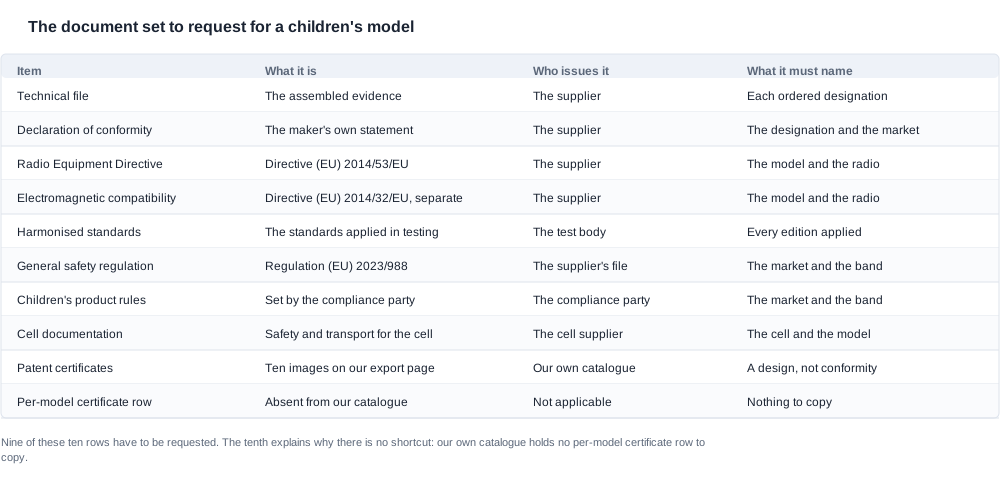
Read the table as a request list rather than as a description. Nine of the ten rows are things to ask for, and each one has to arrive naming the ordered designation and the market it was prepared for. The tenth row is the reason the request list is necessary: our own catalogue does not contain a per-model certificate row that a buyer could simply copy into a file.
What a buyer should be able to do at the end of the request
The purpose of collecting these documents is not to have a folder. It is to be able to answer a reviewer's question without a supplier, a test body or a lawyer in the room. That means the file has to make three things visible without further work: which designation is covered, which market and band it was prepared for, and which version of every referenced standard it was prepared against.
A buyer who cannot produce those three things from the file has a collection of papers rather than a file, and a retailer who asks a follow-up question will find out.

What our export certification page actually holds, and what a patent proves
Our catalogue carries one page of certification-type content, and it is worth being precise about what that page contains, because the way it is usually described leads buyers to draw the wrong conclusion.
The page is made of images. There are ten of them. Eight are appearance-design patents and two are utility-model patents, and they are the only certification-adjacent material the catalogue contains.
What a patent establishes is that a design is new. That is the entire content of a patent, and it is a statement about novelty rather than about performance. A patent says nothing about how a product behaves, nothing about how it was tested, nothing about which frameworks it satisfies, and nothing about which market it may be sold into. This is worth being clear about because a page of ten certificates is visually impressive, and a procurement manager who sees it can easily record a conclusion that the documentation does not support.
Three further points about our own position, stated as plainly as we can state them.
There is no per-model certification row anywhere in the catalogue. Not one of the three children's models has a line of its own, and neither has any other designation in the range. There is no line that maps a designation to a certificate number, an issuing body or a validity date, and there is no pending or provisional entry either.
No conformity marking is named in the catalogue text. Our documentation does not reference any European, United States or international conformity marking scheme, and it does not state that any model has been assessed against one. A buyer who needs that position has to obtain it in writing from the manufacturer, and the wording used in the answer matters as much as the answer.
The conformity documentation for any model has to be requested from the supplier. So does the manufacturer's own declaration for the market in question. Neither is a document we can forward, because we do not hold them, and a buyer who has been told otherwise will discover it at the point of a customs query or a retailer review rather than at the point of a document request.
The OEM export documentation piece covers what a manufacturer-provided file normally contains, and the kids export considerations piece covers the same question from the shipping side.

The document set to request, and who should issue each one
The sequence below is the working order. The first two steps belong to the buyer and involve no supplier lead time, which is exactly why they should not be left until the supplier is engaged.

The requests themselves break into groups with different characteristics, and a buyer should ask for them in those groups rather than as one undifferentiated list.
- The product's own documentation. The technical file and the manufacturer's declaration for each market in scope, each naming the designation and the market. These are the two documents a reviewer will ask for first, and they are the two that take the longest to assemble.
- The radio and electromagnetic compatibility work. The Radio Equipment Directive (EU) 2014/53/EU governs the radio side, and the electromagnetic compatibility framework (EU) 2014/32/EU is a separate instrument with a separate scope. A file that covers the radio does not cover the compatibility side, and a supplier who answers both questions with one document has not answered either. For the A07, the published radio generation gives the buyer a reference point; the A05 and the A06 publish no radio version, so nothing about their radio can be asserted.
- The test reports behind those frameworks, with the standards and the editions that were applied. This is where the harmonised standards appear, and the distinction matters, because a harmonised standard is a method that a test body applies rather than a certificate that anyone holds. The radio and compatibility standards most often encountered in this category are the EN 301 489 series and EN 300 328. A buyer who has been handed a list of these has been handed the method, and still needs the report.
- The general safety framework. The General Product Safety Regulation, (EU) 2023/988, applies to consumer products placed on the European Union market, and it is a framework to be demonstrated rather than a certificate to be produced. The demonstration appears in the technical file.
- The children's product determination, per market and per age band, from the buyer's own compliance party. This is the item that cannot be bought from a supplier, because it is the buyer's own obligation, and it is the item most often left until a launch is imminent.
- The cell documentation and the transport reference for the cell as fitted in the model. Our catalogue publishes a cell capacity for all three children's models and a charging method, and it publishes no safety report, no transport test reference and no cell specification sheet. The battery transport compliance checklist covers the transport side of this in more depth.
- The change-control commitment, in the form of an obligation to notify the buyer before any safety-relevant component, firmware default, lens material or frame material is altered.
A parent-facing prompt raises a separate question about data, and the privacy questions piece takes that one; the age suitability piece covers the band itself.

How a directive, a harmonised standard and a general safety regulation differ
Buyers routinely collapse four different things into the single word "certificate", and then cannot tell whether a document they have been given is the right one. The matrix below separates them, and the practical value of doing so is that a missing document becomes visible as a missing document rather than as a vague worry.
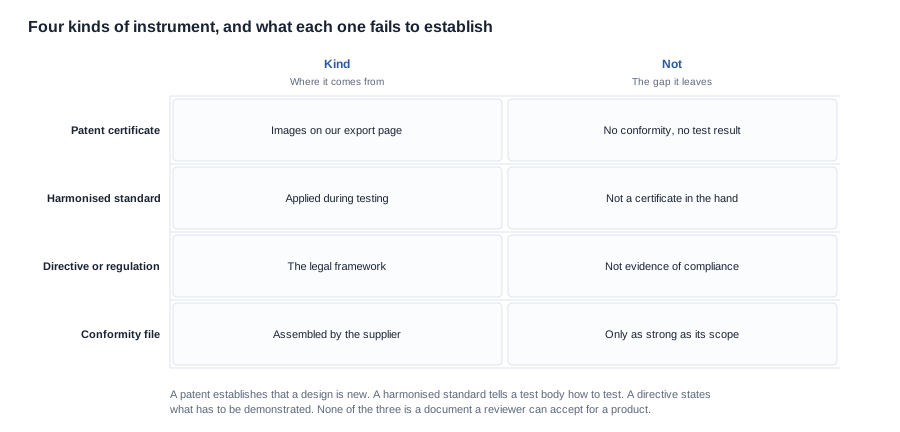
A directive is a statement of what has to be demonstrated. The Radio Equipment Directive (EU) 2014/53/EU sets out what a radio product must satisfy and what the manufacturer must do about it. It produces paperwork on the manufacturer's side and no physical item on the buyer's side.
A regulation is a general rule, and it does not hand out certificates either. The General Product Safety Regulation, (EU) 2023/988, operates on the product rather than on a document, and compliance with it is demonstrated in the technical file rather than certified by a third party.
A harmonised standard is a method. The EN 301 489 series and EN 300 328 tell a test body how to carry out the radio and the compatibility evaluations. A test report that lists them is telling the buyer what was done. The report is the evidence; the standard is the recipe, and the recipe alone is not evidence of anything.
A patent is a novelty claim, and it is the one instrument here that is attached to a physical certificate. Ours are, in the catalogue, ten images on a single page.
What a reviewer can accept for a product, in the end, is a technical file and a declaration, assembled by the manufacturer, referring to the designation and the market. Everything else in the stack is either the legal basis for that file or the method behind part of it.
The record a reviewer has to be able to follow
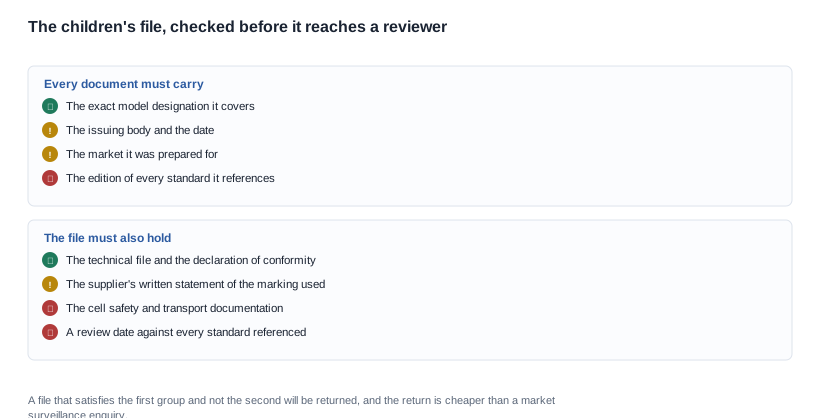
The checklist has two halves because a file can fail either way. The upper half is a property of each document individually, and it is the half that is cheap to check and expensive to discover late. The lower half is a property of the file as an assembly, and it is the half that a buyer's own due diligence has to cover, because no supplier will assemble it for you.
How to send the request so it comes back complete
A request for this file is usually answered in three exchanges instead of one, and the reason is almost always structural rather than a matter of cooperation. The supplier is asked for a category of thing rather than for a list of named things, so the reply is a category of documents, and the buyer then has to evaluate whether what arrived is what was needed. A list prevents that.
The form of the request that works is short and specific: the markets, the designations, the age band, and the ten rows of the table above with the issuing body and the naming requirement written next to each. Add the question about the shared file for the two protective designations, because it changes the size of the whole request. Add the date by which the review team needs the file, because a date moves a supplier's prioritisation in a way that a polite request does not.
Four questions to ask in the same message, because the answers change the schedule rather than just the paperwork.
- Which document will be the primary evidence for a reviewer in each market, and who issues it?
- Which of the ten items is the longest lead item, and does its lead time depend on the market?
- Does the supplier's file for the audio model already include the radio and the compatibility work, given that a radio version is published for it?
- Is the transport reference for the fitted cell available in the same file, or is it issued separately?
The due diligence here is not in the requesting, it is in the comparing. When a reply arrives, compare it against the ten rows one at a time and mark each as complete, partial or absent, and treat a partial as absent. A file that is complete on eight rows and partial on two is a file that will be returned by a reviewer, and the cost of the second exchange is far lower than the cost of the shipment being held.
The five checks a procurement team should run on the file
- Does every document name the designation, and does the designation match what was ordered? A document that says "smart glasses" rather than a model is not a document for your product, and this is the single most common reason a file is returned.
- Does every document state the market it was prepared for? A file prepared for one market is not evidence for another, and a buyer who assumes otherwise discovers it at the border.
- Is every referenced standard recorded with its edition? Frameworks move, and a file built against a superseded edition is a retest waiting to happen, which is far cheaper to find now than in the second year of a programme.
- Does the file include the cell documentation and the transport reference for the cell as fitted? This is the item most often assumed to be covered because the cell capacity is published, and a cell capacity is not a safety report.
- Is there a review date against each standard, and a notification obligation on the supplier? A file with no review mechanism expires quietly, and the buyer discovers the expiry when a reviewer asks for a current edition.
The questions worth asking before you order are these: which document is expected to be the primary evidence for a reviewer in the destination market; which of the ten items above is the longest lead item; what the supplier's position is on the same questions for the audio model, where a radio version is published and the radio work is therefore already in scope; and whether the two protective designations can share a file, since their published rows are identical and a shared file is the cheapest outcome available. The buying guide covers how the three models sit against each other, and the institutional requirements piece covers what a school purchaser asks for.
A file assembled in practice
The scenario is constructed to show the order of work rather than to describe a customer.
A distributor is asked to place a children's line into two markets in a single season, with a retailer's technical team holding up the first shipment until it has seen a file. The distributor's first step is not to request documents; it is to have its own compliance party determine the requirements for each market and for the intended band, because that determination decides which of the ten items in the request list are needed at all.
Two of the items turn out not to apply in the way the distributor assumed, and one of them applies twice: the audio model carries a published radio generation, so the radio work is already scoped, while the two protective designations publish no radio version and need the position confirmed in writing before anything is ordered. The distributor also learns that the two protective designations may be covered by a single file, which removes one item from the schedule.
The request goes out as a single grouped list. The reply comes back with the file, the reports and the standards applied, and the distributor's own check finds two documents that name the family rather than the designation. Those two are returned. The cell documentation is present but the transport reference is missing, and that is the item that goes to the top of the follow-up list because it is the one with a lead time attached.
The file is complete after a second exchange, and the retailer's technical team accepts it because every document names a designation, a market and a date, and the review date is already on the cover sheet. The decisive actions were the compliance determination first, the grouped request, and the check on the returned documents. None of them involved a document that our catalogue could have supplied.
What our documentation holds on this subject, and what it does not
It holds one page of images: ten patent certificates, of which eight are appearance-design patents and two are utility-model patents. It holds no per-model certificate row, no listing of a conformity marking, no reference to a standards edition, and no cell safety or transport reference for any of the three children's models. The product rows themselves are published: the cell, the rated endurance, the bound on the charge time, the charging method, the radio version on the audio model, and the feature rows carried by the two protective designations.
We do not publish a compliance statement for these models, and we will not write one, because the statement would have to be a determination that belongs to the party carrying the obligation in each market. What we can do is tell a buyer which items in the request list are ours to answer, which are the supplier's, and which are the compliance party's. Give us the two markets, the intended age band and the designations under consideration, and we will mark the ten rows against those three answers so the request goes out in one round rather than three.


