
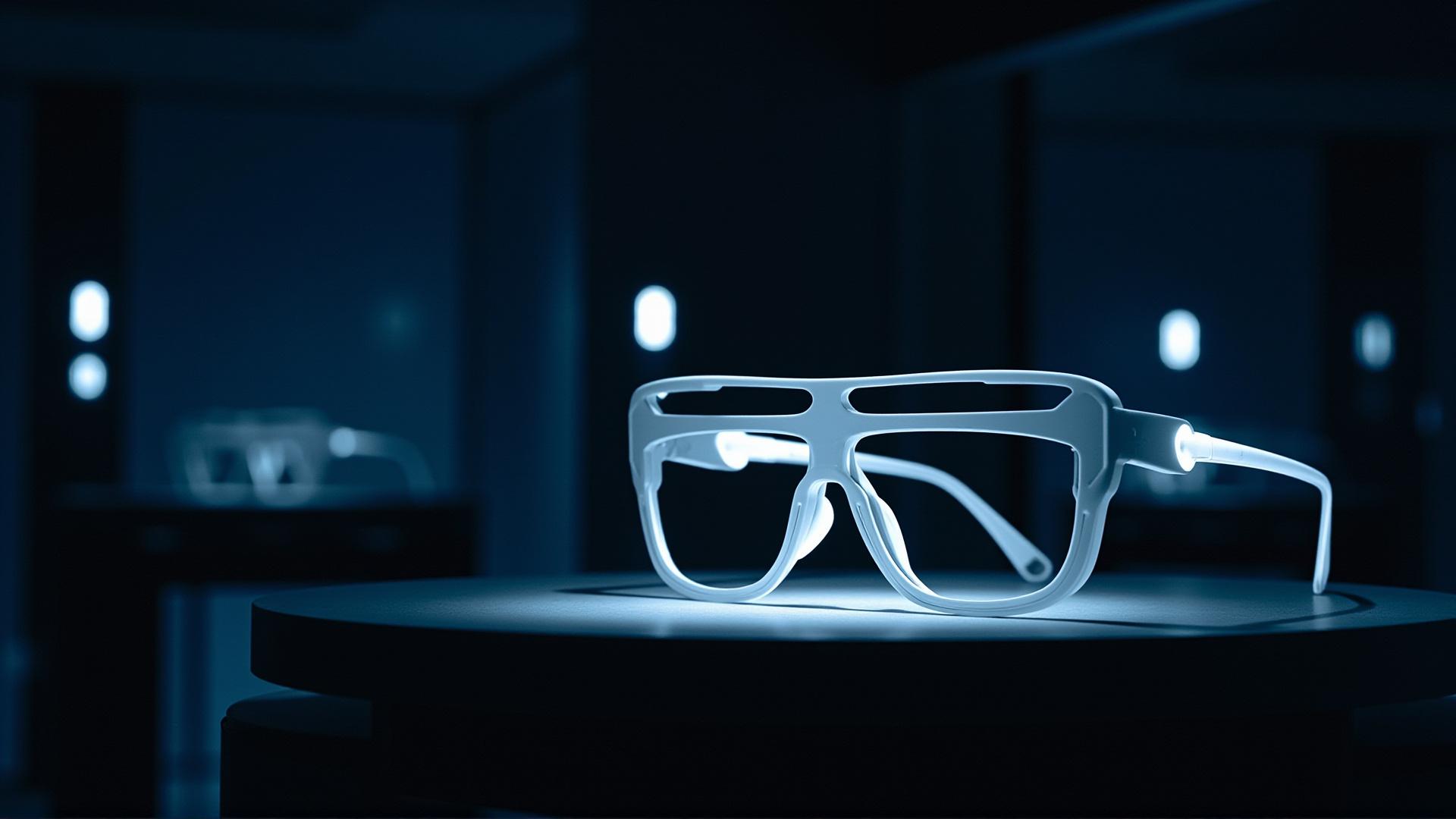
A form factor comparison between the A05 and the A07 runs into a wall before it starts: neither model publishes its frame dimensions and neither publishes its weight, so the visible differences cannot be described from the documentation at all. What the documentation does support is a comparison of what each product is built to do, and the hardware each one has to fit inside a temple. That comparison is more useful to a buyer than an appearance comparison, because the form factor follows the function rather than the other way round.
The short version is that the A05 carries sensing hardware and the A07 carries audio hardware, and the temple space those two jobs need is the reason the two products are shaped differently even though neither shape is documented. A buyer who is choosing on form factor is really choosing on function, and the function is documented; the millimetres are not.
This article works through what each frame has to accommodate, why the published numbers hide the physical difference between them, how to size a children's product when no dimensions are published, and the four physical questions that only a sample can answer.
A05 form factor: the temple budget decides the frame
Internal volume in a children's frame is the scarcest resource in the whole product, and every functional decision spends it. The temple has to carry the cell and its protection, the radio and its antenna, the sensing electronics or the speaker and its driver, the charging contacts, the hinge, the structure that keeps all of it in alignment, and whatever padding sits between that structure and a child's head. There is no room left over for decoration, which is why children's frames in this category tend to read as utilitarian whatever the designer intended.
That is why the form factor of a smart glasses product is not a styling decision made after the engineering. It is the visible consequence of a bill of materials and a target age band, and it can be read backwards from the feature set with reasonable accuracy even when the dimensions themselves are withheld.
Two published facts frame the comparison. The A05 carries a 40 mAh cell, which is the smallest cell published anywhere in our catalogue. And the A07 carries a 70 mAh cell, which is seventy-five per cent larger. Those two numbers are not styling; they are a direct statement about how much internal volume each frame was designed to accommodate, because a cell does not compress.
There is a second published fact that constrains the reading. Neither the A05 nor the A07 publishes an ingress protection rating. Across our whole catalogue, only two models carry one. That matters for a form factor comparison in a way that a specification comparison would miss: a frame without a published rating tells you nothing about the sealing of the temple cavity, and the temple cavity is where the sensing electronics live.
The supply chain consequence is worth stating at this point too, because it is the reason the form factor question is a procurement question rather than a design question. A children's frame is bought on a schedule, and the schedule is set by how long the template, the tooling and the first material lead time take, none of which is published for either model. When you are comparing two frames that publish identical endurance figures and no dimensions, the physical characteristics you would normally use to differentiate them are the ones that are withheld, and the only remaining differentiator is the one you can act on: which of the two products the feature set actually suits. That is a shorter decision than a form factor comparison looks, and it is the right one to make first.
The reading a buyer can make without a drawing
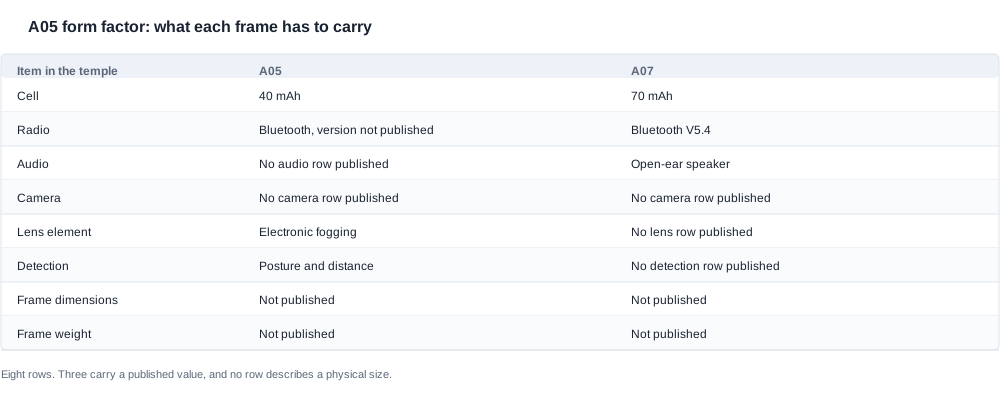
Take the feature set of each model and ask what has to be inside the temple. For the A05: a lens-type electronic fogging element, posture detection, distance detection, a 40 mAh cell, a radio whose version is not published, and the charging contacts for a magnetic interface. For the A07: a 70 mAh cell, a Bluetooth V5.4 radio, an open-ear speaker, the charging contacts, and no camera, no fogging element and no detection rows at all.
The A05 is therefore the frame with more discrete subsystems to accommodate and the smaller cell. The A07 is the frame with one large subsystem, a speaker, and room for a bigger cell. Those are two different shapes, and the fact that the catalogue cannot describe them does not make them the same shape.
Why this is not a cosmetic comparison for a buyer
Form factor in a children's product carries three commercial consequences that are easy to lose when the discussion is about appearance.
The first is the sizing and the age band. A frame with more subsystems in the temple tends to have a bulkier temple section, and a bulkier temple on a small head is a sizing problem before it is a styling problem. Since neither model publishes dimensions, this cannot be checked on paper at all, and it has to be checked on a sample.
The second is the returns rate. A child's head grows, and the frame that suits a six-year-old in the autumn may not suit the same child in the spring. Neither model publishes a detachable temple specification, a temple adjustment range or a replacement-parts policy, so the replacement question is a commercial term you have to obtain rather than a feature you can read from a sheet.
The third is the freight and the packaging. A bulkier frame changes the carton count per unit, the pallet configuration and the volumetric weight, which moves landed cost in a way that a unit price comparison does not show.

What each frame has to accommodate inside a temple
The table below lists the published rows that bear on what each product physically contains. Read it as an inventory of subsystems rather than as a comparison chart, because the value of the table is that it tells you what is in the temple, and therefore how the temple has to be built.
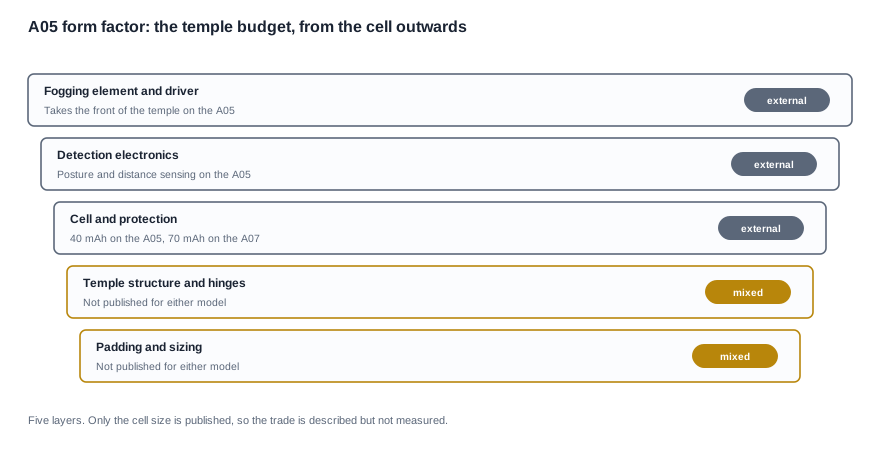
The A05's fogging element is the first constraint. A lens-type electronic fogging element is not a passive film; it is an active assembly with a driver circuit and a power supply, and the catalogue's own illustration contrasts a clear lens against a fogged one, which confirms the element changes state. An element that changes state needs somewhere to put its electronics, and in a temple that means forward of the hinge.
The detection electronics are the second constraint. Posture detection and viewing-distance detection need sensors, a signal path and somewhere to put both. The published rows tell you the capability exists and tell you nothing about the sensing range, the thresholds or the power draw, and that silence is itself informative: it means the detection behaviour cannot be inferred from the shape of the frame either.
The cell is the third constraint and the only one with a number. 40 mAh on the A05. The smallest published cell in the catalogue, in a frame that also carries the two subsystems above. The A07's 70 mAh sits in a frame carrying one speaker and a radio.
The radio differs in a way that is documented and a way that is not. The A07 publishes Bluetooth V5.4. The A05 publishes no radio version at all, although a low-power Bluetooth connection exists at the family level. That is a paperwork difference as much as a hardware one: a brand using the A07 can write a compatibility statement from the published row, and a brand using the A05 cannot.
The charging interface is identical. Both models charge magnetically. That is a shared design decision rather than a shared form factor, and it has a consequence worth noting: a magnetic interface needs a flat, precisely positioned contact area on the temple, which is a form factor constraint as much as an electrical one, and it is the reason the seating behaviour has to be checked on a sample.
The camera row is absent for both. There is no camera row published for the A05 or for the A07. That is worth stating plainly in a form factor comparison because the absence of a camera is one of the few physical differences a buyer can state on a product page, and it is also one of the few things that reduces the form factor question rather than adding to it.

Why a chart of the published numbers hides the physical difference
Here is the trap. Both models publish roughly twenty hours of rated use. A chart that plots the two models against each other shows two bars of identical length, and a reader concludes the two are equivalent on power. They are equivalent at the published duty cycle. They are not equivalent at a heavier one, and the published duty cycle is a condition, not a constant.
The reason the two publish the same figure is that the rating is describing how often the device wakes and what it does when it wakes. A frame with a periodic detection reminder and a frame with an open-ear speaker are being measured against different workloads, and the twenty-hour figure on each is the result of that workload plus the cell that supports it. When the workload changes — a heavier reminder frequency, a longer stretch of audio playback — the two models separate, and they separate by a factor set by the cell.
So a comparison built on published hours is a comparison of two different questions carrying the same number. The A05's number answers "how long does a frame with sensing and a small cell last at a light duty". The A07's answers "how long does a frame with audio and a larger cell last at an audio duty". Neither is wrong. Neither transfers to the other's workload, and a buyer who wants to know how the A05 behaves in a heavier school day needs a figure that has not been published.
The same trap has a physical form. Two frames with the same published runtime, the same charging method and no published dimensions read as identical in every comparison table, and the buyer concludes there is no form factor difference to pay for. In fact the A05 has to accommodate two additional subsystems and the A07 does not, and the A07 has to accommodate seventy-five per cent more cell. Those two facts are the entire physical difference, and neither of them appears in a row-by-row comparison of the published specifications.
Sizing a product for a growing head with no dimensions published
This is where a form factor comparison stops being interesting to a reader and starts being urgent to a procurement team, because sizing is a returns question and returns are a cost line that nobody puts in the price comparison.
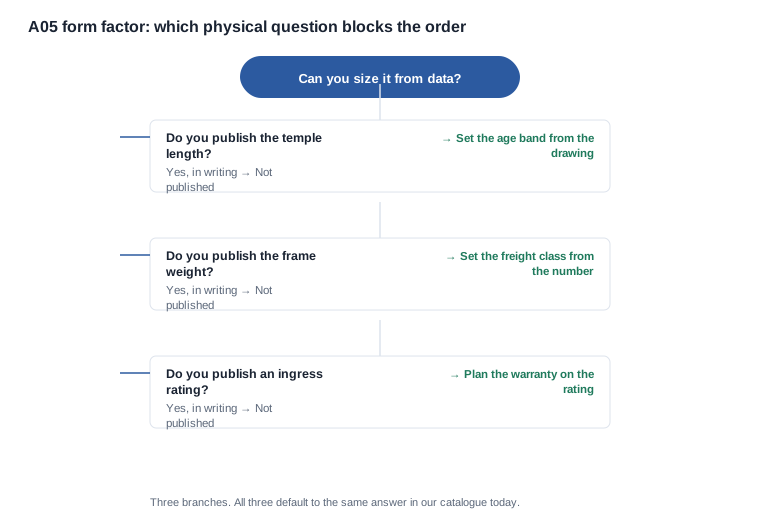
Neither the A05 nor the A07 publishes a frame weight, a temple length, a lens width, a bridge width, a recommended age band or an adjustment range. The catalogue publishes one weight in total, and it is the 158 g of the MT6 glasses unit, which is a camera model in the adult range and a different product category entirely. It is not a figure you can scale down to a children's frame.
The consequence is that the age band has to be chosen rather than read, and it is chosen from three inputs. The head size the frame was designed around, which is a physical fact you can only observe. The design intent, which is a product decision you have to ask about. And the regulatory floor, which is set independently by the destination market and by the smallest detachable part, and which can force the band lower than either of the other two would suggest.
Those three inputs do not always agree, and when they do not, the regulatory floor is the one that binds. That is why the age band and the small-parts assessment belong in the same request as the certification documents, and why a listing that states an age band before the small-parts check is done is a listing with a compliance exposure attached to it.
The commercial consequence is direct. A children's product with a fixed frame and a narrow age band returns more than one with an adjustable or detachable temple, and neither of these two models publishes a detachable temple specification. That return rate belongs in the landed cost of the unit, and the kids sizing analysis covers what the published rows leave out.
The four physical questions a sample has to answer
Because nothing physical is published for either model, the sample review is the only place these questions can be closed. Four of them, and each has a pass condition you can write before the units arrive rather than argue about afterwards.
Temple length and the age band. Measure the temple length, the lens width and the bridge width on three units from the order, not on a showroom sample, and record the range rather than a single reading. Then put the sample on a child of the target age for a full session rather than five minutes. The pass condition is that the child is still on it at the end of the session and that no adjustment was needed.
Frame weight. Weigh every unit and record the number against the batch code. The pass condition is that the weight is consistent across the units you weighed, because a tolerance you did not record is a tolerance you cannot quote to a channel that asks about it.
Charging contact seating. Seat the frame on the magnetic interface and observe the alignment behaviour. A temple that seats slightly off can appear to charge while progressing very slowly, and on a product used by a child that is a support and returns issue rather than a minor usability detail.
The lens state through a cycle. If the lens fogging element is active, watch it fog and recover. A lens that stays fogged is an immediate return, and the instruction that prevents that has to exist in the pack.
What to ask the supplier in the same request
The four physical questions and the commercial questions belong in one request, because a supplier who answers the first set and ignores the second set has told you something useful. The questions to ask fall into two groups, and a buyer who sends only the first group has done half the due diligence. Ask for the frame profile and the weight for both models together with the age range each is designed for; the detection thresholds and the reminder interval on the A05; the endurance test condition for both, given that they publish the same figure on very different cells; and the certification position for each model in each destination market, naming the standards and the test reports.
Alongside those, ask the terms that decide whether the physical answer is usable. The minimum order quantity for each model, the lead time for the quantity you are ordering rather than for a nominal run, the carton dimensions and the units per carton, the replacement-parts position for a broken temple, and the defect rate you intend to write into the purchase order. A frame weight without a carton dimension is not enough to model landed cost, and a form factor decision without a lead time is not enough to model a launch. A procurement team that has to send three more emails to close the commercial terms has usually already lost the schedule it was trying to protect.
The total cost is where the two groups meet, and it is why the questions have to be asked together. A form factor that adds two subsystems in the temple changes the carton, the volumetric freight and the seal design, and a form factor with seventy-five per cent more cell changes the battery transport documentation that travels with the shipment. Neither of those shows up in a unit price comparison. When you evaluate two models that publish the same endurance figure, the criteria that actually separate them are the physical ones you measured and the commercial ones you were given in writing, and neither set is available from the catalogue alone.
What to write into the purchase order
Whatever you measure on the sample has to end up somewhere binding, and that somewhere is the purchase order. Write the measured frame weight as a tolerance around a stated figure rather than as a bare number, because a bare number invites a substitution and a tolerance invites a conversation. Write the temple length and the age band you have validated, so that a change of frame becomes a change of specification rather than a grey area. Write the seating behaviour of the magnetic interface as an acceptance item, because it is the one physical characteristic that a child and a parent will both meet on the first day. Write the warranty against the defect categories you actually observed on the sample rather than against a generic return window, and write the replacement-parts terms for a broken temple as a separate clause, because a growing head and a weak hinge are two different failure modes and one returns clause handles them badly.
The commercial structure follows from the same place. If the physical difference between the two models turns out to be the only difference, then the two models are competing with each other and the range has to be organised around a channel rather than around a feature tier — a retail pack against a bulk carton, a channel-exclusive designation, or a single SKU with the second held as an alternate code. Each of those is defensible and each can be stated in a price list. A price difference with no stated reason is not defensible, and it is the kind of gap a competitor prices into. Whichever model you choose, the checklist to work from before you order is the one in this section, and the shortlist it produces is one model with a written specification rather than two models with an open question.

Those four questions are the reason a form factor comparison in this category has to end at the sample. There is no other route to the numbers, and a buyer who wants them has to budget for the sample stage rather than for a further round of email.
A note on the A05 and the A06
Two models in the same family publish identical specifications, and the source does not state what differs between them. That is a separate question from this one, but it comes up in the same conversations, and it is worth resolving before a two-model children's range is built. The A05 and A06 specification comparison covers the detail, and the A05 and A07 decision analysis covers the choice between a sensing frame and an audio frame.
The A05 and the A07 should never appear on the same product page as two versions of one product, because a customer comparing them is being asked to choose between a sensing device and an audio device. We will not describe the detection functions as producing a vision, health or prevention outcome, and we will not use protection as a performance claim for either frame. We will also be straight about the documentation: the frame profiles, the weights, the ingress ratings and the certification status for both models are not published, and the questions have to be closed with a test house and with a sample before either is listed in a market that requires it.
Send us the buyer, the age band and the destination market, and we will tell you which model's published feature set matches the requirement, and which of the four physical questions our documentation can answer and which one has to be closed on a sample.
Related reading
- The functional difference in full — A05 smart glasses versus A07
- The published rows for the sensing frame — A05 specifications and features
- Selling this category to institutions — kids smart glasses school requirements
Tell us the buyer and the age band, and we will say which model matches and which physical questions remain open.


