
Kids smart glasses sizing is settled by measurement, not by the age label on the box. For a buyer working through the three children's models in our catalogue, the situation is specific and awkward: the nine rows that decide a fit — total frame width, temple length, bridge width, lens height, weight as shipped, adjustment range, what the detection actually measures, whether replacement temples exist, and whether any ingress marking applies — are not published for any of the three. What is published describes the electronics well enough to write a specification sheet and not well enough to size a frame. This article turns that gap into a working request list: the measurements to demand, the failure mode behind each one, the evidence to collect before a purchase order is signed, and the boundary of what our own material can honestly support.
A retailer sees a returned pair and replaces it. A brand owner has a colourway, a packaging design, a listing and a distribution plan already committed against a frame it has never held. Sizing is where those commitments meet the first physical unit, and it is far cheaper to settle before the artwork is approved than after.
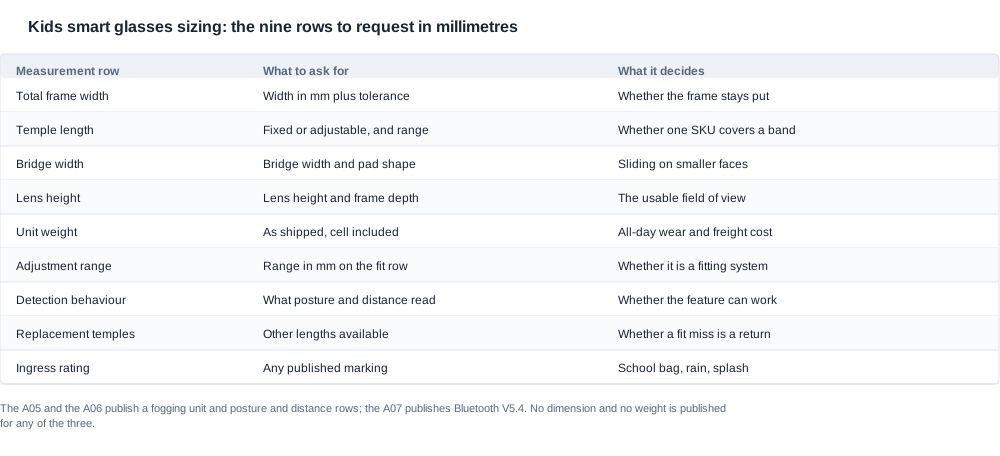
Kids smart glasses sizing: the nine rows that decide whether the unit stays on the face
A child's head changes faster than a buying cycle. A fit that works at seven is a fit that fails at nine, and the failure mode is not a complaint — it is that the child stops putting the glasses on, which means the feature set is never evaluated and the whole programme reads as a failure with no attributable cause. That is the commercial argument for treating fit as the first gate rather than a finishing detail.
Ask for these nine rows in writing, in millimetres, and treat a supplier who cannot answer all nine as a supplier who has not decided to support the category.
- Total frame width, temple to temple, and the tolerance on it. This is the number that decides whether the frame stays where it is put. A tolerance figure matters more than the nominal width, because a nominal width with no tolerance describes a drawing rather than a product.
- Temple length, and whether it is adjustable and over what range. Adjustability is what lets a single stock keeping unit cover a growth band. A fixed temple length converts the age band into a size curve.
- Bridge width and nose pad geometry. A narrow bridge on a small face is the most common cause of sliding, and it is the failure that most often gets misread as a child "not cooperating".
- Lens height and frame depth. A shallow lens reduces the usable field of view, which matters if the device is used for anything visual at all.
- Weight of the whole unit as shipped, including the battery. A figure quoted for the bare frame is not comparable with anything, and it is not a specification.
- The adjustment range, in millimetres, on the fit-critical dimension. A number without a range is not a fitting system; it is a single point.
- What the posture and distance detection actually measures. The A05 and the A06 publish these rows, which makes them the two models in this category where the fit decision has a functional consequence rather than only a comfort consequence.
- Whether replacement temples of different lengths are available. This converts a sizing mistake into a cheap accessory rather than a returned unit and a re-listing.
- Ingress protection. Not published for any of the three children's models. A school bag is not a swimming pool, but it is wet, and a warranty position on a wet bag is a question worth asking.
None of these nine is published for the A05, the A06 or the A07. One weight figure is published anywhere in our catalogue — 158 g for the MT6, an adult camera model whose specification says nothing about frame geometry, and whose battery and camera are part of that mass. It is not a proxy for a children's frame and we will not present it as one.
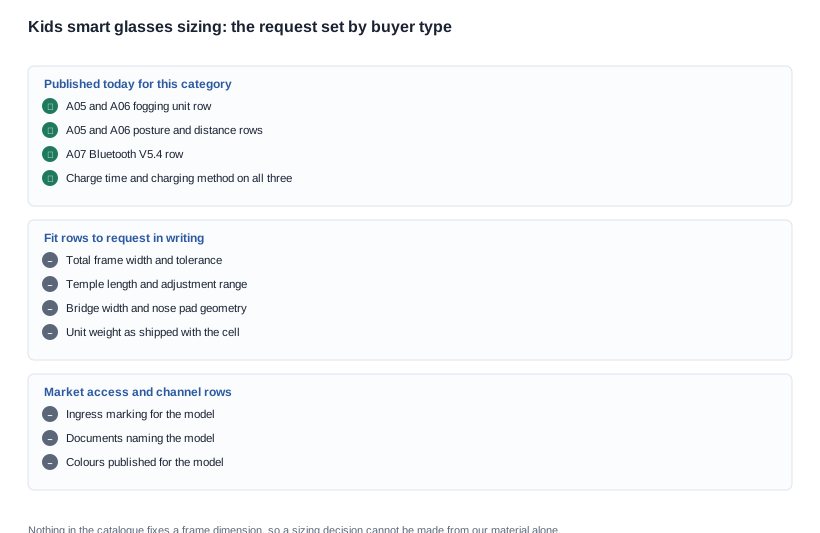

What the A05, A06 and A07 rows settle, and what they leave open
It is worth being precise about what the catalogue does say, because the published material is not empty — it is simply silent on the questions a sizing decision asks.
The A05 and the A06 are named as children's smart protection glasses. Each publishes a 40 mAh cell, a charge time of two hours or less, magnetic charging, and a rated runtime of about twenty hours. Each publishes a lens-type electronic fogging unit, and each publishes rows for correct posture and distance, incorrect posture and distance, lens clarity and lens fogging. The catalogue also carries functional illustrations for both models contrasting a correct posture and distance against a poor one, and a clear lens against a fogged one — which tells you the detection state is visible to whoever is using the frame.
The A07 is named as children's smart audio glasses. It publishes a 70 mAh cell, a charge time of two hours or less, magnetic charging, the same rated runtime of about twenty hours, and Bluetooth V5.4. It publishes no camera row and no sensing row.
Two observations follow directly from those rows, and neither is a matter of opinion.
The first is that the twenty-hour figure describes a light duty cycle with a long standby rather than twenty hours of continuous active use. The A05 and the A06 carry 40 mAh, the A07 carries 70 mAh, and all three are rated at about twenty hours. Two very different cell sizes producing one identical runtime means the rating is dominated by standby. Read it that way and the number is coherent and usable for planning. Read it as continuous active use and the 40 mAh figure is simply wrong. The endurance test condition is not published for any of the three, and it is the first thing to ask for.
The second is that the internal volume taken by the fogging unit and its electronics is what keeps the A05 and the A06 on the smallest cell in the catalogue. That is a structural fact about the platform rather than a marketing choice, and it constrains any future revision of the hardware. It is also worth asking the supplier about directly, because it explains why a cell increase would require a redesign rather than a component swap.
What the catalogue does not publish for any of the three: frame width, temple length, bridge width, lens height, frame depth, unit weight, the adjustment range, the recommended age band, the charging case capacity, the endurance test condition, the colour list, and any document naming the model. The age suitability analysis works through the seven items that decide an age band, and the published specification lists are the honest baseline for each model.
Why the posture and distance rows make sizing a functional question
On most consumer products, a poor fit is a pressure problem and the consequence is a review. On the A05 and the A06 it is a functional problem, and this is the single most important difference between sizing in this category and sizing in ordinary eyewear.
The detection reads posture and distance. Both readings depend entirely on where the frame sits on the face. A frame that is too large sits low and forward, so the measured distance from the eye is wrong regardless of how good the sensing element is. A frame that is too small sits high, the child reads over the top of it, and the angle reading is wrong in a different direction. A narrow bridge lets the frame slide, and a sliding frame changes the distance reading continuously rather than once.
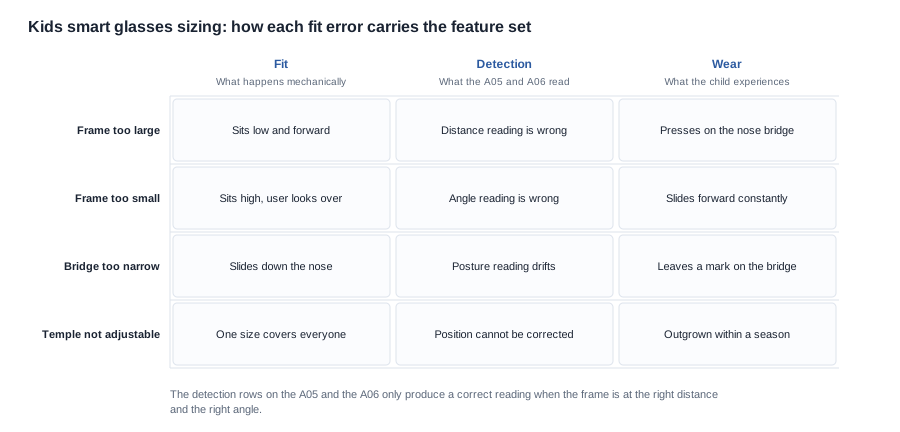
Three consequences follow for a procurement process.
The detection rows are unusable until the fit is settled. You cannot evaluate the feature on a demo unit that happens to fit an adult head, and you cannot sample the feature across a range of child head sizes if the frame does not accommodate them. The measurement has to precede the evaluation, and the evaluation has to happen at more than one fit if the product claims to work across an age band.
The fit specification and the feature specification are the same specification. When you write the requirement for this model, it is not "a posture detection feature" and separately "a frame that fits ages eight to twelve". It is one requirement: a frame whose fit holds the detection reading correct. Splitting it into two briefs lets each one be signed off separately and both to be wrong.
The data question follows the feature question. The A05 and the A06 raise something the A07 does not: what the detection produces, whether any of it leaves the device, who operates the application, and where anything is stored. The privacy considerations piece sets out those questions in full, and for an institutional buyer they are a larger constraint than the frame geometry, because they cannot be fixed by a moulding change.
We also need to be clear about something this category invites and cannot support. Nothing in our published material supports a claim about protecting eyesight, preventing myopia, supporting eye health or any other vision outcome. The fogging and posture rows are functional descriptions of what the device does, and they would need clinical evidence that a catalogue cannot supply before any such claim could be made. If your marketing plan depends on a vision benefit, that is a separate evidence project and it should be budgeted as one.

Sizing a range: how many sizes the three models force a buyer to carry
Sizing has a commercial consequence that buyers tend to discover late, usually when the first reorder is split across three stock keeping units and the packaging has already been printed.
If the published frame width covers a narrow band, covering ages five to thirteen takes several sizes, and each one carries its own artwork, its own listing, its own barcode and its own inventory position. The alternative is one adjustable stock keeping unit with a documented range, which is commercially attractive but puts the adjustment burden on the parent at the point of purchase — and, in a category where the parent is often not the buyer, on a customer who cannot evaluate it.
The workable compromise most buyers settle on is one main size with a documented adjustment range, plus one accessory size. The catch is that the adjustment range is a design decision taken at moulding time. It cannot be added later, it cannot be specified after tooling is cut, and it is the row most often left out of a supplier's first response because it is not in the brochure.
Two further range-level questions belong in the same conversation.
Does the range cover a growth band or a product line? A single adjustable model covers a growth band. A product line of two or three sizes with different colourways covers a merchandising plan. These are different briefs and they produce different answers to the adjustment-range question, so the brief has to be settled before the request is sent.
What is the replacement policy? If temples of a second length are available as a spare part, a fit miss becomes a ten-dollar accessory instead of a return, a re-listing and a customer service contact. That is a genuine commercial lever, and it belongs in the purchase order rather than in a conversation with a sales contact.
The school requirements checklist sets out what an institutional buyer asks for on top of these, and the kids buying guide covers the range-level decisions across the category.
The packaging consequence is the same problem wearing different clothes. A frame that needs two or three sizes does not only multiply stock keeping units; it multiplies the artwork, the barcode, the carton quantity, the listing and the customer service script for each one. Before a buyer commits to a size plan, the sensible step is to establish the minimum order quantity for each configuration and the production lead time each one carries, because a range built on a long cycle and a range built on a short cycle produce very different launch dates against the same marketing date. We publish neither figure, and the honest position is that both are quotation terms rather than planning assumptions. The OEM ready platforms range page covers how configuration planning is handled on the supply side.

Fit evidence to collect before a purchase order is signed
Fit is unusual among the open rows in this category because it is one of the few that a buyer can close unilaterally. A supplier who will not answer a weight question can be weighed by you, in ten seconds, on a sample.

Step one: send the nine rows as one written request. Ask for millimetres, tolerances, and the test method behind any tolerance. A supplier who answers nine questions in a single response is giving you a different signal from one who answers three and goes quiet, and that signal is worth more than any single figure in the list.
Step two: weigh and measure the sample as shipped. Put the unit on a scale with the cell fitted and the accessories in the box, and record the configuration you weighed. Weight the box and the unit separately so the freight model and the fit model do not contaminate each other.
Step three: test the detection at more than one fit. On the A05 and the A06, put the frame where it should sit, then deliberately move it up and down and note what the detection reports. If the reading does not change when the frame moves, the detection is telling you something other than what you assumed, and that is a finding worth having before the first order rather than after the first complaint.
Step four: record findings per unit rather than per batch. A weight taken on one sample is a sample data point. A weight taken across ten units from the same production lot is a tolerance, and a tolerance is what you can write into an acceptance criterion.
Step five: write the measurements into the purchase order. A figure that exists only in correspondence is not a term. The unit weight, the frame width with its tolerance, the adjustment range, and the detection behaviour at the agreed fit are all acceptance criteria, and a lot that fails them is a lot you can refuse.
The sample evaluation process covers how to structure a sample order so the findings are usable, and the certification checklist covers the document side that runs in parallel with it.
The defect categories are the commercial output of the review. The value of measuring per unit rather than per batch is not the measurement itself but the vocabulary it produces. A unit weight with a measured spread, a frame width with a tolerance, a charging seat that seats reliably on one temple and intermittently on the other — each becomes a named category rather than a general complaint, and named categories are what a returns policy and a warranty claim are written against. Agreeing those categories at sample stage is also the cheapest moment to agree them, because the supplier has not yet priced them into a production lot.
One thing that must not be missed in this category: no document in our material names the A05, the A06 or the A07, and the catalogue's export certification page is a company-level page whose content is images rather than text. The catalogue text contains no reference to CE, FCC or RoHS and there is no per-model certification row anywhere. That does not mean the product is uncertified — it means the evidence is something to request in writing and verify against the issuing body's own register rather than something our catalogue can evidence. The file an EU launch needs is the starting point for that request list, and for a device carrying a radio the Radio Equipment Directive (EU) 2014/53/EU is the relevant framework to ask a supplier about.
The boundary of our own fit data on the three children's models
On sizing in this category, our position is that it should be settled by measurement and not by a category label, and that a supplier who cannot produce the nine rows above has not decided to support the category whatever their literature says. We will not publish a child's frame dimension we have not measured, and we will not describe an adjustable fit system for a model where the adjustment range is unknown to us.
What we can do is tell you exactly which rows exist for the A05, the A06 and the A07, which rows have to come from the tooling programme before they can appear in a specification sheet, and which of them are decision blockers for the age band you have in mind. We will also tell you plainly where a question needs a written answer from the production side rather than an inference from our catalogue. The criteria we apply are simple enough to state in a sentence: no measurement, no claim, and an unanswered row is a blocker only when it changes the brief.
For positioning, the A05 against the A07 comparison covers the functional split inside the category, the A06 against A05 specification comparison covers the question of what differs between the two sensing models, and the who needs the A07 analysis covers the audio platform. The kids smart glasses range page lists the three models with their published rows.
Related reading
- The three children's models and the features each of them publishes — the kids smart glasses range
- What the protection and posture claims in this category actually rest on — kids eye care technology
- How to test a delivered unit before you commit to a volume — sample evaluation
- The file an EU launch needs before the first unit moves — GPSR obligations
Send us the age band you are targeting, whether the device is used at a desk or on the move, and how many sizes you are willing to stock. We will tell you which published rows apply, which measurements we still need to confirm, and which of them decide the brief.


