

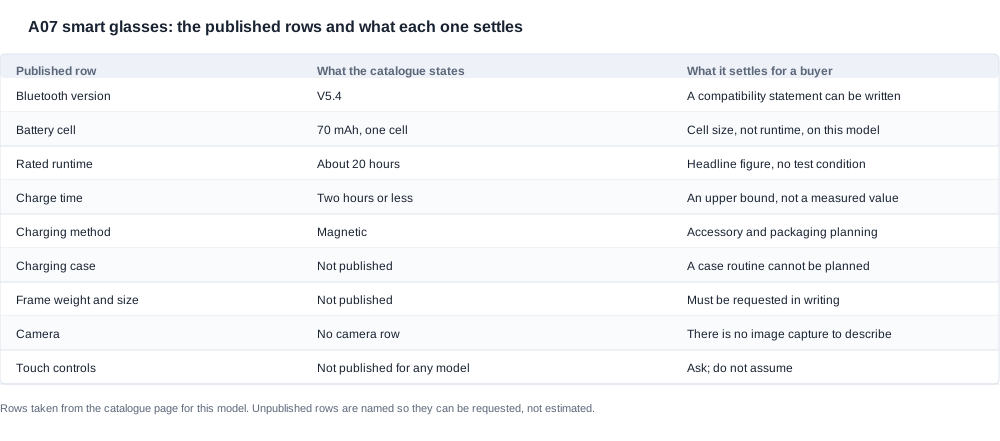
A07 smart glasses value for money is not a question this catalogue can answer, because the catalogue publishes no price for this model or for any other in the range. What it can answer is the question underneath the price question: which programme requirement this model actually meets, which requirement it does not meet, and what has to be confirmed in writing before a quotation is worth reading. The published rows are short. This model carries a 70 mAh single cell, a rated runtime of about 20 hours, a charge time of two hours or less, magnetic charging, and Bluetooth version V5.4. That is the whole of the electrical and radio specification. Everything else a buyer needs — frame weight, frame dimensions, charging-case capacity, recommended age band, touch configuration, certification position — is not published for this model, and in most cases not published for any model in the range.
Read as a filter rather than a verdict, the position is straightforward. This is the model in its group with a published radio version and the largest published cell, and it is also the model whose feature documentation is the thinnest. A buyer whose programme depends on a behaviour-detection function will not find that function here. A buyer whose programme needs a camera-free, long-running audio product has a model that can be described from published rows today, without waiting on a sample test. This article sets out how to run that filter, what to ask the supplier, and what we will and will not put in writing.
The 70 mAh cell, and why a cell difference is not a value difference
The cell row reads 70 mAh, one cell. The runtime row reads about 20 hours. The charge row reads two hours or less, with magnetic charging. These three numbers are published, and between them they will carry most of the commercial weight in a decision about this model, but they carry it in a way that is easy to misread.
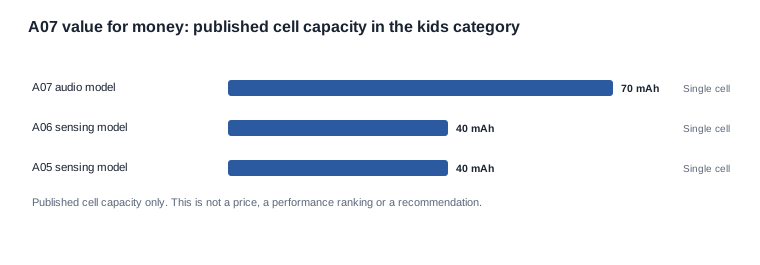
A cell difference is a component difference, not a value difference. Between the two neighbouring models in this category and this one, the cell moves from 40 mAh to 70 mAh. A cell of that size is a small fraction of the assembled cost of a children's smart glasses product. The bill of materials is driven by the electronics that surround it: the radio, the amplifier and speaker, the enclosure tooling, the packaging, the certificate route and the freight handling of the finished carton. A buyer who treats the 30 mAh step as the price story is reading the smallest line on the specification sheet as if it were the largest.
The runtime row is a rating, not a measurement. About 20 hours is the largest rated runtime published anywhere in this catalogue, and it appears on three models in the same family with cells of 40 mAh and 70 mAh. A figure that holds across a 30 mAh spread cannot be a simple capacity-to-load ratio, and the catalogue publishes no test condition behind it: no statement of what was running, whether the radio was connected, at what interval a reminder sounded, how many units were averaged, or whether the figure is a mean or a best case. Read it as a manufacturer rating that has been established under conditions nobody has written down, and treat any comparison that depends on the exact value as unfounded.
What the larger cell does buy is headroom, and headroom is invisible on a listing. Under a published rating that both models carry, extra capacity gives engineering margin against a heavier duty cycle. That margin matters commercially in two places: it reduces the risk that a real-world usage pattern lands below the rating, and it reduces the number of returns caused by a product that stops before the end of a working day. It does not produce a claim you can print, because both models publish the same runtime and a listing that says one runs longer than the other would be wrong on the published rows.
Planning a recharge routine from a published rating
Because no test condition is published, a programme cannot derive a recharge interval from the rating directly. What it can do is build its own duty cycle and then ask the supplier whether the published figure holds under it. Take the common case in this category: a school day of roughly seven hours, with the device on for a short morning session, idle through the lessons, on again after school, and on for a fixed window in the evening. That pattern produces a low active-hours figure and a long idle figure, and it is exactly the pattern that a low-power radio can exploit when no audio is playing. A programme that assumes continuous operation will plan a completely different interval, and the two plans will not agree with each other.
The practical sequence is to write the duty cycle down as hours of active use and hours of idle use, put that same cycle to at least two suppliers in identical wording, and ask each of them to state whether the published rating holds under it. Where the suppliers agree with the published figure, the interval can be written into the listing and the support script. Where they do not, the programme has found something worth knowing before an order was placed rather than after.

The radio row, and the one difference that changes the work rather than the hardware
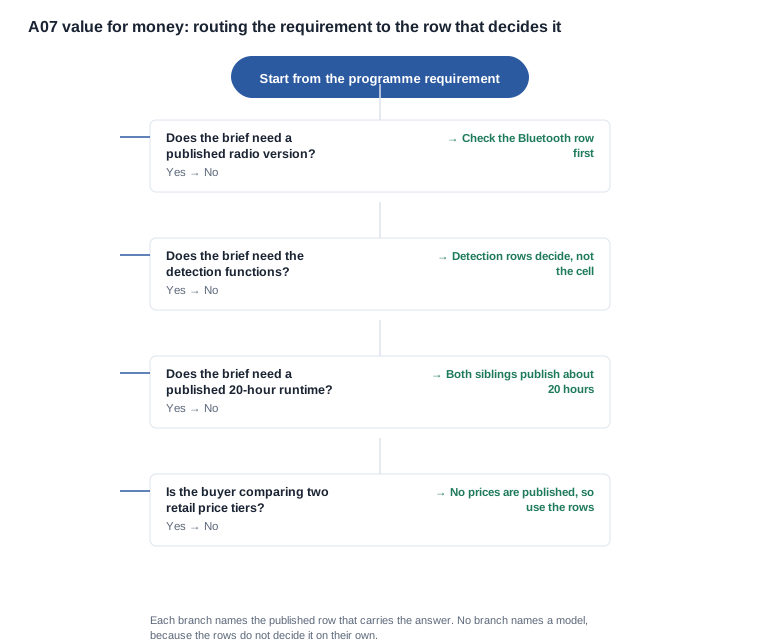
The A07 publishes Bluetooth version V5.4 on its model row. Its two neighbours in the family publish no radio version at all. That is not a small detail for a procurement team, because a published radio version is the difference between a listing you can write on Monday and a listing you cannot write until a supplier replies.
With a published radio version, three things can be produced immediately. A compatibility statement for a channel or a channel listing, a connection procedure for an instruction leaflet, and a support script that answers the first question any buyer of an audio product asks. None of those documents needs a sample, a test certificate or a written confirmation from the factory. They are drafted from a published row and they carry no risk, because the row is the source.
Without a published radio version, the same three documents are blocked on someone else's calendar. That is not a criticism of the documentation, which simply does not publish the row. It is a scheduling fact, and it belongs in your programme plan rather than in your inbox. If the model you are evaluating cannot produce a compatibility statement, then every downstream artefact that references connectivity inherits the same delay, and the programme inherits it too.
On the other side of the ledger, the feature documentation is thin. This model carries no camera row and no detection-function row. For a programme selling into a children's category, that is often a commercial advantage rather than a gap: there is no image-capture claim to describe, no detection data to govern, and no companion application behaviour to document. It also means the proposition has to be built on something other than sensing. If your programme exists because a customer wants a behaviour tool, the absence of detection functions here is disqualifying, and it is better to discover that on a specification sheet than at the sample stage.

Why a price comparison cannot be built out of this catalogue
We publish no prices, no price tiers and no entry, mid-range or premium labels, and this article will not estimate a gap between this model and any other. That is a standing position rather than a gap in the documentation, and it is worth explaining why, because a buyer comparing two models on value is often actually trying to answer a different question.
The commercial question behind "value for money" is usually a total-cost question. For a programme that will be sold in volume, the number that matters is the landed cost of a compliant unit in a specific destination market, with the accessory and packaging that configuration requires, against the return rate the category typically produces. That number is assembled from a quotation, a freight arrangement, a compliance route and a defect record. None of those four inputs is a catalogue line, and assembling them from a catalogue is how programmes end up with a cost basis that no longer holds at the point of order.
The feature gap is a larger commercial variable than the hardware gap. If one model in a family carries a lens-type electronic fogging element and posture and viewing-distance detection, and another carries neither, the cost difference between them is not a component difference. It is the difference between a product with a subsystem and a product without one, and it is the difference between a listing that can describe a capability and a listing that can only describe a runtime. That is the variable to put in front of your supplier when you ask what separates two models in the same family.
The compliance route is a cost with a duration attached. What our catalogue holds on certification is one company-level export page, and it is pictures rather than text; the catalogue text does not name CE, FCC or RoHS, and not a single per-model certification row is published. So the certification position for this model, in any destination market, is not something you can read — it is something you must obtain in writing, from a testing body or from the supplier, with a lead time and a cost attached. A programme that plans around an assumed certification route has a schedule risk that no specification sheet discloses.
The claims boundary is a commercial variable too. A listing that stays on the right side of the regulatory line is one your distributor's due diligence can pass; a listing that crosses it is a liability you cannot price and cannot fix with a disclaimer. For a product in a children's category, that is a live consideration rather than a theoretical one.
The assortment cost of a family with unresolved rows
A category buyer often inherits a decision that was made before them. The range page shows several models, the programme already carries one, and the question becomes whether a second one earns its place. Two models in this family publish identical rows across the cell, the runtime, the charge time and the charging method, and the catalogue carries no statement that separates them. That is a documentation state rather than a product state, and it has a consequence that a specification comparison will not reveal on its own.
Carrying two models that publish identical specifications is not free. Each one needs its own listing, its own copy, its own support script, its own compliance file and its own inventory position. If the specifications turn out to be identical once the confirmation arrives, the second one is a second line of stock with no difference to sell against it, and the assortment cost was already committed before anyone knew. A buyer asked to carry both should ask the confirmation question before the second SKU is created.
The same logic runs in reverse when a model does publish a distinguishing row. A published radio version, a stated charging interface, a published charging-case capacity and a published ingress rating are all separators: they let a buyer carry two models without confusing a customer, a distributor or a support agent. Where such a separator exists on one model and not on the other, a two-model range is workable. Where it does not exist, the range decision is deferred until the supplier confirms the difference in writing.

What to request in writing before this model goes on a shortlist
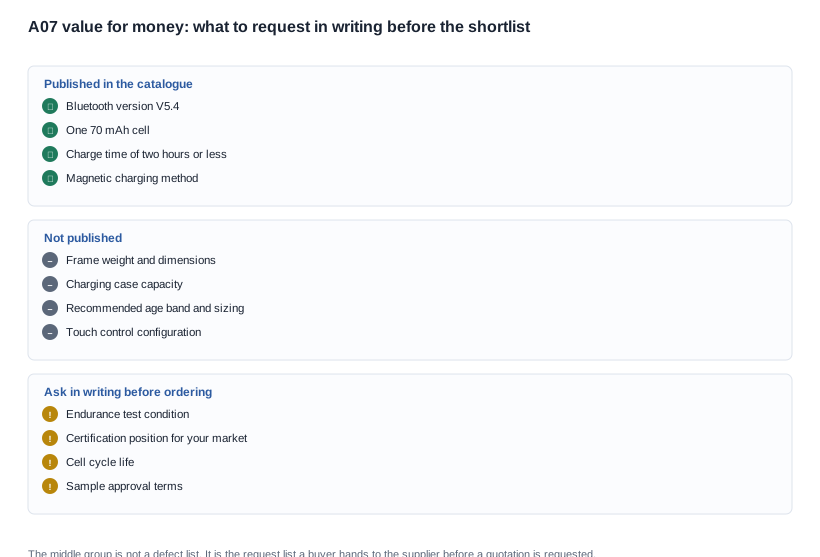
The list below is what turns a catalogue page into a shortlist entry. It is written as a request list rather than a checklist of things we know, because the second half of it is where the risk sits.
Hardware and electrical rows
- The cell capacity and cell count for the production configuration, and whether the published 70 mAh figure applies to that configuration.
- The charging interface fitted to production units, and the connector or pad that a buyer must stock alongside the product.
- Whether a charging case exists for this model and, if so, its capacity. The catalogue publishes no charging-case row for this model, so the routine of a case-based programme cannot be planned from it.
- The Bluetooth version actually fitted to production units, confirming the published V5.4.
The endurance figure
- The test condition behind the rated runtime: what was active, what was idle, whether the radio was connected, and the interval at which any periodic function ran.
- How many units the figure was drawn from, whether the cells were new or cycled, and whether the published value is a mean or a best case.
- The expected cell cycle life at the rated duty cycle, and what the warranty position is on the cell.
Physical and fit-related rows
- Frame weight with the cell fitted, and whether the quoted figure includes or excludes the case.
- Frame dimensions, temple length and lens dimensions, for the production revision.
- The recommended age band and the sizing band, and whether the frame is offered in more than one size.
Software, data and claims
- Whether the product has any companion application requirement, what it collects, and whether the product functions without it.
- The wording the supplier is willing to have used on a listing, and which of those words the supplier will support in writing if challenged.
Compliance and commercial
- The certification position for this model in each destination market, with the certificate or test report reference and the issuing body named.
- The battery transport documentation available for the cell configuration offered.
- The minimum order quantity, the lead time and the unit price, all against one fixed configuration and one destination market.
A worked screening exercise
Take a hypothetical buyer with an ordinary brief. A distributor wants a children's audio product for a channel that sells to parents, with a camera-free proposition, a published radio version, and no interest in a behaviour-detection function. The distributor needs a compatibility statement, an instruction leaflet and a support script, and needs all three before the range is announced to the sales team.
Run the published rows against that brief. The camera-free requirement is met by the model with no camera row. The published radio version requirement is met by the model whose row carries Bluetooth V5.4, and by no other model in the family. The absence of a detection requirement is met as well. The runtime requirement is met by all three models, so it does not narrow anything and should not be presented as if it did. The charging method is magnetic on all three, so the accessory plan is identical across the range and can be settled once rather than model by model.
Three published rows have now done all the work, and the twenty-hour rating has done none. What remains open is everything the catalogue does not publish: frame weight, frame dimensions, the recommended age band, the charging-case capacity, the touch configuration and the certification position. None of those six items changes which model the brief selects. All six change whether the programme can proceed, and all six sit on the request list above.
The exercise generalises further than this model. Most value arguments in this category are settled by two or three published rows and then diluted by everything else on the sheet. The commercial discipline is to identify the rows that are actually load-bearing for your brief, let them decide, and then treat the remainder of the specification as a qualification task rather than a selection task. That is a faster route to a decision, and it is the one that survives a distributor's due diligence review.
What we will and will not put in writing about the A07
The useful way to talk about value on this model is structural, because a numerical comparison would be fiction. The catalogue publishes five rows that describe this model completely: a 70 mAh single cell, a rated runtime of about 20 hours, a charge time of two hours or less, magnetic charging, and Bluetooth version V5.4. Those rows tell you what the product is, what it can be described as, and what your programme cannot claim. They do not tell you what it costs, and no honest reading of them produces a "best value" label, because value is a relationship between a price and a requirement, and we publish only the requirement side.
We will not attach a detection function to this model because two neighbouring models carry one. We will not present the twenty hours as a guaranteed working time, because no test condition is published. We will not quote a frame weight, a dimension, a charging-case capacity, an age band or a certificate number that the documentation does not contain, and we will not fill those rows with figures typical of the category. We will not name a price tier, because publishing one would imply a price position we cannot support and would put your buyers in a market we have not measured.
What we will do is tell you exactly which of your programme requirements this model meets on the published rows, which it does not, which questions have to go to the supplier before the specification is worth signing, and what a comparable model in the same family does and does not publish. The published specification list for this model is the honest baseline, and the category buying guide covers the range decision that sits above it.
Related reading
- The functional split between the models — A05 versus A07
- The detection function and how it should be described — posture monitoring
- The buyer review list for this model — A07 buyer review checklist
- The category range page — kids smart glasses
Send the programme, the buyer type and the required functions, and we will come back with what is documented and what is not.


