

Neither the A07 nor the A06 publishes a frame dimension or a weight, so a form factor comparison has to be built from what each frame has to carry rather than from how the two appear side by side. That turns out to be a more useful comparison for a procurement team, because the internal volume a frame has to spend on hardware is what determines the difference between these two products — and because it is the only part of the physical question that the documentation actually settles.
The published facts are these. The A07 carries a 70 mAh single cell, a rated runtime of about 20 hours, a charge time of two hours or less, magnetic charging and Bluetooth version V5.4. The A06 carries a 40 mAh single cell, the same rated runtime, the same charge ceiling and the same charging method, and on its model row a lens-type electronic fogging element with posture and viewing-distance indication, with no Bluetooth version published. Neither publishes a weight, a dimension, a temple length, a lens size, a material, a hinge rating or a recommended age band.
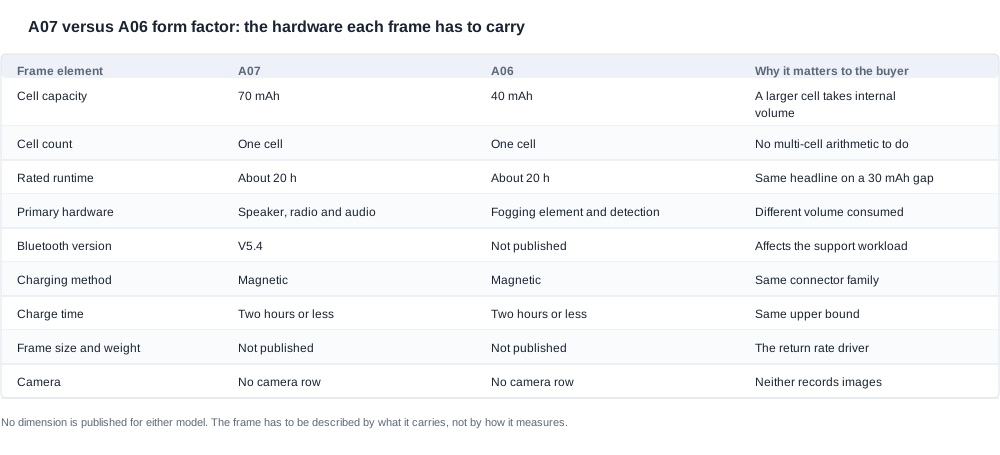
A07 versus A06 form factor: what each frame has to carry
The A07 carries an audio path and a larger cell. A 70 mAh cell, a Bluetooth 5.4 radio, a speaker and an amplifier sit in one temple. No camera, no fogging element, no detection sensors. That is a frame whose internal volume is committed to audio hardware and to energy storage, and to nothing else.
The A06 carries a sensing path and a smaller cell. A lens-type electronic fogging element, posture detection and viewing-distance detection, a 40 mAh cell and a radio whose version is not published. The fogging element and its electronics occupy temple volume that a cell could otherwise have used, and the result is a cell that is smaller than the A07's in a frame with a comparable amount of work to do.
That relationship is the whole form factor story. It explains why two frames with different internal budgets publish the same rated runtime. A frame that spends most of its rated life sampling a sensor and signalling a change draws less than a frame that is ready to drive an amplifier and hold a radio connection, so the headline numbers converge even though the hardware volumes do not.
Form factor is therefore a capacity question before it is a presentation question. The question a buyer should ask is not what the frame resembles but what the frame has been designed to contain. Once that is answered, several downstream decisions follow on their own: how much the electronics can grow before the profile changes, whether a case is a necessity or an accessory, how the product presents itself on a shelf, and how much of it there is to ship.
One row makes the two models commercially distinct in a way the dimensions will not. The A07 publishes a radio version and the A06 does not. The A06 publishes a sensing feature and the A07 does not. So the two frames are not two sizes of one product; they are two products with different content, and the form factor question sits on top of a primary question about what the product is.
How to choose between them on form factor grounds alone. Evaluate the four axes that the published rows actually settle — the hardware volume each frame commits, the runtime each publishes, the accessory arrangement each implies and the documentation burden each carries — and then check whether the envelope measurement programme you have to fund anyway produces a different answer. If the envelopes turn out to be comparable, the form factor question stops mattering and the content question decides. If they are not comparable, the packaging and freight consequences are the ones to price. That is the whole evaluation; what follows is how to run it.
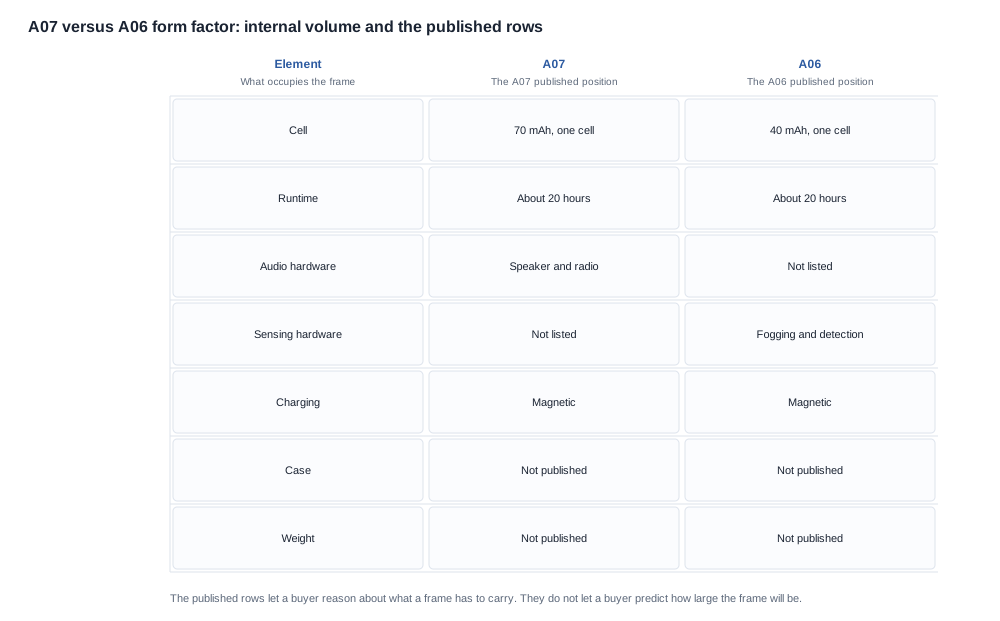

Internal volume, and why the smaller cell does not mean the smaller frame
The instinct is to read the cell row as a proxy for frame size. It does not work, and the reason is worth being precise about.
A cell is a volume, but it is not the only volume. The A07's 70 mAh cell occupies more space than the A06's 40 mAh cell, and that is real. But the A06 gives back some of that space in a different direction, and the fogging element is not a thin addition — it is a lens assembly with its own electronics behind it. The two frames could arrive at a similar external envelope with very different internal budgets, which is exactly the situation where a buyer relying on the cell number would draw the wrong conclusion.
External size and internal capacity can move in opposite directions. A frame with more internal room may be built with a smaller cell because the design prioritises thinness, or it may be built with a larger cell because the design prioritises endurance. Neither direction is visible in the published rows. What the published rows show is what each frame contains, and a buyer who reasons from that is reasoning from something real.
The envelope that matters commercially is the one the retailer and the shipper see. Carton dimensions, shelf footprint and packed parcel profile are what a channel buyer and a logistics team work with, and all three are consequences of the external envelope plus the packaging. None of them is published for either model. So the form factor comparison has to end in a measurement programme rather than in a conclusion, and that is not a failure of the comparison — it is the correct output of a comparison whose inputs are specification rows.
The accessory decision is a form factor decision. The A07 and the A06 both charge magnetically, so the charging method does not differentiate them, but neither publishes a charging-case row, so the case question is open on both. A case has to match the external envelope of the frame it holds, and a case that does not match is a case that does not get used. If the programme intends a case-based routine, the envelope has to be measured before the case is specified.
The shipping consequence is worth quantifying early. A frame with a deeper profile changes the carton depth, which changes the master carton, which changes the number of units per carton, which changes the freight quote and the warehouse pick face. A programme that discovers the envelope after the packaging artwork is frozen has a packaging redesign on its hands. Measuring the sample early and writing the values into the purchase specification prevents that, and it is one of the cheapest risk reductions available in the whole buying process.
The measurements a form factor comparison actually needs
Here is the checklist of values that would let a buyer compare these two frames properly. Every one of them is unpublished, and every one of them is obtainable.
Frame geometry. Temple length, lens width and height, bridge width, and the overall frame width. These are the numbers a retailer needs for shelf planning, a distributor needs for the product data sheet and a parent or a school needs to judge the product against the head it will sit on. A tolerance belongs on each.
Weight, stated precisely. Two weights matter and they are frequently conflated: the weight of the frame with the cell installed, and the weight of whatever is supplied in the box with it. The catalogue publishes neither for these two models. Where the only published weight in the wider catalogue appears, it is for a different model entirely, and it excludes that model's folding charging case — which is a reminder that a weight quoted without its inclusion rule is not a usable number.
The profile, in the places that matter. Temple height at the hinge, the depth of the electronics housing, and whether the charging contacts are visible or covered. These are the dimensions that determine whether the product sits flat in a pocket, in a case, or against a face, and they are exactly the dimensions a buyer cannot guess.
Material and hinge. Frame material, temple material and any hinge rating are unpublished. In a children's category this is a durability question and a safety question at once, and the answer is a document rather than a sample inspection.
The accessory envelope. If a case is supplied, the case dimensions and its weight, and how the case is packed alongside the frame. A case that adds a second lithium cell also adds a second transport document and changes the parcel profile.
The age band and the sizing. Neither model publishes a recommended age band or a sizing band. Where the models differ in what they are published as, that difference is itself a form factor signal, because a protective frame and an audio frame are usually pitched at different head sizes and different proportions.
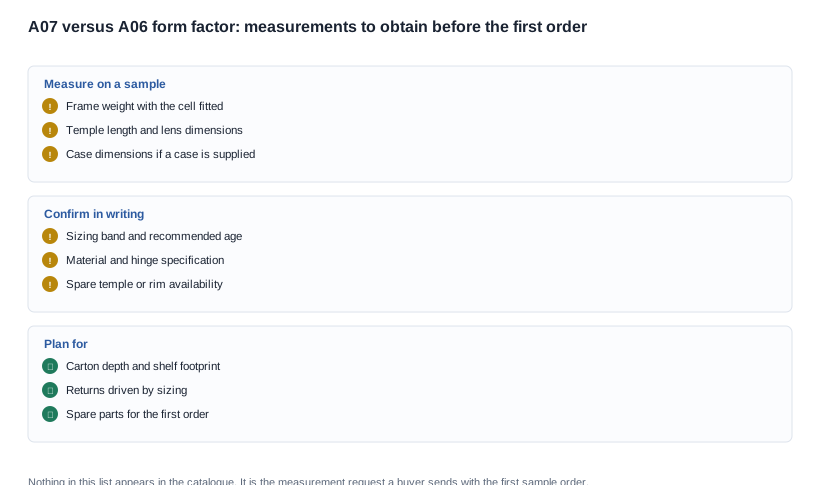

Obtaining frame measurements you can put in a specification
The sequence matters more here than in most comparisons, because a measurement taken from the wrong source can be repeated and propagated all the way into a purchase order.
Step one, ask for the drawing. A production drawing gives the nominal geometry and the tolerances in one artefact. It also gives the revision, and the revision number is what tells you whether the drawing describes the unit that will actually ship. A drawing without a revision reference is a drawing you cannot match against a sample.
Step two, require a production-revision sample. Showroom units and pre-production samples differ from production units in ways that are difficult to predict: material finishes, battery suppliers, moulding tolerances and firmware packaging. A measurement taken from a showroom unit is a measurement of the wrong object, and it is the kind of error that only surfaces at incoming inspection.
Step three, weigh the unit as it will be shipped. Weigh the frame with the cell installed, and record separately what was included in the weighing. State the method in the same line — a weighing instruction that leaves out the inclusion rule is an instruction that will be read two ways by two parties, which is how a dispute starts.
Step four, measure the geometry with an instrument. A tape or a calliper, with the units and the reference points written down: temple length measured to the centre of the bend, lens width measured at the widest point, and so on. A measurement without a stated reference point is not repeatable, and not repeatable means not verifiable.
Step five, compare the measurement against the drawing and log the difference. Where the physical unit disagrees with the drawing, the physical unit is what ships, and the difference is a finding that belongs in the specification. Where the difference exceeds a tolerance the programme cares about, that is a conversation to have before you commit to the order rather than during incoming inspection.
Step six, write the measured values into the purchase specification. Every measurement needs a nominal value, a tolerance, a method and an acceptance rule. Only then does the number do any work: at incoming inspection, at quality control, and in the arguments a buyer has with a supplier when a batch arrives outside the band.
Step seven, re-measure the first production batch. One measurement programme at the sample stage protects the first order. A second, on the first shipment, protects the relationship and the returns rate. In this category the frame is usually the thing a customer returns, and it is the thing least likely to be checked on arrival.
When to stop measuring. There is a point at which the envelope question has been answered well enough to proceed, and beyond it the marginal measurement adds nothing. That point is reached when the carton depth, the packed weight and the case decision are all determined. Any further geometry belongs in the quality file rather than in the buying decision, and holding the programme for it is a common way to lose a season.
Put the measurements in the agreement, not in a spreadsheet. A tolerance band, a measurement method and an acceptance rule belong in the purchase specification and, through it, in the supply agreement, so that a batch arriving outside the band is a documented non-conformance rather than an argument. The same clause should state which document governs if the drawing and the physical unit disagree. For a buyer running due diligence on a new supplier, this is the kind of clause that distinguishes a supplier who will be measured from one who will not, and it is far cheaper to agree it before the first order than to enforce it afterwards.

Trade-offs and pitfalls in comparing two frames that share a category
The first pitfall is reading a cell capacity as a frame size. It is the most common error and it produces a completely false conclusion about which product is easier to package and ship. The published rows support the cell comparison; they do not support an envelope comparison.
The second pitfall is comparing the runtime rows as if they were independent. Both frames publish about 20 hours. A comparison table that shows two identical numbers beside two different cells invites the reader to conclude that the larger cell produces the same result more efficiently. The published rows do not establish that, and a copywriter who asserts it on the strength of the table will be quoting a conclusion the catalogue does not support.
The third pitfall is treating the unmeasured envelope as the same envelope. Two frames in one category are often assumed to be interchangeable in a carton, a case or a display fixture. Where the envelope is genuinely different and the assumption was never checked, the cost lands at packaging design, at the first production run, or at the warehouse.
The fourth pitfall is deferring the measurement to the first production run. Every one of those costs is avoidable with a sample and a tape measure. The reason programmes skip it is schedule pressure, and the reason they should not is that the sample stage is the cheapest place in the entire process to be wrong about a dimension.
The trade-offs a buyer is actually choosing between. The A07 carries more hardware volume and a published radio version, and asks less characterisation work. The A06 carries a different hardware volume, a sensing function and an unpublished radio version, and asks more. Neither is a better frame; they are different commitments, and the right way to assess which one to take is to price the commitment rather than to compare the frames.
Where these two models sit in a form factor plan
The honest summary is that the form factor of neither model can be described today. Both dimensions and weights are unpublished, so any statement about how these frames compare in size or weight would be an invention. What can be described is what each frame carries, and that is the part with procurement consequences.
The contents drive the envelope, the envelope drives the packaging, and the packaging drives the freight. A buyer who treats the frame as an unknown volume and asks the packaging question late will discover the carton depth after the artwork is signed. The order that avoids this is to obtain the sample, measure it, and take the carton decision from the measurement.
The differences that are real today are the hardware contents and the documentation rows. One frame carries an audio path and a published radio version; the other carries a sensing path with no published radio version. Those two facts explain the cell difference, the runtime convergence, the support load, the data question and the claims work, and they are enough to decide which of the two a programme should be qualifying.
The two models are not variants of one product and should not be presented as two sizes of one product. A customer comparing them is being asked to choose between an audio product and a behaviour-indication product. The published rows support that distinction clearly, and a range built on it is one a distributor can follow.
A shortlist rule for this pair. Shortlist on the content question first — does the programme need a sensing function, and does it need a published radio version for the listing — and only then open the envelope measurement. Opening the measurement first produces a programme that spends its time on the question that the published rows already answer, and that delays the decision that actually matters.
Our position on form factor for these two models. We will not publish a dimension, a weight, a temple length, a lens size or an age band for either model, because the documentation does not contain them, and we would rather hand a buyer a measurement request than a typical figure that turns out to be wrong. We publish the cell, the runtime, the charge ceiling, the charging method, the radio version where it exists and the feature note exactly as the model row states it. Where the frames differ, we say what each one carries. Where they are alike, we say that the published rows are alike and that the measurements have to be taken. The published specification list for the A07 and the published specification list for the A06 are the baselines for any envelope you plan against.
Related reading
- The functional decision in this category — A05 versus A07
- The published rows for the A06 — A06 specifications and features
- The category buying guide — kids smart glasses buying guide
- The sibling form factor comparison — A05 versus A07 form factor
Send us the buyer, the age band and the markets, and we will tell you which model matches the requirement and which compliance questions remain open.


