
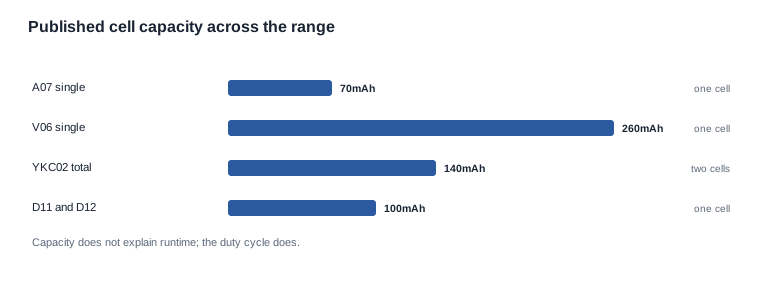
The A07 publishes Bluetooth V5.4, a 70 mAh cell, charging in two hours or less, roughly 20 hours of rated use and magnetic charging. It does not publish certification status, frame weight, a runtime test condition or lens material data. For a children's product, those four absences are the ordering decision. Below is the checklist in the order the questions will actually bite.
So an a07 smart glasses what to check before ordering question resolves into a simple structure: five rows are published, and everything that determines whether you can sell the product is not among them. This is a model with the shortest published row and the largest documentation burden in the children's range, and that combination is unusual enough to be worth explaining before listing the checks.
The odd part, stated plainly. In the same three-model range, the other two models publish a lens element and a posture-and-distance sensing function that this one does not. The A07 publishes a larger cell and the only radio version, and it publishes the least about what the product does. That is why a buyer who shortlists on specification rows alone can end up with a model whose feature story is undocumented — and why certification has to be the first question rather than the last.
There is a reason the ordering of the checks matters so much for this model specifically. With five published rows, a buyer can complete a specification table in an afternoon and feel as though the evaluation is done. It is not done — it is at the beginning. The work that follows is the work that determines whether the product can be listed, shipped and supported, and none of it appears in the table. Articles that treat a short specification sheet as a simple product usually get that product wrong.
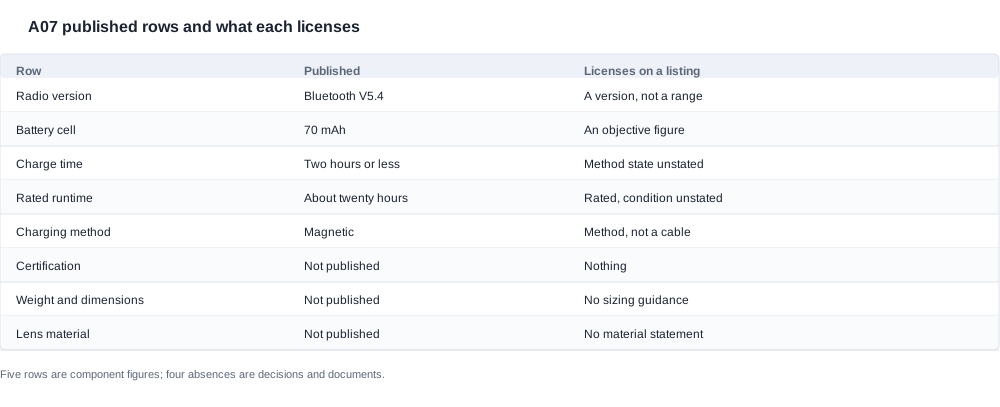
A07 smart glasses: the published row, and the four absences that decide the order
Start with the five published rows, because they are short and they are consistent.
| Row | A07 published | What it licenses on a listing |
|---|---|---|
| Radio version | Bluetooth V5.4 | A version, not a range or a distance |
| Battery cell | 70 mAh | An objective figure |
| Charge time | Two hours or less | An objective figure, method unstated |
| Rated runtime | Roughly twenty hours | A rated value, condition unstated |
| Charging method | Magnetic | A method, not a cable inclusion |
Then the four absences, which is where the ordering risk actually lives.
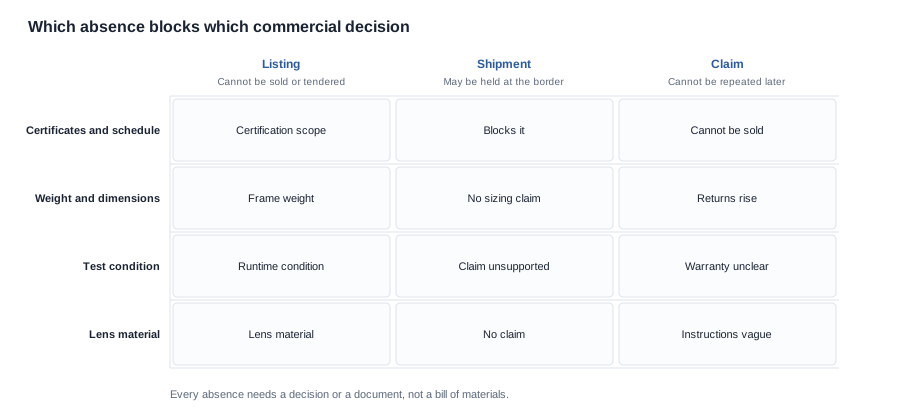
- No certification status, scope or model schedule. This blocks the listing, the tender response and, in some markets, the shipment.
- No frame weight or dimensions. This blocks any sizing guidance, any age guidance and a large part of the return rate.
- No runtime test condition. This blocks a defensible endurance claim and the warranty position that depends on it.
- No lens material data. This blocks any material statement and any cleaning or handling instruction.
The pattern is worth naming: the absences cluster on the paperwork rather than on the hardware. Every one of the five published rows is a component figure that a factory can state from a bill of materials. Every one of the four absences is a figure that requires a decision, a document or a test. That is why a short specification sheet in this category does not mean a simple order.
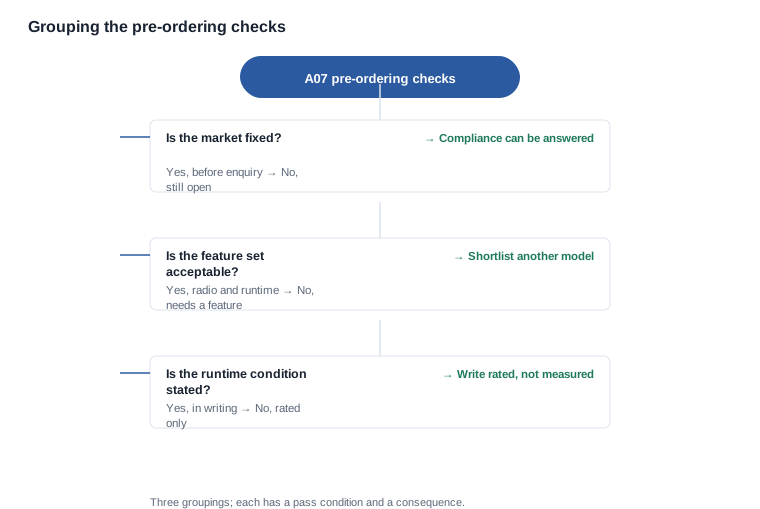
And a fifth absence that is easy to miss because it is a negative. The other two models in this range publish a lens element and a posture-and-distance sensing function. This model publishes neither. If your channel brief was built around a feature story, that story has to be rebuilt around the radio version and the endurance row, or the model is the wrong one. Decide that before the enquiry, not after the quotation.
Why this model's configuration is worth a paragraph, because it is counter-intuitive. It has the largest published cell of the three and the only published radio version, and it has the least documented about what the product does. A buyer comparing on feature count would rank it last; a buyer comparing on radio version and endurance would rank it first. Both readings are correct, which is exactly why the shortlist criteria have to be written down before the quotation rather than chosen from it.
A discipline worth building for a category this small. Write your shortlist criteria as three sentences before contacting any supplier, and keep them. The temptation in a three-model range is to fall in love with the model carrying the most published numbers, and the published numbers are not the same thing as the criteria. Writing the three sentences down also makes the conversation with a supplier shorter, because you are asking a narrower question.

Certification first, and what to ask for
For a children's product, this check comes before the commercial conversation, and the order is not negotiable.
The reason is that every other check depends on it. A unit price is irrelevant if the product cannot be listed in the destination market. A lead time is irrelevant if the shipment is held. A brand that negotiates price first and compliance second has negotiated the terms that were easy to change and left the one that was not.
What to ask, in the order a compliance team will want it.
- Which certificates cover this model, by number, with issuing body and validity period. Our documentation publishes no certificate number, issuing body or validity period for this model, and we will not imply that they exist.
- Does each certificate's model schedule name this model? A certificate that covers a family is only useful to you if the schedule includes your SKU. Ask for the schedule itself rather than a statement of coverage.
- Which destination markets do those certificates support, and which markets require additional documents? The children's question is separate rather than stricter — see child product compliance.
- Is there a radio-related document position for the market you intend to ship to? The published row names Bluetooth V5.4, and Bluetooth SIG qualification is a separate question from radio regulatory conformity in most destination markets. See Bluetooth SIG and FCC for the structures.
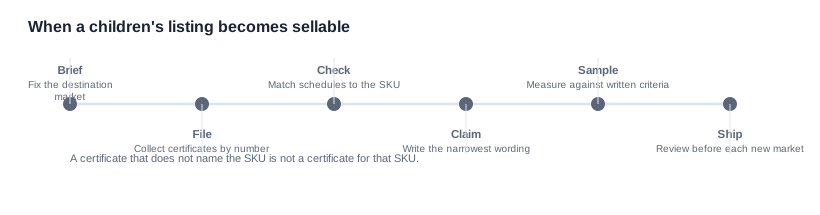
And the two questions that decide whether the file is usable rather than merely present. Can you have the documents themselves, not a summary? And will the supplier commit to the certificate scope in the contract, so that a lapsed certificate becomes a breach rather than a discovery at the next shipment?
One red flag specific to this model. If a supplier answers the certification question with "it is the same as the other models in the range," that answer may be true and is still not usable. Three models sharing a family certification is a common position, and it is also the exact situation in which one model quietly falls outside a schedule. Insist on the schedule for this model.
A second red flag, subtler. A certificate list that names certificates but gives no validity dates usually means the list was assembled at some point and not maintained. Ask for the expiry date of each one, and then write a reminder into your own calendar, because a certificate that lapses mid-range converts a running product into a stopped one.
A third, and the one most likely to be missed in a children's range. Ask whether any test report in the file is specific to this model or derived from a platform test. A platform test tells you about the platform; it does not tell you that this finished product, in this configuration, sits inside it. The distinction is the same one that matters in the V06 comparison, where a family marking and a model report are different documents — and it is worth reading the IP ratings page alongside the certificate file rather than treating the two as one subject.
Our certification checklist sets out the file structure, and the model-level position is in A07 certification status.
What the row does not say about the radio and the duty cycle
Bluetooth V5.4 is a version number, and a version number is the beginning of a specification rather than the end of one.
Nothing is published about the radio profile, the codec, the supported profiles, the pairing behaviour or the multipoint behaviour. Each of those is a normal question about a Bluetooth product, and each is a question a channel's technical buyers will ask once the product is listed. If your listing copy needs to say anything about how the audio behaves, the answer has to come from the supplier's documentation rather than from the version number.
A caution that applies to any published radio version. A version indicates a Bluetooth specification level; it does not indicate audio quality, range in a particular environment, connection stability with a particular phone, or battery impact in real use. Each of those is measurable at a sample stage and none of them is on the row. See Bluetooth connectivity for how to frame the questions.
The battery row needs the same treatment, and it needs it more, because the two figures sit oddly together. Seventy milliamp hours and roughly twenty hours of rated use is a duty-cycle figure. Unless you know what the product was doing during those twenty hours — what audio level, what connection state, what ambient temperature — you cannot convert the rating into a capability your customer will recognise. Ask for the test condition, record it, and state it beside the figure. See battery life.
And the charge-time row has a scope question of its own. "Two hours or less" does not say from what state of charge, and a charge time quoted from a partial battery is not comparable with one quoted from empty. Our documentation does not state which applies here, so it is a question rather than a gap you can fill.
One more practical point about this model's position in the range. It publishes the largest cell and the only radio version among the three children's models, and it publishes the smallest feature set. A buyer who wants the radio version and the endurance and also wants a feature story is looking at a requirement this range does not currently satisfy in one SKU, and that is a range-planning decision to take before the enquiry rather than after it.
A question about pairing that is worth asking anyway, because the row is silent on it. Ask how many devices the product holds connections to, and whether simultaneous connections are supported. It is not published, it is a normal expectation in this category, and an answer that is "one at a time" changes what your listing may say and what your support team will hear about in month two.
And a question about the physical product that the specification row does not reach. Ask what the product is for, in the supplier's own words — not what it does, but what job it was designed to do. For this model that is a genuinely open question in our documentation, because the feature set is narrower than its siblings', and an answer that is not coherent with the published rows is worth discovering before the purchase order rather than after the listing goes live.

Defect categories, acceptance criteria and the contract
This is the check most buyers leave to the end, and it is the one that decides what a return costs you.
The published rows tell you what the product is. They say nothing about what counts as defective, who pays when a unit fails in the field, or what happens to a shipment that arrives outside your criteria. All three are contractual, and all three are far harder to change after production than before.
Four questions to put in writing.
- Which failures count as warranty returns? Not "malfunctioning units" — the categories. A unit that will not charge, a unit whose sensing does not fire, a unit with a damaged lens, a unit the customer says stopped working after a month. Each category has a different root cause and a different supplier remedy.
- What is the remedy? Replacement, credit or rework, and on what timescale. A supplier who will not name a remedy has declined the claim in advance.
- Who pays the freight, in each direction? Inward and outward are usually argued about and usually not written down.
- What is the acceptance route at the destination? What is measured, by whom, within what window after arrival — because a claim raised outside the window is a claim without a remedy.
And the physical questions that feed directly into defect categories, because none of them is published. Frame weight, temple length, lens dimensions and lens material. For a children's product these are not comfort questions; they are return questions, because a frame that does not suit the child is returned as unsuitable rather than as faulty, and a product returned as unsuitable does not become a warranty claim. Decide how your own acceptance criteria treat that category, because your supplier's will treat it differently.
And the terms that belong in the same document. MOQ, not published. Lead time, not published — and specifically what the lead time is measured from. Unit price at your actual volume including packaging, not published. Payment terms and deposit structure, not published. The MOQ, lead time, pricing, payment terms and contract terms pages set out how each is normally structured, and quality consistency covers the acceptance route itself.
Two terms that are easy to omit from a first order and expensive to add to a second. The first is a continuity commitment — how much notice the supplier must give before discontinuing a model, and what stock position is held in the last period. The second is a price-adjustment mechanism, which in a category with a small bill of materials and a volatile cell market is not a theoretical concern.** Both clauses are easy to agree in the first negotiation and nearly impossible to introduce afterwards, because by then the supplier knows what your switching cost is.**
And a term that belongs with the samples rather than the contract. Agree what happens if the sample passes and the production run does not. A supplier who will state, in advance, what evidence they will accept as a production defect has already told you what their quality control route looks like, and that answer is worth more than a written quality policy.
Running all of it as one enquiry
The most efficient version of this checklist is a single structured enquiry, and the reason is that the questions are not independent.
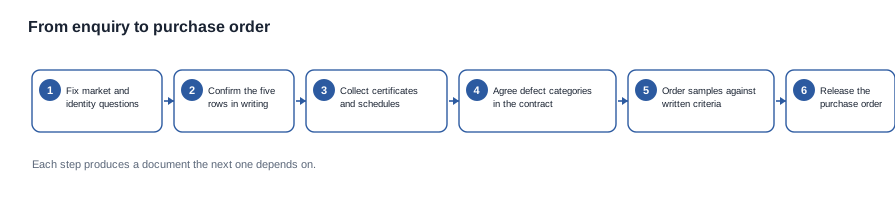
Send one message that asks, in this order. The identity and market questions. The five published rows confirmed in writing, with the runtime test condition and the charge-time measurement state stated. The certificates, by number, with model schedules. The feature set for this model specifically, given that it is narrower than its two siblings. The physical parameters. And the defect categories and the acceptance route, in contract language.
Why one message rather than a sequence. A sequential enquiry multiplies the elapsed time by the number of steps and repeatedly reopens questions. A single structured enquiry lets a supplier answer in one pass, and it makes the gaps visible: an answer that skips a numbered item is obvious in a way that an answer that arrives separately is not.
What to do with a complete answer. Write it into a technical file for this model, dated and attributed, before you issue the purchase order. Then write the listing from that file, using the narrowest wording each answer supports — which for this model means describing a radio version and a rated endurance figure, and stopping there.
What to do with an incomplete answer. Decide, explicitly, which gaps you can carry into the first shipment and which block it. Record that decision in the file with a reason, because at the second order the decision will be revisited by someone who was not present when it was made.
Two closing points that are specific to this model. First, the narrower feature set means the listing has to be written around the radio version and the endurance row, and that is a thinner page than a competitor with a feature story will have — so the compensation has to come from somewhere else, usually from the colour schedule, the packaging or the warranty. Decide which, before the quotation, because each one changes the MOQ.
Second, and this is the practical one. Because this model has less published about what it does, your own testing carries more weight than usual. The sample stage is where the product's behaviour gets described, so write the acceptance criteria with particular care here: what has to be true of the radio, what has to be true of the endurance, and what constitutes a failure in each. A narrow published row is not a reason for a narrow acceptance route.
Our position on this model is that the specification row is usable and the documentation load is the real product risk. We will not present roughly twenty hours of rated use as a measured endurance without a test condition, we will not infer a radio claim from a version number, and we will not present a certification position that our documentation does not publish. Tell us the destination market, the volume and whether the narrower feature set is acceptable for your channel, and we will tell you which checks have to be closed before the order and which can follow the first shipment.
Related reading
- The published rows and where they differ — A07 compared across the range
- Where the documentation gaps sit — A07 limitations
- The radio row in context — A07 battery life and charging
- The certificate question — A07 certification status


