

AI camera glasses market trends reach a procurement team as a single figure with no scope attached, and that figure is almost never the thing the purchase depends on. What a buyer can actually use is narrower and more durable: the structure of the published specification rows, the questions those rows force, and the gaps that only a supplier can close. This article sets out that structure, the five claims to refuse when they arrive unscoped, and the seven questions that belong in the first supplier call. We do not publish market size, market share or growth-rate figures, and the section on why an unscoped number cannot settle a purchase decision explains the reasoning rather than offering a substitute for it.
AI camera glasses market trends: what a buyer asks instead of a number
The published position in this category is unusually informative for a narrow reason: the catalogue specifies twenty-eight models in total, eleven of which carry a camera, and for those eleven the electrical rows are complete enough to compare directly. That is the substitute for a market report. A buyer cannot tell you whether a segment will grow, and no supplier can tell you that with evidence either. A buyer can tell you that the range splits into two resolution tiers, three charge-interface positions and a case-versus-no-case distinction that is published for some models and absent for others — and every one of those splits changes what the buyer has to ask.
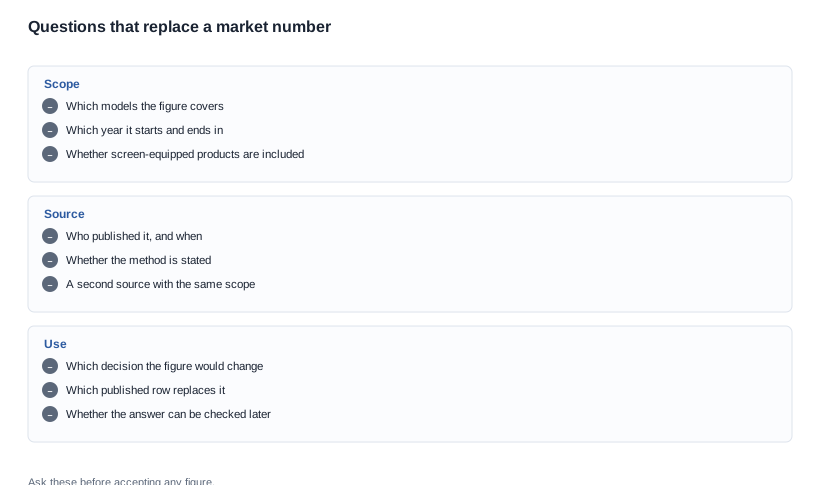
Three questions cover most of what a market number would have told you, if the number had been sound.
What is actually changing in the published rows? A trend in a technical category is a change in what suppliers publish, not a change in a headline figure. When a row appears on a new model that was absent on its predecessor, that is a direction signal you can verify. When a row disappears, that is a signal too. The published catalogue makes this observable: charge time is published for all twenty-eight models, resolution is published for all eleven camera models, while the charging interface is published for a majority and left open on four of the camera models.
Which structural grouping does my requirement fall into? This is a shortlist question, not a trend question, and it is worth answering before any commercial call, because it decides what you ask for and what you refuse to pay for. If your channel needs one charge interface across the whole range, the interface row becomes the first filter. If your channel cannot carry a second lithium cell, the case row becomes the filter. If your listing leads on still images, the resolution row becomes the filter.
Which published rows are missing for the models I am considering? This is the question that turns an unscoped market claim into a procurement action. Every camera model publishes a resolution, a cell capacity, a charge time and a rated runtime. Four of them do not publish which charge interface they use. Only one of them publishes a weight. Two of them publish an ingress rating. This is where your supplier diligence goes, and it is a better use of a call than any conversation about market growth.
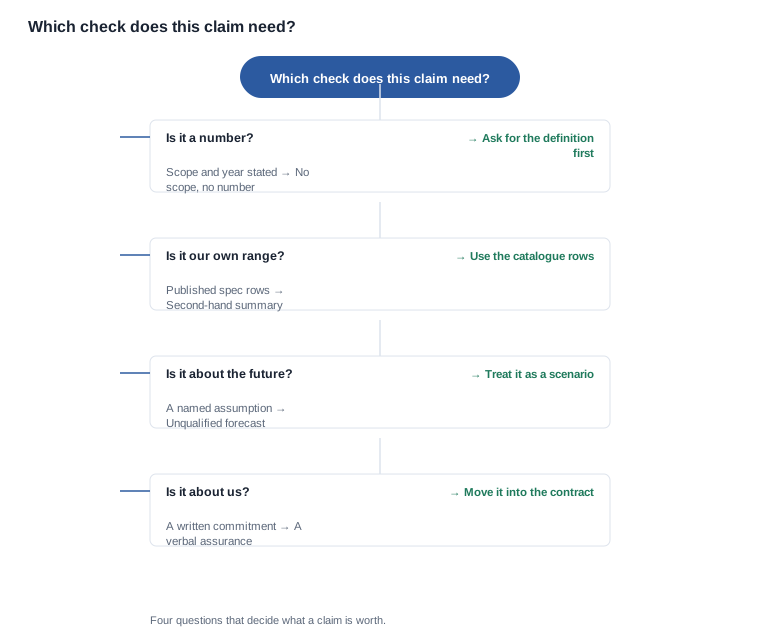
How to evaluate the answer you get back. The three questions above are easy to ask and easy to answer badly. A supplier who replies with a brochure has not answered them. The evaluation criteria are simple: does the answer name a model designation, a number or a document; does it carry a date or a version; and would it still be true for the configuration you intend to order. If the reply to any of the three is a paragraph rather than a line, that is a signal to put the same question to the next supplier before you compare the answers. Before you order anything, you want the answer in a form your compliance reviewer can check, not a form a sales contact can repeat.
The order matters. A buyer who asks for a market number first will spend the meeting on a number the supplier cannot substantiate and the buyer cannot verify. A buyer who opens with the published rows and the gaps gets a supplier to talk about the specifications, the documentation and the commercial structure, which are the three things that actually determine the outcome of an order.
Why an unscoped figure cannot settle a purchase decision
An unscoped figure is not a small gap in the evidence. It is a different kind of claim, and the difference shows up the moment you try to use it.
A market value only means something against a definition. Three definitions are in play for any camera-equipped glasses category, and they produce different numbers from the same year. A scope that counts display-equipped products measures a different market from one that excludes them. A scope that counts only units with a camera measures a different market from one that counts every glasses product with a radio. A scope that counts consumer sales measures a different market from one that counts shipments into a channel. The number on the slide carries none of that, because the slide is not a methodology document.
The second problem is that the figure cannot be checked. A number with a source and a year can be checked, re-read and argued with. A number without a scope cannot be checked, because there is nothing to check: the reader would have to guess which of several incompatible series was meant, and the guess changes the conclusion. In a procurement file this is decisive. A requirement that cannot be audited cannot be defended to a compliance reviewer, and a price tier built on an unauditable number cannot be defended to a channel partner when the margin does not appear.
The third problem is the one that costs money. A buyer who acts on a growth figure has bought the expectation that the category is expanding, and has usually priced the programme as though it will sell quickly. The relevant question is narrower and more useful: is my volume coming from the segment where price competition is densest, and what does my product carry that a listing page cannot? Those two questions have answers that come from the supplier and from your own channel data. The growth figure has no answer at all.
So the rejection is not scepticism for its own sake. It is that the figure is unusable for the decision it is being offered for, while the published rows are usable for exactly that decision. The AI camera glasses buying guide covers how to turn the range into a shortlist; the AI camera glasses competitor landscape covers the competitive set, and the smart eyewear range best selling categories piece covers how the category structure is usually described.
Reading technical direction from published specification rows
Because the catalogue publishes complete rows for eleven camera models, the technical direction in this category is observable rather than inferred. Three groupings do most of the work, and each of them is a fact rather than a forecast.
The resolution split is a two-tier structure, and it is unambiguous. Three camera models publish a 13 MP resolution row: the L1 Pro and the L2 Utral, and the S7. The other eight camera models publish an 8 MP row. That is the entire published resolution structure of the category, and it is more useful than a market chart because it tells you exactly which product groups a competitor can and cannot copy with a specification claim. A listing that leads on "13 megapixels" is making a claim that only three models in our range can match, and that is checkable against a supplier sheet in one question.
The charge-interface split is a three-way structure. Among the eleven camera models, five publish magnetic charging, two publish a Type-C port, and four publish neither. The four that publish neither are not the same thing as the four that publish a magnetic port with a case: CY05 and L1 Pro, and MT6 and CY03 each publish a charging-case capacity but leave the interface unstated. If your channel wants one cable across the range, that group of four is where your diligence goes, and the question is simple enough to put in writing.
The accessory split is a five-versus-six structure. Five camera models publish a charging-case capacity: the CY03 and the CY05, and the L1 Pro — each at 1400 mAh, the L2 Utral at 900 mAh or 1400 mAh, and the MT6 at 1200 mAh in a folding case. The remaining six publish no charging-case row at all, which is a different statement from publishing that they ship without one. A second lithium cell per unit changes packed weight, freight class, battery transport paperwork, warehouse volume per unit and the customer's charging routine, so this grouping is a commercial grouping as much as a technical one.

How to build the shortlist without a market report. Take the rows your deployment actually depends on, list them in the order the failure would hurt most, and read them across the eleven camera models. A deployment that cannot tolerate a short shift and a deployment that cannot tolerate a second lithium cell produce two different shortlists from the same catalogue. Where two rows point at different models, the deployment has not been specified tightly enough yet, and the honest conclusion is that the requirement needs another question rather than a different model. That is the point at which the supplier list starts to matter more than the range list.
Two further observations are worth carrying into a supplier call, because they show the difference between a complete row and an absent one. Charge time is published for every model in the catalogue: twenty-six of them at two hours or less, and two at about one hour. What is not published is the starting state of the cell and the point at which charging is treated as complete — which means the published figure is a ceiling, not a measured cycle. And the camera models publish no Bluetooth version at all, so any statement about radio behaviour on these models has to come from a supplier rather than from a catalogue page.
That is the whole of what a technical trend in this category can be grounded on. It is less dramatic than a market forecast and considerably more actionable, because every item in it can be checked on a quotation, a specification sheet or a sample.

Five claims that arrive without a scope
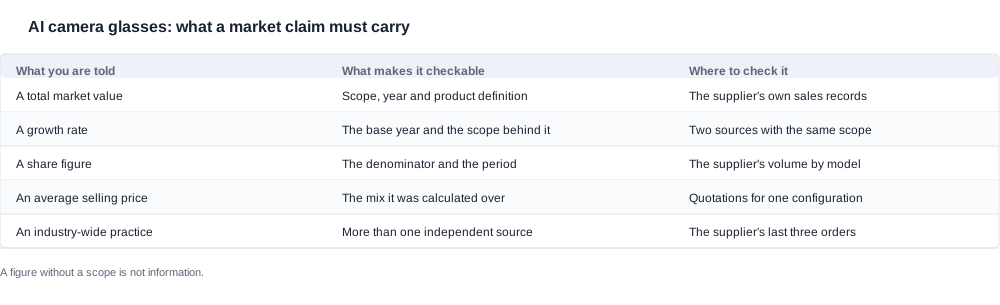
These five are the ones that show up most often in a sourcing conversation, and each of them fails for a reason the buyer can state in one sentence. Naming the failure is more useful than issuing a general warning, because it lets the buyer redirect the conversation in the same meeting.
A total market value for the category. The failure is that the value is only defined against a product scope, and the scope is rarely stated. A buyer cannot compare two values from two houses unless the scopes match, and in this category they frequently do not, because one series may include display-equipped products while another treats them separately. Redirect: ask which models and which years the figure covers. If the answer is a product description rather than a model list, the figure cannot be used.
A growth rate. The failure is that a growth rate is a statement about two points in time, and both points inherit the scope of the underlying series. A rate quoted without its base year is not a growth rate, it is a direction. Redirect: ask for the base year and the definition behind it, and treat the answer as a scenario rather than a forecast.
A vendor or category share. The failure is that a share figure requires a denominator, and the denominator in a category where the units are defined loosely changes faster than the numerator. Redirect: ask what the denominator is and over what period. A share number without a denominator is a marketing claim.
An average selling price for the segment. The failure is that an average is only meaningful against a mix, and the mix in this category includes models with a charging case and models without, models with a 13 MP row and models with an 8 MP row. Redirect: ask which models are in the average, and ask for a quotation against your own configuration instead.
An industry-wide practice. The phrase covers everything from "this is how every factory does it" to "this is what the regulation requires", and the two have opposite force. Redirect: ask for the specific source and the specific scope. If the practice cannot be named, it is a habit, and a habit is not a constraint on your purchase order.
The way to handle all five is the same, and it is worth having scripted before the call. Name the claim, name what is missing from it, ask the one question that would supply the missing part, and move on if the answer does not come. A buyer who does this once will be offered fewer numbers in the second meeting, because a supplier learns quickly which questions get an answer. The red flags to watch for in the reply are specific: a figure with no year, a share with no denominator, an average with no mix, and a practice with no source.
There is a fifth pattern worth naming even though it is not a number: a figure attached to a customs code. Customs classifications for camera glasses often aggregate a product with unrelated goods, so a per-category export value is not obtainable from the aggregate. Do not estimate it, and do not accept an estimate from anyone else, including from a supplier who offers one readily. The correct response is to say that the code does not isolate this product.

A sourcing walkthrough for a brand entering the category
The following is a hypothetical sourcing walkthrough, written to show the decision sequence rather than to report a result from a client project.
Assume a consumer electronics brand with an existing accessory business is deciding whether to add a camera-equipped glasses line for a spring launch. The brand has no glasses history, a small team, and a market entry plan for two territories. Its constraint is not capital; it is that it cannot afford a launch in which the units arrive with documentation that does not cover them, because the brand has no one on staff who can chase a conformity file.
The brand's first step is deliberately unglamorous. It writes down the deployment it is actually buying for: staff carrying the unit through a working shift, recording hands-free documentation, with the recording uploaded at the end of the shift. That deployment produces four published rows that govern the purchase — the rated runtime band, the charge-time ceiling, the charge interface and the model designation that will appear on the documents and the carton.
The second step is to group the range against those four rows. The runtime row divides the eleven camera models into three bands: five to eight hours for the V03 and the S7, and the V03 Pro and the V06; six to eight hours for the KY06 and the MT5; and about seven hours for the CY05 and the L1 Pro, and the MT6 and the L2 Utral, and the CY03. The interface row divides them five, two and four. The brand learns at this stage that four models — those with a published case capacity — leave the interface unstated, and that only the V06 and the S7 publish an ingress rating, which matters because one of its two territories is a coastal market.
The third step is the question that replaces the market figure. The brand asks each candidate supplier for the same four items, in writing: the model designation that appears on the conformity documents for each variant it would order; the charge interface for each of those variants; the packed weight and carton dimensions for each configuration; and the certificate numbers that cover those exact variants. Three of the four are answered with a document. The fourth is answered with a range that differs between suppliers, which is precisely the information the brand needed and could not have obtained from a market report.
The fourth step converts the answers into contract language. Each published row becomes an acceptance criterion: a charge time at or under two hours, a runtime inside the published band for the model, a case capacity matching the published figure where a case ships, and a designation on the units matching the designation on the documents. Rows that are not published are recorded as open items with a named owner, rather than being quietly dropped.
The outcome of the walkthrough is a narrower range than the brand expected and a defensible purchase order. The decisive work happened before the first sample order, and none of it involved a market number.
Where our published position stops and the supplier's begins
On AI camera glasses market trends, our position is that the direction of travel in this category is visible in the published specification rows, and that the size of the category is not something a catalogue should attempt to state. We publish twenty-eight models with their electrical rows, eleven of them camera-equipped, and we publish which of those rows are absent for which model. We do not publish a market size, a market share, a growth rate, an average selling price or an industry-wide practice, because our documentation does not contain them and an estimate that becomes a quotation is worse than an open question.
There is a second boundary worth stating plainly. The catalogue includes a company-level export certification page with image content instead of text content, and the catalogue text points to no CE, FCC or RoHS marking. There is no per-model certification row anywhere in it. That means every certification question a buyer asks about a specific model is a question for the supplier, and it means the written answer you need is a certificate number with an issuing body and validity dates, not a mark on a carton. The O-series compliance analysis covers what that evidence needs to contain, and the AI camera glasses which model to pick piece covers how the range decision and the model decision connect.
If you are sourcing in this category, send us the deployment, the territory, the volume band and the model designations you are considering. We will tell you which published rows apply to each of them, which rows are missing for each of them, and which questions those gaps put on your supplier list.
Related reading
- Where the range decision sits — AI camera glasses buying guide
- The model decision — AI camera glasses which model to pick
- The competitive set — AI camera glasses competitor landscape
- The category structure — smart eyewear range best selling categories
- The compliance evidence — OEM ready platforms certification coverage


