

AI camera glasses competitor landscape is not a list of rivals. It is a list of specification rows that any supplier's sheet can be screened against, and the buyer who has those rows in front of them can hold a conversation with any factory without needing to know a single brand name in the category. The brands are irrelevant to the method; the rows are what decide it.
This article is that method. It sets out which published rows a comparison can be built on, which questions turn a catalogue sheet into evidence, and how to run a screen that produces a shortlist rather than an opinion. It deliberately contains no competitor names, no competitor pricing and no market-share estimate — because our catalogue does not publish market data of any kind, and a procurement framework built on unverifiable numbers is worse than no framework at all.
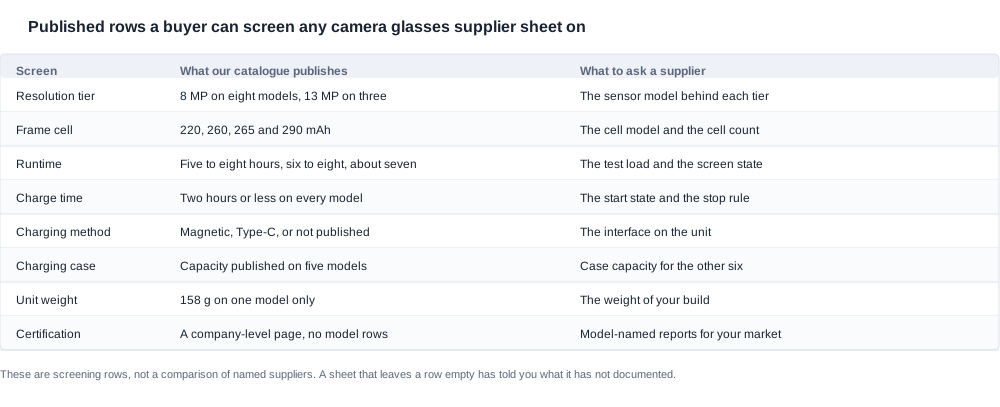
Our own position in that landscape is worth stating at the start. We publish twenty-eight catalogue entries, of which eleven are camera models: the CY05 and the V03, the S7 and the L2 Utral, the MT6 and the V06, the KY06 and the V03 Pro, the L1 Pro and the MT5, and the CY03. The eleven divide into a published resolution split — 8 MP on eight of them and 13 MP on three — and a published frame-cell split. That is the structure a screen can be run against. What follows is how to run it.
AI camera glasses competitor landscape: run the comparison on published rows
A comparison in this category usually goes wrong in one of two ways, and both are avoidable without knowing anything about the competitors.
The first failure is comparing marketing pages. Product pages are written to close a sale, not to be read by a procurement team, and they are not comparable to each other because they are not written to the same criteria. One page leads with a megapixel figure, another leads with a battery claim, a third leads with a feature list. Placing those three side by side produces a comparison of rhetorical choices rather than of products, and it tells a buyer nothing about which sheet is more reliable.
The second failure is comparing published rows against quoted terms. A published row is a fact that can be accepted or rejected; a quoted term is an offer that can be negotiated. If they sit in the same column of a comparison sheet, the comparison is incoherent, and the conclusion that follows from it — that one supplier is more expensive — is an artefact of the sheet rather than a finding about the market.
The remedy for both is a separation, and it is the whole method. Rows are for comparison; terms are for negotiation. Build the first sheet on the rows that exist in everyone's catalogue, and keep the second sheet — MOQ, lead time, unit price, payment terms, packaging, warranty, tooling and NRE treatment, sample terms — for the conversation that happens after the shortlist has narrowed. A supplier does not need to be beaten on a price to be beaten on a screen; a sheet with twelve empty cells is a weaker position than a sheet with twelve documented answers, and that is a comparison a buyer can make without naming anyone.
There is a third discipline that makes the screen fair. Ask every supplier the same questions, in the same order, and record the answers in the same format. A screen built from what each supplier chose to publish first is not a screen; it is a ranking by marketing effort. The published sheet is the baseline, the identical questionnaire is the correction, and the empty cells that remain after both are the questions that are still open when the order is placed.

Six published rows that let a buyer screen any supplier sheet
These are the rows that exist across this category and that a buyer can therefore use as a common frame. They are grouped here by what they settle, and each one has a corresponding question that turns a published number into evidence.
Resolution tier. A megapixel figure is the row most often quoted and least often interpreted. It settles the class of the imaging module and nothing else: not the sensor, not the field of view, not the video output, not the low-light behaviour. On our own range it is a two-tier structure — 8 MP across eight camera models and 13 MP across three — which is the shape most of this category takes. The screen question is which tier each model sits in, and the evidence question is what sensor sits behind the tier.
Frame cell capacity. This is the published row that most reliably predicts the shipped weight, and it is published for every model in our range. It is also the row that a supplier's sheet is most likely to express in a form that cannot be compared — a total for a multi-cell pack, or a value that quietly includes an accessory. The screen question is the cell capacity and the cell count as separate numbers, because they are separate things.
Runtime. Published for every model in our range, and published as a band or as a single figure depending on the model. A band and a single figure are not comparable with each other, so the screen has to record which kind it is. The evidence question is the test load, the screen state and the ambient conditions, because a runtime without a condition cannot be compared to a runtime with one.
Charge time. Published for every model in our range at two hours or less, which is a ceiling rather than a measurement. Two suppliers can both publish a compliant ceiling and have entirely different real-world behaviour, and the screen has to record the ceiling as a ceiling. The evidence question is the starting state and the termination rule, because a charge time measured from an empty cell is not the same claim as one measured from a partly discharged cell.
Charging method. Magnetic, Type-C, or not published. On our own range the method is published for seven of the eleven camera models and absent for four — the CY03 and the L1 Pro, and the MT6 and the CY05. It is worth noticing that those four are exactly the models that publish a case capacity, which means the packaging and the in-box contents of four models cannot be finalised from the catalogue alone.
Charging case and unit weight. The case capacity is published for five of our eleven camera models and the unit weight for exactly one — 158 g for the MT6 glasses unit, which includes the battery and the camera and excludes the foldable case. These two rows together are the ones that decide the parcel, and they are the least complete across the category. A screen that ignores them will compare two suppliers on cells and battery and will miss the difference that actually reaches the buyer as a freight cost.
How the six rows should be recorded. The format matters more than the rows themselves, because a screen is usually read by somebody who was not present when it was built. Four rules keep it readable. Record each value with its unit and, where the supplier gives one, its condition — a runtime with its test load, a charge time with its starting state, a capacity with its cell count. Record the source of each value as a link or a document reference rather than as a note, so that a later reader can go back and check it. Leave a cell empty rather than filling it from a neighbouring supplier's sheet, because a wrongly filled cell is worse than a gap: it looks answered. And date every column, because a screen that is four months old will be used as if it were current.
There is one more practice that separates a screen that works from a screen that gets abandoned. Convert every empty cell into a named question before the screen is circulated. A sheet with forty empty cells looks like a failure and will be left on a desk. A sheet with forty empty cells and forty named questions looks like a work plan, and each question can then be routed — to a supplier for a written answer, to a sample for a measurement, or to a decision to accept the gap and write it into the order as a known limitation.

The three questions that turn a supplier sheet into a shortlist entry
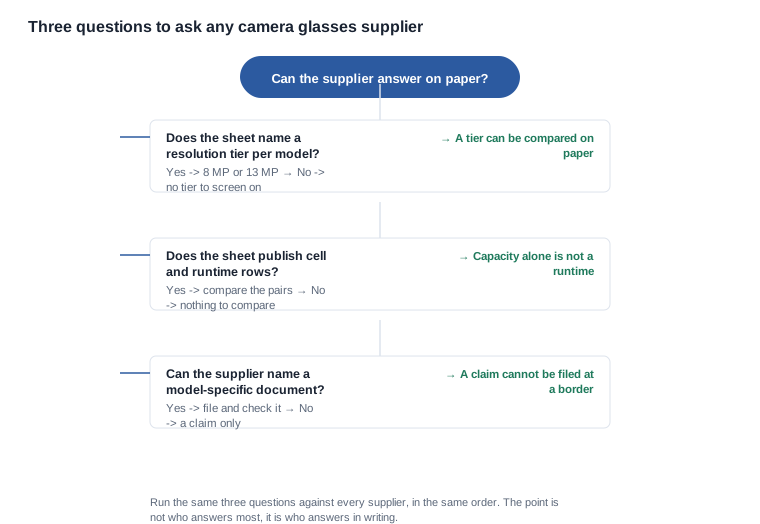
A screen produces a shortlist only if it produces evidence rather than impressions. Three questions do most of that work, and the reason they work is that each of them has a falsifiable answer.
Question one: does the sheet name a resolution tier for each model, rather than for the range? A range-level resolution claim cannot be screened, because it tells a buyer nothing about which unit on the order has which tier. A model-level tier can be checked against the sample, which is what makes it evidence rather than marketing. If the answer is yes, the model can go on the shortlist. If the answer is no, the model stays on the sheet as an open question.
Question two: does the sheet publish the cell capacity and the runtime as separate rows? These two are often merged into a single endurance statement, and the merge is where comparisons go wrong. Cell capacity determines the base weight of the shipment; runtime determines the customer's day. A supplier who publishes both separately has shown that they are aware of the difference, and a supplier who publishes only a combined statement has not.
Question three: can the supplier name a model-specific document? Not a company statement, not a capability description, and not a certificate number on a different model. A document naming the designation that will appear on the unit. This is the question that separates a supplier who can be filed in a compliance folder from a supplier who can only be described, and it is the one that decides whether a first shipment is a programme or an incident.
There is a fourth question that is less technical and often more revealing, and it belongs here because it is the one most often skipped. What does the supplier do when a row is empty? A supplier who answers "the catalogue does not publish that, and here is the document that does" has a documentation habit. A supplier who fills the gap with an estimate has shown you exactly which figures in their sheet you cannot rely on. Knowing where a supplier's knowledge ends is worth more than knowing where it begins.
Two further questions close the screen, and both are about programme rather than product. What is the minimum order for each configuration that is being compared? Not because the answer is interesting, but because a configuration with a high minimum cannot be compared against one with a low minimum at the same planned volume, and the screen will produce a false winner if it ignores that. And what is the lead time for the configuration, split between production and delivery? A model with a long lead time that is the only one satisfying every published criterion is not a shortlist candidate; it is a programme risk. Both answers belong on the quotation sheet rather than on the specification screen, and the screen's job is to make sure the two are never confused.

Building the shortlist without a table of names
The output of a screen is a shortlist with visible gaps, and the format matters more than the scoring. A shortlist that shows only the completed rows is misleading, because it makes the unanswerable rows look like rows that were not asked about.
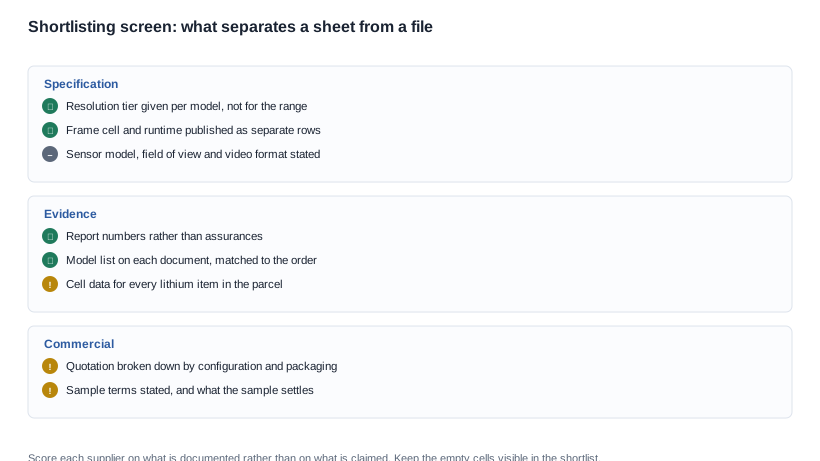
The format that works has one line per model and one column per published row, plus two columns that are not rows at all: evidence held and questions still open. A model with a complete line and a short evidence column is ready for a quotation. A model with a complete line and a long questions column is a model worth a sample order, because the sample is what converts the open column into a decision. A model with an incomplete line and a long questions column is a model that has not been screened, and it stays off the list until it has been.
Scoring is where these screens usually go wrong, so it is worth setting the rule in advance. Score documentation, not capability. A supplier that publishes fewer specifications but files every one of them with a resolvable document is in a stronger position than a supplier that publishes more specifications and evidences none, because the first supplier's shortlist can be turned into a purchase order and the second supplier's has to be turned into a sample order with a test programme attached. That rule also keeps a comparison honest without needing to know anything about market position, brand strength or customer base — none of which our catalogue publishes and none of which a procurement team can verify from a product page.
The second rule is to keep the comparison to the models that are actually orderable. A sheet that includes a concept, a prototype, a discontinued line or a region-only variant will produce a larger and more impressive table and a smaller and more accurate shortlist. The third is to record the answer date. A screen is a snapshot, and a supplier sheet that was accurate eight months ago may not be the sheet you are reading now, particularly in a category where certification status and platform structure both move.
The boundary of a fair comparison in this category
There are limits to what any framework in this category can deliver, and stating them is part of a fair comparison.
A screen cannot rank product quality. It ranks documentation. Two suppliers can publish identical rows and one of them can be building a better camera, and the published material does not settle it. The honest conclusion from a completed screen is that a supplier's evidence is complete, not that their product is superior.
A screen cannot price the programme. Nothing in a published sheet settles MOQ, lead time, unit price, landed cost, payment terms or margin. Those are quotation items and they are only comparable once quoted. The AI camera glasses buying guide covers the category decision that precedes the comparison, and the OEM ready platform readiness overview covers where platform readiness is documented rather than asserted.
A screen cannot tell a buyer which market to enter. Our catalogue publishes no market size, no market share, no growth rate and no sales ranking for this or any other category, and we will not offer one. A supplier who offers a share figure for a category that is not publicly measured is either quoting a research house that should be named and paid for, or estimating. Either way the figure belongs in the file with its source attached rather than in a comparison column.
A screen has a shelf life, and it is shorter than people expect. Certification status changes, platforms are revised, models are added and withdrawn, and a sheet collected at the start of a programme can be wrong by the time the order is placed. The two most common pitfalls are treating a document that has lapsed as a document that exists, and treating a model that has been superseded as a model that will be produced again. The remedy is procedural rather than clever: put a review date on the screen, set it against the delivery schedule rather than against the order date, and re-run the screen whenever a supplier announces a platform revision.
What a screen can deliver is a defensible answer to a narrower and more useful question: which of these suppliers has published enough to be worth a quotation, and which of them can evidence it. That is a question a procurement team can act on, it can be answered entirely from documents rather than from impressions, and it produces the same result whatever the brands in the category happen to be.
The rest of the reading in this category handles the parts of the work a screen does not cover. The certification coverage notes set out the documentation side, the export documentation checklist covers what has to be in the file before a shipment, the sample before bulk notes handle the stage where open rows are converted into measurements, and the quality checks cover the inspection criteria that a shortlist should be judged against once an order is placed. The wider market context sits in the market trends notes, and we treat it as context rather than as a screen: our catalogue publishes no market size, no market share and no growth rate, so nothing in that material is a substitute for a supplier's own documented rows.
If you are running a screen on this category, send us the sheets you have collected and the models under consideration. We will tell you which published rows you can compare directly, where the differences in the sheets are differences in published scope rather than differences in product, and which rows will have to become a sample programme before an order. The range is at AI camera glasses, and the broader market context sits in the market trends notes.
Related reading
- Deciding the category — AI camera glasses buying guide
- Documentation depth — OEM ready platforms certification coverage
- Turning open rows into measurements — OEM ready platforms sample before bulk
Send us the sheets you have collected, and we will tell you which rows can be compared directly and which will need a sample programme.


