

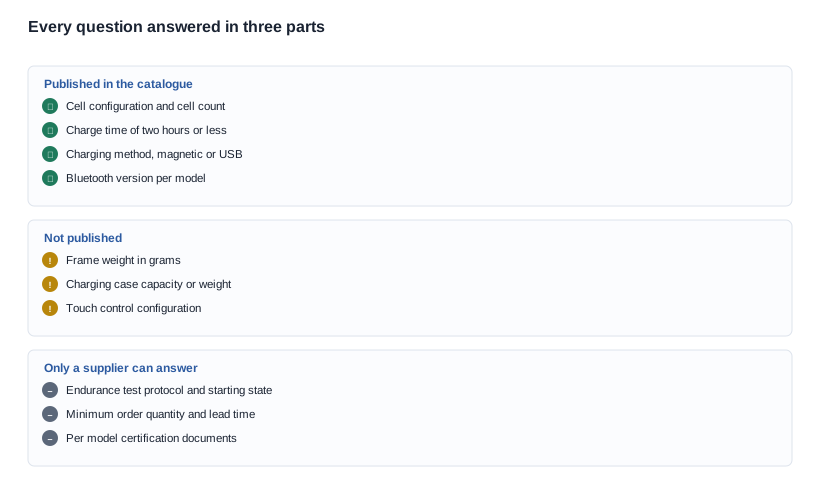
Buyers ask the same questions about this range in almost the same order, and the useful thing about the questions is that most of them have a definite answer that can be traced to a published row — while a smaller set have no answer at all, and the correct response to those is to say so rather than to fill the silence with a plausible figure. This article answers eight of the most common questions about Bluetooth audio glasses in a consistent three-part form: what the catalogue publishes, what it does not publish, and what has to be asked of a supplier instead.
Bluetooth audio glasses common questions: the eight-model reference
Before the individual questions, the range has to be stated correctly, because a large share of the confusion in this category comes from models being counted into the wrong family. The audio range is eight models, and it is worth writing them out once.
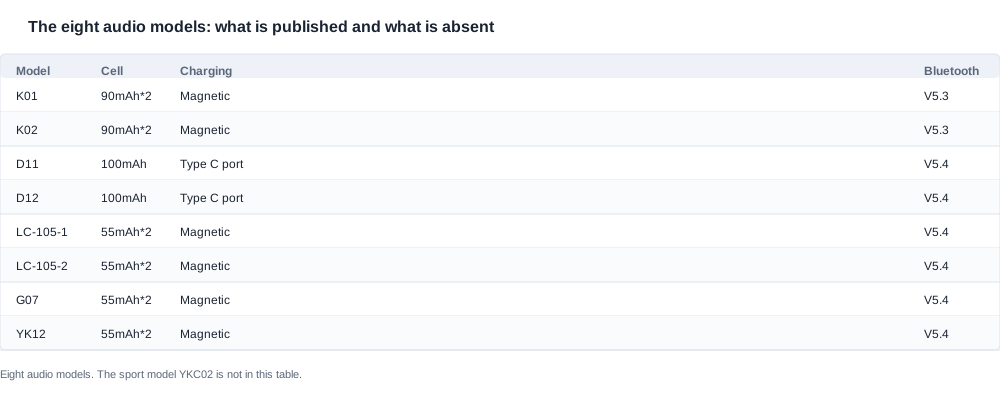
The eight audio models are the LC-105-1 and the LC-105-2, the D12 and the K01, the G07 and the D11, and the YK12 and the K02. The YKC02 is not among them: it is a sport model that happens to sit in the same stretch of the catalogue, and counting it into the audio range is the single most common classification error made about this family. Its cell configuration, 70 mAh × 2, also differs from every audio model, which is usually the clue that it has been counted into the wrong group.
Those eight rows answer the majority of the questions below before they are even asked. Within the eight, the published rows divide as follows. Six models charge magnetically and two charge over a Type C port. Two models publish a 90mAh*2 cell, four publish 55mAh*2, and two publish a single 100mAh. Two models publish Bluetooth 5.3 and six publish 5.4. Every one of the eight publishes a charge time of two hours or less.
Which models are on which Bluetooth version?
What is published. The K01 and the K02 publish Bluetooth 5.3. The G07 and the D12, the LC-105-1 and the D11, and the LC-105-2 and the YK12 all publish Bluetooth 5.4.
What is not published. The catalogue does not state whether the version refers to the radio in the frame, the profile supported on the phone side, or anything bundled with the product. It does not publish a supported codec list, a transmission range, or a pairing limit.
What to ask a supplier. Which side of the link the published version describes, whether the same figure applies to every unit in the order or only to the sample, and whether the version is held constant across production runs or can change with a component substitution.
Which model has the longest published endurance?
What is published. The highest rated figure in the audio range is about eight hours, and it appears on four models: the K01 and the K02, and the LC-105-2 and the LC-105-1. The G07 and the YK12 publish about six hours. The D11 and the D12 publish about seven hours.
What is not published. No model publishes the starting state of charge, the end-of-test criterion, the volume setting, or a test protocol of any kind. There is also no indication that the figures were taken under one shared protocol, and the cell rows suggest they were not: the LC-105-1 and the LC-105-2 publish 55mAh*2 with about eight hours, while the G07 and the YK12 publish the same 55mAh*2 with about six hours.
What to ask a supplier. The starting state of charge and the end-of-test criterion behind each published figure, the playback load used, and whether the figures were taken from the same units under one procedure. A buyer comparing these numbers without that answer is comparing measurements of unknown provenance. The battery comparison article works through the same issue across the power rows.
What is the charge time, exactly?
What is published. All eight audio models publish a charge time of two hours or less. This is an upper bound rather than a measured value, and it is worth being precise about the distinction: a ceiling of two hours permits a unit that takes exactly two, whereas a claim of being under two hours does not.
What is not published. No starting state of charge, no charger rating, no indication of whether the figure is for the frame alone or for a frame and case together, and no termination criterion.
What to ask a supplier. Whether the two-hour figure assumes a particular charger output, whether it applies with a case attached, and what state of charge counts as complete. The charging options article treats this ceiling and the accessory question in more depth.
Which models charge magnetically and which over a Type C port?
What is published. Six models publish magnetic charging: the LC-105-2 and the K02, the K01 and the YK12, and the LC-105-1 and the G07. Two publish a Type C port: the D11 and the D12.
What is not published. Nothing about the carton. The catalogue publishes no charging-case row for any of the eight models — no capacity, no weight, no interface, and no statement about what is included in the box at any order quantity.
What to ask a supplier. Whether a pad, a dock or a case is included at the ordered quantity, and if a case ships, its capacity, weight, interface and own charge time. The absence of a case row means the catalogue is silent on the subject — it does not mean the models have no case.
What is the frame weight?
What is published. Nothing. No audio model in this range publishes a frame weight, a temple length, a lens dimension or a nose pad specification.
What is not published. All of the above, for all eight models. There is also no published tolerance, no measurement standard and no indication of whether any figure would be a bare frame or a shipped unit.
What to ask a supplier. The unit weight in grams as the unit ships, the temple arm length, the lens dimensions, and whether the quoted weight includes the cell. A supplier weighing a bare frame will give an accurate answer to a different question. The comfort and fit article sets out the measurement programme that fills this gap.
Do the models have touch controls?
What is published. Nothing on touch. The catalogue publishes no touch row for any model — not the K01, not the K02, and not any other model in the range. Where the catalogue does publish control-related rows at all, they belong to a different product entirely, and even those describe a button rather than a touch surface.
What is not published. Whether a touch surface exists on any temple, how it is configured, which gestures it recognises, and whether it can be disabled.
What to ask a supplier. Whether the temple carries a touch surface, how it is configured, what it does on a long press, and whether the behaviour is the same across the colourways in the order. This is a question to ask rather than a feature to assume, because a product page that implies touch control without a published row is making a claim the catalogue cannot support.
Which models have a surround-sound feature?
What is published. The D11 publishes a surround-sound row alongside a long-endurance row. The YK12 publishes a row combining surround sound with a slim temple. The G07 publishes a slim temple with a detachable temple.
What is not published. The D12 publishes no feature row at all — it carries the five standard specification rows and nothing beyond them. It is the only model in the audio range with no acoustic descriptor whatsoever, and any claim that it shares the D11's surround-sound treatment is unsupported.
What to ask a supplier. What the surround-sound row describes physically — driver count, driver size, or a processing mode — and whether the D12 differs from the D11 in any way beyond the absence of that row.
What about certification, warranty and commercial terms?
**What is published.A single company-level export certification page appears in the catalogue with image content rather than text content, and no CE, FCC or RoHS reference appears in the catalogue text. There is no per-model certification row anywhere in it.
What is not published. Certification identifiers, warranty periods, minimum order quantities, lead times, production capacity, prices and defect rates. None of these is published for any model in the audio range.
What to ask a supplier. Which certification documents exist for the exact configuration ordered, whether each document names the model or configuration on it, the warranty period as a period rather than a percentage of order value, the minimum order quantity against a frozen configuration, the lead time with milestone definitions, and the defect rate on the previous production run. The certification article covers the document set in detail, and the bulk ordering article covers the commercial terms.

The method behind these answers, and where it stops
All eight answers above follow the same three-part structure, and the structure is the transferable part rather than the answers themselves. Check whether a published row covers the question. If one does, quote it and stop. If none does, say the catalogue is silent — and do not read silence as a negative answer, because the most common analytical error in this category is converting an absent row into a claim that the feature does not exist.
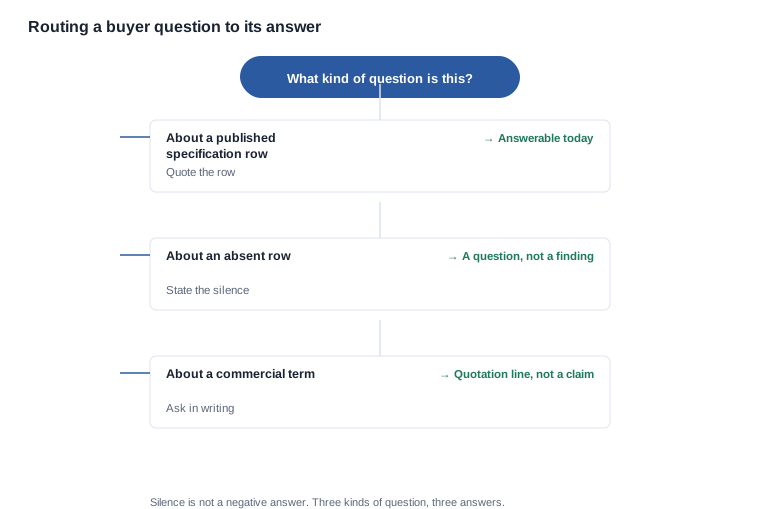
That error has a specific shape worth naming. The catalogue publishes no touch row, and the tempting conclusion is that these models have no touch control. The catalogue publishes no case row, and the tempting conclusion is that these models have no case in the box at all. Both conclusions are inferences the source does not support, and both are the kind that later surface as a product-page correction or a customer complaint. The honest statement is that the row is absent and the question belongs in the supplier questionnaire.

Our published position is the one this structure is built on. We publish the electrical rows and the feature rows for all eight audio models, in the form the factory builds them. We do not publish frame weights, case capacities, prices, minimum order quantities, lead times, warranty periods or certification identifiers, and we would rather tell a buyer that plainly than quote a typical figure that cannot be verified against a configuration. Where a question falls outside the published rows, it belongs in the request list rather than in the specification sheet — and that distinction is what keeps a shortlist defensible when a competitor or an inspector asks where a particular claim came from.
Why the three-part structure beats a single confident answer
The reason this structure is worth the effort is that it survives contact with a supplier. A single confident answer to an unpublished question — a plausible weight, an assumed case capacity, an implied touch feature — looks better on a specification sheet and is worth less than nothing once it is contradicted. The three-part form is slower to write and considerably more useful, because each part has a different downstream consequence.
The published part can be quoted directly into a technical specification and frozen there. It does not need to be renegotiated, because it is the same figure for every buyer. The absent part, stated as an absence, tells everyone in the room which question is still open and prevents the open item from being quietly closed by whoever writes the specification next. And the supplier part converts an unknown into a quotation line, which is the only form in which an answer to a commercial question has any force.
The failure this prevents is specific. In a programme where a specification sheet carries a number nobody can source, the number eventually reaches a product page, a trade-show specification or a tender response. At that point it is no longer a gap to be closed — it is a claim to be defended, by whoever happens to be in the room when it is questioned. The three-part structure costs a paragraph and prevents that entirely.
How the answers change with the order quantity
One complication deserves its own note, because it applies to several of the questions above without altering any of the published figures. The published rows describe a model. They do not describe a configuration at a particular quantity, and some of the answers that matter commercially can legitimately differ between a sample, a pilot run and a production order.
The carton contents question is the clearest case: whether a pad, a dock, a case or a cable is included is frequently a function of quantity, and the catalogue publishes no inclusion statement at any level, so there is no published row that applies to all three stages. The same is true of accessory finish, packaging format and colour availability. By contrast, the electrical rows — cell configuration, charging method, Bluetooth version, charge-time ceiling — describe the product itself and should not move with quantity. If a supplier quotes a different electrical row at production quantity than at sample quantity, that is not a configuration difference, it is a substitution, and it is worth knowing about before the order is placed.
The practical instruction is to ask each question twice: once about the sample, once about the production quantity, and to treat any difference between the two answers as information rather than as detail.
Questions that arrive from the customer rather than the buyer
A second category of question comes from the other direction: not what a buyer needs to order, but what a support team or a reviewer will be asked once the product is on a shelf. These questions are harder to answer than the procurement ones, because the asker has usually seen a product page rather than a specification sheet, and the gap between the two is where the difficult conversations happen.
The most common is the case question — a customer who expected a case in the box, or who wants a second one. Because no audio model publishes a case row, the answer depends entirely on what the order actually included, which is why the carton contents question is the single most consequential line in the whole list. If the quotation settled it and the packaging shows the same thing, the support answer is easy. If it did not, the answer becomes a negotiation with a customer who has already seen a photograph.
The second is the endurance question — why the product does not last as long as the page says. The catalogue publishes a figure without a protocol, and a customer comparing it against their own experience is doing arithmetic neither side can complete. The honest answer names what the figure is a rating for and not a guarantee of, which is a defensible position precisely because the published row supports it.
The third is the compatibility question — will it pair with a particular phone. That is not a catalogue question at all: no pairing compatibility is published for any model, and the answer belongs in the supplier's support material rather than in a procurement specification. A buyer who has not asked it will discover it after launch, which is why it belongs in the same enquiry even though it belongs to a different phase.

The shortlist version of the same eight questions
If a buyer needs a condensed form for a supplier enquiry, these are the eight lines in the order they are usually most useful.
- Bluetooth version, and which side of the link it describes.
- Endurance figure, with starting state of charge and end-of-test criterion.
- Charge time basis, and whether the ceiling assumes a particular charger.
- Carton contents at the ordered quantity, and case details if a case ships.
- Unit weight as shipped, temple length and lens dimensions.
- Touch surface presence and configuration on the temple.
- Surround-sound row details, and how the D12 differs from the D11.
- Certification documents, warranty period, minimum order quantity and lead time.
Working the list against a real shortlist
The condensed list is most useful when it is applied rather than filed, so it is worth showing how it behaves against a shortlist of three models — a hypothetical comparison of existing models, not a client project and not a recommendation.
Take the K01, the LC-105-1 and the D12, because between them they touch every structural pattern in the range: the K01 publishes 90mAh*2 with magnetic charging and Bluetooth 5.3, the LC-105-1 publishes 55mAh*2 with magnetic charging and Bluetooth 5.4, and the D12 publishes a single 100mAh with a Type C port and no feature row at all.
Running question one across the three settles the Bluetooth version immediately, from published rows, with nothing to ask. Question two does not settle it: the K01 publishes about eight hours, the LC-105-1 publishes about eight hours and the D12 publishes about seven, and since the catalogue publishes no protocol for any of the three, the figures cannot be compared — so the protocol question goes to all three suppliers rather than being answered from the table. Question seven separates the D12 from the other two on a published basis, since the D12 is the only one of the three with no feature row, which tells a buyer that the D12 is the model with the fewest published references of any kind.
Questions four, five and six return no published answer for any of the three, because all three are questions about rows that do not exist in the catalogue for any audio model. That is a useful outcome even before the supplier replies: it identifies three of the eight questions as open across the whole shortlist, which tells the buyer where the programme's uncertainty is concentrated before a single message has been sent. A shortlist whose open items are known is a shortlist that can be planned; a shortlist whose open items are assumed is not.
Related reading
- How the range decision is made — Bluetooth audio glasses buying guide
- The power rows in depth — Bluetooth audio glasses battery comparison
- The accessory decision — Bluetooth audio glasses charging options
- The geometry gap — Bluetooth audio glasses comfort and fit
Send us the models on your shortlist and the questions you need answered for a specific configuration, and we will tell you which of them the catalogue settles and which have to come back as a written line in the quotation.


