

The G07 smart glasses are for a buyer who wants two things the rest of the range does not offer: a temple that detaches, and an ultra-slim temple that is visibly different from anything else on the shelf. They are not for a buyer who wants the longest published endurance, the largest cell or the biggest set of documented features, because on all three the G07 sits at the bottom of the range.
That is an unusual position for a model, and it is a deliberate one. The G07 is a design and serviceability product that happens to be sold on the same hardware platform as three others.
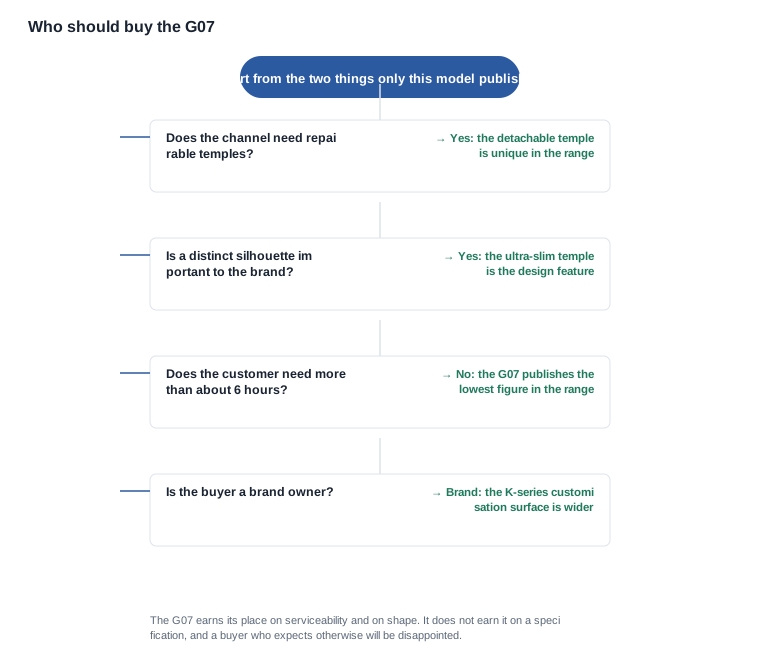
G07 smart glasses: a serviceability argument and a silhouette argument
Almost every other article in this series argues from a number. This one argues from a mechanism and a shape, and it is worth being explicit about why those are harder to buy than numbers and also why they are worth more when they land.
A detachable temple is a serviceability feature. The part most likely to be sat on, caught in a bag strap or dropped is the temple, and on a fixed frame that event ends the product. On a detachable frame it ends a spare part. For a brand running a repair promise, a distributor handling returns, or a catalogue with a genuine spare-parts business behind it, that is not a convenience — it is a line of revenue and a reason the customer buys the brand rather than the frame.
An ultra-slim temple is a different argument. In a category where most open-ear frames present almost identically from a metre away, a visibly thinner temple profile is what lets a product be recognised on a shelf, in a video call, or in a photograph the customer posts. That is a merchandising argument rather than a specification one, and it only works in channels where the product is seen rather than compared.
Neither argument can currently be made from our documentation. No temple profile, no frame dimensions and no weight are published for this model. That is the single most important thing to understand about buying it, and it shapes everything below.
It is worth being precise about why this is harder than it sounds. A weight is a measurement you can take on a sample in ninety seconds with a scale, and once taken it is defensible forever. A temple profile is a drawing, a tolerance and a material, and until all three exist the phrase "ultra-slim" has no fixed referent: two frames described the same way from two suppliers can differ by more than the difference between them and a conventional temple. So the merchandising argument is real and the specification argument is not available, and a brand that leads its listing with the slim temple is making an aesthetic claim rather than a measurable one. That is a legitimate way to sell eyewear. It is not a legitimate way to win a specification comparison, and pretending otherwise is how brands end up with a returns rate they cannot explain.
There is also a channel consequence. A design-led product needs photography as part of its cost base, because the entire value is in how the product presents. That means a proper shoot rather than a supplier's existing images, on a background and at an angle where the temple profile actually reads, and it means accepting that the same investment spent on a feature-led model buys a better instruction leaflet and a stronger support answer instead. Which allocation is right depends entirely on the channel, and it is a decision worth making before the sample order rather than after the first campaign underperforms.
Finally, the serviceability argument only survives contact with a parts policy. Brands that buy detachable-temple products to reduce returns frequently find that the returns fall, the part orders rise, and the part supply becomes the operational constraint instead of the return rate. Ask what a replacement temple costs as a fraction of a new frame, because below roughly a tenth the serviceability story is commercially strong and above roughly a third the customer will simply buy a new frame. We cannot answer that ratio today, and neither can the catalogue.
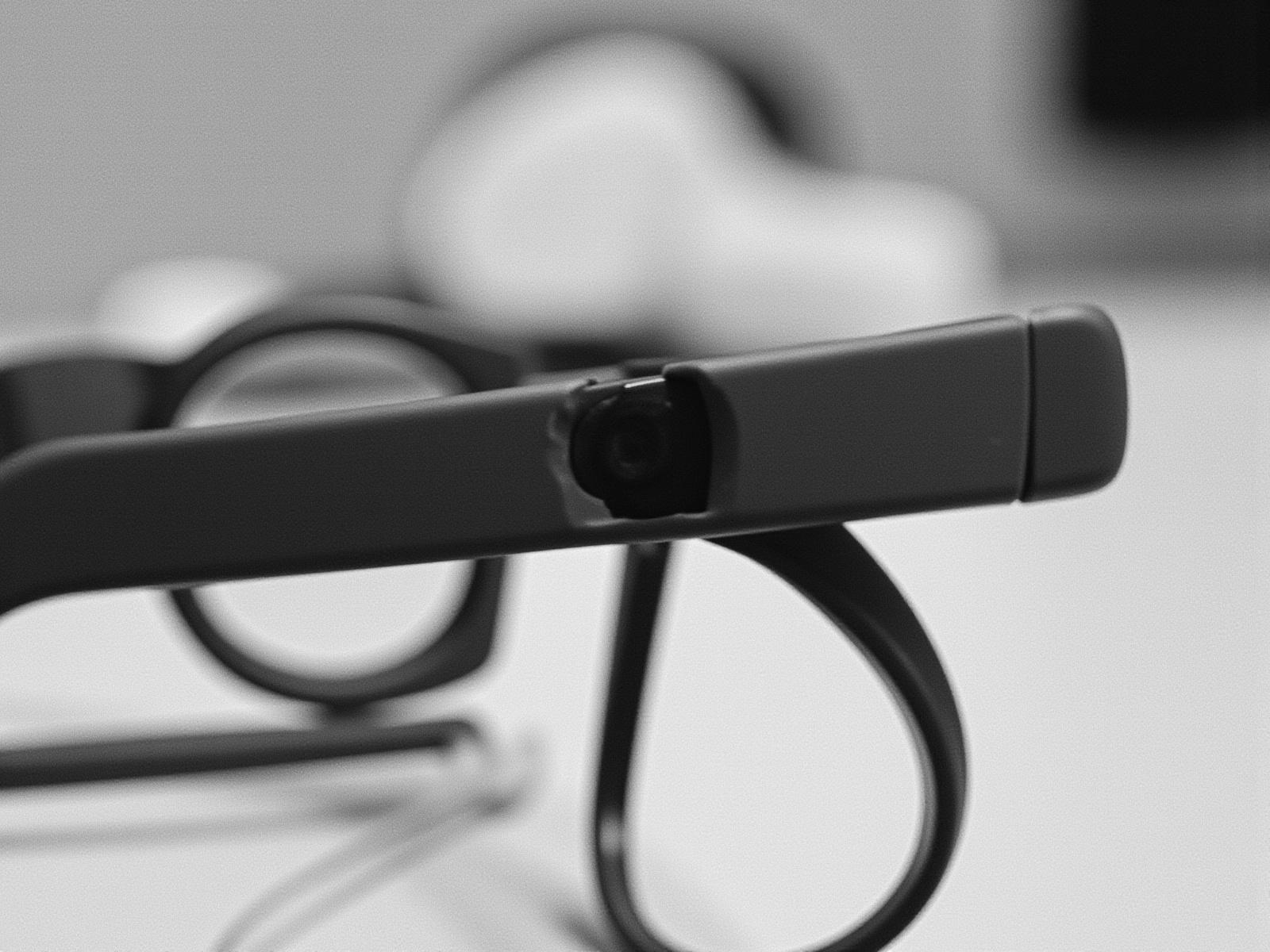
The four branches that decide it for the G07
Branch one: does the channel need repairable temples? If yes, the G07 and only the G07. The catch is that the mechanism has to be engineered, tested and documented, and none of that is published. The cycle count, the connector design, whether a replacement temple is orderable separately and what it costs are all open questions. The G07 limitations analysis sets out the full gap set, and the G07 buyer review checklist covers what to test on the sample.
Branch two: is a distinct silhouette important to the brand? If yes, this is the model. The slim temple on the G07 and the slim temple on the YK12 are the only design features published in this range. The catch is the same one: a design feature without dimensions is a merchandising argument rather than a specification, and it cannot go in a fit claim. The comfort and fit analysis covers what a fit claim would actually need.
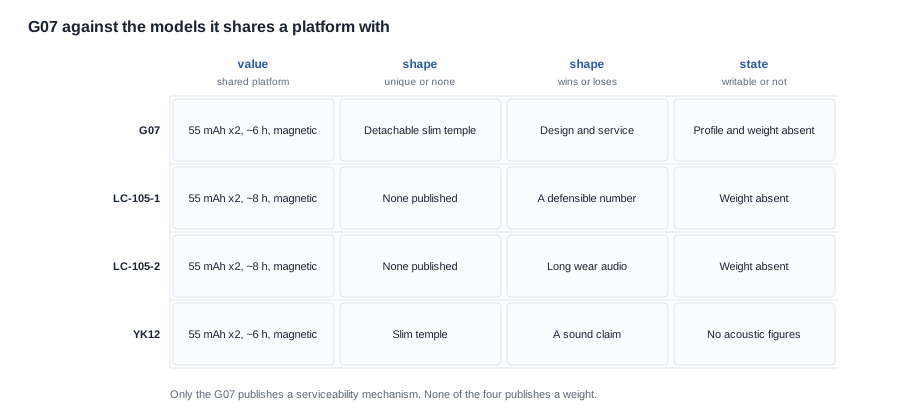
Branch three: does the customer need more than about six hours? No, and this is where the G07 loses. It publishes about six hours, the lowest figure in the range, on the same 55 mAh × 2 cell configuration that the LC-105 pair manages at about eight hours. Same cells, two hours apart, with no test condition for either. That tells you the figures were not taken under one protocol rather than that the G07 is physically slower, and the distinction decides whether you can put both numbers in a comparison chart. The G07 battery life analysis covers this in more detail.
Branch four: is the buyer a brand owner or a reseller? A brand owner should weigh the G07 against the K-series, whose customisation surface is the widest in the range. A reseller selling on specification rows should not buy it at all: every published row this model has is shared with at least three other models, and the G07 specification list makes that uncomfortably clear on its own.
A fifth consideration that is not a branch but decides the arithmetic: which platform are you already on? The G07 shares its cell configuration, charge method and charge time with the LC-105 pair and the YK12. A brand already stocking one of those has a shorter route to this model, a thinner documentation stack and a simpler warranty position than a brand arriving cold, because the technical file and the inspection routine are largely the same. A brand arriving cold should ask whether a model with a documented feature would serve them better for the same onboarding effort, because the onboarding effort is a real cost and it is the same cost for every model in the range.
The reverse also holds. A brand that has already decided not to carry feature claims still has a reason to consider this model, because a design argument is not a feature claim. It is harder to disqualify and easier to substantiate than a specification nobody has measured. In a channel where legal review is the bottleneck rather than product performance, that difference often decides the shortlist.
How to evaluate a detachable temple on a sample order
This is the only model in the range where the sample programme has to be a mechanical test rather than a comfort test, and it is worth setting up properly before you commit to a bulk order.

Step one: establish whether the temple detaches at all, and how. Ask the factory for the intended removal method before you touch the sample, because a temple that requires a tool is a different product from one that does not, and the customer instruction leaflet cannot be written until you know which. Record the method in words, not in a photograph, because the photograph does not tell your support team whether a pin was pressed or a screw released.
Step two: count cycles yourself, in batches, and write down where it fails. Do not do twenty and conclude it is robust. Do fifty in one session and a hundred across a week, on at least two samples rather than one, and record the first failure rather than the average impression. If it fails at a specific count rather than a gradual degradation, that is a much better problem for your warranty position than intermittent sticking, and the distinction is only available from a counted test.
Step three: test re-seating quality. A detachable temple that reconnects but sits a fraction high changes the fit every time the customer removes it. Take a measurement across both temples after each reconnection rather than trusting the feel, and if the measurement drifts, the mechanism is a warranty item rather than a design feature.
Step four: test the electrical side of the detachable joint. If the temple carries a control, a microphone or a battery contact, every detachment is a connector cycle. Ask whether audio drops during reconnection, whether a failed seat is detectable by the wearer, and whether the failure presents as silence or as a partial working state. A silent failure is easier for a customer to describe and easier for you to resolve; a partial failure generates support contacts that neither side can classify.
Step five: write down what a replacement temple costs and where it ships from. If there is no spare-parts route, the whole serviceability argument collapses and the model is just a slim frame, which is a considerably cheaper proposition and a considerably less interesting one. If there is a route, get the part number, the lead time and the minimum order for spares in writing, because a spare-parts business built on a thirty-week lead time is not a spare-parts business.

The buyer profiles that fit
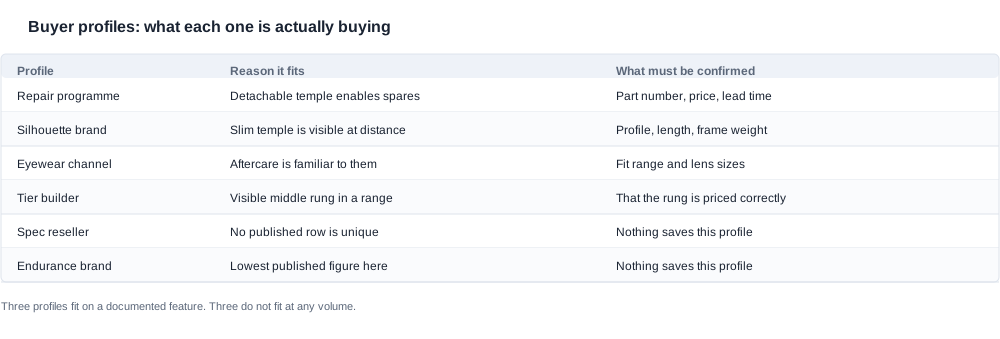
A brand with a repair or spare-parts programme. The detachable temple is the whole argument, and it has to be backed by a documented replacement route, a part number and a price. Ask for all three before the first order, not after the first warranty claim. A brand that cannot say where the replacement temple comes from has bought a serviceability story it cannot deliver, and the cost of that gap lands at the customer service desk rather than at the factory.
A brand whose identity is a silhouette. Where the product has to look different in a photograph or on a shelf, a slim temple is a design decision a buyer can see immediately and a competitor cannot copy by changing a colour. The merchandising value of this is real, but it only exists in channels where a photograph happens, so a distributor selling purely on price will not pay for it.
An optical or eyewear channel that cares about fit and aftercare. A detachable temple is a serviceability story, and serviceability is something optical channels already understand from prescription frames. That alignment makes the conversation shorter: you are not introducing an idea, you are extending one the channel already uses. The caveat is that optical channels will ask for the temple profile, the temple length and the fit range, and we cannot supply them today.
A brand building a tier where the rung above is a feature rather than a number. Placed above the LC-105 pair on design and below a camera model on capability, the G07 gives a range a middle rung that is differentiated by something a customer can see. The G07 value analysis sets out the commercial case, and the YK12 comparison covers the sibling that shares the platform.
Two practical points belong with that profile. First, a tier rung is only real if the customer can be told why the rung above costs more. On the G07 the answer is a mechanism and a silhouette, which is a weaker answer than a feature, so the tier structure works best in channels where photography carries the explanation and worst in channels where the comparison happens in text. Second, the rung is only profitable if the spare-parts route carries a margin. A serviceability story that transfers your entire retail price to the customer in replacement parts is a customer relationship rather than a product line, and the parts price is the number that decides which one it is.
A fourth profile is worth naming even though it is conditional: a brand that already owns an eyewear channel and a repair capability. For that buyer the detachable temple is not a new idea but an extension of something they run already, the fit data is something they can generate themselves from their own samples, and the only genuinely external dependency is whether the factory will supply a spare temple on a term that works. That is a much shorter negotiation than it appears, because most of the work is already done.
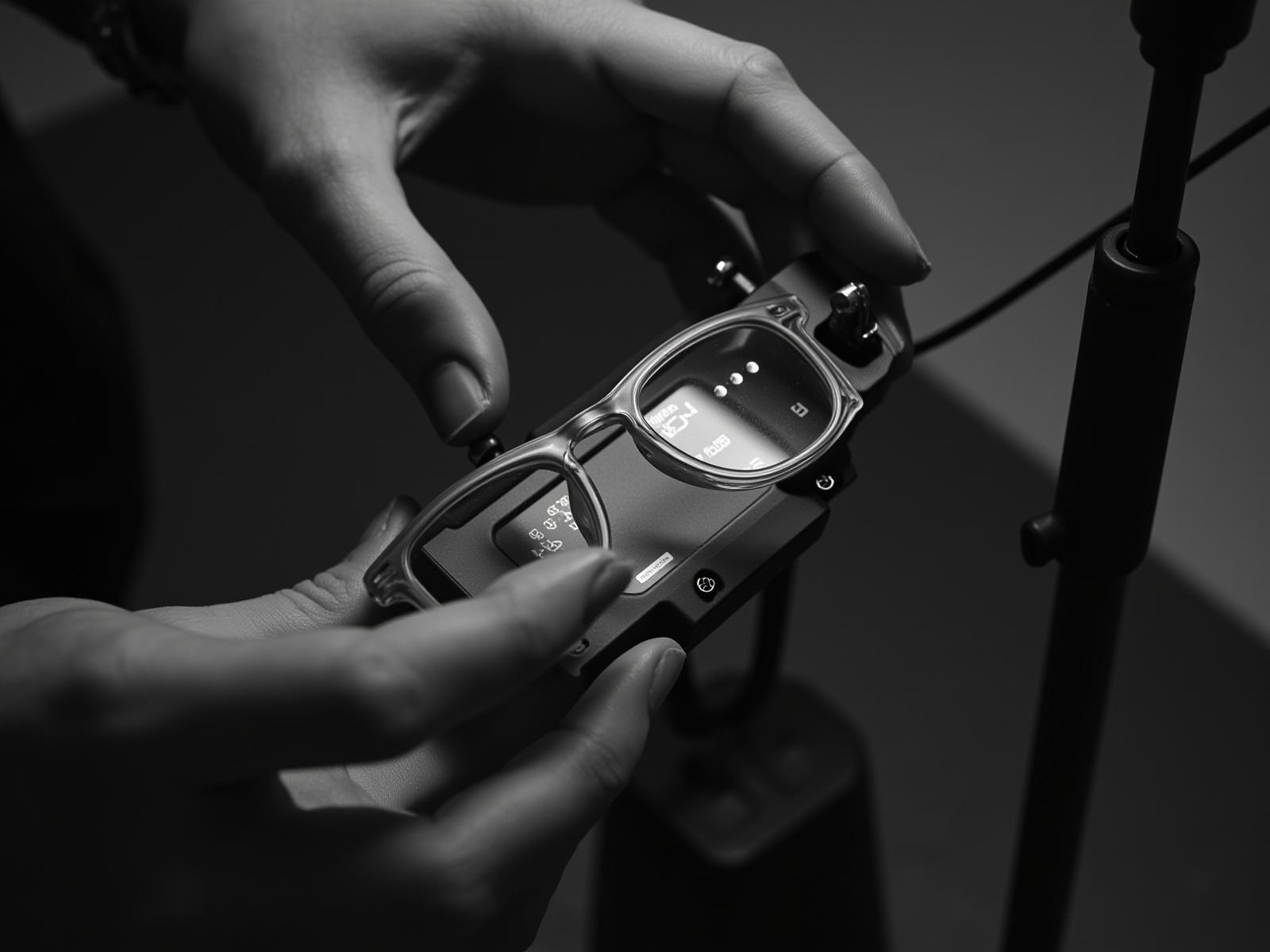
The buyer profiles that do not fit
A reseller selling on specification rows. Every row this model publishes is shared with at least three other models in the audio range. The detachable temple is a feature and the slim profile is a description, so neither appears in a comparison table, which means the two reasons to buy it are precisely the two reasons a specification-led customer will never see.
A brand whose proposition is endurance. About six hours is the lowest published figure in the range, on cells that a sibling reaches eight hours from. If your listing leads on battery life, this model makes your claim weaker than the platform already does.
A channel that needs a fit claim to close the sale. No weight, no temple profile, no head-size range and no lens dimensions are published. Until that set exists, the model cannot be sold on comfort, and comfort is the objection most optical and premium channels hit first.
A buyer expecting a case in the box. No model in the audio range publishes a charging case. The whole case proposition lives in the camera family, and a brand whose retail story is the unboxing has chosen the wrong range.
And a brand whose differentiation is a documented feature, rather than a design. If the proposition is "tap to answer", no model in the range publishes a touch control row, so the behaviour has to come from the supplier in writing. If the proposition is a feature a customer can be shown working, the K01 and K02 comparison is the more useful page to read.
What to ask before you commit
Five things, in the order that they block work.
- The temple profile, the temple length and the frame weight. Not an estimate — the measured values, so the fit claim can be written.
- The detachable mechanism: the intended removal method, the tested cycle count, the connector design and whether a replacement temple is orderable separately at what cost.
- The endurance test condition behind the six-hour figure, asked in the same words you would use for any other model, so the answers are comparable.
- The charging case capacity, and a measured packed unit weight, since a case question on this model may have no answer at all.
- The certification position for the G07 in each destination market, and whether the declaration names this model or only the company.
Then the commercial set, which is the same on every model in this range and equally unpublished: minimum order quantity, lead time, price, incoterms, payment terms and the warranty position. Ask specifically whether the warranty covers the detachable mechanism as a wear item or a defect item, because the answer decides whether the serviceability argument is worth anything commercially or only rhetorically.
The G07 is a design-and-serviceability product rather than a specification product, and a buyer who expects it to win on a datasheet will be disappointed by a model that was never trying to. We will not present the "ultra-slim" description as a quantified advantage, we will not present the six-hour rating as a working day, and we will not quote a weight, a temple profile or a certificate number that the documentation does not contain.
On the warranty, the specific question is whether the detachable mechanism is treated as a wear item or a defect item. If it is wear, the buyer is carrying a serviceability promise that the factory will not honour on the mechanism, and the spares route has to be commercially attractive enough to carry the volume that the warranty will not. If it is defect, the claim rate on a cycling-count mechanism becomes the supplier's problem, and that is the outcome a serviceability-led brand actually wants. The answer changes the margin on the whole programme, which is why it belongs in the first conversation rather than in the contract review.
On the parts programme, the number to fix early is the minimum order for spares. A spares minimum of five hundred is commercially meaningless to a distributor holding two hundred frames, and it is the single most common reason a serviceability argument quietly stops working about a year after launch. Ask for a small-batch or sample-quantity route, and if none exists, price the spares assumption into the range rather than discovering it later.
Send us the customer, the proposition and the volume, and we will tell you whether the G07's serviceability is worth its shorter published endurance for your brief — and whether the parts route that makes it work exists yet.
Related reading
- What this model publishes — G07 smart glasses specifications and features
- The endurance question in detail — G07 smart glasses battery life
- The design-led alternative — YK12 smart glasses how it compares
Send us the customer, the proposition and the volume, and we will tell you whether the G07's serviceability is worth its shorter published endurance for your brief.


