

A premium position in this category has to rest on something a buyer can verify, and the published documentation supports three things well: the battery configuration, the charging interface and the radio version. Everything else that a premium would normally rest on — acoustic quality, build, weight, certification depth — is either described without a number or not described at all. That is not a reason to avoid the premium tier. It is a reason to know which arguments you can actually make, which have to be earned on a sample, and which cannot be made at all. This page is written for the buyer who has to defend a premium price to a customer and to a retailer's buyer in the same meeting.
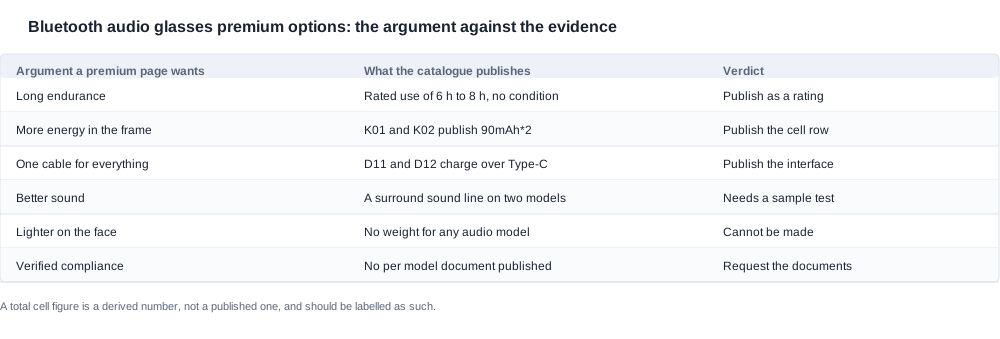
Bluetooth audio glasses premium options rest on three published rows
The published rows in this range are unusually checkable, and that is what makes a premium position possible here rather than merely asserted. Each of the three rows below can be read directly off the catalogue, compared model by model, and defended in a meeting without a single sample measurement.
The battery configuration. The K01 and the K02 publish two 90 mAh cells, which is the most generous published energy configuration in the audio range. Two things about how this is used matter commercially. First, the figure a customer compares against is the total, and the total is a derived number rather than a published one — the catalogue publishes the cell and the count — so a listing that uses the total has to say so. Second, the endurance figure does not separate the pair: the K01 and the K02 publish roughly eight hours, and so do the LC-105-1 and the LC-105-2 on a smaller published cell configuration. The capacity separates the models; the endurance does not. A buyer who builds a premium argument on endurance alone is arguing with a row that a competitor at a lower configuration can match.
The charging interface. The D11 and the D12 charge over a Type-C port, and they are the only audio models in this range that do; the other six charge magnetically. That produces a genuinely better first-week experience for a customer who already owns a USB-C cable, a smaller carton, a lighter parcel and a lower delivered cost. It is also an argument that is unusual in this category because it is checkable by the customer without a sample, which is the strongest kind of premium argument available. The economics of the two interfaces are covered in Bluetooth audio glasses charging options, and the model itself is in D12 how it compares.
The radio version. The K01 and the K02 publish Bluetooth V5.3 and the other six publish V5.4. On its own this is a compatibility row, and a premium argument built on a radio generation is thin. What it can support is a narrower and more defensible claim: that the product is on the current radio generation for its platform, which is worth something to a buyer whose customer fleet is on the newer generation.
What a premium tier is not, in this category
It is worth being blunt about what the premium tier in this category is not. It is not a higher camera resolution, because there is no camera in the audio range at all. It is not a display, because there is no display in the audio range either. It is not a lighter frame built from a better material, because no weight is published for any audio model and no material description is published either. A premium in this category has to be built on the three published rows, on the product's own fit and finish as evidenced by a sample, and on the strength of the brand attached to it — which is the part that is genuinely the buyer's own work and the only part that does not need a supplier document behind it.

The four arguments that need work before they can be listed
These are arguments that a buyer wants to make, that are plausible, and that cannot be published until something has been established. None of them is forbidden; each of them is currently unsupported.
A documented feature line. Three audio models publish a feature line. The D11 publishes one naming surround sound together with long battery life; the G07 publishes one naming a slim build together with a detachable temple; the YK12 publishes one naming surround sound together with a slim temple. The other five audio models publish nothing beyond the five electrical rows. A feature-led listing has to name the model, quote the published wording, and not add a qualification the line does not contain. Where a line names surround sound, the listing may say that surround sound is a published feature of that model; what it may not say is that surround sound improves clarity, or that it is a specification, because no driver size and no response figure is published for any model in this range.
A design feature. The G07's slim build with a detachable temple and the YK12's slim temple are the two published physical configurations in the audio range, and they are the two features that let a product present differently from the rest of the range. The G07's detachable temple adds a serviceability story on top, provided the replacement path is established. Neither publishes a temple profile, a frame dimension or a weight, so the feature is a merchandising argument until a sample supports it. The G07 best-for analysis covers the case for that model.
Acoustic performance. This is the argument a premium would most want to make and the one the documentation supports least. A surround sound line is named on two models and quantified on none: no driver size, no frequency response, no description of the sound field, no leakage rate, no microphone specification. A premium claim about sound quality has to be established by testing samples, and the microphone testing notes cover how to run that test.
Verified compliance. No per-model document is published for any model in this range, and our catalogue's export certification page is a company-level page whose content is images rather than text with no per-model certification row anywhere. A premium that claims verified compliance has to produce the documents, and the certification coverage notes explain why a certificate that does not name the model is close to worthless.
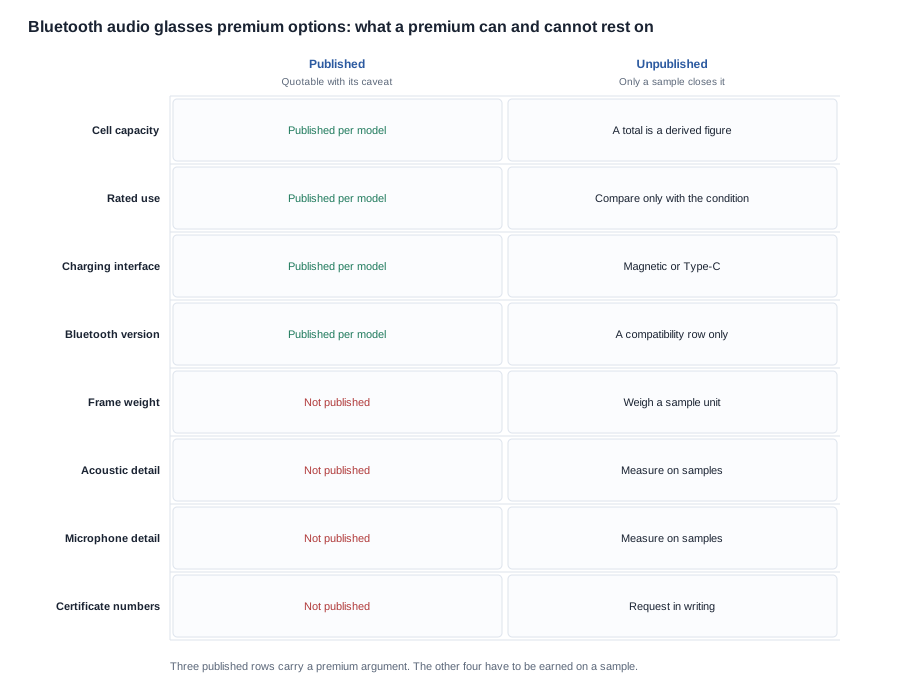
The two arguments that cannot be made at all
Weight and build quality. No weight is published for any audio model in this range. The only published weight in the catalogue is 158 g for the MT6, which is a camera model with a different cell and a foldable case, and it cannot be used as a proxy. A premium built on lightness, and a premium built on materials, are both arguments that cannot be made from the documentation. The practical consequence is that weighing a sample of each model is the cheapest item on the list of things a buyer can do to close this gap, and the weight comparison across the audio range covers what happens to a shipping calculation without it.
A specification comparison the data cannot support. A premium page that positions one model against the rest of the range on a single dimension — weight, acoustic detail, leakage, microphone specification, ingress rating, certification depth — is a page resting on a row that does not exist. The only dimensions on which the range can be compared honestly are cell configuration, rated use with its caveat, charging interface and radio version. A premium argument built on three checkable rows is narrow. A premium argument built on one uncheckable row is a liability, and the retailer's buyer will find the difference in a single comparison.

How a premium claim is traced back to a source
The discipline that makes a premium page survive a retailer's buyer is a tracing exercise, and it is not complicated: every claim on the page has to resolve to one of four places.
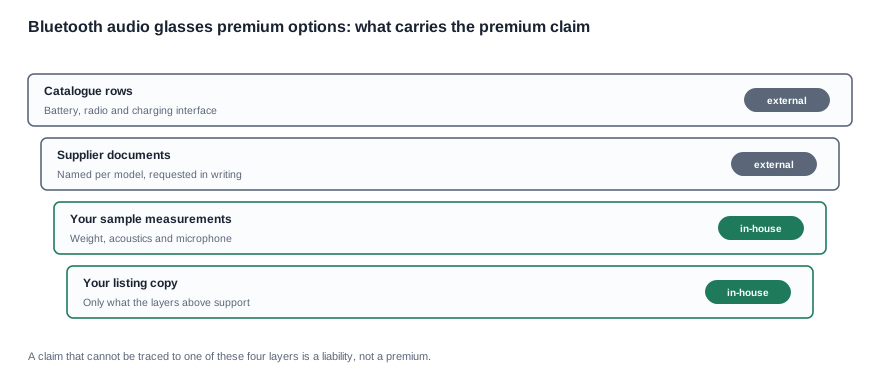
The catalogue rows. Battery configuration, radio version, charging interface, rated use and the published feature line. These are quotable as they stand, with their caveats, and they are checkable by anyone who has the catalogue in front of them.
The supplier documents. The certificate evidence that names the model, and any written confirmation of a feature line's exact wording. These are obtainable, they are per model, and they cost time rather than money — which is why they have to be requested at the request-for-quotation stage rather than at the artwork stage.
Your own sample measurements. Weight, acoustic and microphone behaviour, leakage. These are the buyer's own evidence and the most defensible kind, because nobody can dispute a measurement the buyer made and documented. They cost a sample programme, and in a premium launch that programme is usually already funded.
Your own listing copy. The last layer, and the one that carries the liability. Everything on the page has to resolve to one of the three layers above it. A claim that resolves to nothing is not a marketing decision, it is an exposure, and in a premium listing the exposure is larger because the price is higher.
Where the tracing breaks most often
The break almost always happens at the same point: a feature line is read as a specification. A published line naming surround sound is copied into a listing as though it were an acoustic claim, and the gap between those two things is invisible on the page. The second break is a derived number presented as a published one — a cell total, a comparison of energy configurations, a claim about how much longer a battery lasts — where the arithmetic is correct but the status of the number is not. Both breaks are cheap to prevent and expensive to discover, because they surface in a retailer's comparison table rather than in the buyer's own review.

What a premium launch has to fix commercially
A premium position does not only need better evidence; it needs a different commercial structure. A value-tier product can be sold on a low unit price with a wide margin for returns and a single artwork master. A premium product cannot, because the price itself raises the cost of every mistake: the artwork has to be approved more carefully, the sample programme has to be bigger, the documentation has to be complete before the launch, and the return of a premium item is more expensive to process than the return of a value item. Four lines of the purchase agreement carry most of that difference.
The sample programme has to be sized for the evidence, not for the budget. A premium launch whose acoustic claim rests on a single sample unit has not established anything, because a single unit tells the buyer about a single unit. The protocol should run on more than one unit of each shortlisted model, and the sample should be purchased on the same commercial terms as the production order so the result and the lot are the same population. Before you order, the criteria for the sample programme should be written, because a premium acceptance criterion invented afterwards is a negotiation the buyer loses.
The acceptance criteria belong in the purchase agreement. A premium claim that a supplier disputes is not settled by an email. The acoustic result, the measured weight and the leakage judgement, with their conditions, belong in the agreement as acceptance criteria, so that a lot which fails them is a lot that can be refused and reworked.
The payment node should follow the evidence. A node released after the sample tests pass, rather than after production completes, moves the risk to the right side of the contract. In a premium launch this is worth negotiating carefully, because the premium is exactly the case where the sample programme is the thing that should gate the money.
The returns and the warranty need a different answer than a value tier. A premium item that comes back is a larger loss per unit and, in a retail channel, a more visible one. Agree the return window, the quantity band, who carries the freight and the warranty response time in writing, and ask for the terms to be stated against a defined failure rather than against a general condition.
The trade-offs worth naming before the order
Premium versus platform breadth. A range that spans the highest published configuration and the lowest is harder to cost, harder to stock and harder to explain than a range that sits on one platform. The trade-off is breadth against manageability, and it is a decision about the buyer's operating capacity rather than about the product.
Premium against feature count. In this range the three published feature lines are the only features available, and one of them is a phrase that combines a listening attribute with an endurance claim. A premium built on the count of features is a premium built on a number of words. The trade-off is a narrow, checkable argument against a broad, uncheckable one, and the narrow one survives a retailer's comparison.
Premium against speed to market. Every line of evidence above adds time before the artwork can be approved. The trade-off is a launch date against a defensible page, and the correct point of balance depends on whether the channel is one where the listing is checked by a retailer's buyer before the first order or one where it is checked by the customer after delivery.
A worked example: a premium line for an established audio brand
This is a worked case rather than a customer case. The point is the order of steps.
Assume an established audio brand with an existing customer base, a working compliance file for its wired range and a retail channel that already knows the brand. The brand wants to launch a premium open-ear audio frame and has been asked by its retail buyer to substantiate the premium with evidence.
Step one, the argument. The brand reads the published rows and identifies what it can actually say: the two-cell configuration on the K01 and the K02, the current radio generation on six of the eight models, and the Type-C advantage on the D11 and the D12. It discards, at this stage, any plan to argue on weight, on materials or on acoustic quality, because none of those is published and it does not yet have its own measurements.
Step two, the samples. The brand buys one unit of each shortlisted model on production terms, weighs them, and runs an acoustic and microphone comparison against the wired range it already sells, using a fixed protocol written before the samples arrive. The measurement produces the two things the catalogue does not publish, and the brand now holds its own evidence rather than a supplier's claim.
Step three, the documents. The brand asks for the certificate evidence naming each candidate model, with the issuing body and the validity dates, at the same time as the request for quotation, so the compliance file is assembled in parallel with the samples rather than after them.
Step four, the commercial structure. The brand asks for a payment node released after the sample tests pass, for return terms and a warranty response time stated against a defined failure, and for the tooling and artwork position on the premium box. It freezes the model list at this point, because every extra configuration adds a re-validation cost that a premium launch cannot absorb twice.
Step five, the page. The brand's listing leads on the three published rows, quotes the measured weight as its own measurement with the method described, and uses the published feature wording where a feature is named. It makes no acoustic claim that its own test did not support, and it carries no weight claim for a model it did not weigh.
The result is a premium page whose every line resolves to the catalogue, to a supplier document, or to the brand's own measurement. The retailer's buyer cannot find an unresolvable claim on it, which is the practical test of whether a premium page is ready.
Why we rank platforms by published rows and not by preference
The premium in this category is currently a battery-and-interface argument, and it is a stronger one than it looks, because those figures are checkable, comparable and visible on a spec sheet. We will not present a named feature as a characterised one, we will not present a surround sound line as an acoustic specification, and we will not quote a weight, an acoustic figure or a certificate number that the documentation does not contain. Where our own data is thin we will say so and point to the test that closes it, because a premium page built on unverified claims is the one a competitor can take apart in a single comparison.
There is a commercial reason for that discipline that is specific to a premium position. A premium listing is read by a retailer's buyer who is explicitly looking for the weakest claim on the page, and the weakest claim is the one the buyer cannot verify. The premium tier is where an unverified claim stops being a rounding error and becomes the finding, because the retailer's whole job is to find the gap between what the page says and what the product does.
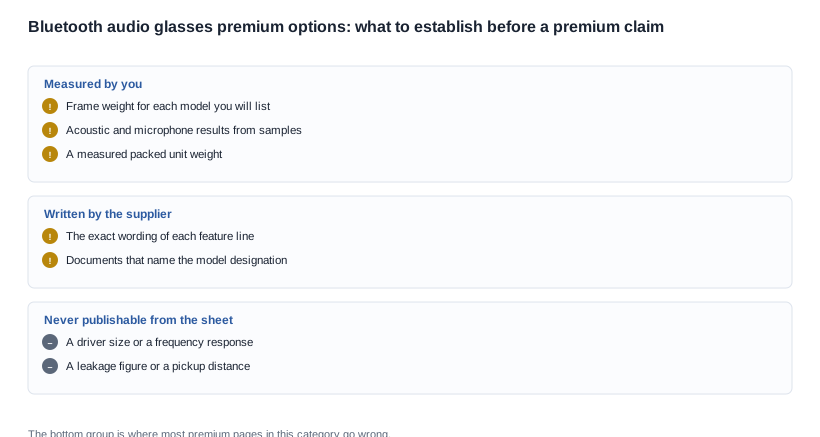
The six things to establish before a premium position is published
- The measured frame weight for each model you intend to list.
- The acoustic and microphone results from your own samples, with their conditions.
- The exact wording of the published feature line for any model whose listing leads on a feature.
- The documents that name the model designation, with the issuing body and the validity dates.
- A measured packed unit weight, for the delivered cost and for the freight class.
- The rated use figure, quoted as a rating, with the condition stated or the condition requested.
The range decision is in the Bluetooth audio glasses buying guide, the model decision is in which model to pick, and the branded route is in private label options.
Related reading
- Deciding the range — Bluetooth audio glasses buying guide
- The charging advantage — Bluetooth audio glasses charging options
- The measurement behind an acoustic claim — how to test microphone quality
Send us the channel, the target price band and the markets, and we will tell you which premium arguments the documentation supports and which have to be earned on a sample.


