

Bone conduction glasses technology: the answer and the buying task
When bone conduction is the right platform
Bone conduction is the right platform in exactly two situations: the audio has to be private, or the source is a masked voice the wearer needs to follow. Everywhere else it is the wrong tool. Music needs a frequency response the skull path does not carry well. An all-day session needs a frame that is not also delivering vibration into the temple. And a frame that also carries a camera has a power budget that a 200 mAh cell cannot serve alongside a transducer, a radio and an image sensor.
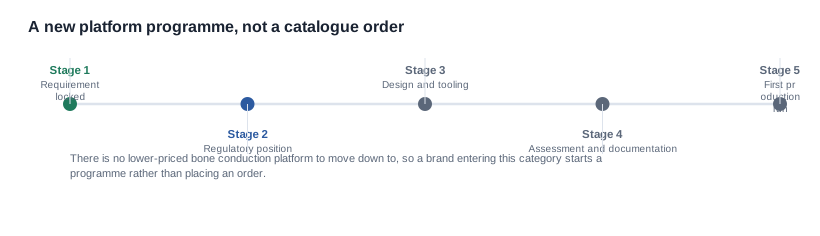
Do not choose it as a cheaper alternative to an open-ear frame, either. Our range holds no lower-priced bone conduction platform, so a brand that wants this technology at a lower price point is starting a development programme rather than placing an order. That difference — choosing a platform versus building one — is the single most expensive confusion in this category, and it is what this article is organised around.
The four things to put to a supplier before anything else are the model designation, the measurement method behind the gain figure, the regulatory position in each destination market, and the frame weight with its temple geometry. We publish none of those four for our entry, and we would rather tell you that than quote a typical figure you cannot verify.
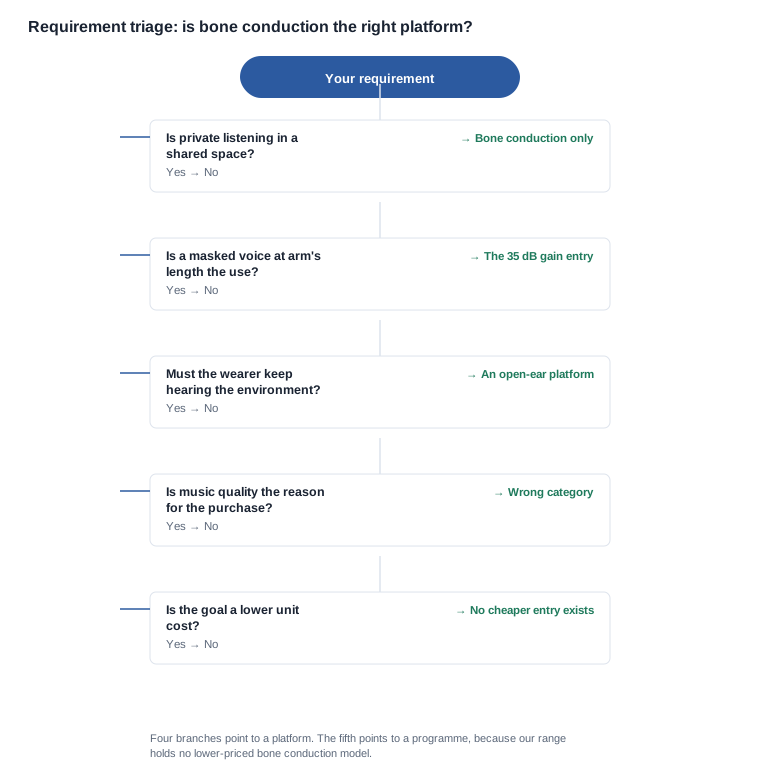
The buying task behind the question
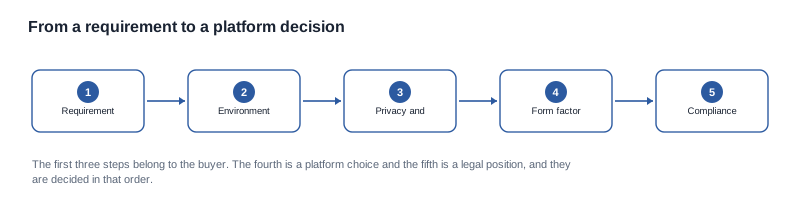
"Do we need one" collapses three separate decisions, and they have to be taken in order, because a wrong answer at the first one wastes the other two.
The first decision belongs to the product owner, not the buyer: does the end customer need the function this form factor provides, or do they need a good audio product that happens to be eyewear? A customer buying eyewear wants a frame that looks right, lasts, and does something they cannot get from their phone. A customer buying audio wants sound, and will tolerate a frame. Only the second customer is a bone conduction candidate, and only for two use cases.
The second decision belongs to you: does your range need this form factor as a differentiator against open-ear platforms, or as a coverage item so a buyer comparing your line-up against a competitor's does not find a gap? The first is a positioning decision with a marketing cost attached. The second is a completeness decision with a development cost attached, and the two are frequently confused because the second is easier to justify internally and much harder to deliver.
The third decision is the one this article is about: given that you want the form factor, is there a platform to order, or does the platform have to be built?
The reader here is usually one of four people. A brand owner who has been asked to put a smart audio product on the roadmap with no in-house acoustics knowledge. A category buyer holding two or three supplier quotations that use the same vocabulary and describe different things. A channel buyer selecting a product for a marketplace listing where the return rate is the main risk. A product or R&D lead who has to brief an engineering team on what to develop.
What they have in common is a risk question, not a product question. The category's predictable failures are not acoustic; they are commercial and regulatory. A product page that attracts the customer whose expectation the technology cannot meet, and the return arrives as a defect. A listing that quietly makes a hearing-related claim, and the listing is removed after launch. A platform with no published model designation, which means it cannot be named on a certificate, a label or a purchase order, and cannot be re-quoted when you are asked to reduce unit cost in year two.
Our published position is narrow and we will not extend it. The bone conduction entry in our range publishes a 35 dB amplification gain, a bone conduction transducer, a 200 mAh cell, a charge time of two hours or less, roughly seven hours of rated runtime, and Type-C charging. It carries no model number, and its customisation capability is recorded as undisclosed. Everything in this article is built on those facts and on the question of what has to be established beyond them.
Why the same device costs what it costs in this category
Where the cost actually sits
A bone conduction frame is not an open-ear frame with a different driver in it. The bill of materials diverges early, and the divergence is what makes two quotations for the same-sounding product differ by a wide margin.
The acoustic element itself is the first divergence. An open-ear platform uses a small dynamic driver in the temple; a bone conduction platform uses an actuator that produces mechanical vibration, and the actuator has to be pressed against the skull with a consistent force. That force is a mechanical design constraint that propagates into the frame: the temple has to hold contact, the contact area has to be controlled, and the frame's mass and stiffness become part of the acoustic result rather than only part of the fit. It also propagates into assembly: a transducer that must sit at a defined position and pressure is harder to place consistently on a line than a speaker that goes into a cavity.
The electronics diverge next. A 35 dB gain is a demanding amplifier stage, and the power it draws competes with everything else in the frame. Our entry's 200 mAh cell is roughly double to four times the capacity of the smaller cells typical of open-ear audio platforms in the same range, which is consistent with a transducer and an amplifier stage drawing more current than a small speaker. A larger cell is also a larger pack, which changes the frame's mass, which changes the contact pressure the temple has to hold, which changes the acoustic result. The power budget and the acoustic result are the same decision in this category.
Certification is the third cost block, and in this category it is the one that is fixed. A conformity assessment, a technical file, a declaration, labelling and instructions, and the laboratory time behind them do not negotiate. What does negotiate is scope: which markets the file covers, whether one assessment covers several configurations, and whether the claim is narrow enough to keep the route simple. A buyer who arrives at the quotation stage with an unresolved claim is buying the most expensive version of everything.
Packaging and logistics are the fourth block, and they are where two quotations for an identical product usually diverge. A colour-matched charging case, an artwork approval cycle, a magnetic dock, a cell that needs a specific transport file, a retail box with a compliance panel on it — each is a separate line a supplier may or may not have included, so two quotations with the same unit price can be two very different projects.
Where the buyer's leverage is
Leverage in this category sits in three places, and only one of them is price.
The first is the first run. The factory carries the most exposure on a first production run: a frame that does not meet the specification is a scrap event, and the supplier knows it. The pilot tier, the colour mix, the logo and lens tint, the packaging, the split delivery against staged payment, and the choice of which models go on one purchase order are all negotiable because they redistribute risk rather than reduce cost.
The second is claim scope. Whether the file covers one market or four, whether the assessment is per model or per family, and whether the amplification claim is written one way or another are decisions that change the cost of the programme more than any unit price discussion.
The third is the number of sources. A category with one entry and no model designation has no obvious second source, and a buyer with no second source has no lever at all. Identifying a comparable platform before tooling is worth more than a percentage point of unit price, because it is the only thing that makes the next quotation a comparison rather than a fresh negotiation.
The five rows that decide the platform
The thresholds, and what each one is measured on
Five specification rows decide whether a bone conduction platform can be evaluated at all. Each of them has a way it is measured, a line it has to clear, and a characteristic way it is misreported.
1. Amplification gain. How it is measured: as electronic signal gain in the circuit, at a stated input level, across a stated frequency band. The line: a gain figure accompanied by its measurement condition, so that two suppliers' figures can be compared at all. How it is misreported: quoted with no method, or quoted as though it were a sound pressure level at the ear. Our entry publishes 35 dB and no method, which is why the figure tells you the electronics are capable of amplification and tells you nothing about how loud or how clear the result will be.
Decibels are logarithmic — a six-decibel increase is roughly a doubling of sound pressure — so a gain figure is a statement about level, not about intelligibility. Two units with identical gain can sound materially different to two different wearers, because the gain sits upstream of the coupling, and the coupling is where the variation lives. Any supplier that gives you a gain figure without a band and an input level has given you a number you cannot use, including against your own second sample.
2. The rated runtime, and the duty cycle behind it. How it is measured: a stated playback condition, a stated volume, and a stated radio connection state. The line: a runtime that covers the longest single block of work the product is sold into, with margin, plus a mixed-use figure that reflects the real duty cycle. How it is misreported: one figure for continuous playback and for mixed use, treated as interchangeable. Our entry publishes roughly seven hours with no test condition, so it is a scale figure rather than a planning figure.
3. Cell capacity and recharge. How it is measured: cell capacity in milliamp-hours, charge time to full, and the interface. The line: a device that recharges inside a break, using a cable the buyer already stocks. How it is misreported: a charging case in the box with no stated capacity, which moves the constraint from the desk to the pocket and turns a two-hour recharge into a carry-a-second-object requirement. Our entry is 200 mAh, two hours or less, Type-C — the simplest possible charging arrangement in the category, and one of the few rows where this platform is straightforwardly better than its alternatives.
4. Acoustic transparency and leakage. How it is measured: the sound pressure radiated into the room at a stated playback level. The line: a design where the ear canal is mechanically clear of any inserted device, and a leakage figure if privacy is being claimed. How it is misreported: open-ear temple speakers presented as equivalent to a bone conduction path for privacy. They are not. An open-ear device radiates sound outward, and the louder it is played the more the person next to you hears. This is the single most important commercial difference between the two architectures, and it is the one that gets flattened in comparison charts.
5. The model designation and the traceability that follows from it. How it is measured: a stable, printable code that appears on the purchase order, on the packaging artwork, on the label, on the declaration of conformity and on the certificate. The line: the same code on all of them. How it is misreported: a family-level document offered as covering an unnamed model, which it does not. Our entry publishes no model designation, which makes this row the hardest gate in the set.
The two axes that actually decide the fit
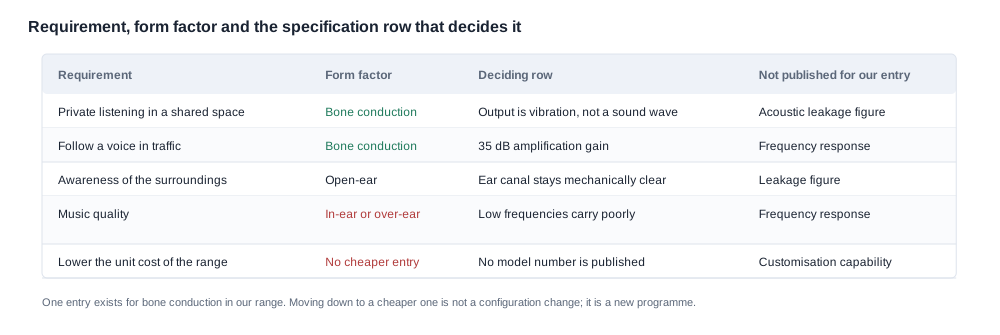
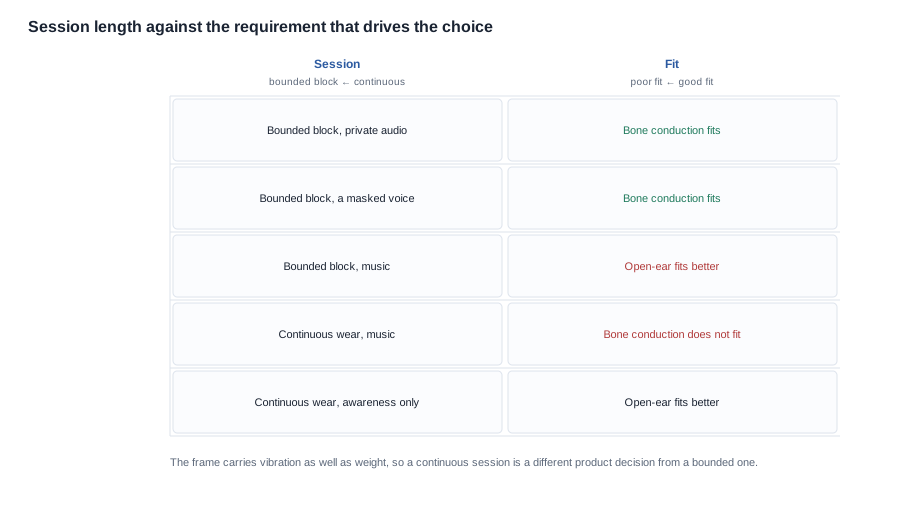
If you strip this category back, two variables do most of the work: the length of a single work block, and what the audio is for. Everything else in the twenty-odd questions a buyer might ask is downstream of those two.
On the session axis, a bounded block and a continuous day are different products. The frame carries vibration as well as mass, and the contact pressure that keeps the transducer coupled is the same pressure that produces localised bone pressure fatigue over a long session. How quickly fatigue appears depends on the individual and on the fit, and no specification describes it, which means it can only be established on a sample with real wearers over a real day.
On the requirement axis, private audio and music sit at opposite ends, and the technology is decisive on the first and weak on the second. A private-audio requirement has exactly one answer in this category, because the output is a mechanical vibration in the skull rather than a sound wave in the room. A music requirement is answered better by an open-ear platform, because a temple speaker carries far more low frequency than a bone conduction path, and because the fit that keeps a transducer coupled is not the fit that keeps a speaker comfortable for a day.
The useful consequence for a buyer is that the two axes can be read off the customer's brief, and they narrow the range of plausible platforms to one or two before a single supplier is contacted.
A warning about comparing numbers across suppliers
Two bone conduction quotations will rarely be comparable on paper, and the reason is worth stating plainly before anyone builds a comparison sheet. A gain figure from one supplier may be a peak figure at a single frequency and the same figure from another may be a broadband figure. A runtime from one may be a mixed-use figure and the same number from another may be continuous playback. A cell capacity may describe a different cell from the one fitted at shipment, which is also a transport and compliance question rather than only a runtime question.
The rule is: before comparing two numbers, ask both suppliers what the number is measured on, in writing. If either answer is vague, the number is not a comparison point and should not appear in a scorecard. Where you are given a method, you can compare. Where you are not, the honest move is to mark the row "method not stated" rather than to score it.

Proving a supplier's answers, and where programmes break
The document trail, in the order that works
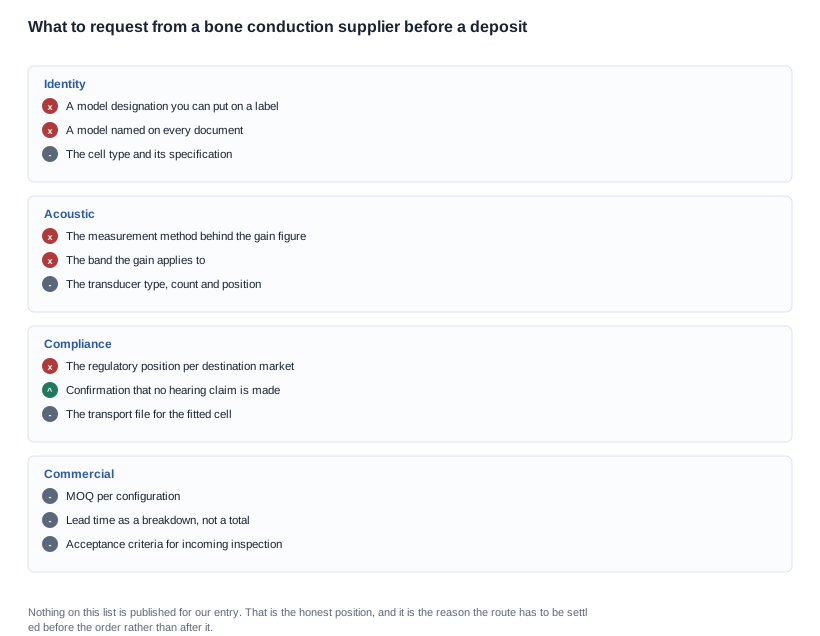
Verification in this category is a document exercise, not a listening exercise. A sample tells you whether the product is acceptable to the people who will wear it. It does not tell you whether your listing is legal, whether the certificate covers the model you are ordering, or whether the supplier is the party you think they are.
Step one: get the identity settled. Ask for the model designation and trace it to the label artwork, the purchase order and the certificate. If the three codes differ, you have a traceability problem that surfaces at customs rather than at the warehouse. Completion standard: one code, on every document, traceable to a physical unit in a photograph.
Step two: get the acoustic method. Ask for the measurement condition behind the gain figure — input level, band, coupling arrangement, and whether the figure is at the transducer or at an internal point in the circuit. A figure with a method can be checked against a second unit; a figure without one cannot be checked against anything. Completion standard: a written method, not a verbal assurance.
Step three: get the regulatory position. Ask which category the product sits in each destination market, and on what basis. In the United States, the framework at 21 CFR 800.30 separates an over-the-counter hearing aid — an air-conduction device intended for a person aged eighteen or older — from a non-device personal sound amplification product. A bone conduction product is neither air-conduction nor a hearing aid, so the legitimate positioning is the non-device side of the line, and the reasoning has to be on paper. Completion standard: a written position per market, reviewed by whoever in your organisation carries regulatory risk.
Step four: check the register, not the certificate. For every certificate number the supplier gives you, look it up in the issuing body's public register. Confirm that the model named on the certificate is the model you are ordering, that it covers the configuration you are shipping, and that the validity date has not passed. A supplier's confidence in a certificate is not the same as a certificate that names your configuration. The range-wide checklist is at certification checklist.
Step five: check the transport file. Air movement of lithium cells requires documentation that the logistics provider asks for at the border, and the test summary covers a specific cell. A cell substitution invalidates the summary regardless of whether the finished product is unchanged — and here a cell substitution also changes the amplification behaviour, so it is a compliance change as well. The obligations are set out at battery transport.
Step six: establish who owns the listing copy. Some suppliers write it, some buyers do. Whoever writes it carries the claims in it, and the gain figure is exactly where a carelessly written product page turns from a marketing problem into a compliance problem. The boundary between device and non-device is described at medical device boundary.
Where bone conduction programmes break
A listing written around the gain. The most common failure is a product page that leads with the decibel figure and a photograph of somebody on a construction site. That attracts precisely the customer whose expectation the technology cannot meet, and the return arrives as a defect report. The fix is upstream: the specification should state the working environment and the session length, and the copy should follow the specification rather than the other way round.
Fatigue treated as a defect. A frame that transmits through the skull has to hold contact pressure at the temple, and sustained pressure produces localised discomfort that can appear after roughly an hour. A support script that treats this as a fault generates replacement cost on a product behaving as designed. It is a wear limit with a time to it, and it belongs in the listing and in the training given to channel staff. A buyer who has not planned for it will pay for it in returns.
A camera added to the same cell. This is a power-budget problem before it is an acoustic one. A sensor, a radio, a transducer and a small cell compete, and the runtime that reaches the customer is set by the hardest of them. Treating the combination as a configuration option is how a project ends with a product that passes a laboratory demonstration and fails in a shop. It should be scoped as a design project with its own schedule.
A single unnamed platform with no equivalent. Because the model designation is not published, a buyer who decides to move category after a sample evaluation has no way to re-quote the same product, and no way to check whether a cheaper competitor quote is really the same device. Decide the shortlist first, then secure the second source. Doing it the other way round costs the whole evaluation.
Certification assumed rather than evidenced. A supplier who quotes a low unit price and cannot produce a certificate number for the exact model is quoting a price for a product that cannot ship. That conversation belongs at the factory audit stage, not at the purchase order stage, and the difference is measured in months.
What can be negotiated, and a worked procurement scenario
The split between fixed and movable
Fixed, and not a negotiation target. The regulatory classification work and its cost. The certification cost and lead time. The acoustic hardware itself. Tooling cost, which is usually amortised across a first order and should be asked about explicitly as a separate line rather than folded into a unit price. The cost of a second qualification run of the same model. Nothing in this list moves because you negotiate harder; it moves only if you reduce scope.
Movable. Minimum order quantity tiers. Colour and temple configuration. Logo, lens tint and retail packaging. Which models combine into one purchase order. Splitting a first production run into two deliveries against a staged payment. The number of units taken at the pilot tier rather than the run tier, which is where most of the real room sits, because the factory's exposure concentrates in the first run. The scope of the conformity assessment, and the number of markets it covers.
Documents to request before a deposit. The model designation table. The certificate register with numbers and validity dates. The battery transport documentation for the fitted cell. The packaging artwork proof. The agreed acceptance criteria for incoming inspection. Written confirmation that no claim in the listing copy characterises the product as a hearing aid or makes any claim about treating, preventing or improving hearing. The clause language to work from is at contract terms, and the commercial structure of a first order is set out at pricing.
A worked scenario
Assume a brand owner for a workwear line has been asked whether the range should include a bone conduction product. The target channel is industrial distributors; the end customer is a supervisor on a plant floor who needs to hear a colleague over machinery; a single session is a shift block; the price point sits at the middle of the range; and the first market is the European Union with a United States launch following.
The first step is the form factor, and it is decided without a supplier. Privacy is not the requirement, so the differentiator cannot be secrecy. The requirement is a masked voice, which is what the 35 dB gain entry addresses. A music expectation cannot be permitted, because there is no frequency response to support it, so the product copy has to state the working environment rather than the entertainment. A shift block is bounded, so a 200 mAh cell with a roughly seven-hour rating is in range, and Type-C charging means the customer charges it at a workstation rather than carrying a case. Open-ear is not excluded — a supervisor who wants music is a different customer — but it does not serve the stated requirement, so it stays off the shortlist for now.
The second step is the platform, and here the answer is uncomfortable. Our own range publishes no model designation and no customisation capability for this entry, so there is no SKU to put on a workwear line's purchase order, no code to name on a label, and no disclosed route to a private-label programme. That is a fact about the entry, not about the category: a platform with a designation would let the buyer proceed to a conformity file, and this one cannot until the designation is established.
The third step is the compliance route, and it must be settled before the artwork is approved, not after. In the European Union the product is a radio product and the general product safety regime applies, so the file needs a technical file, a declaration, labelling and instructions, and an economic operator in the market. In the United States the claim has to stay on the non-device side of the air-conduction line at 21 CFR 800.30, and the same copy serves both markets because a listing is usually global. The transport file for the 200 mAh cell is a separate gate that the logistics provider will enforce at the border.
The fourth step is the schedule, and it is where this scenario is most likely to fail. The claim, the target markets, the artwork and the model designation all have to be frozen before the date means anything. A supplier who quotes a date without naming its constraint is quoting a guess.
The fifth step is the sample, and it is narrower than a usual audio evaluation. The questions the sample has to answer are the ones no document can: whether a full shift of contact pressure is tolerable to a real wearer, and whether a masked voice in a real plant is followable with the level the unit delivers. Everything else is a document question and belongs in the file.
What we will and will not tell you, and what to send next
A narrow architecture, and saying so plainly
Concretely, bone conduction is a specialised architecture with a narrow and defensible set of applications, and saying so plainly is more useful to a buyer than presenting it as a universal open-ear solution. We publish the 35 dB gain, the 200 mAh cell, the two-hour charge time, the roughly seven-hour runtime and the Type-C interface because the catalogue states them. We publish the absence of a model designation and the undisclosed customisation capability with the same prominence, and we will not substitute a typical weight, a driver size or a frequency response for a measured value we do not have.
We will not write a claim that positions the product as a hearing aid, in the United States or anywhere else, and we will not describe it as improving, protecting or treating hearing. A catalogue entry cannot supply the regulatory position that such a claim would require.
What we will do is tell you which branch your requirement falls into, and what has to be established on a sample before a deposit is sensible. The mechanism is described under bone conduction audio, the cost comparison is in bone conduction cost vs performance, and the test protocol is in how to test before ordering. The product range itself is at bone conduction glasses.
Working environment, session length and the markets in scope
Send us four things: the working environment, the length of a single session, the destination markets, and the price band you are working inside. We will tell you whether this architecture answers that requirement or whether an open-ear platform serves your customer better, which of the published rows cover your configuration, and which items have to be settled in writing before a deposit is paid. If you already hold quotations, send them and we will tell you which lines are comparable and which are not. The sampling route is at samples.
Related reading
- The cost comparison — bone conduction cost vs performance
- The specification — bone conduction spec sheet explained
- The open-ear alternative — open ear audio for different use cases
Tell us the requirement and we will tell you which branch it falls into and what the sample has to settle.


