

Bone conduction glasses technology: a new buyer's first task
The one-paragraph version
A bone conduction device sits against the skull and vibrates. The wearer hears the source amplified, and the ear stays completely open, so they hear traffic, a colleague, a bicycle bell and the device at the same time. Nothing is put in or against the ear canal, so there is no inserted object that can heat, that can fall out during movement, and that has to be carried as a second object. And because the output is a vibration rather than a sound wave, no sound reaches the room.
Those two sentences are the whole commercial case for the architecture, and they are also the whole of it. A buyer who understands them will know immediately which applications the product serves and which ones it does not, and will know which specification rows are worth arguing about and which are decoration.
The first task, which is not a comparison
The most common mistake a new buyer makes in this category is to begin by comparing products. That approach fails here for a specific reason: the specification sheets you would compare are thin in a way that is uneven across rows, so a comparison built on them will look like a comparison while measuring nothing.
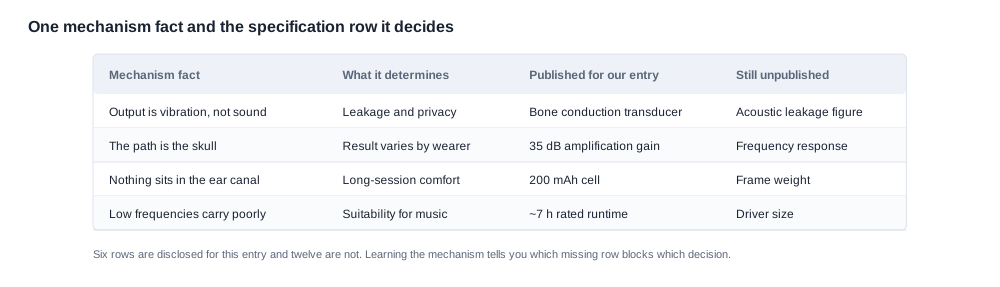
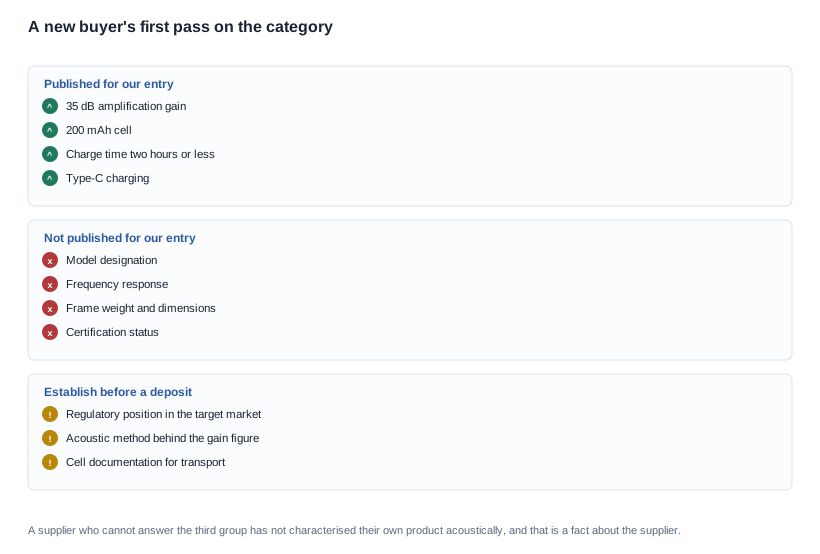
Our range publishes one bone conduction entry, and it discloses six rows and withholds twelve. The six are an amplification gain of 35 dB, a 200 mAh cell, a charge time of two hours or less, a roughly seven-hour rated runtime, Type-C charging, and the fact that no model designation is published. The twelve that are withheld include the transducer type, position and count, the frequency response, the perceived loudness conditions, the frame weight, the frame dimensions, the ingress rating, the battery chemistry, cycle life and replaceability, the customisation capability, the acoustic leakage, the microphone pickup distance, and the certification status.
A comparison sheet built from those six rows compares two things that are not comparable: a gain figure that has no method attached to it, and a runtime that has no test condition attached to it. So the first task is not to compare. It is to learn which rows decide a comparison, so that you know what to ask for and why, and so that you can tell a supplier who has characterised their own product from one who has not.
Who is reading this, and what they are deciding
Four readers arrive at this article, and each of them is at a different point in a different decision.
A brand owner who has been asked to put a smart audio product on the roadmap has the hardest version of the problem, because they do not yet know which questions to ask. Their risk is not choosing the wrong supplier; it is spending two months comparing a spec sheet that was never capable of deciding anything, and discovering the gap at the sample stage.
A category buyer holding two or three quotations faces a different risk. Each supplier uses the same vocabulary, and each uses it to mean something slightly different, so the buyer is comparing language rather than products. The fix is not more quotations; it is a request that forces each supplier to state what their figures mean.
A channel buyer selecting a product for a marketplace listing cares about one number that no datasheet contains: the return rate, and what the returns will be attributed to. In this category the return driver is predictable and it is not a defect — it is fatigue and it is expectation mismatch — and both are design and copy decisions rather than quality failures.
A product or R&D lead who has to brief an engineering team needs a different thing again: the list of physical variables the mechanism puts into the design brief, because in this architecture the frame geometry and the frame mass are not ergonomics decisions that happen to sit next to the acoustics. They are the acoustics.
Why the mechanism decides which specification rows matter
One fact, and the four things that follow from it
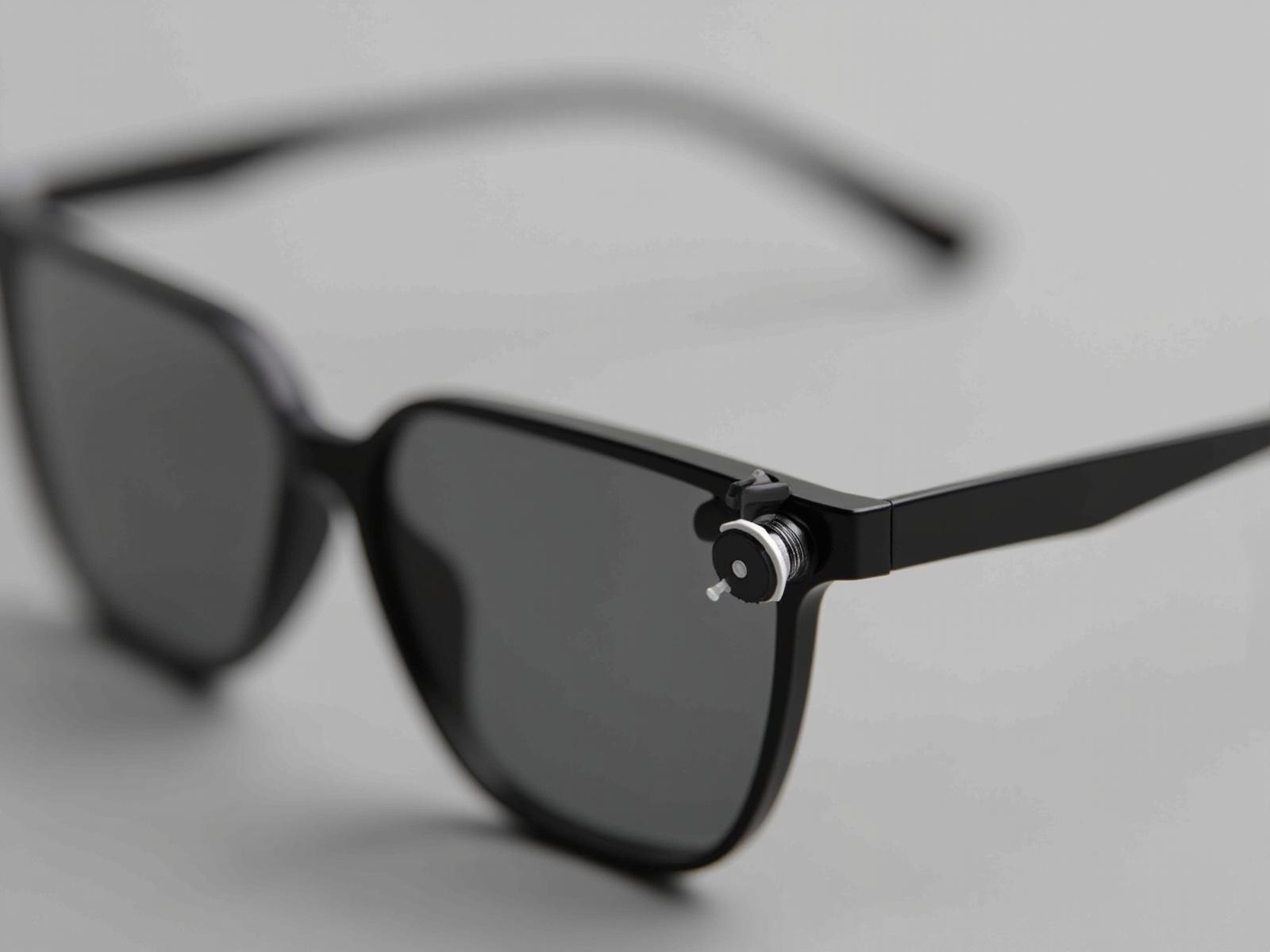
The fact is that the sound does not travel through the air into the ear. It is delivered as a mechanical vibration through the skull, bypassing the ear canal entirely. Every commercially important property in this category, including the inconvenient ones, is downstream of that fact. A new buyer who takes the fact seriously gets most of the way there without any measurement at all.
First consequence: privacy is structural, not engineered. Because the output is a vibration in the skull rather than a sound wave in the room, nothing radiates audibly. This is not a noise-cancelling achievement or a leaky-driver trade-off that has been optimised; it is a different output path. That is why privacy is the one property in this category that can be stated without a measurement — and also why no leakage figure is published for our entry, because the figure would be measuring a property the architecture does not have.
Second consequence: the result is a property of the wearer, not of the unit. The transfer path runs through the skull, so fit, head size, bone density and the wearer's own anatomy are all in it. Two people wearing the same unit can hear materially different things. This has two commercial consequences that a new buyer should absorb early. A case study has to name its wearer, because an unnamed wearer makes an individual result look like a product specification. And a specification sheet is less useful in this category than in an air-conduction product, because the number cannot be made independent of the person.
Third consequence: the fit is an acoustic variable, not only a comfort variable. Where the transducer sits and how firmly it presses changes what reaches the inner ear. A loose fit is quieter and duller, not merely less comfortable. This is the mechanism's most expensive consequence for a procurement team, because it means the frame weight, the temple geometry and the contact pressure are audio specifications and should be requested, recorded and written into the acceptance criteria. None of those three is published for our entry, and they are three of the twelve withheld rows.
Fourth consequence: the environment is never out of the signal path. A bone conduction device leaves the ear open, so the wearer hears the amplified source and the real world simultaneously. In a quiet room the amplified signal dominates. In a street, the environment can dominate it, and no amount of additional gain fixes that, because the device amplifies the street too. This is why a microphone specification would matter more than a gain figure in a noisy application, and why the microphone pickup distance is one of the twelve rows we do not publish.
Where this category sits in the supply chain
Bone conduction occupies an unusual position: it is a mature acoustic technique in a young product category. The transducer itself is an established component type with established suppliers. What is young is the combination — a frame that has to hold contact pressure reliably, at a controlled position, in a product that is also being sold as eyewear.
That combination is why the supply chain for this category is thinner than for open-ear audio. A buyer used to comparing open-ear platforms across many factories will find fewer options, and the ones that exist will vary more in what they publish. The cost of that thinness shows up in three places: in how long it takes to get a comparable sample, in how much of the specification you have to obtain by asking rather than by reading, and in how exposed you are to a single supplier's schedule.
The published position in our range is deliberately narrow. We publish the 35 dB amplification gain, the 200 mAh cell, the two-hour charge time, the roughly seven-hour runtime and the Type-C interface, because the catalogue states them. We publish the absent model designation and the undisclosed customisation capability with the same prominence, because those two absences change what a buyer can actually do. Everything else in this article is a method for deciding what to do next, not a claim about the product.
The order to work through, before anything is ordered
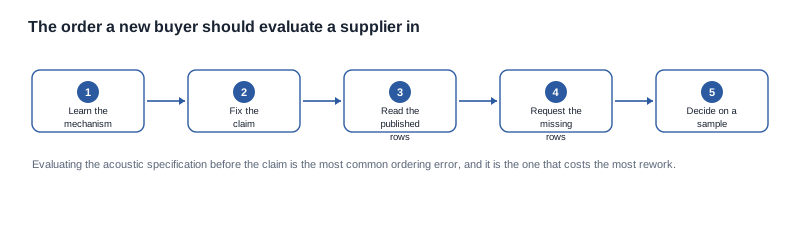
Five steps, in the order that avoids rework
The single most expensive ordering error in this category is to evaluate the acoustic specification before settling the claim. A gain figure only means something in the context of a stated claim, and the claim decides the regulatory route, the route decides the file, and the file decides the schedule. Fix the claim first and much of the acoustic question answers itself.
Step one: fix the claim in one sentence. Write down what the product does, in the words a customer would read on the product page. Describe the mechanism and the environment — "an open-ear amplified audio frame for people who need to follow speech in a noisy workplace" — rather than an outcome for a person. The rule is that the claim must be defensible without any measurement we do not have. A sentence that contains a promise about what a customer's hearing will be like is already a compliance conversation, and it is a conversation for a legal adviser in your market, not for a catalogue.
Step two: read the published rows and mark what each one constrains. A gain figure constrains how you may describe the electronics. A cell capacity constrains the session length. A charge time constrains the recharge window. A charging interface constrains what the customer has to carry. A model designation constrains whether you can list the product at all. Read the rows this way rather than as marketing attributes, and you will notice immediately which of your own plans each row actually blocks.
Step three: request the withheld rows, in the order of what they block. The twelve withheld rows for this entry are not equally important. Three of them block a purchase order outright: the model designation, the customisation capability and, if your channel requires evidence, the certification status. The rest block specific claims or specific design decisions, and can be requested in parallel with the sample.
Step four: agree the method before you agree the number. For any acoustic figure that matters to you, ask what it is measured on — input level, band, coupling arrangement, and where in the circuit the figure is taken. A figure with a method can be checked against a second unit and quoted in a comparison. A figure without a method cannot be checked against anything, including a second sample of the same product from the same factory.
Step five: decide what only a sample can answer. In this category that is a short list: whether the contact pressure is tolerable over a real session, and whether a masked voice in the real environment becomes followable at the level the unit actually delivers. Everything else is a document question.
The rows that carry the decision, and the ones that only look like they do
A useful discipline for a new buyer is to sort every row of every quotation into three buckets: decision-carrying, context, and decoration. Decision-carrying rows change whether you order. Context rows help you use the product correctly. Decoration rows are numbers on a web page that no one has defined.
The gain figure is decision-carrying in a way that is easy to misread. It is a genuine engineering parameter and it does tell you that the electronics are capable of substantial amplification, which is why the category exists. But because decibels are logarithmic and because the gain sits upstream of the coupling, it is not a loudness figure, not a clarity figure and not a distance figure. It is decision-carrying because it triggers the regulatory question, not because it predicts the user's experience.
The battery rows are context for the product and decision-carrying for the programme. A 200 mAh cell with a roughly seven-hour rating tells you the product was scoped for a bounded work block rather than an all-day one. That is a product definition, and it is useful, but only if you read the runtime as a scale figure and ask for the test condition before you plan a duty cycle around it.
The charging interface is the clearest decision-carrying row in the set, and it is consistently underestimated. Type-C means the customer recharges at a desk during a break with a cable they already own. A magnetic charging case means a second object has to be carried, charged, and found. Both can be right for different channels, and the difference shows up in returns rather than in the specification.
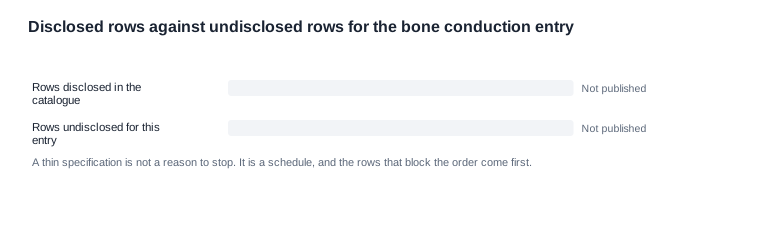
The rows that only look decision-carrying are the ones that get quoted most often: driver size, frequency response, and total harmonic distortion. All three are genuinely useful, and all three are Not published for our entry. Their absence is not a reason to stop; it is a specific list of requests, and a request you can make in one email.

Checking the answers, and the mistakes that follow
What to ask, and what a good answer sounds like
The difference between a supplier who has characterised their product and one who has not is visible in the answers, and it is visible in a single exchange. You do not need an audit to see it; you need to know what to look for.
Ask for the model designation and the certificate register together. A supplier with a designated model can produce a document that names it. A supplier without one will produce a family-level document and a confident assurance that it covers your configuration. Neither is a reason to walk away, but both are reasons to establish the designation before a deposit, and the answer tells you which conversation you are about to have.
Ask for the acoustic measurement method. A good answer names the input level, the band and the point in the circuit where the figure is taken, and it distinguishes a broadband figure from a peak figure. A weak answer repeats the number in a louder tone.
Ask which cell is fitted and get the cell specification rather than the capacity alone, because the transport file and the test summary cover a specific cell and a substitution invalidates them. In this product a cell substitution also changes the amplification behaviour, so it is a compliance change and not only a logistics one.
Ask who writes the listing copy. Some suppliers write it, some buyers do, and the answer determines where the 35 dB figure will be positioned. It should not be the supplier writing a hearing-related description on your behalf, because the supplier does not carry your regulatory exposure.
The range-wide document checklist is at certification checklist, the transport obligations are at battery transport, and the compliance boundary is set out at medical device boundary.
The five mistakes that cost a first programme its date
Comparing on the six published rows. Two suppliers' gain figures are only comparable if both are measured the same way, and two runtimes are only comparable if both are measured the same way. Building a scorecard on the six rows without first asking for the methods produces a confident answer to the wrong question.
Buying the claim instead of the product. The single largest error in this category is a specification that leads with the gain figure and a picture of a person on a construction site. That attracts the customer whose expectation the architecture cannot meet, and the return arrives with a defect report. The specification should state the working environment and the session length, and the copy should follow the specification.
Treating fatigue as a fault. Contact pressure at the temple has to be maintained for the transducer to work, and sustained pressure produces localised discomfort that can appear after roughly an hour. A support script that treats this as a defect generates replacement cost on a product behaving as designed, and the cost lands on the channel rather than on the factory.
Adding a camera to the same cell. A sensor, a radio, a transducer and a 200 mAh cell compete for the same budget, and the runtime the customer receives is set by the hardest of them. Treating this as a configuration option produces a product that passes a demonstration and fails in a shop.
Assuming a second source exists. Because no model designation is published, a buyer who changes direction after a sample evaluation has no way to re-quote the same product and no way to check whether a cheaper competitor quotation is really the same device. Secure the second source before the tooling, not after.

The commercial conversation, and a worked first enquiry
Which terms move, and which do not
The commercial structure of this category divides cleanly, and confusing the two halves is the most common quoting error in the category.
Fixed, and not a negotiation target: the regulatory classification work and its cost; the certification cost and lead time; the acoustic hardware itself; tooling cost, which is usually amortised across a first order and should be asked about as a separate line rather than folded into the unit price; and the cost of a second qualification run of the same model.
Movable: minimum order quantity tiers; colour and temple configuration; logo, lens tint and retail packaging; which models combine into one purchase order; splitting a first production run into two deliveries against a staged payment; the number of units taken at the pilot tier rather than the run tier, which is where most of the real room sits because the factory's exposure concentrates in the first run; and the scope of the conformity assessment, including how many markets it covers.
Before a deposit, request the model designation table, the certificate register with numbers and validity dates, the transport documentation for the fitted cell, the packaging artwork proof, the agreed acceptance criteria for incoming inspection, and written confirmation that no claim in the listing copy characterises the product as a hearing aid or makes any claim about treating, preventing or improving hearing. The clause language sits at contract terms, and the commercial structure of a first order sits at pricing.
A worked first enquiry
Assume a brand owner for a sports-and-commuting accessories line wants to know whether bone conduction is worth adding to the range. The channel is consumer retail and marketplace. The price band is the middle of the range. The first markets are the European Union and the United Kingdom, with the United States following. Nothing has been sampled.
The claim is settled first, because it is the cheapest thing to fix. The product is sold as a private-listening and communication frame for people who cannot or will not wear an earbud — that is what the architecture genuinely delivers, and it does not require a single unpublished figure to support. Music is removed from the copy, not softened, because there is no frequency response to support a music claim. Nothing in the copy describes what a customer's hearing will become.
The published rows are then read as constraints rather than attributes. The 200 mAh cell and the roughly seven-hour rating scope the product to a bounded session, so the packaging copy says "for a shift or a journey" rather than "all day". Type-C means no charging case appears in the box, which also removes a battery from the transport file and simplifies the bill of materials. The 35 dB gain is kept in the technical description and out of the headline.
The withheld rows are then requested in the order of what they block. The model designation first, because without it there is no label, no certificate, no purchase order and no re-quote later. The customisation capability second, because a consumer line under its own brand needs to know whether logo, tint and packaging are available at all. The certification status third, because a marketplace channel with a returns policy to protect needs to know the position before the listing is written. Only then does the acoustic detail follow, on the understanding that it supports a comparison rather than a headline.
The sample is then scoped narrowly, with a protocol rather than an impression: a real session length rather than a five-minute demonstration, several wearers rather than one, and a written acceptance criterion agreed before the sample is evaluated, so that a good impression cannot become an order. The one question the sample cannot answer is the regulatory one, and that stays in the document track.
The commercial conversation follows the evidence. The pilot tier, the split delivery against staged payment, the logo and packaging configuration and the assessment scope are the four negotiable items, and they are negotiated as a package against the first-run risk the factory carries. The unit price is not the first conversation, because the configuration that determines it has not been fixed yet.
What we can tell you, and what to send us
The absent rows, published with the same prominence
We publish the 35 dB gain, the 200 mAh cell, the two-hour charge time, the roughly seven-hour runtime and the Type-C interface because the catalogue states them, and we publish the absent model designation and the undisclosed customisation capability with the same prominence. We will not present a maximum output as a result, and we will not write a hearing-improvement claim, because a hearing-related description can pull the product into a regulatory framework that a catalogue entry cannot address. We will not estimate a frequency band, a frame weight or a certification status, because those are precisely the rows where an invented value survives longest and is discovered most expensively.
The use case behind the enquiry
Send us the use case behind your enquiry, the destination markets, the session length you are designing for and the price band you are working inside. We will tell you whether the requirement behind your enquiry is the one this technology answers, which of the published rows cover your configuration, which items have to be established in writing before a deposit, and what a sample still has to settle. The mechanism is described under bone conduction audio, the specification is walked through in bone conduction spec sheet explained, and the questions to put to a supplier are collected in what to ask a supplier about bone conduction.
Related reading
- The full mechanism — how bone conduction works
- The comparison — bone conduction cost vs performance
- The questions to ask — what to ask a supplier about bone conduction
Tell us the use case behind your enquiry and we will tell you whether this technology answers it, and what a sample still has to establish.


