

Volume is one of those features a buyer tests once, in a quiet office, in the first week — and then hears about from a customer six months later. The phone slider moves the level, the customer assumes it will stay there, the glasses come back on a desk at a different level, and the complaint arrives worded as "the volume resets itself".
That experience has a technical explanation, and it is not a defect. It is also not something that a product page can fix. The sentence "can I adjust the volume per device" is used by people buying smart glasses to mean at least four different things, and the four answers come from four different places in the system. A buyer who has one of them in mind and receives a supplier's answer to another of them will end up with a sample that satisfies the question badly asked.
This article sorts the four questions apart, then walks through what actually decides the answer, what our own documentation publishes, and how to settle it on a sample before you commit to an order. We will be explicit about the rows we publish and the rows we do not, because the volume question is exactly the kind of question where a plausible-sounding guess is worse than an open answer.
can i adjust the volume per device: four questions hiding inside one sentence
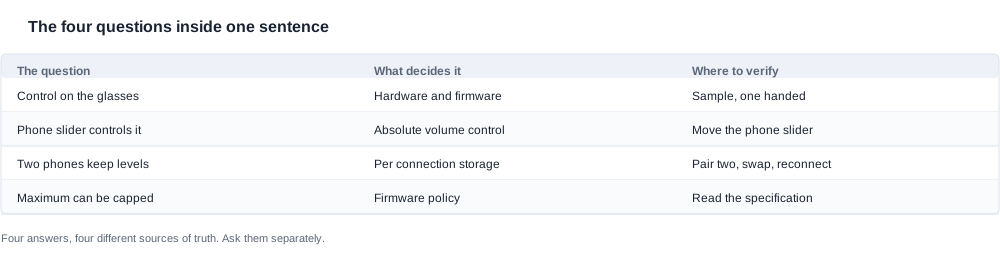
Strip the sentence down and four separate decisions are sitting inside it. They are frequently bundled together in a specification, and they are very rarely all true of the same product.
- Does the wearer get a volume control on the glasses themselves? A button, a rocker, a slider, a double-tap, a long press. This is a hardware and firmware question about the product.
- Does the phone's volume slider control the glasses? This is a protocol question about whether the glasses implement absolute volume control, so the phone writes a level rather than sending a relative nudge.
- Do two different phones keep different levels? This is a memory question: does the device store one level for everyone, or one level per paired device.
- Can the maximum level be capped? This is a firmware policy question, and it is the one that turns a feature into a specification you can put on a product page.
A buyer asking about a retail product is usually asking question one and half of question two. A buyer building a fleet for staff, or a product that gets paired to a company phone, is usually asking question three. A buyer in a market where hearing-safety claims are scrutinised is asking question four. And the person writing a listing that says "volume control" without specifying which of the four it means is usually the one who generates the returns.
The reason to separate them is that they can be independently true. A product can have hardware buttons and no absolute volume control, in which case the phone slider moves the phone's stream and the glasses ignore it. A product can implement absolute volume control and store a single global level, in which case two phones fight over the same register. A product can have a firmware cap that the operating system then overrides or sits underneath. Every combination you can imagine is somebody's actual product, and the datasheet phrase "supports volume adjustment" says nothing about which one you have.
The control path that decides can i adjust the volume per device
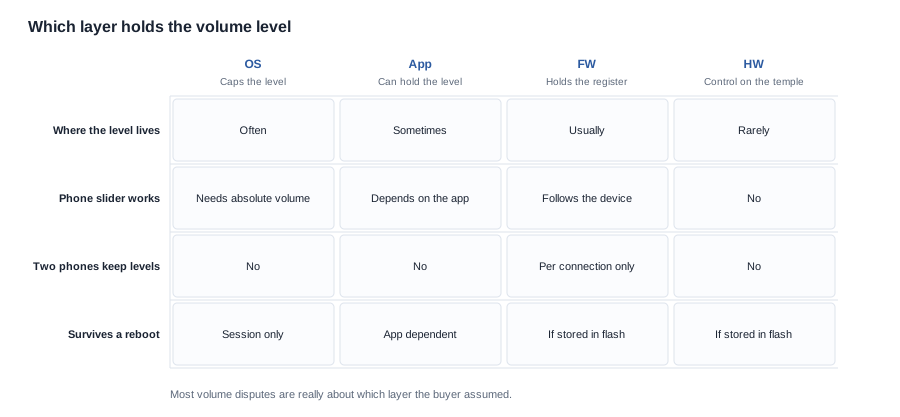
The useful mental model is a path. A volume command starts somewhere — a button on the temple, a key on the phone, a slider in an app, a policy in the operating system — and ends at the amplifier and the speaker. Each stage along that path can hold, ignore, translate or override the command, and the stage that holds it decides what the wearer experiences.
Where the level is held. If the level lives only in the phone, the glasses have no volume of their own: they are a speaker driven by whatever the phone sends, and the setting disappears with the phone's session. If the level lives in the device, the glasses keep their own setting and the phone is only a remote. If the level lives in a companion app, the app has to be running or the level has to be cached, and you have now added a software dependency to a hardware product that is otherwise meant to work without one.
How the two ends talk. The mechanism that decides whether the phone's slider moves the glasses is absolute volume control over the Bluetooth audio control profile. Where it is implemented, the phone writes a level to the device and the device's own volume display and buttons follow. Where it is not, the phone can only send relative up and down commands, and in practice some platforms simply do not send anything at all to a peripheral that does not implement it. This is the single most common reason a buyer's own phone appears not to control the glasses, and it is invisible in a product photograph.
Whether the device can hold more than one connection. A per-device level only means something if more than one device can be connected at the same time. If the product holds one connection at a time, the moment a second phone connects the first is disconnected or paused, and when it comes back it is a new session as far as the product is concerned. The wearer experiences this as "the volume is whatever the last phone set".
Whether the level is stored per connection or globally. This is a separate decision and it is the one most often assumed. A product can support two simultaneous connections and still hold a single volume register, in which case the second phone silently overwrites the first. A product with a register per connected phone remembers two levels and restores them on reconnect, and it should also restore them after a power cycle. Buyers should treat "does it survive a reboot" as a separate line item, because a product that forgets its state when it is powered off will also forget it when a customer puts it down overnight and picks it up in the morning.

Why can i adjust the volume per device is decided by the platform, not the factory
Here is the part that surprises people who have only tested with one phone in one building. The maximum level a wearer can actually reach is frequently not set by the glasses at all.
Mobile operating systems impose their own limits on media volume when a headset is detected. Android has, for several generations now, capped media playback below the maximum on connected headsets and left the user to lift that cap in settings; iOS applies its own related behaviour for Bluetooth media devices. The precise number, the behaviour by version, and the way each phone maker's user interface presents the override all vary, and they are properties of the operating system, not of the product in your box. The consequence for a buyer is specific: a product page that claims "maximum output" is making a claim about the glasses, while the level the end user can actually reach is partly a property of the phone they already own.
That is why a ceiling set in device firmware and a ceiling applied by the operating system are two different features with two different names. If your product ships with a firmware ceiling — for instance, a level that the device itself will not exceed — that ceiling is a property you control, test, and document. If the effective limit comes from the platform, it is a property you inherit and cannot document as your own.
The second reason the platform matters is behavioural. Because the override lives in the phone's settings, the wearer who wants maximum volume has to go and find it, and many never do. A product whose usable volume depends on a settings hunt will generate support contacts that have nothing to do with the audio quality. A product whose own hardware controls are obvious and immediate does not.
The third reason is the acoustic one, and it is the reason open-ear products are treated differently from earbuds. Open-ear audio radiates into a shared space. The maximum level a manufacturer is prepared to publish is therefore constrained by how much leakage they accept in a public place, not only by how loud the wearer wants it. A product tuned to be comfortably loud in a quiet room will leak into a quiet room; a product tuned to be tolerable in a noisy street will leave the wearer reaching for the volume control in a quiet room. That tension is a design decision, it is visible to anyone sitting next to the wearer, and it is the reason the level that "the factory published" and the level that "works in the street" are often different numbers.
All three of these platform effects have a commercial consequence that shows up in a buyer's own due diligence. A specification that says "maximum output level" without saying who applies it is a specification that will produce a different customer experience on a Samsung handset than on the phone the specification was written with. The way to protect the launch is to write two numbers instead of one — the device ceiling and the platform ceiling — and to publish the test method behind each. That is more work in the copy, and it is considerably less work than explaining to a marketplace reviewer why the product in their hand stops at a lower level than the listing promised.
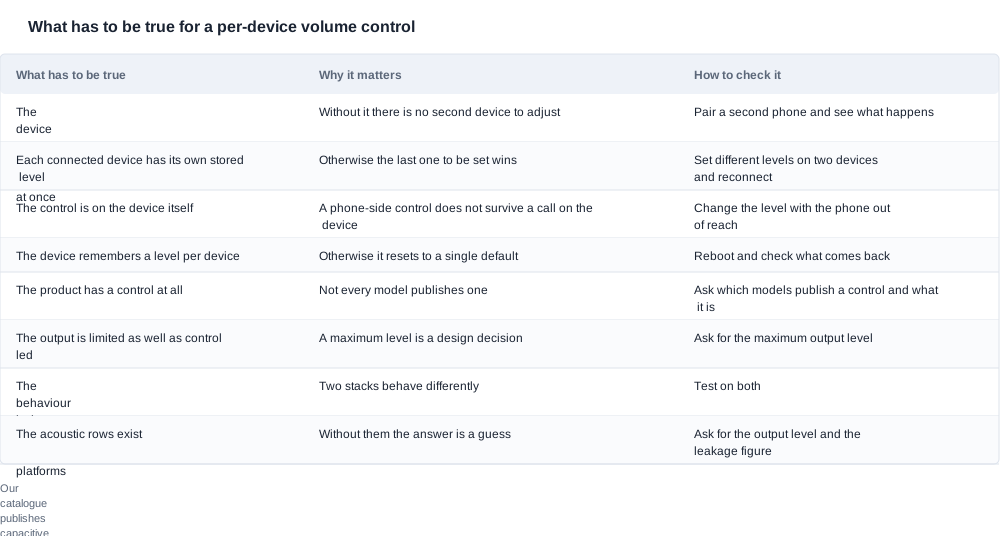
None of the acoustic figures are published in our catalogue. We publish no maximum output level, no leakage figure, no microphone pickup distance, no driver size and no frequency response for any model in the audio family. Those numbers have to be requested, and a buyer who has them can answer most of the volume questions without a sample at all.

What our catalogue publishes about can i adjust the volume per device
The honest position, stated in full. Our audio range covers eight models — the K02 and the YK12, the D12 and the D11, the LC-105-2 and the G07, and the K01 and the LC-105-1 — and the rows we publish across the catalogue as a whole are things like the Bluetooth version, the charging method, the charging case, the charge time and the battery figures. On the audio models specifically, a Bluetooth version is published for every model in the range; across the whole catalogue a version is published for 14 of the 28 models we list, and it is marked as not published for the 11 camera models, the A05, the A06 and the bone conduction entry.
What we do not publish anywhere in the catalogue is a capacitive-touch row or a translation row. That is worth stating plainly in a volume answer, because a supplier who tells you "you can adjust the volume with a touch panel on the temple" is making a claim that our own documentation does not support for any model. It does not mean the claim is false; it means it is unverified, and the only way to resolve it is to ask for the model-specific evidence and to test the sample.
The same applies, with more force, to volume itself. We publish no volume control row, no multipoint capability, no per-connection level storage, no maximum output level and no leakage figure for any model in the audio family. In the audio range the D11 and the YK12 publish a surround sound row; in the sport range the YKC02 and the D17 publish one, and the ZH12 publishes the Chinese 立体环绕音 line. Those are the published differentiators, and they are the rows a buyer can compare on today.
The practical conclusion for a procurement team is this: no volume claim for any of our models can be assembled from the catalogue alone. It has to come from a written answer naming the model, plus a sample test, plus a decision about which of the four questions in the first section the claim is actually about. If you are comparing suppliers on a volume claim, compare the four sub-claims separately. A supplier that answers "yes, adjustable" to all four has told you nothing, and a supplier that answers "no on this one, and here is why" has told you a great deal.
The request itself is simple, and writing it well saves a round trip. Name the model designations rather than the range, name the platform or platforms your customers actually use, and ask for the four sub-answers separately instead of asking whether volume is adjustable. Ask for the output level with a measurement distance and a measurement method attached, and ask whether the ceiling is enforced in hardware or in firmware. Ask what happens to the level after a power cycle. The answers you get back in that form can go straight into a product page and a test script; answers to a single broad question cannot go anywhere.
There is one more trap worth naming, and it is the one that catches buyers who are moving fast. A "yes" on the volume question from a supplier who also offers firmware customisation often means a firmware change is assumed rather than a capability that exists today. The difference matters commercially, because a firmware change to add a control path or a per-connection register is engineering work with a lead time attached, not a configuration switch. Before you record the answer as a capability of the model, ask whether it is in the current firmware or in a roadmap item, and ask which one you would be receiving in the first shipment.
A sample protocol for can i adjust the volume per device
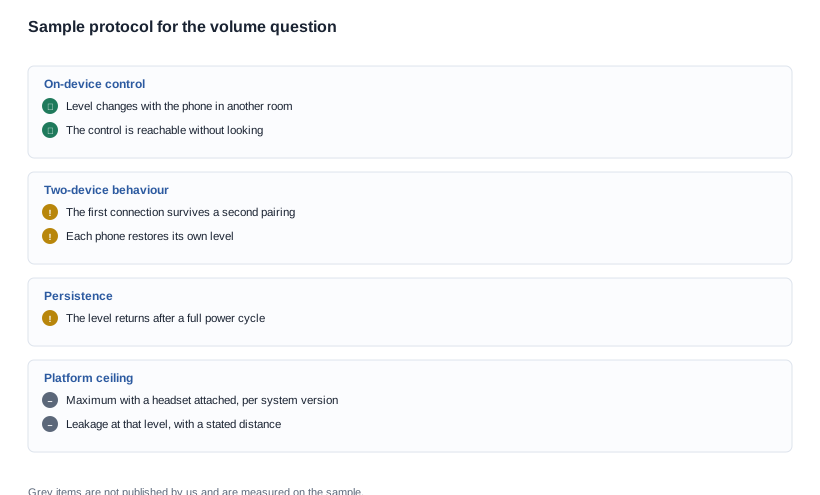
A sample order is where this question should be settled, and the order in which you run the tests matters, because each test tells you which of the next ones is meaningful. We would run it in this sequence.
- On-device control with the phone out of reach. Put the phone in a pocket or on a desk in another room. Raise and lower the level on the glasses. If nothing happens, the volume is controlled only by the phone, and the product is harder to live with than its listing suggests. This is the single most valuable test for a wearable and it takes thirty seconds.
- Phone slider control. With the phone in hand, move the system volume slider and watch the device. If the level on the glasses follows, absolute volume control is implemented. If it does not, note it and check whether a vendor control app is expected to be the route instead — and if so, you now have a software dependency to qualify.
- Two-device behaviour. Pair a second phone while the first is connected. Record what happens to the first connection: does it stay alive, does it drop, does it pause? Then set a different level on each device, disconnect both, reconnect them in the reverse order, and see which level comes back. This single sequence separates simultaneous connections from per-connection storage, which are usually assumed to be the same thing and are not.
- Persistence across a power cycle. Power the device down fully and bring it back. Check the level, and check the level again for each phone. A product that resets to maximum on boot is a product that will be reported as "the volume is too loud" by a customer who simply picked it up.
- The platform cap. On each operating system version you intend to ship to, connect the glasses and find the maximum the phone will actually allow with a headset attached. Record the ceiling the platform imposes, and record the firmware ceiling separately if the device has one. Write both into your product page as different numbers, because they are different numbers.
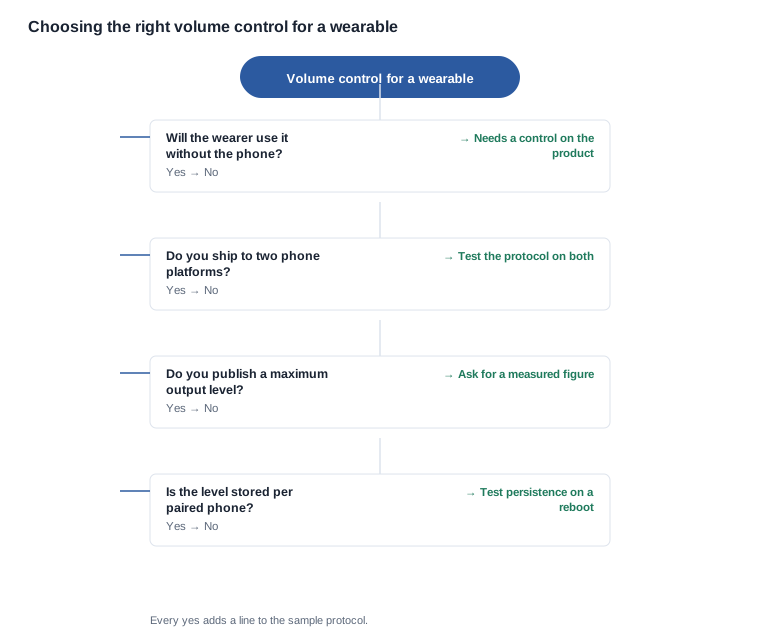
Run the same sequence on both phone platforms if you are shipping to both. The behaviour of a peripheral with respect to a paired device is not identical across platforms, and the differences are not always documented anywhere a buyer would look.
If leakage matters to you commercially — and for an open-ear product sold into shared spaces it usually does — add one more measurement to the protocol: play a fixed track at the level you intend to publish, and measure the sound at a stated distance in a stated room. A figure with a stated distance and a stated method is comparable between suppliers; a figure without them is decoration.
The supplier questions that settle can i adjust the volume per device
Put these in the supplier questionnaire before you ask for a price, because the answers change what the price is buying.
- How many devices can be connected at the same time, and is the volume level stored per connected device?
- Does the firmware implement absolute volume control, so the phone's slider sets the level rather than nudging it?
- What controls are on the product itself, and which models have them?
- What is the maximum output level, at what measurement distance, and is it a hardware limit or a software cap?
- What is the leakage figure at that level, and how was it measured?
- Does the behaviour differ between phone platforms or operating system versions?
- Does the published maximum survive a reboot, and does it restore per device?
The shortlist criteria that follow from those questions are about evidence rather than features. A supplier who answers at the level of the model rather than the range, who states a measurement distance, who distinguishes a hardware limit from a firmware cap, and who is willing to say "that is not published for this model" is a supplier whose volume claims you can put on a product page. A supplier who answers all seven with a single affirmative has told you that the product has volume, which is the least informative thing on the list.
Those criteria are worth turning into a checklist before the shortlist meeting rather than after it, because the questions in this section are also the questions that expose where a supplier's evidence is thin. If a supplier cannot state a measurement distance, the acoustic figures will not survive comparison either. If a supplier cannot tell you whether a feature is in the current firmware or planned, the sample you receive may not behave like the product you are buying. The trade-off is plain: a slower due diligence conversation now costs an email, and a faster one now costs a launch, a return rate or a listing page you have to rewrite.
Our own position is the second kind. We publish the rows we hold — the Bluetooth version, the charging method, the charging case, the charge time and the battery figures — and we mark the volume rows as open rather than estimating them from typical values. For a specific model and a specific pairing scenario, we will tell you which of the five tests above would settle the question, and we will tell you which of the seven questions our documentation can answer today. We will not guess an output level, and a buyer who builds a volume claim on an assumed maximum is the buyer who receives the complaint about noise in a quiet space.
The acoustic background behind these rows is under open-ear audio, the measurements that decide a volume claim are under microphone and output quality, and the protocol for a sample evaluation is under sample evaluation. Unit price, minimum order quantity, lead time and the sample fee are not published on our side and are quoted per project.
Related reading
- The technique and the models — open-ear audio
- The acoustic rows that decide a volume claim — microphone and output quality
- The protocol for a sample test — sample evaluation
Tell us the models you want to pair and the platform your customers use, and we will say which of the five tests will settle it and what our documentation can answer today.


