
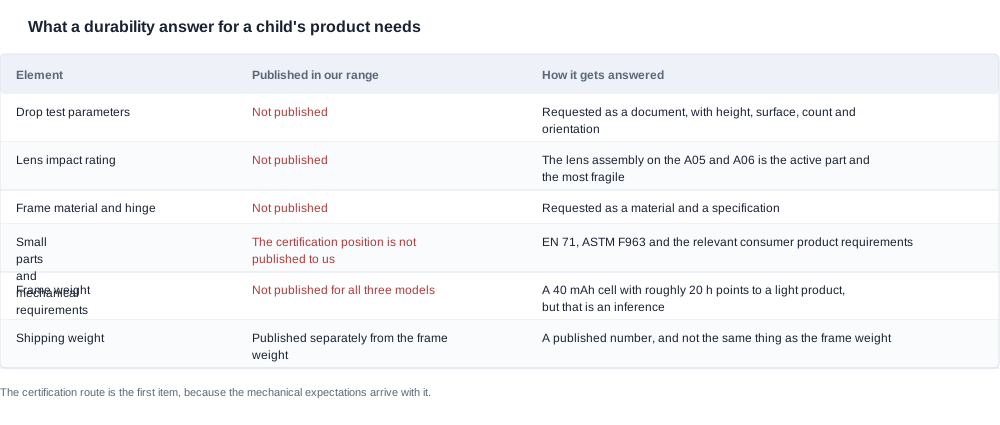
This is a question with an answer that our published position does not give, and the gap is not a marketing convenience. There is no drop data, no impact rating, no frame material specification, no seal material and no frame weight published for any of the three children's models. The A05 and the A06 publish a 40 mAh cell, charging in under two hours, a rated runtime of roughly twenty hours, magnetic charging, a lens-based electronic anti-fogging arrangement, and posture and distance detection. The A07 publishes Bluetooth 5.4, a 70 mAh cell, charging in under two hours, a rated runtime of roughly twenty hours and magnetic charging. No kid model publishes an IP rating, and no kid model publishes a certification row.
So a children's product with a roughly twenty-hour runtime on a 40 mAh cell is, by inference, a light product, and a light product is one whose failure mode is more likely to be a dropped-and-broken frame than a swollen battery. That is an inference, and the frame weight that would confirm it is not published for any of the three models.
The reason the question deserves a full answer anyway is that "can the child break it" is not really asking about strength. It is asking three different questions in one sentence: will it survive the handling it will actually get, what does the manufacturer stand behind when it does not, and what can the buyer truthfully print on the box. Each of those has a different source, and only the first one needs a drop test.
Can the child break it: what a durability answer has to contain
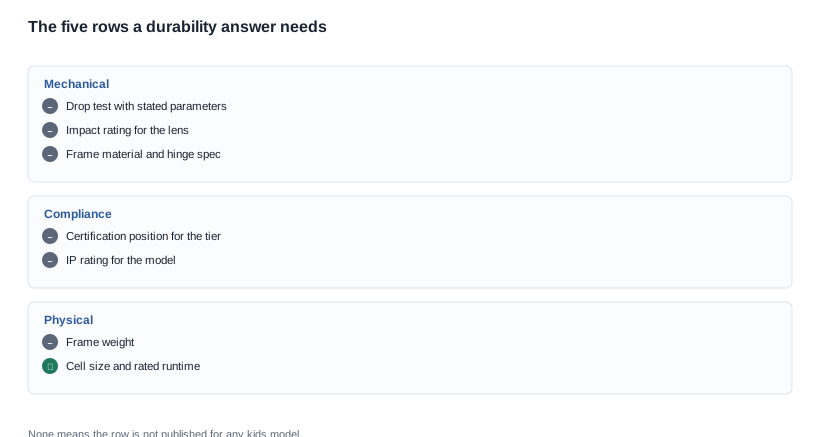
A durability answer that a buyer can use has five parts, and each of them needs a specific form rather than an adjective.
1. A drop test with a stated height and a stated surface. Not a claim that it survives drops, but a number: which height, which surface, how many times, from which orientation, and how many units were tested. None of that is published for the A05, the A06 or the A07, and the parameters matter more than the outcome. A product tested at a low height onto a padded surface and a product tested from waist height onto a tiled floor are different products for the purposes of a buyer's copy, and a supplier who quotes the result without the parameters has given you a claim rather than a specification.
2. An impact rating for the lens. This is the row that is specific to this product category and it is the one most buyers forget. The A05 and the A06 carry a lens-based electronic anti-fogging arrangement, which is an active assembly rather than a plain piece of plastic, and an electronic assembly inside a lens is the part of a children's product most likely to be damaged by a drop. A lens that cracks, or a lens whose heating element or sensor assembly is displaced, may not visibly fail — it may simply stop clearing. That failure is invisible to a returns department and visible to the parent, which is the worst combination in this category. No impact rating is published for any kid model.
3. A frame material and a hinge specification. Frame materials are not published anywhere in our range, and the frame materials discussion covers what a frame material specification normally contains and why the name alone does not settle anything. For a children's product the hinge is at least as important as the front, because a hinge is the part that carries the bending load when the frame is dropped, sat on, or twisted by a small person who has decided the glasses are a toy.
4. A certification position that includes the mechanical requirements. The frameworks that come into play for children's products in the destination markets include EN 71, ASTM F963 and the relevant consumer product requirements, and those frameworks are where the mechanical and small-parts expectations actually live. The certification position for this tier is not published to us, so this is the first gap to close, and the A05 certification status is the honest starting point for what is known and what is not.
5. A weight figure. Not published for any of the three models, and it is the number a parent would want most. It is also the number that would settle the inference in the next section.
There is a sixth item that is not a durability property but behaves like one, and it is worth putting on the same list because it changes the answer: the packaging. A product that travels in a backpack is a product that lands on a floor, and the box is the first thing to fail and the thing that decides what reaches the floor. A product shipped in a padded case behaves differently from the same product in a thin mailer, and that difference is worth more than a marginal improvement in the frame.
The runtime caveat, and can the child break it in spite of a light design
Here is where the inference has to be handled carefully, because it is the most quotable thing in the children's range and also the easiest to over-read.
A roughly twenty-hour rated runtime from a 40 mAh cell is a low average power draw, and a low power draw on a product that has to run a display, sensors and a radio is evidence that the product is light. It is worth stating plainly, because it points the failure mode towards the frame and the lens rather than towards the battery. The battery life discussion sets out what the figure does and does not establish, and the short version is that it describes the electronics and says nothing about the structure.
Three reasons the inference stops where it stops. The first is that power draw is governed by the electronics, not by the frame, so a light product can still have a heavy front section and a light temple, and it is the front that absorbs the impact. The second is that light frames are frequently built with thinner sections and lighter hinges, which is a deliberate trade of durability for comfort and weight, and that trade is exactly what a drop test would expose. The third is that the lens assembly is unaffected by the runtime figure altogether — the anti-fogging arrangement is an active assembly whatever the battery weighs, and it is the part with the least margin.
So the honest position is that the published runtime points towards a breakage mode rather than a battery failure mode, and that it is consistent with a light and therefore a more drop-tolerant design, but that neither the frame weight nor any drop data is published, and the inference cannot be promoted to a claim. A buyer who writes "child-proof" or "unbreakable" on the basis of a battery figure has written something the catalogue does not support and that a parent's dropped glasses will disprove in a week.
It is worth adding the same caution to the A07, which publishes a 70 mAh cell rather than 40 mAh. The larger cell pushes in the same direction as the lighter inference — more energy for the same runtime implies more electronics or a bigger battery — but the direction of the inference is the same and the conclusion is the same: nothing about a cell capacity is evidence about a frame.
There is one further point about the age range, because it changes what the durability question even is. The frameworks and the use case both scale with the age of the user, and a product intended for a four-year-old is not in the same exposure class as one intended for a ten-year-old, regardless of the hardware being identical. The younger the child, the more likely the product is to be handled roughly, the more likely it is to be left in a bag or a car, and the more likely a failure is going to be reported as the child having broken it rather than as a defect. That changes the returns handling, the warranty design and the way the copy is written, and it is a decision a buyer makes with the channel rather than with the factory. It is also the reason the age range belongs in the first message to a supplier rather than in the fifth.
What you can do, and can the child break it be tested before you order

- Establish the certification position first, because the mechanical expectations come with it and they are already a defined set rather than an open question. This is the cheapest route to most of the answers because the framework carries the drop and small-parts requirements, and a buyer who needs the answer for compliance has to go there anyway.
- Request the drop data as a document, with the parameters — height, surface, orientation, number of cycles, sample size and the pass criterion — and treat a refusal or an absence as the answer it is rather than as an oversight.
- Run your own drop test on samples, if the certification route is slow. The sample ordering discussion covers the process, and a small sample set tested at a defined height tells a buyer more than a brochure, because it is the buyer's own data and the buyer's own pass criterion.
- Treat the packaging as part of the answer, because a product that is dropped in a bag is a product that is dropped onto a floor, and a children's product in a school bag is a different exposure from a children's product on a table.
- Check the shipping weight, which is a published consideration on its own terms and is not the same thing as the frame weight, but which at least gives you a number to reason with. The shipping weight discussion is the reference for why the two should not be confused.
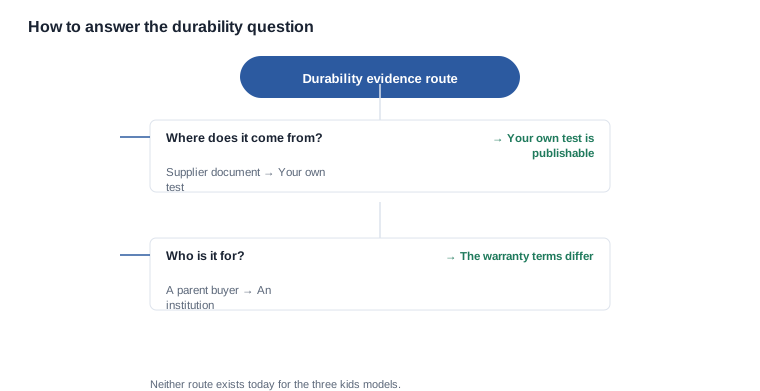
A drop test designed by the buyer is worth a paragraph, because most informal drop tests produce nothing usable. Define the height, define the surface, define the orientation, define the number of units and define what counts as a pass before you start. The pass criterion is where informal tests fail: a frame that survives without a visible crack may still have a shifted lens assembly or a failed anti-fogging element, and the functional check afterwards is what actually tests the product rather than the plastic. Three units per model at one defined height, with a functional check after each, is a smaller and better programme than an undefined number of drops with no criterion.
Two cautions on the destructive side. Never run a destructive test on a unit that is going to be inspected against the incoming golden sample or sold, and say clearly in the sample request which units are expendable. And keep the tested unit. A unit that has been dropped and still functions is the most valuable document in the programme, because it is the reference against which the next delivery can be compared, and because it is what lets a buyer answer a parent's question with something better than an adjective.
Record the protocol as well as the result, because a result without a protocol is the thing a customer's parent will argue with. The record should say what was dropped, from what height, onto what surface, in what orientation, how many times, how many units, what the pass criterion was, how many units passed, and what functional checks were run afterwards. That is a single page, and it converts an opinion into a claim the buyer can publish and defend. It also has the useful property of being reusable: the same page can go into the technical file, into the listing copy, and into the answer to a customer service ticket, which is three uses for the same afternoon's work.
The certification route, and can the child break it be answered by the framework
The certification route deserves its own treatment because it is where most of the answers come from, and because it is also where the buyer's timeline is decided.
The frameworks that apply to children's products in a destination market — EN 71 in Europe, ASTM F963 in the United States, and the corresponding national requirements elsewhere — carry the mechanical and small-parts expectations. They are structured around age bands and around the parts a child of a given age could swallow or choke on, which is why the age range of the intended user changes the requirements rather than merely the labelling. They also carry the drop and tumble expectations that a durability answer is really about, because a standard that specifies a test defines the test parameters as well as the result.
On that route has to be stated accurately, and it, our position is not a strong one. The certification position for this tier is not published to us. No kid model publishes an IP rating, no kid model publishes a certification row, and the body of our catalogue mentions no conformity regime at all — the only certificates we publish anywhere are ten patent certificate images on the export-certification page, eight design patents and two utility models, which protect the appearance and construction of the product and are not conformity evidence of any kind.
That means the certification route is a programme you would have to run, not a document you could collect. For a buyer it means four things: the cost is real and belongs in the first quotation rather than in a later conversation; the lead time is long enough that it can set the launch date on its own; the application should be scoped to the exact configuration, which for these models means the colourway, the lens arrangement and the packaging, so a change to any of them forces a re-check; and the commercial terms — who applies, who pays, what happens if the configuration changes afterwards — are negotiable and should be negotiated.
That last point is where a buyer has more leverage than they usually realise. The factory holds the bill of materials, the component specifications and the test evidence it has already generated. Whether the application names the brand as the applicant, the factory as the applicant or both as co-applicants is a structural decision with a different cost and a different control profile, and it is a decision worth taking deliberately rather than by default. The certification checklist is the working reference for scoping that decision.
For an institutional channel — a school, a childcare group, an education programme — the framework conversation is not optional and the buyer should expect the institution itself to have a view on which framework applies and what evidence it will accept. That is a useful forcing function, because it turns the question from an open-ended enquiry into a defined deliverable that can be priced and scheduled.
The answer, and can the child break it be stated honestly in your copy
What can be written in the listing, and what should stay out.
Publishable from the catalogue. The cell size and the rated runtime for each model, the charging method and the charge time, the Bluetooth version for the A07, the electronic anti-fogging arrangement on the A05 and the A06, and the posture and distance detection on those two models.
Publishable once measured. The frame weight, the packaging dimensions and the shipping weight, each with the date and the source recorded.
Publishable only with a test. Any durability statement at all, and it must carry the test parameters and the sample size with it. "Drop-tested from a height of X onto a surface of Y, with Z units tested, all Z functional afterwards" is a publishable claim. "Built for active kids" is not a claim, it is a mood.
Not publishable. Any impact rating, any frame material, any seal specification, any ingress claim for the kids range, and any durability statement that implies the certification frameworks have been met, because we publish no certification row for this tier.
The commercial side of this product has one feature that other categories do not: the failure pattern is predictable and concentrated. A children's product is dropped, sat on, twisted and put in a bag, and the same handful of components take the damage every time — the lens assembly, the hinge, the temple tip. A warranty policy for this category is therefore much better defined as a replacement policy than as a repair policy, and it is worth negotiating on that basis, along with the response time, the DOA allowance and whether the replacement ships with the paperwork already completed.
There is a second commercial consequence of the concentrated failure pattern that is worth putting in the quotation, and it is the one that decides the category's margin. A repairable product carries a repair cost, a workshop relationship and a turnaround time that all vary by market. A replaced product carries a unit cost, a logistics cost and a reverse-logistics cost, all of which are visible and quotable, which is why a buyer who has decided the product is a replacement product can negotiate a much clearer commercial model than one who has not decided. The decision itself does not depend on the supplier — it follows from what the child does to the product — so it is worth making early, before the terms are settled.
The terms worth negotiating are the unit price and its volume tiers, the warranty period with a stated response, the replacement terms for a unit that has been damaged rather than failed, the packaging specification, delivery splitting, payment nodes against inspection, and the terms of a pilot order. Two lines are not the negotiator's to move: certification cost and its lead time follow the process and the testing body, and tooling is usually amortised across the first order while certification cost sits per product family — ask which one a quoted line represents.
The agreement should carry the published rows for the configuration ordered, plus the certification position for that configuration, the drop test parameters and sample size, the measured frame weight, the packaging specification, the warranty period with a stated response, and the replacement terms. What should stay out is anything measured on a different model, anything borrowed from an adult model, and any figure we have substituted for a typical value.
We publish the three children's models' rows accurately and we do not publish drop data, impact ratings, frame materials, seal materials or the frame weight for any of them, and we will not substitute a typical value or a figure borrowed from an adult model. We will also be direct that the certification position for this tier is not published to us and that it is the route to most of the answers a parent or a school would need, which is why it is the first item rather than the last. And we will say plainly where the twenty-hour runtime on a 40 mAh cell points, and where it stops.
Tell us the markets, the age range and the use case, and we will tell you which of these gaps the certification route closes and which need a sample.
Related reading
- What a frame material specification contains — smart glasses frame materials
- The starting point for the compliance question — A05 certification status
- Running a sample programme properly — how do I order a sample
- The weight question, handled separately — AI camera glasses shipping weight
- What the runtime figure establishes — A05 smart glasses battery life
Tell us the markets, the age range and the use case, and we will tell you which gaps the certification route closes.


