
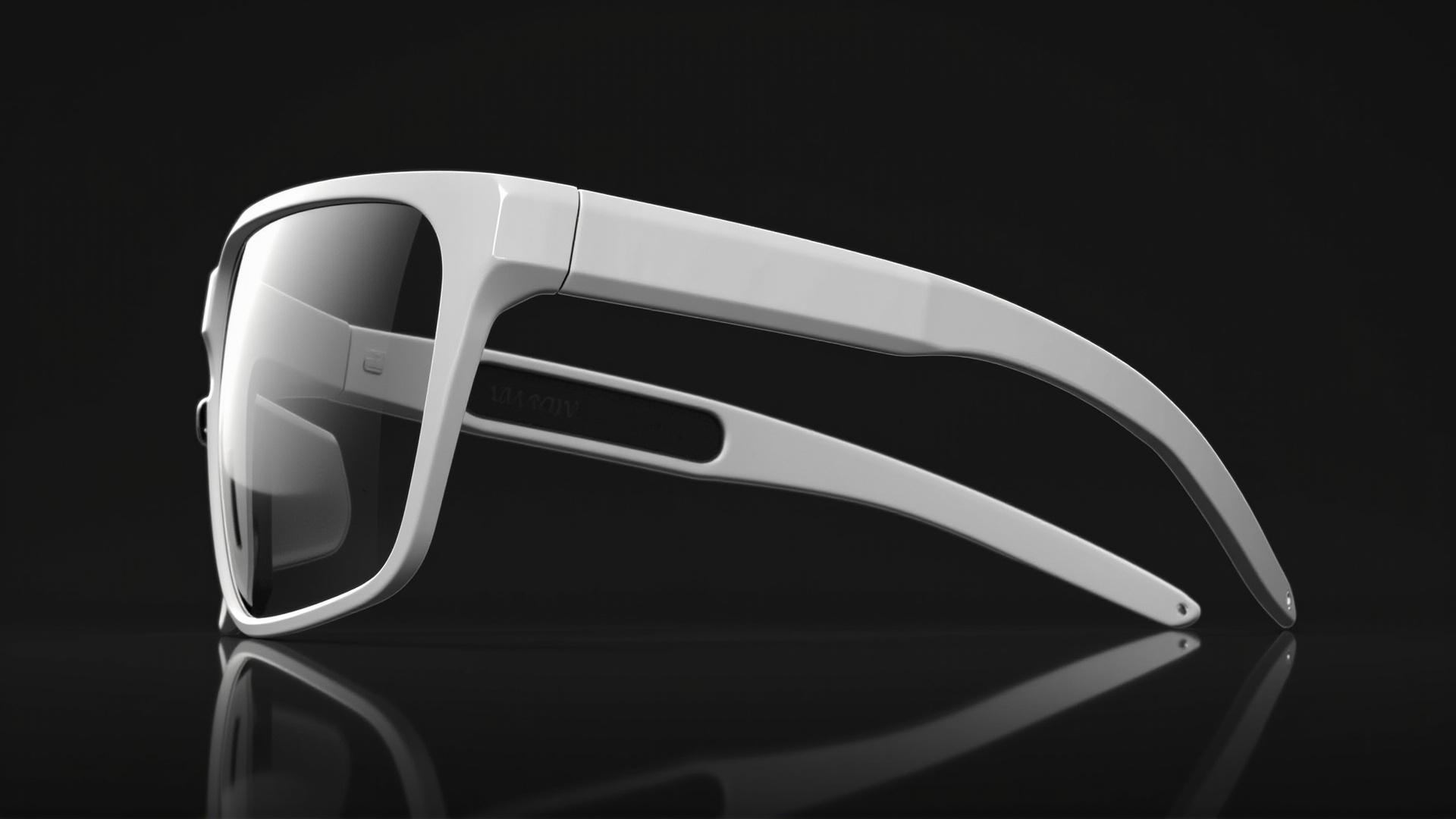
The CY03 smart glasses support a commercial argument in two situations — a retail proposition led by the charging case, and a brand building a camera range on the 290 mAh platform — and in little else. The published configuration is 8 megapixels, a 290 mAh cell, a charge time of two hours or less, about seven hours of rated endurance and a 1400 mAh charging case, and it shares its platform with the CY05 and the L1 Pro, and the L2 Utral. We publish no prices for any model in this range, so this article is not about which model is worth more. It is about which claims the published rows can carry, what the delivered cost structure looks like, and where a value argument on this model stops being defensible.
What a CY03 value argument can legitimately rest on
A value argument is a claim about what a buyer gets relative to what they give up. For that claim to be defensible, it has to be built on something the supplier can evidence — and, in this category, a large part of the usual value argument is not evidenced at all.
What the published rows support. The 1400 mAh charging case is the largest case capacity published in the camera range, shared with the CY05 and the L1 Pro, and published alongside a 900 mAh option on the L2 Utral. The 290 mAh frame cell is the largest published in the range. The ~7 hour endurance rating is a manufacturer rating, shared across four models. These are facts about the product's architecture, and they support a claim of the form "the case is the largest published in this category" — which is checkable against the catalogue by anyone.
What the platform sharing supports. Four models on one cell means one accessory programme, one camera specification request, one battery document and one instruction set across up to four SKUs. That is a real and quantifiable reduction in documentation and packaging work, and it is the strongest structural argument available to a brand building a range.
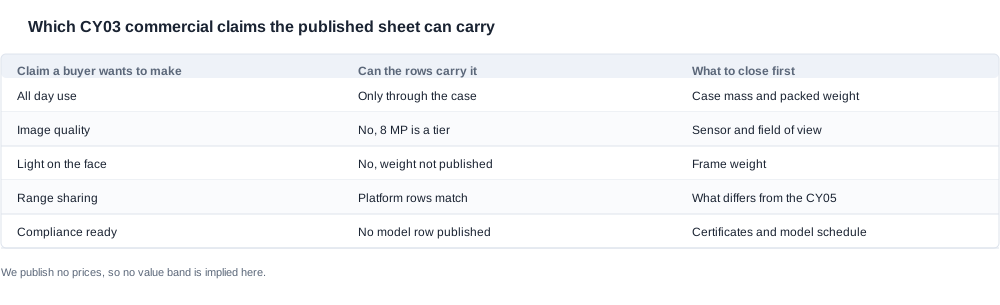
What the published rows cannot support. An image quality claim, because 8 MP is a resolution class and the sensor model, field of view and video specification are not published. A weight or comfort claim, because no frame weight is published for this model or for any camera model except the MT6 at 158 g, on a different platform with a different case arrangement. A durability claim, because no ingress protection rating is published for this model. A compliance-readiness claim, because no per-model certification row is published. And a price position, because we publish no price for this model or any other.
The 8 MP point deserves one further note, because it is where value arguments most often go wrong. Eight of the eleven camera models are published at 8 MP — the V03 Pro and the V06, the CY05 and the KY06, the MT5 and the MT6, and the V03 and the CY03 — and only three at 13 MP. So the resolution figure does not differentiate this model within its own tier; it positions the tier. A value argument that leans on "8 megapixels" is leaning on something eight models share, which means it is not an argument at all.
The delivered cost structure behind the case, and how to build it
Because no price is published, the honest way to assess value on this model is to build the cost structure from the physical configuration and see what the case does to it. That structure has five lines, and only the first is documented.
Line one: the goods. Not published, and it comes from the quotation rather than from the catalogue.
Line two: the freight. This is where the case does its work, and where a published capacity becomes a commercial number. The case adds a second lithium cell to every unit, and the packed unit weight determines the freight class. The case mass, the case dimensions and the packed unit weight are all unpublished, so the freight line is an estimate until somebody measures a sample. For a channel shipping by air in small quantities, this line is regularly the largest single item in the delivered cost.
Line three: the transport documentation. Two cells per unit means the battery file covers the frame cell and the case cell, the declared watt-hour rating follows the larger one, and the packing instruction describes the configuration as shipped. This is an administrative cost rather than a freight cost, but it is a real one, and it is the item that most often delays a first consignment.
Line four: the packaging. The carton, the insert and the printed material all have to absorb an accessory whose dimensions nobody has published. A case that is larger than the moulded insert was designed for changes the insert design, the packing line and the carton specification.
Line five: the warehouse. Case volume per unit is space that earns nothing. It is the least visible line and the one that matters most to a business running on thin stock.

The order of operations here is what makes the difference. The list above has to be built in sequence, and the freight class cannot be priced until the packed weight is known, which cannot be known until a sample has been measured, which cannot be measured until a unit exists. A buyer who tries to build the cost model from the catalogue alone ends up with four of the five lines as assumptions and discovers the size of the error afterwards — at the point where the price has already been published to the channel.
There is a second point about the case that is easy to miss and expensive to get wrong. A case does not extend the published endurance rating. The frame's ~7 hours is a rating under a condition the catalogue does not state, and the case does not change that number; what the case changes is the routine, from charging on a schedule to charging when convenient. A value argument that presents the case as multiplying the runtime is a claim the published rows do not support, and it is the kind of claim a customer can check by using the product for a week.
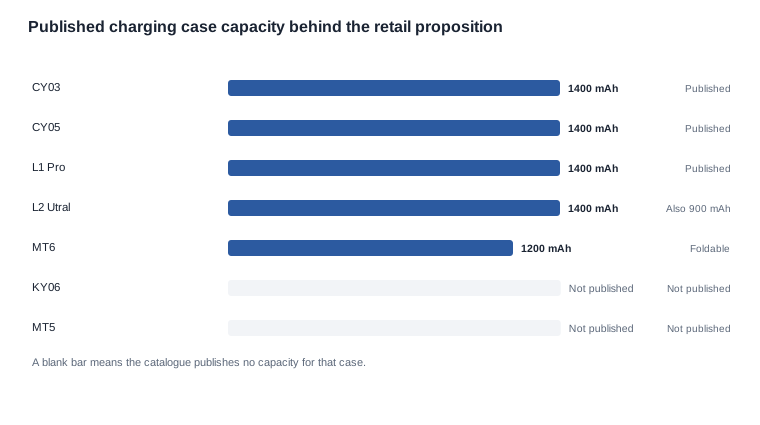
The chart above is worth reading for the blanks as much as for the bars. The L1 Pro and the CY03, and the CY05 publish 1400 mAh. The L2 Utral publishes 1400 mAh and a 900 mAh option. The MT6 publishes 1200 mAh in a foldable form. The KY06 and the MT5 carry a case whose capacity the catalogue does not publish — so their cases exist, but the case-led proposition cannot be asserted for them from the published sheet. The V03 Pro and the S7, and the V03 and the V06 have no case row at all, so a range-level value argument has to treat those four as unresolved instead of assuming a position for them. A range-level value argument about cases has to carry those distinctions or it is not an argument about this range.
Where the CY03 value claim breaks down
There are four places where a value argument on this model stops being supportable, and they are worth identifying before the argument is written rather than after.
The camera. An 8 MP figure with no sensor model, no field of view and no video specification behind it cannot support a quality claim, and it cannot be used to argue against a competing 8 MP model either. At 8 MP the resolution number is not even a shelf argument, because eight of the eleven camera models carry it. The AI camera glasses imaging guidance covers why.
The weight. No frame weight is published for this model. The only published weight in the catalogue is the MT6 at 158 g, and that figure is the eyewear body including its cell and camera and excluding the foldable case — a different model, a different case arrangement, and no basis for a transfer. The weight comparison across the range explains what happens to a comfort claim and a freight class when the weight is not published for the model in hand.
The endurance rating. ~7 hours is a rating. It carries no workload, so it cannot be compared against a model publishing a 5-to-8-hour range without knowing what produced either figure. Converting a rating into a working day is an inference, and an inference on a product page is a claim.
The certification position. No model-level certification row is published, so "compliance ready" cannot be asserted from the catalogue. Our catalogue carries a company-level export certification page whose content is images rather than text, showing ten patent certificates — eight appearance-design patents and two utility-model patents — and the catalogue text contains no reference to CE, FCC or RoHS. That is a real asset at company level and it is not a per-model document.
None of these four breakdowns is a defect of the product. They are the ordinary consequence of a supplier publishing a product sheet rather than a compliance file or a full specification, and the remedy in every case is the same: request the missing row in writing, with the model and the build named.

The CY03 and CY05 twin inside a value argument
The CY03 and the CY05 publish identical specifications — 8 megapixels, 290 mAh, two hours or less, about seven hours, a 1400 mAh case — and the source does not state what differs between them.
That sits directly under the value case, because a brand that intends to run both is effectively running two SKUs of one product with an undocumented difference. It also sits under any comparison against the rest of the range, because two of the eleven models have no published distinction, which means a range-level value argument has to account for a duplication it cannot justify.
Get the answer in writing before the first order. If it is a colourway, a lens or a packaging tier, two SKUs is a reasonable merchandising structure and the value argument holds. If it is a firmware or sensor revision, the value argument has to include the extra application work and the extra documentation scope that the revision implies. If it is nothing, you are carrying freight and warehouse cost for a second line the customer cannot distinguish, and the honest conclusion is that the range should be one SKU shorter. The CY03 versus CY05 price positioning analysis covers the commercial consequences of each answer.
The questions that must close before a CY03 value claim goes on a page
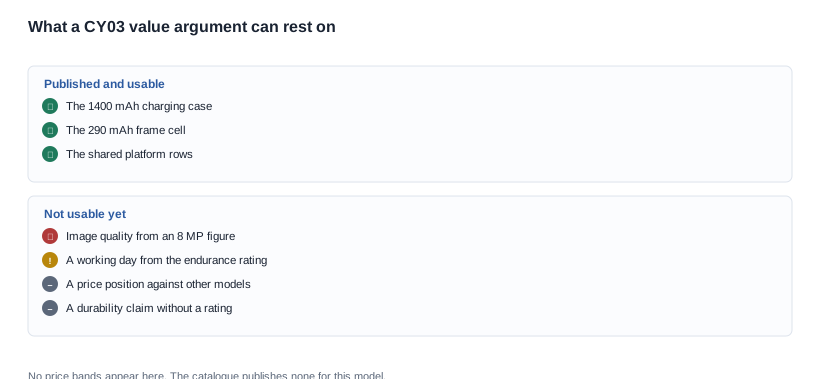
The checklist above separates the usable from the not usable. Working through the open items in order:
- The case mass, dimensions and packed unit weight. Until these are measured, the freight line in the cost model is an assumption and the delivered cost is a guess. This is the item worth spending the sample on first.
- The sensor model, field of view, video format and frame rate. Until these are known, no quality claim of any kind can be made, and the value argument has to rest entirely on the accessory and the platform.
- The endurance test condition. Until the workload behind the ~7 hours is known, the figure is a rating and cannot be used as a working-day claim.
- The frame weight and the colour list. Until these are known, no weight claim can be made and the packaging SKU count cannot be fixed.
- What differs from the CY05. Until this is answered in writing, the range decision is provisional.
- The charging method for this model. The catalogue publishes none, and the assumption will reach the packaging artwork otherwise.
- The certification position in each destination market. Model-level scope, reference, issuing body and date.
- The commercial terms. Minimum order quantity, lead time, payment nodes, warranty, and the quotation basis. We publish none of these for any model in this range, and they belong in the quotation.
Choosing the value argument rather than the model
The trap in a value question is that it sounds like a question about which model to buy, and it is actually a question about which argument you are going to be able to evidence. Working out the argument first changes the shortlist, because two configurations can be equally capable and completely different in what they let you say.
If the proposition is the accessory, the argument runs on the 1400 mAh case, the largest published in the range, and on the customer routine it supports. The criteria are the case capacity, the case mass once measured, the packed unit weight, and the freight class. Under those criteria the CY03 and the CY05, and the L1 Pro are interchangeable on the published rows, which is itself a finding: if the case is the argument, this model's published rows do not select it over its own platform.
If the proposition is the range, the argument runs on platform sharing — one accessory programme, one camera specification request, one battery document, one instruction set across up to four SKUs. The criteria are the platform rows and the number of SKUs you actually intend to carry. The trade-off is the twin problem: the platform contains two models with no published distinction, so the range argument and the twin question have to be answered together.
If the proposition is the resolution, the argument runs on the pixel tier rather than on this model. Three of the eleven camera models are published at 13 MP — the S7 and the L2 Utral, and the L1 Pro — and two of them share this model's cell and case capacity, so the resolution question can be settled without reopening the power and accessory questions. The 8 MP tier cannot carry a resolution argument, because eight models share it.
If the proposition is the delivered cost per unit, the argument runs on the packed weight, the freight class and the two-cell transport file, and it is the one case where the published rows give you the least and a measurement gives you the most. No amount of specification reading substitutes for weighing the unit.
The point of the four is not to rank them. It is that each one produces a different set of criteria, and a configuration that scores well under one of them may be irrelevant under another. Which is why the question worth asking first is not "which model is best value" but "which of these four arguments am I actually going to make in the listing, and does the published sheet support it".
The trade-offs inside each argument
Two of the four arguments above carry an internal trade-off that a buyer should price rather than assume.
The accessory-led argument and the delivered-cost argument are the same configuration seen from two sides, and they pull in opposite directions. A larger case capacity strengthens the customer-facing proposition and enlarges the parcel at the same time. There is no version of this model in which both are optimised, because the case is one component doing two jobs. The honest way to handle it is to know which side your channel is on. A direct-to-consumer channel that ships in small quantities is usually on the proposition side, because the basket value and the returned-goods rate matter more than the freight class. A channel shipping in volume on a fixed freight rate is usually on the cost side, because the case volume per unit compounds across every consignment.
The range-led argument and the resolution-led argument pull the other way, and here the resolution is a separate model rather than a variant of this one. A brand that wants an 8 MP line and a 13 MP line is running two platforms, not one, and the documentation is duplicated accordingly. A brand that wants one platform is choosing a resolution, and the choice between the L1 Pro and the L2 Utral at 13 MP is a choice about the charging interface — Type C and a published case option against no published method row — rather than about the camera, because neither publishes a camera specification beyond the pixel count.
Both trade-offs are the reason to answer the twin question before either argument is built. A range argument that rests on two SKUs with identical rows is not an argument; it is a cost.
The CY03 value boundary and what we will not price
The CY03 is the case-led retail model of the 290 mAh platform, and its commercial case rests on the accessory and on what the platform lets a range share — not on a specification that distinguishes it from seven other models. We publish no price for this model, and we will not publish a price band or name a best-value option, because the catalogue carries no price for any model in this range and a value position derived from a price we cannot evidence is not a value position.
We will not present the 8 MP as an image quality claim, we will not present the roughly seven hours as a working day, and we will not quote a weight, a colour, a certificate number or a minimum order quantity that the documentation does not contain. Where we can be precise, we will be: the 1400 mAh case is the largest published in this range, the 290 mAh cell is the largest published frame cell in this range, and both statements are checkable against the catalogue by anyone.
The published CY03 specification list is the honest baseline, the AI camera glasses buying guide covers the range decision, and the model readiness overview sets out how the platform sharing works.
Related reading
- This model's published rows — CY03 smart glasses specifications and features
- The platform structure — OEM ready platforms which models are ready
- The accessory the value case depends on — AI camera glasses charging case options
Send us the channel, the target price band and the volume, and we will tell you whether the case and the platform sharing carry this model in your range.


