
Neither price is published, so this page does not tell you which of these two models is cheaper. It tells you what actually differs between them, which of those differences a supplier will price, and what to put in a quotation request so that the comparison you eventually make is valid rather than accidental.
That distinction matters more than it sounds. Two models in this range can be quoted on entirely different bases — different quantities, different configurations, different incoterms, different private label scope — and the resulting numbers will differ without either supplier mispricing anything. Most of the apparent price positioning in this category is a difference in quotation basis wearing a costume.
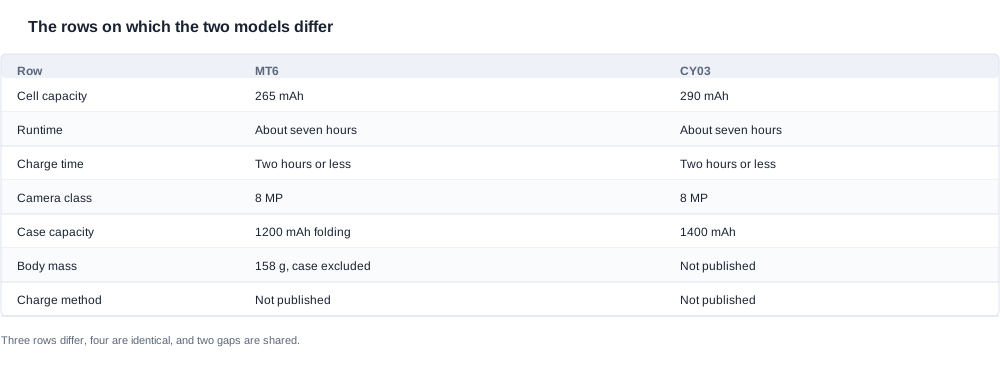
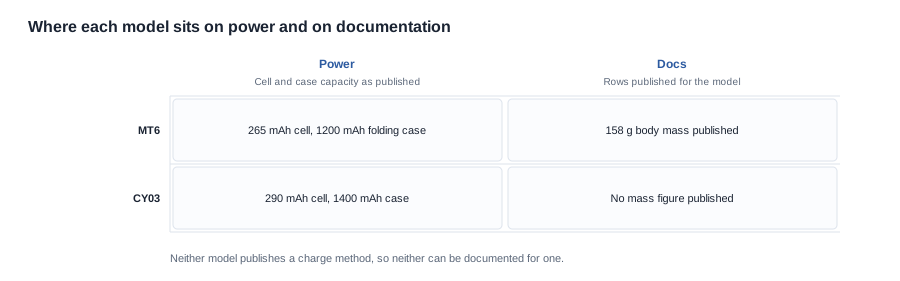
Once the basis is fixed, the comparison becomes tractable, and the two models separate cleanly on three published rows. The MT6 publishes a 265 mAh cell against the CY03's 290 mAh. The MT6 publishes a 1200 mAh folding case against the CY03's 1400 mAh. And the MT6 publishes a 158 gram body mass — the only mass figure in the entire catalogue — while the CY03 publishes none at all. Everything else worth noting is identical or unstated for both.
MT6 smart glasses vs CY03 price positioning: what separates them, and what does not
Start with the rows that are identical, because they eliminate the arguments you might otherwise have. Both models publish a runtime of about seven hours. Both publish a charge time of two hours or less. Both sit in the eight megapixel resolution class. Both publish no Bluetooth version, no ingress rating and no colour options. And — the most commercially significant point of all — both publish no charge method.
That last one deserves emphasis because it is unusual. Of the eleven camera models in this range, four publish no charge method: the CY05 and the MT6, and the CY03 and the L1 Pro. Those four models split the camera group almost exactly in half, so a buyer who needs a documented charge method cannot select between these two on that basis — neither provides it. A buyer who assumes the CY03 charges magnetically because several neighbouring models do will be wrong, and the same assumption applied to the MT6 is equally wrong. The gap is documented in MT6 smart glasses charging options.
So the real separation is three rows, and each of them is a specification rather than a price. That is the honest position, and it is also a more useful one than a ranking: three differences is a shortlist criterion you can apply, whereas an unstated price ranking is not something you can check.
Where the two models are genuinely identical
Run the comparison the other way as well, because the identical rows carry more weight than they first appear. Identical runtime means neither model offers a duration advantage, so a replenishment policy built on the seven-hour figure works the same for both. Identical charge time means neither offers a faster return to service. Identical resolution class means neither can be argued up on imaging grounds, since the class is the only published imaging fact for either.
Identical documentation gaps mean the same due diligence load. Both need the charge method, both need the sensor, both need the ingress position, both need the approval scope, and both need the camera recording mode. Two models with the same gaps require the same written request set, which is worth knowing because it means a buyer evaluating both is not running two exercises — they are running one exercise against two candidates.
The three rows that separate them
The cell capacity differs: 265 mAh on the MT6 against 290 mAh on the CY03. Both are used to publish a runtime of roughly seven hours, which is itself interesting — two different cell sizes producing the same published duration means the workload behind that figure is probably not identical, or one of the figures is generous. Neither row carries a test condition, so the comparison is citable rather than conclusive. Cell capacity in this group ranges from 220 mAh to 290 mAh, so the MT6 sits below the CY03 and below the four models that share the CY03's figure.
The case differs in two ways at once. Capacity: 1200 mAh against 1400 mAh. And construction: the MT6's case is described as folding, portable and ultra-light, while the CY03 publishes no case descriptor at all. Across the whole camera group only this model has a case described as folding, so that is a genuine structural difference rather than a preference — and structural differences of that kind tend to be the ones a supplier prices, because a fold mechanism carries its own tooling and assembly step.
The mass differs because one of them publishes it. The MT6 publishes 158 grams for the body including battery and camera and excluding the case. The CY03 publishes no mass figure. That does not make the MT6 lighter; it makes the MT6 measurable. For a buyer, measurable is worth more than asserted, because it produces an acceptance criterion at no extra cost. The mass question in full is in AI camera glasses shipping weight.

What a supplier will price, and how to ask
Three cost drivers distinguish these two models on the published record, and each is worth putting into a quotation request explicitly rather than hoping it is priced consistently.
The case is the largest. A folding case is a moulded, assembled and packaged component; a case without a published fold descriptor may still be moulded, but it carries no mechanism. If the case is supplied at all — and both models publish a case capacity, so both ship one — that line will appear in the quotation, and it will differ. Ask for the case configuration to be stated as a separate line, so that a comparison between the two models isolates it rather than absorbing it.
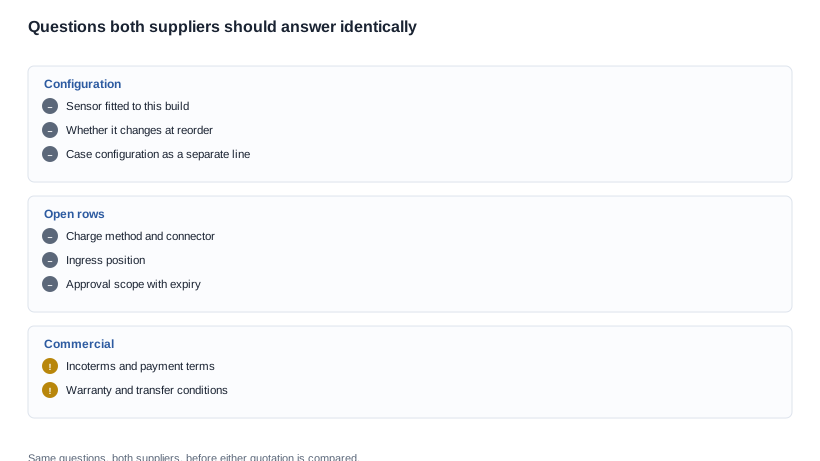
The camera is the second driver, and the honest answer is that you cannot predict it. The resolution class is identical for both models, which tells you nothing about the sensor fitted to either. The sensor is the component that drives camera cost, and it is unpublished for both. Ask what sensor is fitted to each configuration and whether it changes at reorder; a supplier who answers precisely is giving you the one input that makes this comparison meaningful.
The third driver is private label scope, which is identical in principle for both and therefore easy to forget. Logo application, packaging, inserts and any brand manual are quotation lines with their own setup, and they are the same for both models. Fixing them once, at the same level, is what allows the remaining difference between the two quotations to be read as a genuine specification difference rather than a scoping artefact.

The checklist before you compare
Seven items, applied identically to both suppliers. Same quantity. Same configuration description. Same incoterms. Same payment terms and deposit structure. Same private label scope, including whether setup is charged. Same box contents, listed exhaustively. And the same written question set covering the charge method, the sensor, the ingress position and the approval scope.
Once those seven match, whatever difference remains between the two quotations is telling you something about the two configurations. If they do not match, the difference you are looking at is mostly about the scope of each offer. This is unglamorous and it is the whole discipline; it is also the reason some buyers can compare two models from two suppliers and others cannot compare two models from the same supplier.
What this comparison cannot settle
Three things, stated plainly so that nobody builds a decision on them.
It cannot settle which model is better value, because value requires a published or quoted price and neither exists in this catalogue. It cannot settle which camera produces better results, because no sensor, field of view or frame rate is published for either model. And it cannot settle which configuration is more durable, because no ingress rating is published for either and the case construction is documented for only one.
What it can do is narrow the field, and it does so by pointing at three structural differences and two identical published durations. A buyer who needs a measurable acceptance criterion has a reason to prefer this model over the CY03 that has nothing to do with price. A buyer who needs a documented charge method has neither. A buyer who needs the largest published case capacity has the other. Those are the criteria, and applying them is a better use of a sourcing cycle than searching for a ranking that the record does not contain.
The wider comparison material across this range sits in AI camera glasses which model to pick, the entry-level framing in AI camera glasses entry-level options, and the purchase framework in AI camera glasses buying guide. The CY03's own row set is in CY03 smart glasses specifications and features, and the documentation gaps common to both models are set out in MT5 smart glasses limitations and MT6 smart glasses limitations.
Five identical rows, three separating rows, and no ranking
We will publish the rows that separate these two models and the rows that do not, because both sets are useful and neither is flattering. We will not state which model is cheaper, which is better made, or which suits a given channel, because none of those conclusions exists in the record and all three would require us to invent it.
What we can say plainly is this. The two models are closer than a buyer usually expects: five published rows are identical, including the runtime, the charge-time ceiling and the camera resolution class, and they share the same charge method gap as each other. Three rows separate them, and only one of those three — the folding case — describes something structurally different rather than quantitatively different. The fourth difference, the mass figure, tells you which model you can measure rather than which model is lighter.
This is a comparison best settled by two written questions and one sample measurement, not by a ranking. Ask both suppliers for the charge method and the sensor. Measure the case on a sample. Fix the quotation basis. Then the choice follows from your use case rather than from our description of it.
Structuring the request so the answers compare
The most common failure in a two-model comparison is not the analysis; it is the inputs. Ask each supplier a slightly different question, or ask them the same question at different points in the process, and the answers will not be comparable no matter how carefully they are read afterwards.
So fix the question set before the conversation starts, and send it to both. Seven items. Which charge method each configuration uses. Which sensor is fitted to each, and whether it changes at reorder. What the ingress position is for each, treating a written statement that no rating applies as a complete answer. What the approval scope is for each model designation, with report numbers and expiry dates. What the case configuration is for each, and whether the case ships with every unit. What the warranty period and claim procedure is, and whether it transfers under a private label arrangement. And what the quotation basis is, stated explicitly.
Seven questions, both suppliers, the same week. That is the whole cost of a comparison that will actually hold up when you are deciding.
What to measure, and on which model
Two measurements carry most of the weight in this comparison, and they belong on whichever model reaches the sample stage.
The case configuration is the first. Whether the case folds, how it is retained, and what happens when it is dropped are questions with observable answers, and they matter more here than anywhere else in the pair because a fold mechanism is the only genuinely different mechanical feature between the two models. Cycle it, drop it, and ask for the failure mode in writing rather than inferring it from the appearance.
The case mass is the second, and it is unpublished for both models. Since the case is what consumes packing volume, it feeds freight cost on either model, and measuring it on a sample produces a number you own. Weigh the case separately from the body and keep the two figures apart, because the published 158 grams on this model refers to the body excluding the case, and a file that merges them will mislead the next person who reads it.
Beyond those two, the standard sample checks apply to both models equally: body mass against the published figure on this model, a timed charge cycle against the two-hour ceiling, and a runtime test under a stated workload. Holding the workload constant across both models is what makes the resulting numbers comparable, and it is the single thing most often omitted.
Three scenarios, three different answers
Three realistic use cases produce three different conclusions, which is the clearest argument against looking for a single ranking.
A channel where the priority is a measurable, citable specification — one that needs a stated body mass for freight and an acceptance criterion for incoming quality control — resolves in favour of this model, on the strength of the 158 gram row alone. Nothing published suggests it is lighter than the CY05; the point is that it can be weighed.
A channel where the priority is raw case capacity, on the reasoning that a larger published capacity reduces the number of spare cases required, resolves the other way, towards the CY05's 1400 mAh. The caution is that neither figure is a recharge count, so the reasoning should be tested on a sample before it is relied on.
A channel where the priority is anything that depends on how the device charges resolves to neither, because both models publish no charge method. That constraint has to be lifted before either can be evaluated, and it is lifted by asking, not by assuming.
The remaining scenarios resolve on the fold, which is a risk rather than a benefit and should be priced as one. A buyer who treats the fold as a feature without asking about its cycle rating is the buyer most likely to meet it in a returns figure six months later.
What this comparison still cannot tell you
Three things remain outside both records, and it is worth naming them so that no decision leans on them. No imaging conclusion, because both models publish a resolution class and nothing behind it. No durability conclusion, because neither publishes an ingress rating and the case construction is documented for only one. And no cost conclusion, because neither model carries a published price and no supplier will quote on a basis that has not been fixed by the buyer.
Those three limits are not obstacles to choosing between the two models. They are the list of questions that the choice has to be made with, which is a more useful thing to have than a ranking the record cannot support.
A last note on how to close this comparison out. Once the seven questions have been answered by both suppliers and the quotation bases have been matched, write a single page recording which rows differed, which were identical, which gaps closed, and which remained open. That page is what a repeat order is negotiated against, and it is worth far more than the analysis above it, because it is the only part that survives the supplier changing and the configuration being revised.
Buyers who keep it find that the second comparison is nearly free: the identical rows have not moved, the differing rows have not moved, and the only new work is confirming the gaps that have not closed. Buyers who do not keep it re-run the entire exercise every order, and arrive at the same conclusion each time with no accumulated evidence.
Two practical additions before this page closes. First, put the identical rows into your own specification so that a future supplier quotation contradicting them is caught immediately — a quotation quoting a different runtime or a different resolution class for either model is describing a different product, and that is worth catching at quotation stage rather than at goods-in. Second, keep the three differing rows on the same page as the quotation, so the conversation about cost happens against the specification that drives it.
Neither of those steps is unusual, and both of them are the reason a repeat order with this supplier is quicker than a first one. The comparison itself does not need to be re-run; it needs to be recorded once and then maintained.
It is also worth recording who answered, not only what they answered. A reply from a production contact and a reply from a salesperson carry different weight when the configuration changes two orders later and nobody remembers which of them described the earlier build. The name costs one word in the record and removes an entire category of later ambiguity.
The same applies to the date. A supplier answer given before a configuration revision describes a different product from the same answer given after it, and the date is the only thing that distinguishes them. Four columns — row, answer, source, date — will carry this comparison through as many repeat orders as you run it.
Related reading
- The camera range these models belong to — AI camera glasses
- Every published row for this model — MT6 smart glasses specifications and features
- The charge method both models share as a gap — MT6 smart glasses charging options
- Battery rows for both — MT6 smart glasses battery life


