

Most buyers looking at the CY03 ask about the camera, because it is an 8-megapixel frame and cameras are what people buy smart glasses for. The more useful question is about the sheet itself. This model and its sibling in the catalogue publish identical specifications, and nothing in the published data says what separates them. That ambiguity, plus four undocumented rows and one absent row, is what should shape your evaluation. None of the limitations below are defects — they are gaps in the documentation, and a gap behaves differently from a fault in how you handle it. A fault is reported. A gap has to be closed before you order.
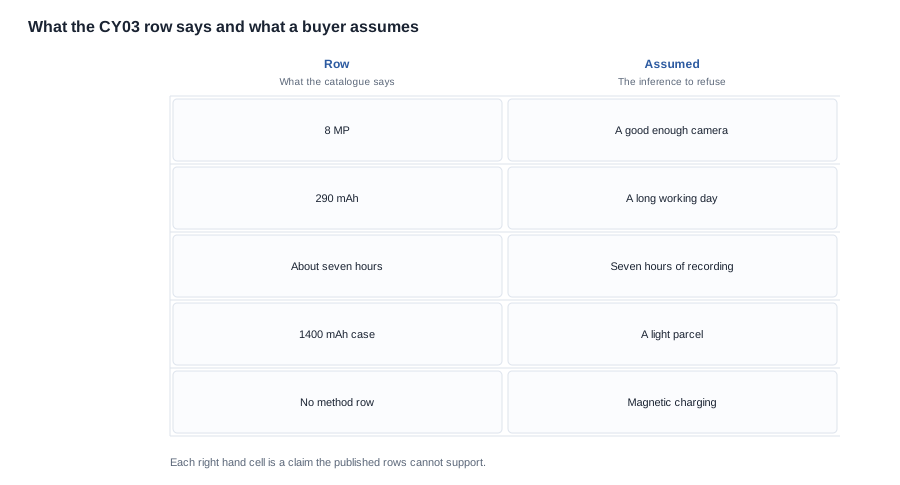
The CY03 limitation nobody asks about: no published differentiator
The CY03 is published as 8 megapixels, a 290 mAh battery, a charge time of two hours or less, about seven hours of rated use, and a 1400 mAh charging case. Another model in the same catalogue — the CY05 — is published with the same five rows and the same values, and neither model publishes a feature row or a charging method row.
If your business depends on telling customers why one model is better than the other, that argument currently rests on something you have not been told. This is not a defect; it is a documentation gap, and it is the kind that becomes expensive late, because a private-label listing that differentiates two products on a feature nobody can name is a listing that invites a question you cannot answer.
So ask, in writing, what distinguishes this model from its sibling. It may be a firmware difference, a frame style, a lens treatment, a supply arrangement, or nothing at all. Any of those answers is usable — with the caveat that a firmware difference and a supply arrangement are not the same thing commercially, and the first one has documentation consequences that the second does not. Silence is not.
There is a second-order effect worth naming, because it is the one that damages the range rather than the product. Two SKUs with identical published rows split the sales history between them. Each one ends up with a thinner record of what customers say about it, and the reviews, the returns data and the support history that would normally tell you which one to drop end up being spread across two lines. If you find yourself unable to tell a customer why one is better, the commercially clean answer is usually one SKU rather than a better paragraph.

The second CY03 limitation: a camera with one published figure
Eight megapixels is the only camera fact published for this model. There is no sensor model, no field of view, no video format or frame rate, no stabilisation, no low-light behaviour, and no storage capacity or file format.
That is a full row of missing data on the feature your customers are buying the product for. An 8-megapixel figure with a small pixel size can produce a worse image than a lower-resolution sensor with large pixels, particularly indoors — which is exactly where first-person content tends to be recorded.
It is also worth being precise about what the figure does and does not tell you inside the range. Eight of the eleven camera models are published at 8 MP: the V03 Pro and the V06, the V03 and the MT5, and the MT6 and the CY03, and the CY05 and the KY06. Three are published at 13 MP: the S7 and the L2 Utral, and the L1 Pro. So 8 MP is the wider tier rather than the weaker one, and it is not a differentiator against another 8 MP model, because seven other models share it. A buyer who wants the higher tier is making a different choice entirely, and the CY03 versus CY05 price positioning piece covers how that tier question is usually framed.
Two of the eight MP models publish feature lines of their own, and one of them is the V03 Pro: a flexible temple, a photochromic lens and a charging over Type-C port, in orange, off-white and black. The CY03 publishes none. So within the 8 MP tier there is at least one model whose structure is documented and one whose structure is not, and the difference is visible to a customer who reads two catalogue pages side by side.
The third CY03 limitation: a 1400 mAh case is a channel decision, not a battery
The case is large, and it is what makes the "sample it, then use it every day" retail story work. It also changes your packed weight, your carton dimensions and your freight cost per unit — and none of those figures are published for this configuration.
A large case is a real cost line that rarely appears in a cost model until it is too late to change. Put it in the model before you order rather than after.
The second thing the case does is add a second lithium cell to every consignment. That changes the transport documentation, because the declared watt-hour rating follows the larger cell and the packing instruction has to describe the configuration as shipped. The third is warehouse volume: the case occupies space in every unit and earns nothing, which matters most for a business running on thin stock and fast turns.
What the case is not is a battery extension. The frame's published rating is about seven hours under a condition the catalogue does not state, and no amount of case capacity changes that number. The case removes the need to charge on a schedule; it does not multiply the runtime. A listing that implies otherwise is making a claim the published rows do not support.
The fourth is a comparison trap. The case is 1400 mAh against a 290 mAh frame cell — more than four times the frame capacity — and it is the largest published case in the range. But the range does not treat the case consistently: the L2 Utral publishes a 1400 mAh case as well as a 900 mAh option, the MT6 publishes a 1200 mAh foldable case, the KY06 and the MT5 carry a case whose capacity is not published, the V03 and the V03 Pro, and the V06 and the S7 have no case row at all, so the case position for those four is a limitation to be closed with the supplier rather than a published fact. A buyer who assumes a case is a constant across the camera category will get it wrong on four of the eleven models.

The fourth and fifth: an endurance rating without a condition, and an absent interface row
The endurance rating has no stated workload. About seven hours, with no condition attached. On a camera frame that matters more than on an audio frame, because the camera is the largest power consumer. Whether the camera was active during the measurement is the question that decides whether seven hours describes your customer's day or half of it.
The charge time has the same shape of problem. Two hours or less is a ceiling, not a typical figure, and the catalogue states neither the state of charge at the start of the measurement nor the point at which charging is considered complete. "Two hours or less" permits exactly two hours, which is a different assertion from "under two hours" — a distinction worth keeping straight on a product page, because it is the kind of difference that gets checked.
The charging interface row is absent for this model. The catalogue publishes a charging method for seventeen models — magnetic — and for seven more — Type C, including the V03 Pro and the L2 Utral. The L1 Pro and the CY03, and the MT6 and the CY05 have no such row. That is a limitation with a specific cost: the in-box accessory set, the instruction artwork, the certification scope of the accessory, and the customer charging routine all depend on an interface the documentation does not state.
Two more absences complete the picture, and both are limitations a buyer can plan around rather than a problem to solve. No frame weight is published for this model, so a comfort judgement over a working day remains a sample judgement rather than a comparison criterion. The only published weight in the catalogue is the MT6 at 158 g, and that figure is the eyewear body including its cell and camera and excluding the foldable case, on a different platform — it is not a proxy for this model in either direction. No ingress protection rating is published, so no durability claim is supportable. Only the V06 and the S7 carry one.
Which limitations are closable and which are structural
The practical question behind every limitation is whether a document or a measurement can close it, or whether it is simply a property of the range that has to be designed around. Sorting the CY03's gaps into those two groups changes the effort involved, because a closable gap is a request and a structural property is an input to the range design.
Closable by a written answer: the difference from the CY05, the charging interface, the sensor model, the field of view, the video resolution and frame rate, the storage capacity and file format, the colour and finish list, the Bluetooth version, the certificate number and covered model schedule, the minimum order quantity, the lead time, the production capacity, and the pricing basis. Each of these has an answer somewhere; the reason it is not on the page is that a product sheet is not a quotation and a catalogue is not a compliance file.
Closable by a measurement: the frame weight, the frame dimensions, the case mass, the case dimensions, the packed unit weight, the endurance figure under a workload you specify, the number of case recharges, and the case's own charge time. These need a sample unit and a bench, not a letter, and they are the items worth spending the sample order on.
Structural, and to be designed around rather than closed: the fact that eight of the eleven camera models share the 8 MP tier, so the resolution figure differentiates nothing within that tier. The fact that the case treatment varies across the range — 1400 mAh, 1400 or 900 mAh, 1200 mAh foldable, unstated, and explicitly absent — so an accessory programme cannot be assumed to be range-wide. The fact that only two models in the entire range carry an ingress rating, so a channel whose proposition is outdoor durability is choosing a different product category, not a different configuration. And the fact that four camera models publish no charging method row at all, so an interface-driven comparison is only available for seven of the eleven.
A buyer who sorts the gaps this way stops asking for the wrong things. Requests for a specification that the range does not distinguish between are wasted effort, and a request that asks the supplier to explain a structural property of their own range is a request that comes back as a policy statement rather than an answer.
There is a fourth category worth naming, and it is the most valuable to close because it affects every model in the range rather than one of them: the difference between a published rating and a measured figure. The catalogue's figures are ratings. A rating is a number with a condition behind it, and for twenty-six of the twenty-eight models in the range the condition is not stated. Everything else in this article follows from that one observation.
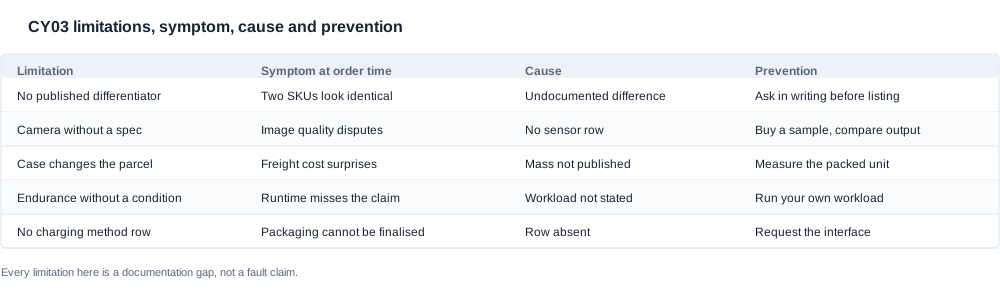

How to interrogate a CY03 limitation instead of absorbing it
A limitation that stays unwritten becomes a cost at the worst possible moment — usually after the packaging is approved, the price is set and the goods are in transit. The four-step sequence below is what we would use to turn each one into a request.

First, write the row exactly as the catalogue states it. Not as you remember it, not as a supplier summarised it in a call, not as a competitor's page describes it. The row itself is the baseline, and it is short enough to transcribe in a minute.
Second, write the inference a buyer would draw from that row. This is the step that exposes whether the gap is actually dangerous. "The catalogue publishes a 1400 mAh case" invites the inference that the parcel is light, and the inference is wrong; "the catalogue publishes no charging method row" invites the inference that it is magnetic, and that inference is also wrong, but the second one is more expensive because it reaches the packaging artwork.
Third, name the evidence that would close the gap. Not "more information" — the specific document, measurement or written statement that would settle it. A measured frame weight, a sensor model, an interface photograph, a battery test summary, a certificate reference with a scope.
Fourth, send the request with the model and build named, and record the answer against the purchase order. An answer that does not name the model does not close the question, and an answer that is not recorded will not survive the next person who asks.
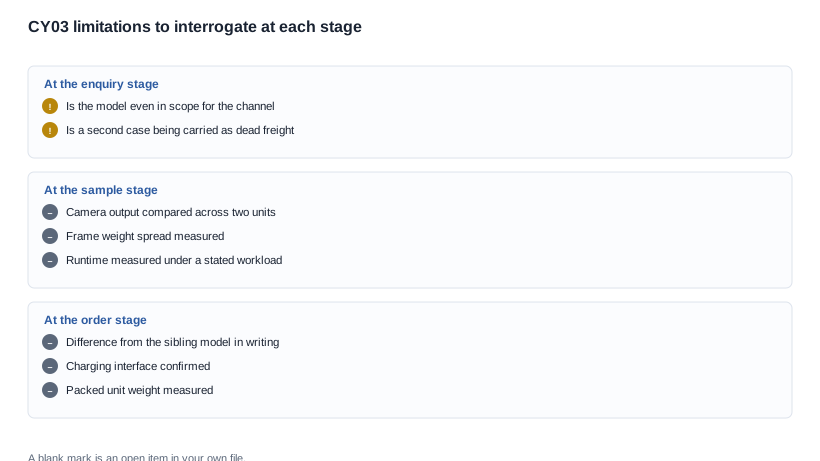
The staging matters as much as the sequence. An enquiry-stage check is nearly free — a question in an email. A sample-stage check costs a unit and a day. An order-stage check costs a rewrite, because by then the artwork is approved, the price is set and the freight class is baked into the cost model. The same limitation handled at the enquiry stage costs one paragraph; handled at the order stage it costs a carton reprint.
Putting a price on the limitations you could not close
A limitation that stays open has a carrying cost, and the cost is not the same for every limitation. Some are cheap to carry because they do not affect a commercial term; some are expensive because they sit on a number that a customer will compare.
The case limitation is the one most often carried without costing it, and it is the most expensive of the set. The published case capacity is a capacity, not a mass. The mass is what decides the packed unit weight, the packed unit weight decides the freight class, and the freight class sits inside the delivered cost per unit. For a channel shipping by air in small quantities, that line is regularly the largest single one in the landed cost, and it is invisible on a product page. A brand that discovers it after the price is set has two bad options: absorb it, which quietly compresses the margin on every unit, or raise the price, which changes a published figure that customers have already seen. Neither is a good outcome, and both are avoidable by measuring the packed unit on a sample before the quotation is accepted.
The endurance limitation has a different cost profile, because it lands on the support line rather than the margin line. If the rating is quoted without a condition and the real figure under customer use is shorter, the returns arrive as complaints that describe quality rather than as battery problems. The remedy is a listing that does not overstate, which costs nothing to implement and removes an entire class of dispute.
The certification limitation costs in time rather than in money, and it is the one that compounds. A missing model-level document is an open item in the launch programme, and open items get carried forward into the next launch. The commercial question to ask a supplier is not whether they have a certificate but whether they can produce one naming this model, with a scope and a date, in the time the programme allows.
The twin-model limitation has a cost that sits in inventory rather than in freight: two SKUs with identical published rows divide the sales history, and the slower one becomes the reason the range as a whole underperforms. Here the correct answer is not a better listing but a shorter range.
The general rule is that a limitation's cost is proportional to how close it sits to a number that somebody else will check. The interface row sits close to the artwork, the packed weight sits close to the freight class, the endurance rating sits close to the product page, the certification scope sits close to the launch date, and the twin sits close to the cash conversion cycle. Those are the four places to look first when deciding which limitation to close before you order, and which one to accept and price instead.
The CY03 boundary and what we will not construct
We will not invent a differentiator between two models whose published specifications are identical, and we will not estimate the sensor, the field of view or the weight of this frame. When you ask us what separates this model from its sibling, we will tell you whether it has been documented for us, and if it has not, we will say so rather than constructing a plausible answer. We will not describe a charging method for a model whose catalogue page carries no such row, and we will not present the roughly seven hours as a working day or the two hour ceiling as a typical figure.
The camera-platform range is set out on the AI camera glasses page, the comparison against a lighter alternative is in CY03 versus KY06 form factor, and the specification-level comparison is in CY03 compared across the range. For the review process itself, the CY03 buyer review checklist turns the same gaps into a sample-stage plan, and the sample evaluation notes cover what a sample can and cannot settle.
Related reading
- Certification position for this platform — certification coverage
- Buyer review checklist for this model — buyer review checklist
- Getting a sample evaluated — sample evaluation
Send the target market and quantity and we will come back with what is documented and what still needs confirming.


