
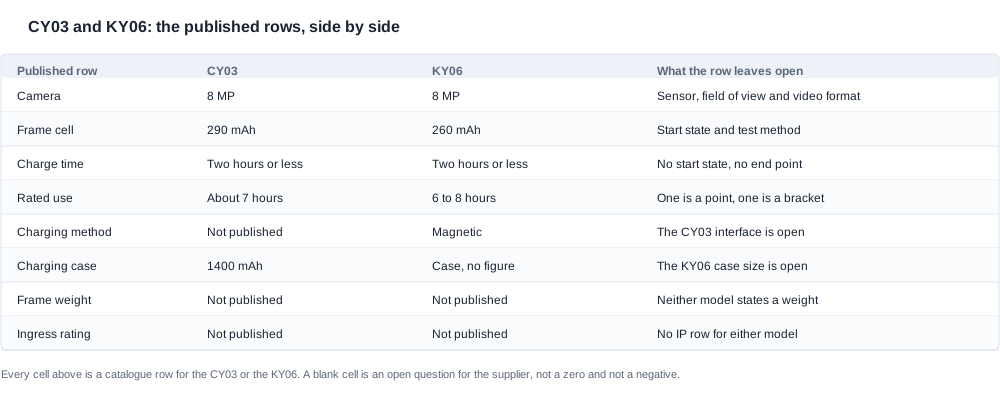
The CY03 smart glasses vs KY06 form factor question has an uncomfortable answer: the form factor is not documented for either model, so it cannot be the thing you decide on. Both frames publish an 8-megapixel camera, a charge time of two hours or less, magnetic charging on one and an unstated interface on the other, and a charging case in the box. Neither publishes a weight, a temple length, a lens dimension, a colour option or an ingress rating.
What is published is narrow, and it separates into three rows that a procurement team can actually act on: the frame cell, the way the runtime figure is written, and whether the case capacity is a number or an absence. Everything else in this comparison has to be closed by measurement on a sample, because no document we hold answers it.
The result is a shortlist rule rather than a verdict, and the criteria for applying it are what follow. Where your brief turns on case capacity, only one of the pair can be costed from published data today. Where your brief turns on how you will describe endurance to a customer, the two figures are written in different styles and cannot be compared line for line. Where your brief turns on fit, the catalogue contributes nothing and the sample is the only instrument, which makes this a question about how to evaluate the pair rather than a question about which one wins.
Treat the result as a screening step, not a purchase decision. Minimum order quantity, unit price, lead time and production capacity are not published for either model, so no commercially complete comparison exists yet, and any page that reads as one is showing you the spec sheet rather than the decision.
CY03 and KY06 form factor: the rows that actually separate them
The two models are published with no feature rows at all. The catalogue page for the CY03 carries five standard rows and the page for the KY06 carries five, and neither page adds a structural line of the kind that appears elsewhere in the range — no lens type, no ergonomic claim, no ingress marking, no colour list, no remote control. For a comparison article, the first consequence is that there is no third differentiator to hunt for. The differences are the three rows and nothing else.
The second consequence is about how these two will be sold. When two models in one family publish the same camera tier and the same charge-time ceiling, a channel buyer is being offered a choice that our documentation cannot express. That is not a reason to refuse the pair; it is a reason to make sure your own comparison sheet has a column that says "what does this document actually tell me", because a sheet that lists only differences will look identical to a sheet that lists nothing because nobody filled the columns in.
Two 8-megapixel models with no feature rows
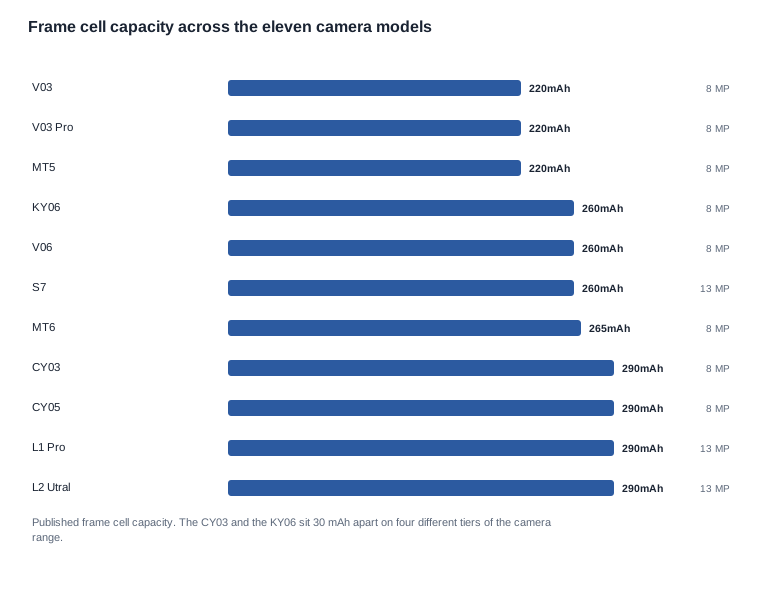
Both are 8 MP. The catalogue publishes eight camera models at 8 MP and three at 13 MP, so both of these sit in the larger group, and neither is in the 13 MP tier where the L2 Utral and the L1 Pro, and the S7 sit. That matters for one specific question and no others: if your channel competes on a megapixel number in the listing title, neither of these gives you the higher figure, and the comparison you are running is between two products at the same tier.
Neither model publishes a sensor model, a field of view, a video format, a frame rate or a storage capacity. A camera glasses product with an 8 MP row and nothing behind it cannot be shown on paper to produce a better picture than another 8 MP product, which means image quality cannot be settled by document in either direction. That is an argument for a sample comparison rather than an argument for a particular model, and it applies to the whole camera family rather than to this pair alone.
The three rows a buyer can price and the two it cannot
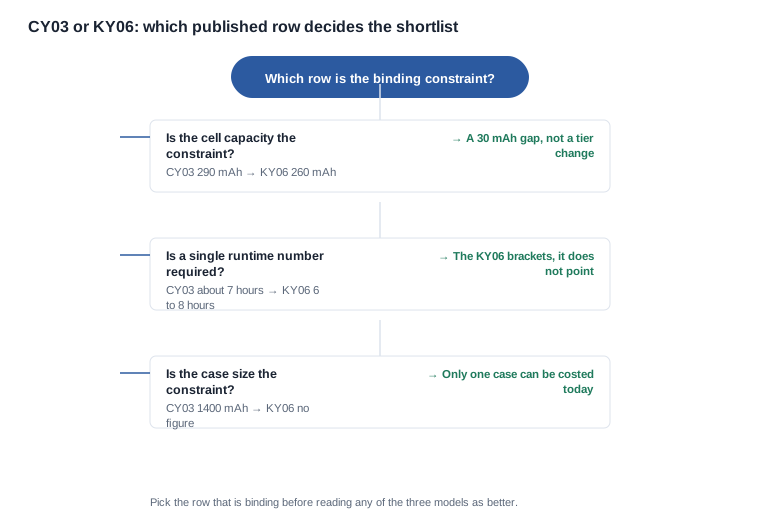
The three workable rows are the cell, the runtime phrasing and the case. The cell is a clean number on both sides: 290 mAh for the CY03 against 260 mAh for the KY06. The runtime is written in two different styles, and that difference is the subject of the next section. The case is a published 1400 mAh figure for the CY03 against a stated case with no capacity for the KY06.
The two rows a buyer cannot price are the frame itself and the interface. No weight is published for either model, and the only camera model in the whole catalogue that publishes one is the MT6 at 158 grams for the glasses body excluding its folding charging case. No ingress rating is published for either model; the IP54 marking appears in the catalogue on the V06 and the S7 only. The CY03's charging interface is not published either — the catalogue gives that model a cell, a charge-time ceiling, a runtime rating and a case capacity, and no charging-method row — so the KY06's magnetic charging cannot be assumed to extend to its sibling.
Runtime written as a point figure and runtime written as a bracket
The two runtime figures are the most useful thing in this comparison and the easiest to mishandle. The CY03 is published at approximately seven hours. The KY06 is published at six to eight hours. Neither number carries a test condition: there is no starting state, no statement of what the camera was doing, no radio duty cycle, and no indication of whether the figure came from one unit or a batch.
Why the two runtime styles are not interchangeable
A point estimate and a bracket are different kinds of claim. "About seven hours" is a single figure that can be quoted, compared and printed on a product page. "Six to eight hours" is a range that tells a buyer the platform was characterised under more than one condition and that the factory was not prepared to collapse it into one number. Both are legitimate. Only one of them can be put next to another model's number in a comparison table without doing something unsound to it.
The trap is that a comparison table almost always picks the more favourable end of a bracket, because a table cell that says "up to 8 hours" sells better than a cell that says "6 to 8 hours, average case not stated". If you build a channel-facing comparison of this pair, write the range as a range and note that the CY03's figure is a point. Two published figures, stated in their own forms, tell a buyer something true. Harmonised figures tell a buyer something you decided.
The same caution applies to the cell comparison. A 30 mAh gap between 290 and 260 is about 12 percent of nominal capacity, and nominal capacity is a ceiling rather than a promise, because average power draw sets the outcome. The two models run different firmware for different cameras, so the gap does not convert into a proportional runtime gap and cannot be used as one in a product page.
The question that turns a rating into a measurement
Three questions convert the pair from a spec comparison into a testable one, and all three are questions for the supplier rather than conclusions from the catalogue:
- What was the camera doing during the measurement? If the camera was recording for the whole period, the published figure describes the heavier duty cycle and you can plan against it. If the camera was idle, it describes an audio-class workload that will not survive a customer who records video.
- Was the radio connected, and on what pattern? A connected-and-idle link and a connected-with-calls link are different loads, and a rating taken on the first is close to a best case.
- What was the starting state, and what counted as the end? A rating from a partly discharged cell or to a fixed voltage cut-off is not comparable with another manufacturer's rating even when the numbers look identical.
Ask these before the sample arrives rather than after. The answer to the first one determines whether the seven-hour figure belongs in your product page at all, and a supplier who answers it in writing has effectively given you a test method that you can repeat on the sample. That repeatability is worth more than the figure, because a number you cannot reproduce is a marketing claim and a number you can reproduce is a specification. What to ask, in other words, is a better subject for the first email than which model you prefer.
The charging case row: 1400 mAh against a case with no figure
This is the row that produces the only genuinely one-sided result in the comparison, and it is worth being precise about which side the asymmetry falls on.
Case capacity as a landed-cost input
The CY03 publishes a 1400 mAh charging case. The case is roughly five times the frame cell, it travels in every carton, and it is the single largest contributor to the parcel weight of the two models. That makes the published figure directly usable: you can model a shipping weight, a freight class, a warehouse volume per unit and a battery transport documentation scope from it today, subject to the case's own weight and dimensions being supplied.
The KY06 publishes magnetic charging with a charging case, and no capacity for that case. That is an absence, not a zero and not a negative. The case exists in the box; what we do not hold is the number that would let you model the parcel. For a buyer whose brief is built on the case as a retail asset and on freight cost per delivered unit, this means the KY06's case has to be weighed and measured before the configuration can be compared at all.
There is a third possibility worth asking about rather than assuming: whether the KY06's case is available in more than one capacity, as the L2 Utral publishes 900 mAh or 1400 mAh. A single case is one packaging decision; a choice of two is a range decision that lets you run two retail tiers off one product. We hold no answer to that question for the KY06, and it is a better question than any speculative figure.
The KY06 case is present but unquantified
The practical consequence is that the KY06's case rows are all open at once: its capacity, its weight, its dimensions, its own charging interface, its own charge time, and whether it carries a charge indicator. Six separate numbers, and none of them published. Each one changes something concrete — the carton cavity, the freight class, the transport declaration, the customer's weekly routine — and each one is cheap to obtain and expensive to guess.
The same set of gaps applies to the CY03's case, with one difference: its capacity is published at 1400 mAh, so the parcel weight still cannot be modelled without the case's own weight, but the comparison of the two cells is at least possible. If your procurement process requires a delivered-cost estimate before the sample, the CY03 is further along that path and the KY06 is not.
One caution on how this is used. A published case capacity is a component of the proposition, not a guarantee of the customer's experience, because the figure the customer feels depends on how the case is charged, how often it is topped up and how the frame is used in between. The 1400 mAh number is a fact about the box. What the customer experiences from that box is a sample question, and it is the same sample question for both models.

Frame geometry, weight and ingress: what neither model publishes
The form factor in the title of this comparison is the part that cannot be answered, and the honest way to handle that is to name it as a measurement request rather than to leave it as a vague gap.
Weight: only one model in the catalogue states one
No frame weight is published for the CY03 or the KY06, and no frame weight is published for any camera model in the catalogue except the MT6 at 158 grams, which is the glasses body with the cell and camera fitted and excludes the folding charging case. It would be wrong to use the MT6 figure as a proxy for these two, and it would be wrong to describe 158 grams as a frame weight.
What this costs you is concrete. The weight of the unit determines the comfort ceiling over a long session, which determines how often a customer takes it off, which determines how often it is put down on a surface where a magnetic charging contact can be displaced. It also determines the packed unit weight, which is a freight input. None of those can be modelled from published data for this pair.
The measurement request to send with the first enquiry
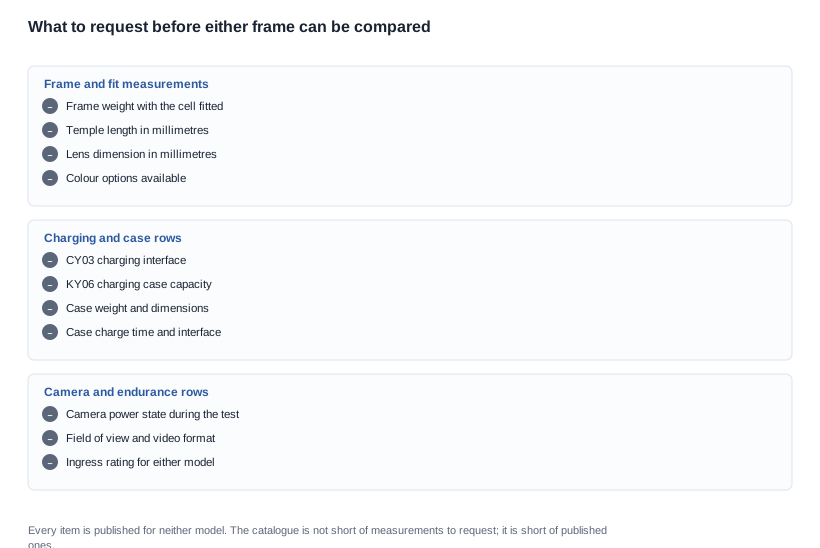
There are nine numbers in this pair's published position that a fit and endurance decision would need and that we do not hold. Sending them as a single request, in one message, with a sample attached, is far more effective than discovering them one at a time:
- Frame weight in grams for each model, with the cell fitted and the case excluded.
- Temple length in millimetres for each model.
- Lens dimension in millimetres for each model.
- The charging interface used on the CY03, and the case capacity for the KY06.
- The weight and external dimensions of the case for each model.
- The charging interface and the charge time of the case itself, for each model.
- Whether the case carries a visible charge indicator.
- The ingress rating for each model, if any is held.
- The colour options available for each model.
The ninth item has a commercial answer attached to it that is easy to miss. A colour option usually means a finish change or a different mould texture, which is a tooling and artwork question, and it is therefore a lead-time and packaging question rather than a product page question. Two models with the same colours cost more to launch than one model with the same colours, because the second one is a second mould and a second artwork approval.
Two pitfalls sit around this list. The first is treating a blank row as a zero, which turns an open question into a product claim you then have to defend. The second is letting the request drift: nine questions sent in one message with a sample attached get answered, and the same nine asked opportunistically over three months get answered selectively. Which one is cheaper to manage depends on how much of your schedule the answer has to survive.
Turning the pair into a shortlist without a price comparison
Shortlisting on published data is possible for this pair, but only if the brief is written as a set of constraints rather than as a preference. Here are the three briefs that this pair can be screened against, and the published row each one turns on.
Three briefs and the published row each one turns on
A brief that turns on what the box contains. This is the one screen that produces a directional result, and it is directional because of a published number: the CY03's 1400 mAh case is the only case capacity in the pair that can be costed. If your retail model is built around the case — and in this category most are, because the case is what removes the recharge objection — then the KY06's case has to be answered before the two products sit in the same comparison. This is a screening result traced to one published row, not a recommendation, and it says nothing about price, availability or lead time for either model.
A brief that turns on how endurance is communicated. Here the two models are not separated by the number but by the form. A channel that wants one clean figure on a carton has a published point figure in the CY03 and a bracket in the KY06. A channel that prefers to publish a conservative bracket will find the KY06's format easier to defend. Either way, the test method behind the figure is what has to be requested, and the sample measurement is what has to be recorded. The trade-off between a tight figure and a defensible one is a channel decision, and it should be taken before the order rather than after the first customer complaint.
A brief that turns on imaging. Neither model can be screened here, because the catalogue publishes nothing behind the 8 MP row for either of them. The screen at this level is not a model choice at all; it is a decision to run a side-by-side sample comparison and to write the camera specification from the result rather than from the datasheet.
The document position before any order
Two documentation points apply to this pair and should be settled before a purchase order rather than after the first shipment arrives.
The first is the twin. The CY05 publishes the same rows as the CY03 — same camera tier, same cell, same charge ceiling, same runtime rating, same case capacity — and our documentation does not state what separates the two. A document that names one of them does not automatically cover the other, because the designation on the report is what an inspector reads and what a certificate holder is measured against. The CY05 and CY03 positioning analysis covers what that ambiguity does to a range structure.
The second is certification, and the published position is narrow enough to state in one sentence. One export certification sheet exists in the catalogue, at company level, and it is written in images rather than in text: ten certificates, of which eight are appearance-design patents and two are utility-model patents. No CE, FCC or RoHS marking appears anywhere in the catalogue text, and no certification row is published for the CY03, the KY06 or any other model. So there is no certification evidence to attach to either model from the catalogue today, no status can be inferred for either model from the company-level sheet, and the request itself — with its cost and its lead time — belongs in the quotation. The camera range certification note sets out the document set to ask for.
What the CY03 and KY06 comparison settles, and what it leaves with you
On this pair, our position is that it is a documentation question rather than a product question, and that the answer is more useful than a ranking would have been. Three published rows separate these models: a 30 mAh cell difference, a runtime figure written two different ways, and a case capacity that is published on one side and absent on the other. Two rows of the frame itself are unpublished on both sides, which means the form factor question in the title has to be answered with a tape measure and a sample rather than with a document.
We will not describe either frame as slimmer, lighter, more durable or more comfortable, because no published figure supports that and an estimate would become a claim on your product page. We will not quote a case capacity for the KY06, a charging interface for the CY03, an ingress rating for either model or a certification status for either model, and we will not treat the catalogue's absence of a charging-case row as a statement that no case exists. And we will not tell you which of the two to buy, because the rows that decide a purchase — price, minimum order quantity, lead time, capacity and warranty — are not published for either model, so a recommendation built on three published rows would be a recommendation about the spec sheet rather than about your order.
What we will do is send you the published rows for both models, put the nine-item measurement request behind them, and tell you plainly which of the three briefs each model can be screened against today. If you would rather start from the commercial side, tell us the channel and the quantity and we will work the total cost of the delivered configuration instead, because that is the figure the decision actually turns on once the sample questions are closed. The published CY03 specification list and the CY03 common questions set are the same material in a different form, and the camera range charging case options analysis covers what the case does to the delivered cost of the pair.
Related reading
- The full camera range — AI camera glasses
- How the case changes the product, not just the box — smart glasses battery life
- Testing a sample before committing — sample evaluation
Send the channel, the quantity and the target market, and we will tell you which of these two screens against your brief on published rows — and which questions have to be closed on a sample.


