
The CY03 and the L1 Pro are one row apart, and the row is the camera tier: 8 megapixels against 13. Everything else the catalogue publishes about them is identical — a 290 mAh frame cell, a charge time of two hours or less, a rated use figure of roughly seven hours, and a 1400 mAh charging case — and neither model publishes a charging interface, a frame weight, a colour list or an ingress rating.
That makes this comparison unusual to write and unusual to buy. It is not a case of two products competing on their strengths; it is a case of one platform offered in two tiers, where the only published difference sits on the single axis that the catalogue documents least well. A sensor model, a field of view, a video format and a frame rate are not published for either model, so the 13 MP row is a tier label and a price point rather than a statement about the picture.
The useful way to read the pair is therefore as a brief-screening exercise rather than a feature contest. Write your use case as a set of constraints, screen both models against the published rows, and see which rows the brief actually turns on. On the evidence in the catalogue, the battery does not separate them, the case does not separate them, and only the camera tier does — and the camera tier is the row you cannot close with a document.
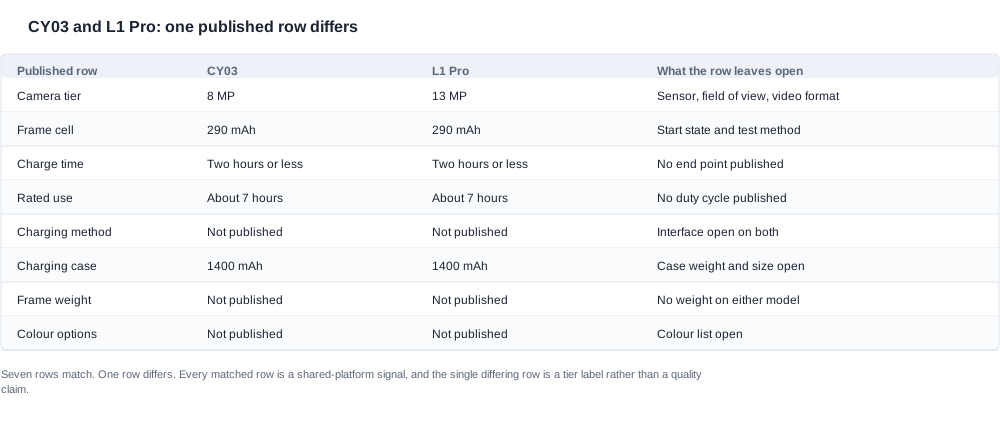
The consequence for a buyer is sharper than it first looks. If your use case leads on the image, this pair does not answer the question on paper, and the answer has to come from a sample comparison. If your use case leads on anything the platform row covers — endurance, charging, case economics, accessory range — both models answer it identically, and the choice is a commercial one that the catalogue does not publish. Which one of those two situations you are in is worth settling before you spend time on a comparison.
CY03 and L1 Pro use case fit: the two models are one row apart
Seven of the eight published rows match, and the matching is not a coincidence of rounding. The 290 mAh cell, the charge-time ceiling of two hours or less, the roughly seven-hour rating and the 1400 mAh charging case are the same values on the L2 Utral, the L1 Pro and the CY03, and the CY05. That is four camera models on one platform with one power architecture and one case configuration.
Only the camera row moves. The catalogue publishes eight camera models at 8 MP — the V03 Pro and the MT6, the CY03 and the V06, and the KY06 and the CY05, and the V03 and the MT5 — and three at 13 MP — the S7 and the L1 Pro, and the L2 Utral. So both of these models sit in the larger of the two groups, and the L1 Pro sits in the smaller one, where the L2 Utral and the S7 are the only other members.
That distribution has a direct commercial consequence. A tier with three members and a tier with eight members produce different ranges. A 13 MP range in this catalogue is a three-model ladder with a charging case on two of them and none published for the S7; an 8 MP range is an eight-model ladder that already covers a sport frame, a photochromic configuration, a folding case and an entry platform. Which of those two shapes your channel can actually sell is a range-design question, and it is a question this pair raises rather than a question this pair answers.
What the shared platform does to the cost of a range
Where the rows match, the money follows. A shared cell, a shared charge ceiling, a shared case capacity and a shared runtime rating mean that the accessories, the firmware and the application behind these two models are the same, so:
- One accessory line can cover the group. If you stock cases, the same case serves the CY03 and the L1 Pro, and the 1400 mAh configuration is shared across four camera models rather than being a bespoke item per SKU.
- One software and one update path can cover the group. This is the largest recurring saving in a multi-model range, because support and firmware maintenance are per-platform costs rather than per-model costs.
- One qualification exercise can cover the group, if the documents allow it. Whether it does is a documentation question, not an engineering one, and it is the subject of its own section below.
The trade-off sits on the other side of the same ledger. A platform this shared creates an invitation to carry a second designation, and the range fragments quietly if the second designation has no published reason to exist. The CY03 and the CY05 already publish identical rows, and our documentation does not state what separates them. Before a two-tier ladder is built on this platform, that gap has to be closed, because the CY05 and CY03 positioning analysis shows what a range looks like when two SKUs publish the same specification.

What an L1 Pro pixel tier does and does not settle about the image
A tier is a quantity of pixels. It is not a description of a picture, and the gap between those two things is where most camera-glasses comparisons go wrong.
What a 13 MP row can do. It can state a specification on a product page, support a channel that compares pixel counts in listings, and give a buyer a defensible tier to price against. In a range where the alternative tier is 8 MP, a 13 MP model is at the top of the published ladder, and a customer who arrives knowing that distinction will recognise it.
What it cannot do. It cannot support an image-quality claim, and it cannot be compared against the 8 MP tier on picture. Pixel count says nothing about pixel size, nothing about the light the sensor gathers, nothing about how wide the lens sees, and nothing about how either model behaves indoors or at dusk. A 13 MP sensor with small pixels can produce a worse image than an 8 MP sensor with large ones, and there is no published row anywhere in this catalogue that would let a buyer decide between them on that basis — because the sensor model is not published for either the CY03 or the L1 Pro.
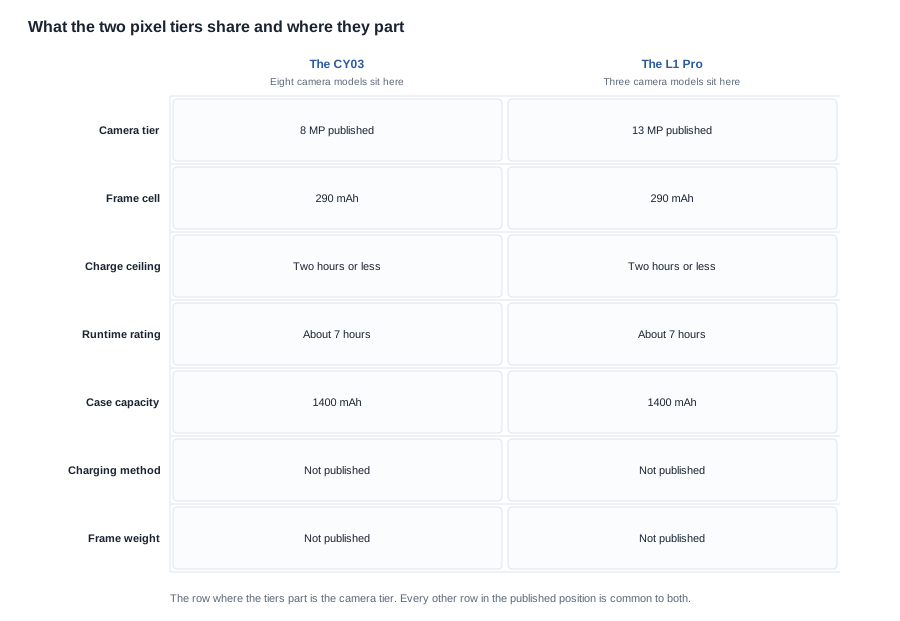
So the honest formulation of the difference is this: the L1 Pro publishes a higher pixel count, and it is the better commercial answer for a channel whose customers compare pixel counts, because it gives you a number to lead with that the CY03 cannot match. It is not the better product on the evidence available, and anyone who tells you otherwise is reading a tier label as a photograph.
The comparison effect worth planning for
There is a second-order effect that has nothing to do with image quality: how your customers compare you. A channel that sells on a specification list tends to attract buyers who read specification lists. Buyers who read specification lists will find the pixel count, and if a competing listing shows a higher one, the lower-tier product is being compared on the axis where it is deliberately positioned lower.
That is a choice, not a defect. A channel that sells on price, on the case, on the accessory ecosystem or on brand is indifferent to the tier question, and the 8 MP model is the more natural fit for it because it sits in the larger group and shares everything else. The evaluation criteria for each case are different, which is why the brief has to be written before the shortlist rather than after it.
The shared platform behind both CY03 and L1 Pro configurations
If the two models are one platform, then the platform is what you are actually buying, and the questions that matter are platform questions: how wide is the range, how many documents does it need, and how much does a second SKU cost you.
Range breadth and the cost of the fourth model
The platform as published supports four camera models with the same 290 mAh cell and the same 1400 mAh case: the CY03 and the CY05 at 8 MP, and the L1 Pro and the L2 Utral at 13 MP. The L2 Utral also publishes a 900 mAh case option, so it is the only member of the group that offers a two-tier packaging configuration, which means a two-tier retail ladder inside one platform is possible there and nowhere else in this group.
That is worth knowing before you decide how many models to carry. A four-model platform with one cell, one case and one software line is a coherent range with a single accessory and support structure. A four-model platform where two of the models publish identical rows is a range with a question mark in it. The difference between those two states is entirely down to whether the differences can be named, and naming them is a conversation to have with the supplier before the range plan is frozen rather than after the first order.
One file or four
This is where the shared platform turns into due diligence, and it is the item most likely to be underestimated. A conformity document names a product. It covers the designation that was tested, in the configuration that was tested, for the market it was tested for — it does not cover a family because the family shares electrical characteristics. A document that names the CY03 does not automatically cover the L1 Pro, even where the two are electrically identical, because the designation is what an inspector reads and what a certificate holder is measured against.
Our published position on certification is narrow and worth stating precisely, because a buyer's question here is legitimate and a supplier's answer here is often not. Our catalogue holds one export certification page covering the company rather than any model, and everything on it is imagery rather than wording: ten patent certificates, of which eight are appearance designs and two are utility models. The catalogue text mentions no CE, FCC or RoHS marking, and there is no per-model certification row anywhere for the CY03, the L1 Pro or any other model. So there is nothing to attach to either model from the catalogue today, no status can be inferred for either from the company-level page, and the request has to be made in writing, with its cost and its lead time stated, as part of the quotation. The certification coverage notes set out why a shared platform does not automatically mean a shared file.
What is worth asking the supplier is narrower and much more useful than a general compliance question: which model designations appear on each report they hold for this platform, and whether the issuer will confirm that one report covers both. An issuer willing to confirm coverage in writing saves you three documents and a qualification cycle. An issuer unwilling to confirm it in writing has told you something useful too.
Screening four channel briefs against CY03 and L1 Pro published rows
Here is how the pair behaves against the briefs a camera-glasses buyer actually arrives with. Each screen names the published row it turns on, so you can check whether your own brief is one of them or something the catalogue has no opinion about.
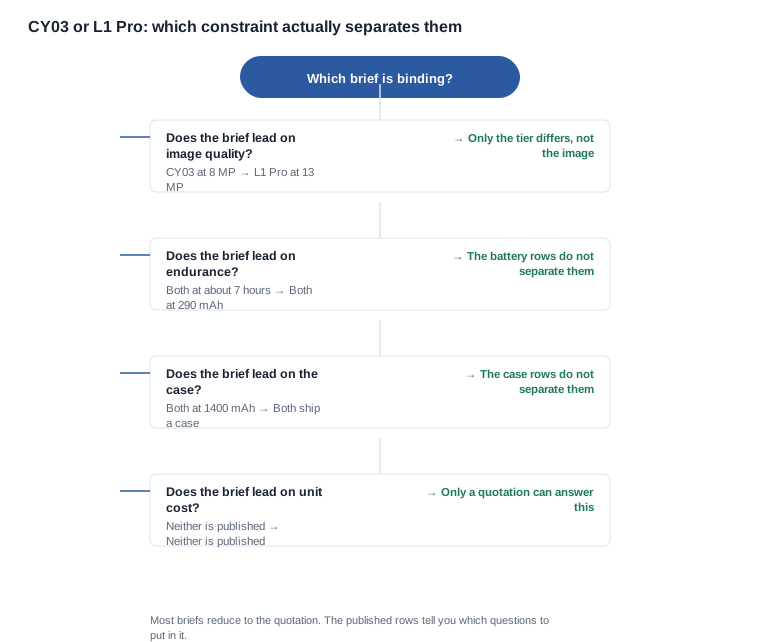
A brief that leads on the picture. The camera tier is the only row that separates the models, and the rows behind the tier — sensor, field of view, video format, frame rate — are unpublished for both. This brief cannot be closed on documents at all. What it needs is a side-by-side sample comparison under the conditions your customer will create, recorded with the conditions written next to the results. The published 8 MP and 13 MP figures are useful for the listing and useless for the decision.
A brief that leads on endurance. Both models publish a 290 mAh cell, a charge ceiling of two hours or less and a rating of roughly seven hours, and neither publishes the test condition. The brief is therefore identical for both models and identical in its unresolved parts, and the screening result is that the camera tier is the only thing left to decide on. Note that the charge ceiling is a ceiling: two hours or less permits exactly two hours, and it is not the same claim as under two hours.
A brief that leads on the case. Both publish a 1400 mAh case, so the endurance story, the accessory line and the packaging are shared. The differences between them are the same for both models and are not published: the case's own charging interface, its weight, its dimensions, its own charge time and whether it carries a visible charge indicator. Five numbers that decide the carton and the freight class, and they are open on both sides of the comparison.
A brief that leads on channel position. This is the brief where the tier genuinely bites, and where the pair separates. A channel that competes on a headline specification is choosing between leading with 13 MP or leading with something else. A channel that competes on price, on the case or on the accessory range is choosing between two products that publish the same numbers.

The order the screens should run in
The sequence matters more than it looks. Screen the brief first, then the published rows, then the sample, then the quotation. Running the quotation first is the common mistake, because a unit price creates the illusion that the specification question has been answered, and it has not: the tier you buy at a given price is still the tier you have to sell.
A useful discipline here is to refuse the comparison until the brief is written as constraints. "We want good camera quality" is a preference; "first-person clips are re-encoded by the platform and viewed on a phone, and the listing will not carry a megapixel claim" is a constraint, and it points at the 8 MP tier on published evidence without pretending that the picture has been compared.

The CY03 quotation questions the published rows cannot answer
Four commercial rows decide whether either of these models is buildable in your channel, and none of them is published: unit price, minimum order quantity, lead time and production capacity. Warranty terms, payment terms and the defect policy are the same category of unpublished row. They are also the rows that decide whether a four-model platform is a range or an ambition.
What to ask, in writing, before the quotation is treated as comparable:
- Unit price at the quantity you are actually planning, and the price breaks at the next two tiers above it.
- Minimum order quantity per model, and whether it applies per designation or per configuration.
- Lead time from deposit to shipment, and whether it is quoted per model or for the platform as a whole.
- Production capacity by month, and whether it is shared across the four models on this platform.
- Warranty terms, and whether the charging case is covered on the same basis as the frame.
- Whether the two tier levels are produced from the same line, and what that means for a mixed order.
These are the questions that turn a comparison page into a procurement one, and they are the same six for every camera model in the range, which is why it is worth asking them once per platform rather than once per SKU. If the answers differ between the CY03 and the L1 Pro — which is entirely possible, and would be commercially sensible — then the tier decision is being made for you by the commercial terms rather than by the customer-facing argument, and knowing that before the listing is written is worth a great deal.
The total cost line deserves its own note, because it is where a shared platform quietly pays for itself. Four models on one cell, one case and one software line carry one accessory structure, one support structure and, if the documents allow it, one qualification file. Two models on two unrelated platforms carry two of everything. That comparison is the real argument for this pair, and it is invisible in a spec sheet.
What the CY03 and L1 Pro comparison settles
This pair should be screened against your brief and not against each other, and the published evidence supports exactly one substantive difference between them. We will publish the 8 MP and 13 MP rows as they are and we will not describe either as producing a better picture, because the sensor model, the field of view and the video format are not published for either, and a tier label is not an image. We will not quote a frame weight, a colour, an ingress rating or a charging interface for either model, because none of those rows exists in our documentation. And we will not tell you which one to take, because unit price, order quantity, lead time, capacity and warranty are unpublished, and a recommendation that rests on one published row would be a recommendation about a spec sheet rather than about your order.
What we will do is send you the published rows for both models, put the six quotation questions behind them, and tell you which of the four briefs above the pair can be screened against today. The published L1 Pro specification list is the same material for the 13 MP tier, the AI camera glasses model guide sets the tier question against the rest of the family, and the charging case options analysis covers what the shared case does to the delivered cost.
Related reading
- The published rows for the L1 Pro — L1 Pro smart glasses specifications and features
- Choosing across the whole camera range — AI camera glasses which model to pick
- The accessory that both models share — AI camera glasses charging case options
Tell us the channel, the target retail price and the markets, and we will tell you which tier the range should be built around and which figures are still unpublished.


