

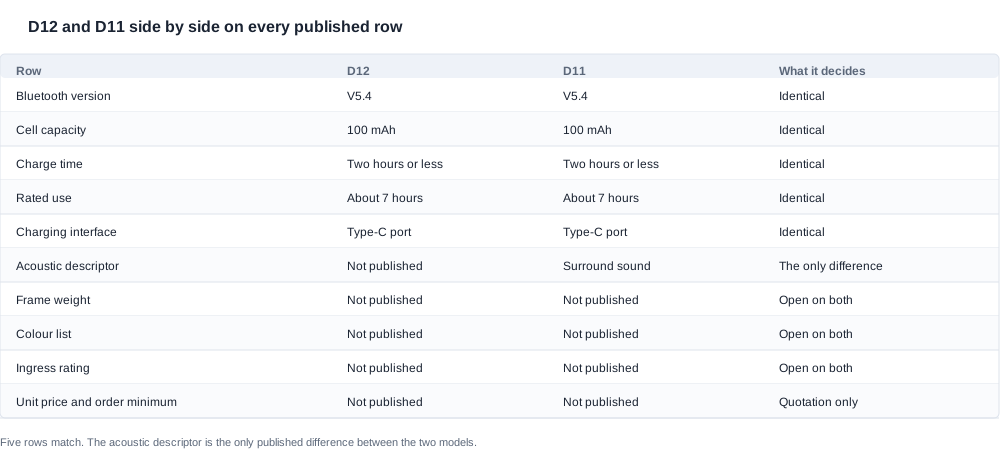
The two models are electrically identical, and that single fact settles the price positioning question before any commercial argument happens. The D12 publishes Bluetooth V5.4, a 100 mAh cell, a charge time of two hours or less, a rated runtime of about seven hours and Type-C charging. The D11 publishes exactly the same five rows, plus an acoustic descriptor. There is no specification gap for a price gap to fill.
We publish no prices for either model, so this page cannot tell you what one costs or what the difference should be. What it can do is tell you which rows differ, which three grounds make a price difference defensible rather than arbitrary, and where the honest limit of the argument sits.
D12 versus D11 price positioning: what identical rows actually decide
Let the table do the work. Reading the two published entries side by side, the only line that differs is acoustic: the D11 publishes a surround-sound row and the D12 publishes no acoustic descriptor at all.
Everything else — the radio version, the cell capacity, the charge ceiling, the rated runtime, the charging interface — is the same on both. The two models also share the single 100 mAh cell arrangement, which is worth noting because the neighbouring models in this family publish two-cell configurations at 55mAh2 and 90mAh2. The D11 and the D12 sit on one platform, and that platform is the product.
Why the shared rows close the argument rather than open it. When two products publish the same cell, the same charge ceiling, the same runtime and the same interface, then the usual reasons for a price difference — a better cell, a faster charge, a newer radio — are simply not available to either of them. A supplier who quotes a higher price for the D11 on the basis of battery or radio has quoted you something the catalogue cannot support, and the correct response is to ask them to point at the row. There is nothing to point at.
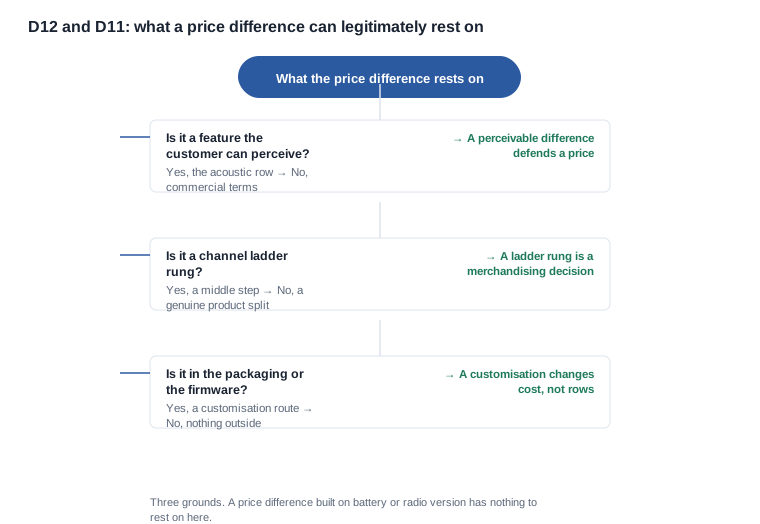
What is left. What remains is a very short list of things that can actually carry a difference: a feature the customer can perceive, a commercial arrangement between the supplier and the channel, or a configuration change that does not appear on the specification sheet at all. Three grounds, each with its own failure mode, and a buyer who cannot tell which one is in play is being asked to guess.

The three legitimate grounds for a price difference between them
It is built on a feature the buyer can perceive. The acoustic row is that feature here, and it is the only published difference between the two models. A buyer positioning the D11 as the better-sounding frame can hold a higher price for it because the customer can hear the difference — provided the customer can hear it.
That proviso is the failure mode. A surround-sound row is a feature name, not a characterised product: our catalogue publishes no driver size, no frequency response, no leakage figure and no sound-field description for any model in this range, so there is no measured basis on which to promise what the extra output does. A listing that says "surround sound" and a listing that says "wider soundstage" are very different claims, and only the first is supported by a published row. This is where the acoustic claim has to be written carefully, and the open-ear audio guidance sets out what to demand before promising anything further.
It is built on channel economics. Distributors who want a good-better-best ladder need a middle rung, and two models with identical specification sheets give them one cheaply. The D12 becomes the volume model and the D11 becomes the step up. This is a completely normal reason to price two things differently, and it is the one most often mistaken for a quality difference.
The failure mode here is that the rung has to be visible. A ladder rung that a customer cannot perceive is a ladder rung that a customer will collapse, because the marketplace will compare the two listings on price and find nothing else to compare on. The rung has to be expressed in terms the shopper can act on.
It is built on something not in the specification sheet at all. Packaging, colourways, order minimums, a modified application, a different product name, a different firmware branch. These are customisation routes that change cost without changing the published rows, and they are the most flexible of the three grounds because they can be specified exactly.
The failure mode here is that customisation is not free and not always available at the quantity you want. Tooling, artwork and firmware work all have minimums and lead times attached, and a private-label version that only exists above a certain order quantity has a cost structure a price ladder has to reflect. The OEM and ODM options page is where that structure is set out.
The failure mode of each ground, side by side
The three grounds are easy to recite and easy to confuse at the moment a price is being agreed, so it is worth setting out how each one fails and what the failure looks like in practice.
The perceivable-feature ground fails quietly. The price holds for a while because the difference sounds real, and then a customer returns the product because the feature did not do what the listing implied. The failure is not in the price, it is in the copy, and it arrives as a returns problem rather than a pricing problem — which is why the acoustic claim on this pair has to be written at the level of the published row and no further.
The channel-ladder ground fails structurally. The two models sit at different price points with no visible difference, and the channel discovers it. Either the shopper takes the cheaper one and the upper rung sells nothing, or a marketplace shows them side by side and the ladder becomes a discount ladder. The fix is not a better listing; it is a rung the customer can see, or a single model.
The customisation ground fails operationally. The model was priced as a customised variant and then ordered in a quantity below the customisation minimum, so the unit cost moves and the ladder breaks. This one is entirely predictable and entirely a matter of recording the minimum alongside the price rather than in a separate note that nobody reads.
What all three have in common is that none of them is a specification difference. That is the practical point of the exercise. A price ladder built on a perceivable feature, a channel rung or a customisation is defensible and can be explained to a customer. A price ladder built on battery capacity, charging speed or radio version is not available on this pair at all, because those rows are identical.
The commercial terms you do not have yet
This is the part that catches people out when they try to plan a range around these two models.
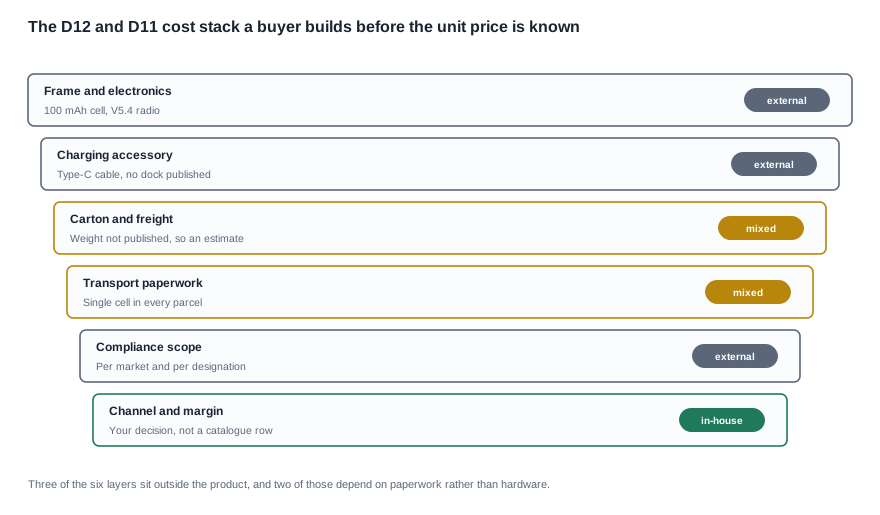
We publish no unit price, no minimum order quantity and no lead time for either model. Our internal documentation currently holds three conflicting figures for the minimum order quantity and we have not arbitrated between them, so none of the three goes into an article. If you are building a range, budget the fact that your landed cost is not yet knowable from published material, and get the commercial terms in writing early rather than discovering them at the artwork stage.
Certification status is unpublished for both models, and certification sits inside landed cost. A buyer moving stock into the European Union will be asked about CE, FCC and RoHS, and our catalogue's text contains no reference to any of them; there is a company-level export certification page whose content is images rather than text, and no per-model certification row for the D12 or the D11 or for anything else. Any price comparison you make between the two models has to be made on the same certification basis, or it is not a comparison at all. We can point you at how the certification route is normally established, and the model-specific detail is in D12 certification status.
And the certification scope can differ between the two models. A document that names the D11 does not automatically cover the D12, even where the two publish identical electrical rows, so a two-model range can require two sets of evidence where a one-model range requires one. That is a cost line that appears only when you qualify the second model, and it is the reason a range decision should be made before the packaging is printed.
How to structure the request so the answers are usable
The commercial terms are the part of the comparison that actually decides the outcome, and the way they are requested matters as much as the items themselves.
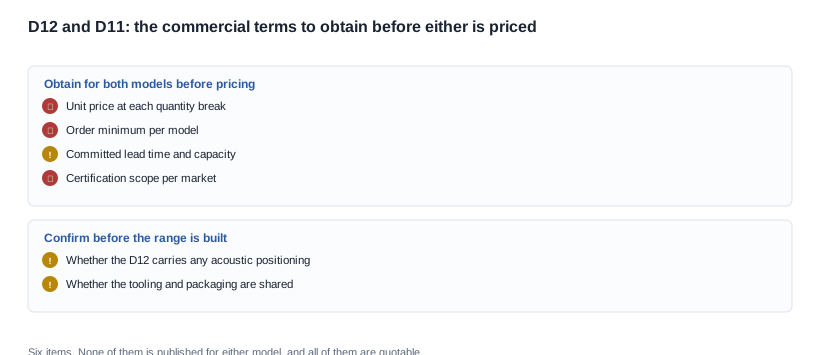
Ask for the six terms for each model as a table, in one message. The six are: the unit price at each quantity break, the order minimum, the committed lead time, the production capacity behind it, the colour and packaging availability, and the certification scope per destination market. Ask for them per model rather than for the pair, because a combined answer tends to come back as a single blended set that belongs to neither model.
Ask for the answers tied to the model designation. This is not a formality on this pair. The two models publish identical rows, so a reply that answers at the family level is a perfectly plausible reply and will look complete on first reading.
Ask for the quantity breaks you intend to order, not the full ladder. A supplier who quotes the whole ladder has spent effort on figures you will not use, and the effort shows up in the time before you get the answer.
Ask what changes the price. Not as a request for a discount, but as a request for the list of things that alter it: the quantity, the packaging, the firmware, the certification scope, the delivery terms. That list is the commercial specification of the product, and it is the thing a buyer needs in order to price a range rather than a single order.
And ask for the minimum order quantity to be stated against the certification scope. The two interact more often than buyers expect: a certification file obtained for one model does not cover a second model, and a supplier who offers a shared file for a family is offering something that has to be verified at model level before it can be relied on.

What the specification sheet still does not tell you
- Frame weight, temple dimensions and lens sizes — not published for either model, so neither can be sold with a weight figure and neither supports a size range.
- Whether the D12 carries any acoustic positioning at all, or simply omits the surround-sound row — the published entry does not say, and the distinction matters for anyone planning to compare the two on sound.
- Microphone count, pickup distance and call quality — not published for either.
- Ingress protection — not published for either. If the range is going near water, that is a blocker rather than a detail.
- Colour lists — not published for either, so a merchandising plan waits on a conversation with the factory.
- The endurance test condition behind the shared seven-hour rating — not published, and it is the item that decides whether the two ratings can be compared at all.

How to build a two-model range on commercial terms

The order of operations matters, because the expensive commitment is the artwork and the artwork comes last.
First, ask whether the two are one product under two designations. A yes answer ends the discussion and saves a packaging revision. This is the same question to put as the one about the D12 and the CY03 in the camera range, and it is worth asking in the same words for the same reason: the published rows in both pairs are identical, and an identical specification sheet is the strongest possible hint that the two are the same product.
Second, request the commercial terms of both models separately, in one message, as a table. Separate, because a combined answer tends to come back as a single blended set. Tabular, because a table of six terms and two models is a document that a colleague can read and a paragraph of description is not.
Third, confirm whether the acoustic row is the only difference, in the supplier's own words. If there is a further difference that the catalogue does not publish, that difference is the most defensible rung available, and it should be documented at model level so that the specification sheets, the compliance files and the listing copy all describe the same object.
Fourth, decide the role of each model — volume, step up, or a model held for a channel that needs a fuller documentation pack — and check that the role survives a change of configuration.
Fifth, write the role into the customer-facing copy. A shopper who cannot see a reason to choose between two models will choose on price alone, and in a marketplace that comparison is automatic.
And if the commercial terms turn out to match as well as the rows, the honest answer is one model rather than two. That is not a failure of the product or of the range strategy; it is the range strategy working correctly on the evidence available.
What a buyer should write into the range plan
The range plan is where the position becomes durable, and it is worth writing down in a specific form rather than leaving it in a conversation.
Name the axis explicitly. "Two models, differentiated by acoustic descriptor, with the D12 as the volume model" is a plan. "Two models, differentiated by price" is not, because it assumes the difference rather than stating it.
Name the evidence behind each claim. For the acoustic descriptor, the catalogue entry for the D11 and the absence of one in the D12 entry. For the interface, the Type-C row on both. For the platform, the shared cell configuration and the shared charge ceiling. A range plan whose claims are each traced to a row can be defended to a channel partner; one that is not traced is an opinion with a price attached.
Name the terms that have to match. If the two models are a ladder, then the order minimum, the lead time and the certification scope should be close enough that the price difference is not swallowed by a delivery or paperwork difference. If they are not, the ladder will not hold in practice, and it is better to know that before the packaging is printed.
And name the fallback. Write down what happens to the plan if the acoustic difference turns out to be the only difference and the commercial terms turn out to match as well. The fallback is usually one model, and a plan that has already written the fallback down is a plan that does not need a meeting to unwind.
How to evaluate the answers. Each must be tied to a model designation, must state the configuration it applies to, and must say what it excludes. The red flags are a price with no quantity attached, a lead time expressed as an average rather than a commitment, a certification answer that names a sibling model, and a colour or packaging answer that turns out to assume a minimum order quantity that was not disclosed.
And the order in which the terms should be closed. The acoustic difference first, because it decides whether there is a range at all. The order minimum and the quantity breaks second, because they decide whether the ladder holds. The lead time and the certification scope third, because both have timelines that belong in the programme plan rather than in the negotiation.
The quantity break structure you should ask for
Two models sold on identical terms behave like one model priced twice, which is why the shape of the quantity break matters more than the headline number. Ask for the break structure in writing and in this order: the minimum order quantity per model, the quantity at which each price band opens, and the unit price at that band including what the band does not cover.
Three questions decide whether a break is real. Does it apply per model or across the pair? A break that only opens when the buyer commits to both models is a range dependency, and it has to be tested against a forecast rather than against an intention. Does the break survive a change of colourway or packaging, or does a private-label version reset it? And what happens to the band if the acoustic difference is not confirmed — does the price hold, or does it move?
If the answer is that the break applies to the pair, build the forecast on the pair rather than on the D12 alone, because the two quantities then stop being independent and a shortfall in one erases the discount on the other. If the answer is that the break resets with the colourway, treat it as a per-configuration band and put artwork approval ahead of the forecast date instead of after it.
Then ask for the floor in the other direction: the quantity at which the two-model terms stop being better than a single-model purchase. A buyer who can consolidate onto one model at higher volume should be able to see that from the same sheet, because a range with no consolidation path tends to keep two low-volume lines alive when one would have been simpler to support through launch and after it.
Where our D12 and D11 position on this sits
The D12 and the D11 should be presented as two tiers of one platform rather than as two products with different capabilities, because that is what the published rows say. We will not tell you which one to order, we will not tell you what either should cost, and we will not tell you that either model holds a certification our documentation does not mention.
What we will do is put the rows on the table, name the one that differs, and be explicit about the three legitimate grounds for a price difference, so that you can see which one your own range is actually built on — and so that a supplier quoting you a difference for battery, charging or radio has to show you the row.
If you tell us the target channel, the volume and the positioning you want, we will come back with what is available and what is not, and we will say plainly where the answer is a conversation rather than a document. The family this pair belongs to is on our Bluetooth audio glasses range page, and the D12 versus D11 selection page takes the model-level decision that follows from this one.
Related reading
- The model detail behind the D11 specification — D11 best for
- What the buyer checklist for this platform looks like — K01 buyer checklist
- Building a private-label version of either model — OEM and ODM options
Tell us the target channel, the volume and the price band you are working to, and we will come back with what is available and what is not.


