
Here is the direct answer, without the politeness: we do not publish a photography asset package. There is no published inventory of studio shots, no published lifestyle set, no published on-model set, no published 3D or render files, no published usage licence and no published shoot turn-around. We will not describe a set of catalogue product images as a marketing asset library, because a buyer who plans around that description discovers the gap in the week the packaging is printed.
What we do hold, and what that means for your launch, is set out below — along with the specific list of shots a listing in this category actually needs, which is shorter and cheaper than most buyers assume.
Do you get a product shot, a photo set, or a media package?
The three are very different things, and buyers often use the words interchangeably when they are actually shopping for the second one and hoping to receive the third.
A product shot is a single frame of the product on a plain background, adequate for reference, for a specification table and for internal review. A photo set is a small group of images that together let a buyer understand the product: front, side, back, in the case, on the charger, at the detail level that matters. A media package is the full commercial asset library — lifestyle scenes, on-model photography, short-form video, render files, and the licence terms that let you use all of it on your own channels and your own marketplace accounts.
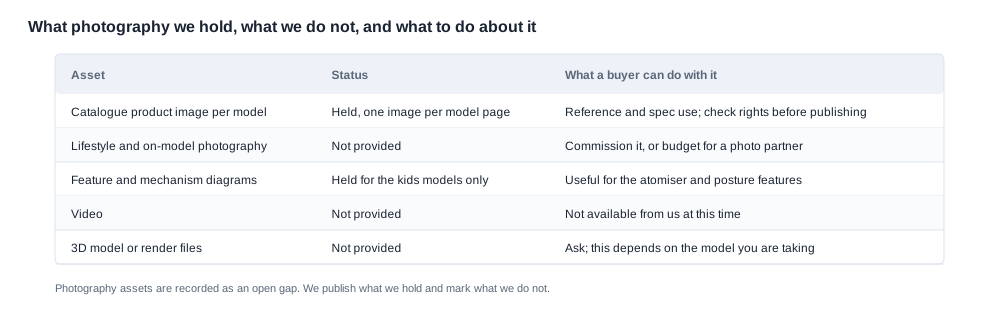
What we publish today is the first of those, on the product pages for our model range. There are twenty-eight models across seven categories in the catalogue, and the product pages carry an image for each of them. We will supply those images, and they are genuinely useful as a starting point, as a colour and dimension reference, and as the basis of a retouching brief.
What we do not publish is a media package. There is no lifestyle photography, no on-model set, no detail series, no video and no 3D files. The photography asset inventory, the file formats, the resolution, the editing and re-cropping rights, the channel-by-channel usage terms, the cost of a shoot and the turn-around for a shoot are all not published, and for most of them we do not have a fixed answer to give you.
This is worth being blunt about, because for a category that lives or dies on the image it is a real gap. A first-person camera product, an open-ear audio product and a photochromic lens are all sold on what they look like in use, and none of them can be sold from a flat catalogue shot. If your launch depends on imagery we do not hold, that is a budget line you need to know about before you commit to a date, not a surprise in week three.
There is also a second, more subtle gap that tends to surface later, and it is about the difference between a product shot and a listing image. A product shot shows the object. A listing image has to make a claim, or at least support the claims made next to it, and a plain-background image often cannot. A frame photographed straight on does not show that the temple speaker sits where the ear expects it. A shot of the device closed does not show that the charging case holds the glasses in the right orientation. A frontal image of a lens does not show that it darkens. Each of those is a claim the listing will make, and each needs its own frame.

Do you have lifestyle shots, on-model shots or detail shots?
No, we do not, and the absence is the reason the answer above matters.
The one place where we hold something beyond a product shot is the kids range. The A05 and the A06 pages carry diagrams showing correct and incorrect posture and distance, and a lens clear compared with a lens fogged. They are useful, they are specific, and they are not available for any other model in the range — the third kids model, the A07, does not have that set, and neither does anything in the audio, sport, camera, AR, electrochromic or bone conduction entries.
Beyond that, the gap is complete. No lifestyle scenes, no on-model shots, no close-ups of the temple, the hinge or the charging interface, no short-form video, no 3D model or render files.
Here is the practical response, and it is cheaper than most buyers expect. The images that move a conversion in this category are functional rather than decorative. A brief written around a small number of specific shots will outperform a large set of generic lifestyle images, and it will cost less to produce. The six shots that a listing in this category usually needs are:
- The front three-quarter view, large, on a clean background. This is the image that appears in the search result, and it is the one that has to look right.
- The side profile, because the temple, the ear position and the speaker placement are the things a buyer is trying to judge from a photograph.
- The charging interface, close in, with the connector visible. This is the shot that pre-empts the most common support question on an audio product.
- The charging case, open, with the glasses seated in it. Buyers misread the case relationship constantly, and one clear frame removes a support category.
- The lens, in a light condition and in a darkened condition, for any model where that is a feature. Only one camera model in our range publishes photochromic lenses with three colour options, so this shot has a narrow but real application.
- The controls, close in. The buttons, the touch area if there is one, the port, the indicator. Buyers of this category want to know what they are pressing.
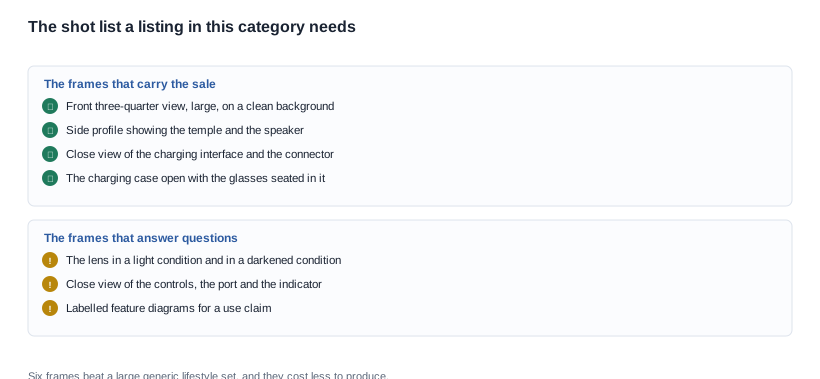
That is six frames, plus a set of angle variants for the marketplace's own crop requirements, and it is a brief that any competent product photographer can shoot in half a day once the units are in front of them. It is also a brief that has to be checked against what the product actually is, which is the subject of the last section of this article.
One category of image deserves separate treatment because it is cheap and it is frequently forgotten: the feature diagrams. The kids range pages demonstrate that a labelled diagram — showing correct and incorrect use, or a comparison of two conditions — can be more useful than a photograph for a specific claim. Where your listing makes a claim about how the product should be used, a diagram is often better than a photo and it does not require a shoot.
Do you commission photography against a shot list or against a mood?
Against a shot list, always, and the difference is not artistic. It is about whether you can tell when the shoot is finished.
A mood brief produces a set of images that look good and that do not cover the specific frames your listing needs, because the brief told the photographer what the images should feel like rather than what they have to show. A shot-list brief produces a set of images that cover the required frames and that can be assessed against a checklist, and it is also the version that survives being handed to a second photographer when the first one is not available in your market.
Three practical steps make the difference between a shoot that works and one that does not.
Decide what the listing has to show before commissioning anything. That sounds obvious and it is skipped constantly, because the booking deadline arrives before the brief. The six-shot list above is a reasonable starting point, and the addition of your own channel's requirements makes it a real brief.
Use the catalogue images as the colour and dimension reference. Whatever you commission, take the product shot as the reference for the finish and the proportions. This avoids the most common error in this category, which is a listing image whose colour does not match the unit that arrives — which becomes a returns argument, then a chargeback, then a review that no amount of marketing can outrun.
Check the rights before you publish anything. This is a step that gets skipped and then becomes a dispute. Establish in writing what you may use, whether the images are licensed for the specific marketplace accounts you will list on, whether they may be edited, cropped and re-coloured, whether the terms survive a change of supplier, and who holds the rights to the images of the packaging and the product in the background. These are ordinary commercial questions, and a photographer or a studio will answer them in a paragraph if you ask before the shoot rather than after the launch.

Budget photography as part of the launch rather than after it, and schedule it in the same plan as the packaging artwork and the listing copy. A brand that treats the shoot as an afterthought discovers the delay in week three, when the packaging is printed and the listing cannot go live, or in week eight, when the first customer asks a question the listing image was supposed to answer. The images and the copy are one deliverable, and they are built from the same specification — which is the point the last section returns to.
Choosing who does the shoot is a shortlist decision with a small number of criteria, and it is worth spending an hour on it because the cost of a re-shoot is higher than the cost of choosing once. The criteria that matter are: can they shoot the product type in the way the listing needs — a wearable on a head, a case opened in the hand, a lens held against a light — rather than only on a table; can they produce the channel variants without losing colour accuracy between the master and the crops; will they work to a checklist and sign off against it; and will they provide the source files in the format the build needs, rather than only delivery-ready exports. Price is a criterion, and it should come after the others, because the cheapest quote in this category is usually the studio that shoots on a table.
The trade-off in commissioning a shoot is worth naming, because it is the one buyers are most often surprised by. A studio shoot is a fixed cost with a variable result, and the result depends on having the right units, the right packaging, the right background and the right references on the day. Which means the shoot cannot happen before the product is final enough to photograph, and the product is often not final enough to photograph until the packaging artwork is signed off. That dependency chain is the reason photography has to be scheduled backwards from the launch date rather than treated as a task that can be squeezed in when the product is ready — because the product is ready roughly when the launch is, which is exactly too late.
The negotiation on a shoot is worth doing on scope rather than on price. The number of frames, the number of locations, the number of colour variants and the delivery of the source files are all separable, and the first shoot is the one where a small scope is a genuine mistake: the frames you did not commission are the ones you cannot use, and re-booking a studio costs more than a wider brief did.
Do you have the rights to publish what you were sent?
The rights question is not legal housekeeping. In this category, a product image is a representation of the product, and a representation of the product is a claim about the product. That connects the image directly to everything else on the page.
The questions worth settling are these:
- Who took the photographs, and who owns the copyright — the studio, the photographer, or the supplier whose units were shot?
- May the images be used on your own website, on your marketplace accounts, on your social channels, in paid advertising and in printed material? Some licences cover retail use and exclude advertising.
- May the images be edited, cropped, re-coloured and composited? If not, every version of the listing becomes a separate licensing question.
- Do the terms survive a change of supplier, or does the licence end with the relationship?
- Are the packaging artwork and the product in shot covered, or only the product?
That last one is the one that catches people. In a private-label programme, the packaging artwork is usually the buyer's own, and it is often present in the frame. A photographer shooting a "lifestyle" image of the product in its box is shooting your artwork as well, and if the artwork is a draft that later changes, the image is showing something that no longer exists.
There is a related point that is easy to miss because it is not about copyright. If an image shows a feature, that image is evidence of the feature being present. If the feature is not there — or is there but behaves differently — the image becomes the strongest piece of evidence against you, because it is your own publication. A listing photograph of a capacitive touch control, for instance, is a claim that the product has capacitive touch, and our catalogue carries no capacitive-touch row for any model in the range. That is not a small detail for a buyer who is about to build a product page on that basis.
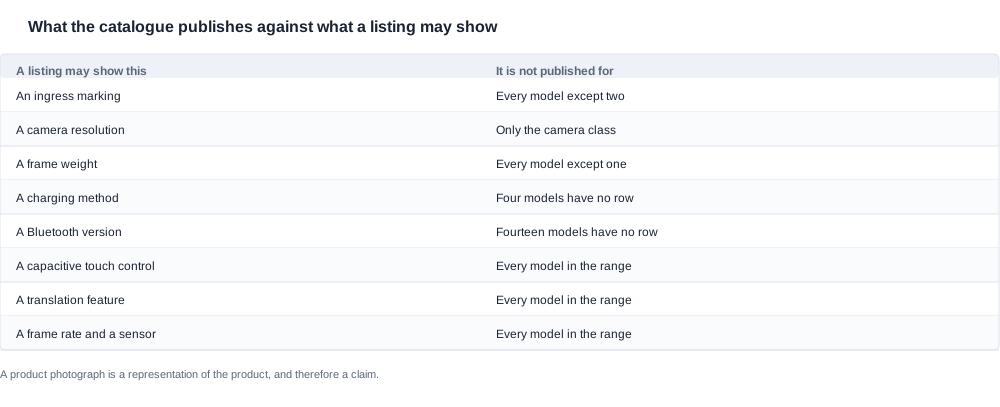
The table above is the version of the problem we can speak to directly, because it is our own published data. On the right-hand side are the things a listing image might readily imply and our catalogue does not support: a frame rate, a sensor, a field of view, a capacitive touch control, a translation feature, an ingress rating on a model that does not carry one, a frame weight on a model where we do not publish one, a Bluetooth version on the fourteen models where it is not published, or a charging method on the four models where the charging method is not published at all.
The practical rule follows directly: show what you can prove, and photograph only what the product does. If a feature is not in the published specification, do not let a photograph imply it. This is the same discipline we apply to our own copy, and it is the reason we publish the gaps in our documentation instead of filling them with a typical value.
Do you want an image that proves a claim, or one that avoids it?
That is the choice every listing photographer makes, and it is a choice the buyer has to make deliberately rather than by default.
An image that avoids a claim is safe and weak. It shows the object without committing to anything, and it will not support a page that needs to explain why the product is worth more than the alternative. An image that proves a claim is strong and carries risk, because it has to be true, and it has to be true of the unit the customer actually receives. Between the two there is a third option, which is the one most listings should use: an image that proves the claim that the published specification supports.
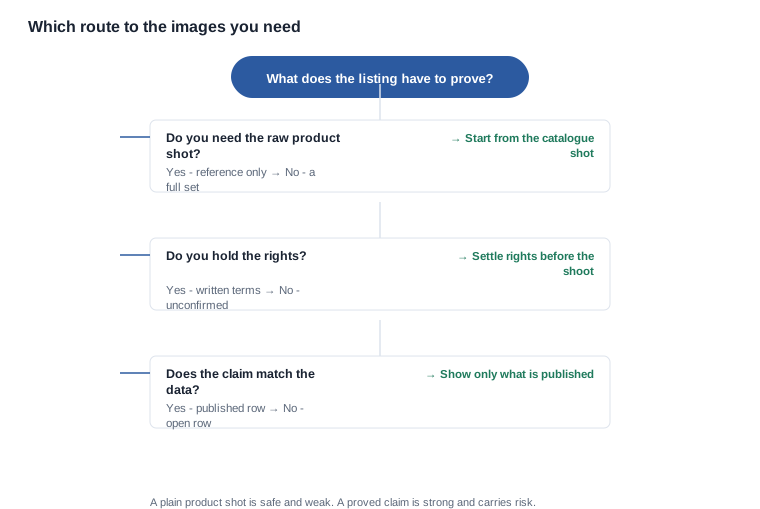
Working through that for a model in our range, the logic is fairly mechanical. If the model publishes an ingress marking — and only the V06 and the S7 do — then a shot of the unit in a wet condition is a claim the published data supports. If the model publishes a charging method, the interface shot shows a real feature; if the charging method is not published for that model, the shot should show the interface without a claim attached to it, or the claim should be deferred until the specification is confirmed. If the model publishes a frame weight, and only the MT6 does, then a weight claim is available for that model and not for the others. If a model publishes a camera resolution — eight megapixels across most of the camera class, thirteen for the L2 Utral and the L1 Pro, and the S7 — then a resolution claim belongs to the image set, and a zoom or low-light claim does not.
It is worth being clear that this is not a restrictive position. It is a position about accuracy, and it happens to be good business, because the most expensive asset a consumer brand has is not the product and not the photograph — it is the accumulated evidence that the brand tells the truth about its products. A catalogue that over-claims is cheap to build and slow to fix.
There is one more case worth putting to the test, because it is the one most private-label programmes hit. You are selling under your own brand, the product is built to your specification, and you want the listing to say something the generic product page does not — a battery figure, a runtime, a capacity, a feature. The rule is the same but the reasoning is slightly different, because in this case the data is not "not published" by a manufacturer, it is unpublished by you for your build. If your build has a different battery, the figure is yours to publish, and it should come from the build you are buying rather than from the generic model. If your build has a runtime measured under a condition you have documented, that condition is the specification, and it belongs in the listing as much as the number does. The photograph and the claim are the same exercise in this case, because both have to describe your actual product rather than a generic one.
Which model you should photograph is a separate and easier decision than how to photograph it. A camera model in our range has the most demanding shot list, because the claims it makes are visual — the lens, the recording position, the case relationship. A bone conduction product is close to the opposite, because much of what makes it work is not visible in a photograph at all and belongs in the copy and in the demonstration rather than in the image. Picking the right starting point for each model is a small part of the work and it saves a lot of wasted frames.
On our own position, then: we hold a product image per model on the product pages and the feature diagrams on the A05 and the A06 pages. We do not publish an asset inventory, a media package, a licence policy or a shoot turn-around, and we will not present a product shot as if it were a marketing asset. What we can be specific about is what the images show, what the published specification supports alongside them, and what does not. Send us a model and we will tell you exactly what exists for it and what it does not show.
The wholesale structure is under smart glasses wholesale, the model range is on the oem ready products page, and the listing-side decisions are covered in oem ready platform listing optimization. The packaging and artwork side is in oem ready platform logo and packaging, the claims discipline is in oem ready platform brand guidelines, and the rest of a launch's paperwork is in oem ready platform export documentation.
Related reading
- Making the catalogue images work — oem ready platform logo and packaging
- The claims behind the images — oem ready platform brand guidelines
- What else a launch needs — oem ready platform export documentation
Ask us for the image set for a specific model and we will tell you exactly what exists, what it shows and what it does not show.


