
No, and we are not going to soften that into something more sellable. We make no myopia-control claim on any model, we publish no clinical evidence for one, and we hold no clinical data at all. The products in our kids range are habit-reminder devices: they detect a posture or a viewing-distance condition and they prompt the wearer. That is the whole mechanism, and the difference between a reminder and a myopia-control device is the difference between a behaviour prompt and a medical outcome.
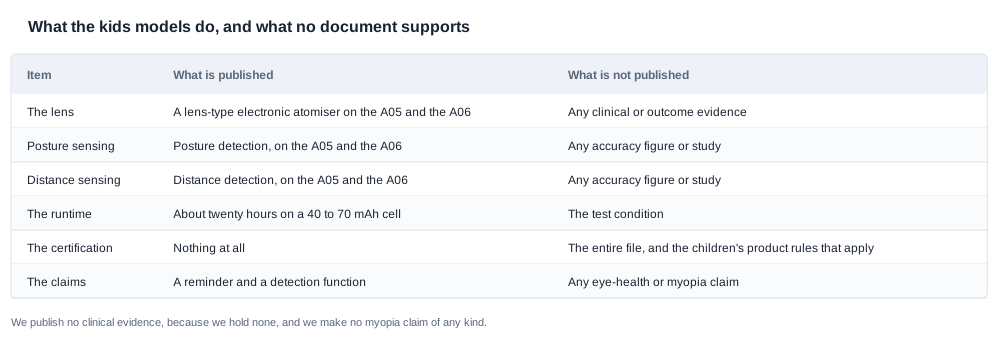
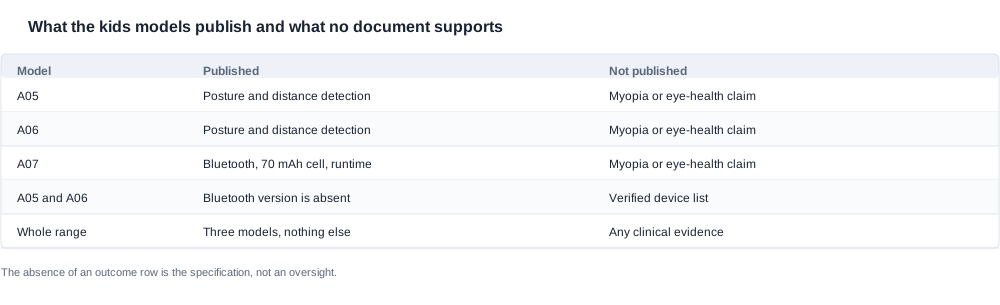
Here is what the catalogue actually publishes for this range, which is A05, A06 and A07 and nothing else. The A05 and the A06 publish posture detection and distance detection. The A07 publishes a Bluetooth version, a rated runtime of about twenty hours and a 70 mAh cell. The A07 publishes a Bluetooth version while the A05 and the A06 do not, and no kids model in this range publishes a myopia-control row, an eye-health row, or any outcome claim of any kind. The absence is not an oversight in the specification; it is the specification.
There is a second reason we answer the question this directly, and it is about you rather than about us. A buyer who is told by a supplier that a kids glasses product "protects eyesight" is being handed a claim that has to be defended in the market where the product is sold. If the claim is wrong, the retailer, the distributor and the brand all carry it — and the brand carries it longest. We would rather tell a buyer plainly where the line is than let them discover it in a listing review.
The background is on our kids smart glasses page, the technology context sits under kids eye care technology, and the market-entry rules are under children's product compliance.
There is also a version of this question that buyers ask with a different tone: they are not asking whether the device works, they are asking whether they can sell it. That is the more commercial question and it has a more useful answer. The device does what the catalogue says it does. What you can say about it in a listing is a question of description rather than of function, and a description that stays with the published specification will pass the review, advertise in the channel and survive the customer. A description that goes further will not, and the cost of finding that out is highest at the point where you have already committed to a seasonal buy.
Does it actually prevent myopia: what a reminder device is, and what it is not
It is a prompt. The device senses that the head has been bent forward for too long, or that the face is too close to whatever the child is looking at, and it tells the child. The evidence for the mechanism is the sensor working as specified. That is a real, useful, sellable product and it does not need a health claim to be worth buying.
It is not a treatment. It does not intervene in the biology of eye growth, and no marketing description of a posture and distance reminder changes that. The distinction is not a technicality. A behaviour prompt changes what a child does in the next thirty seconds; a myopia-control claim asserts something about what happens to the shape of the eye over years. The evidence required for the second is a different category of evidence entirely, and it does not exist in our documentation.
And the claim has a regulatory consequence. A device marketed as preventing or controlling myopia is making a health claim, and health claims in consumer products are treated differently from feature descriptions in most frameworks. In the United States the framework that separates a medical-device hearing aid from a personal sound amplification product works in principle in the same way: what the product is described as decides which side of the line it sits on. A change of description, from "reminder" to "prevents myopia", is a change of category, and it is made in marketing copy rather than in a factory.
The category name is not a claim, but it is not neutral either. The phrase "kids eye protection" appears constantly in search behaviour and in listing copy, and the category name itself is not a health claim. But a listing that leans on the phrase invites the customer, the retailer and the regulator to read it as one, and the more the copy leans on the phrase, the less control you have over how it is read. Our own copy keeps the function and drops the implication, and that is a deliberate commercial choice rather than a stylistic one.
For a buyer, the practical reading of all four points is that you should treat the claim question as a question about the copy, not about the hardware. The hardware in this range is consistent with a reminder device and publishes like one. The risk sits entirely in how the product is described in the listing, the packaging, the manual, the app store entry and the advertising.
One practical detail about the range is worth holding on to, because it affects how you brief a reviewer. The A05 and the A06 publish the detection functions, and the A07 publishes a Bluetooth version, a 70 mAh cell and a rated runtime of about twenty hours. In other words, the published evidence differs from model to model, and a listing that mixes capabilities across the three models creates questions that none of them answers. If you are building a family of three listings, brief them one at a time against their own published rows, and resist the temptation to write one description and apply it to all three. The same discipline applies to the Bluetooth row: the A07 publishes a version while the A05 and the A06 do not, so a listing that states a Bluetooth version for the whole range states more than the catalogue supports.
Why does it actually prevent myopia as a question is a compliance question
The question is not really about our products or anyone else's. It is about who carries the consequence of a claim, and that is where a buyer has real work to do.
The consequence lands on the party that publishes the claim. The brand that writes the listing carries it, and so does the distributor that re-publishes it on its own storefront and the marketplace that hosts it. Each of those may apply a different policy, and the strictest policy in the chain tends to decide whether the product can be sold at all in the channel you want.
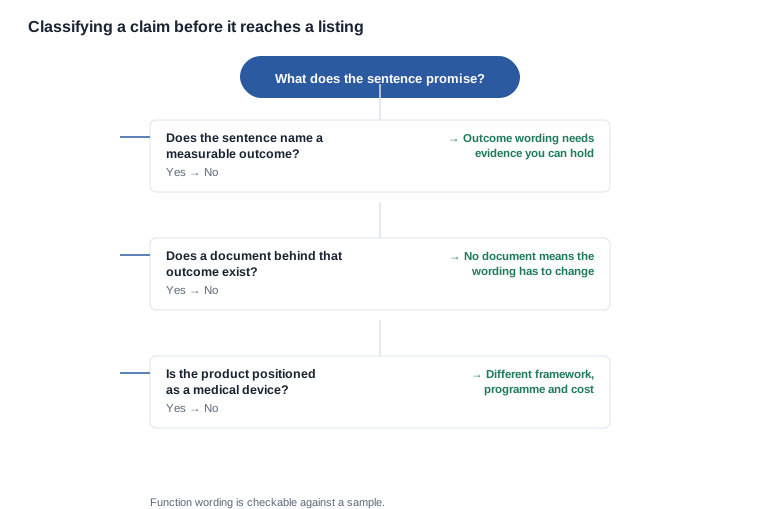
A health claim needs evidence of a different kind. The due diligence question is not whether the feature works in a laboratory sense, it is whether anyone has established the outcome and whether that evidence exists in a document you can hold. A clinical study is a specific and expensive thing to hold, and it comes with conditions, populations, durations and limitations. If a supplier cannot hand you the document, the claim is unsupported regardless of how plausible it sounds.
A medical-device assessment may apply. In some markets a product positioned as preventing or controlling myopia falls inside a medical-device framework, which brings its own classification, conformity assessment, documentation and registration obligations. That is a programme, not a document, and it changes the schedule and the cost of the launch substantially.
Child-specific frameworks sit on top. Whatever the general product position is, a product sold to children attracts additional requirements around materials, small parts, mechanical safety and the age grading of the product. Our children's product compliance page sets out the considerations, and the honest starting point for the kids tier is the A05 certification status page, which is explicit about what is confirmed and what is not.

For a buyer building a shortlist, the useful question to put to each supplier is short and it is diagnostic: what document is behind the outcome language in your listing? If the answer is a document, ask to see it and check that it covers the product and the market you are selling into. If the answer is a feature list, you have your answer about that supplier's documentation generally, because the place where a marketing claim outruns the file is rarely an isolated incident.
What does it actually prevent myopia mean for your listing copy
Three practical consequences, and they are the difference between a listing that survives review and one that does not.
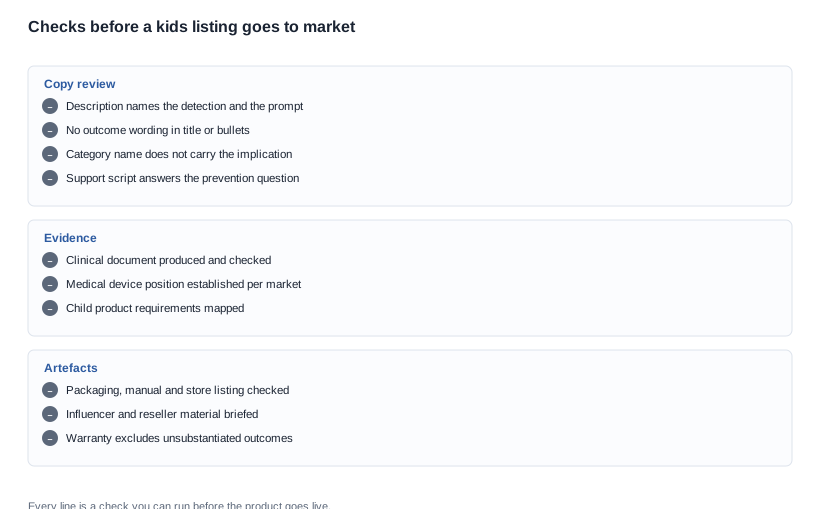
Describe the function, not the outcome. "Reminds the wearer when posture is slouched or when the viewing distance is too close" is defensible against the published specification and can be checked against the sample. "Protects your child's eyesight" is not, and it is not supported by anything we publish or hold.
Do not let the category name carry the claim. The listing can say the product is for children, it can say the product is a habit-reminder device, and it can describe the detection and the prompt. It should not assemble those facts into an implication about eyesight, because implication is what regulators and platforms look for, and it is what a customer remembers when they decide the product did not work.
Be able to answer the customer question. A support script needs one sentence for this question, and it should be the true one: the device reminds, it does not prevent, and no medical claim is made about eyesight. A seller who has to improvise an answer is a seller who will eventually improvise a claim, and the improvised version ends up in a review on a marketplace page where it cannot be taken down.
There is a commercial point hiding in all three. A compliant description is not a constraint on the listing, it is the condition of having a listing that keeps running. Marketplaces review copy, advertising platforms restrict health claims for consumer products, and the rules differ between markets and change without notice. A product whose copy is a feature description can be advertised in all of them; a product whose copy is a health claim can be refused in all of them, usually at the moment you are trying to scale into a new market rather than at the moment you write the copy.
The other commercial point is the reverse one, and it is where the opportunity is. A buyer who is honest about what the device does has a product that can be sold to a parent on the actual mechanism — the prompt, the reminder, the habit — and that argument does not have to be inflated to work. It also means you can answer a retailer who asks about returns honestly, because you are not relying on a promise that the hardware cannot keep.
How to test what a competitor claims about does it actually prevent myopia
If you are evaluating suppliers rather than writing your own copy, this is a question worth asking them directly, because the answer tells you where the rest of their documentation stands.
- Do you publish a clinical study for this product? A yes means ask to see it and check the population, the duration and the endpoint. A no is a perfectly good answer.
- Has the product been assessed as a medical device in any market, and where? The assessment record tells you which framework applied and what it required.
- Does your listing copy use outcome language, and what document sits behind it? This is the question that separates a supplier with a real file from one with a marketing team.
- Who signs off the copy in your organisation, and against what reference? If the answer is a named compliance owner, the file probably exists.
- What does your warranty exclude, and does it exclude health outcomes explicitly? A supplier who has thought about the claim boundary has usually written it into the warranty, which is a useful signal about the rest of their position.
Beyond the supplier conversation, look at the artefacts themselves, because the claim usually appears somewhere other than the specification sheet: in the product title, in the bullet points, in the packaging artwork, in the instruction manual, in the app store listing, and in the influencer material. Any of those can carry a claim the supplier would never put in a quotation, and any of those is what a customer or a reviewer will quote back at you.
One of those artefacts deserves special attention, and it is the manual. An instruction manual is the document a regulator treats as evidence of how the product is intended to be used, and a manual that describes the product as protecting eyesight while the specification sheet describes posture detection is a document set with a contradiction in it. For a supplier whose file is otherwise in order, the manual is usually the weakest link, because it is often written by a different person from the one who wrote the specification. It is worth reading the manual of any kids product before you accept the listing copy, and it is worth asking a supplier for it rather than for the marketing description.
The reverse check is equally useful. If a supplier's manual is careful and functional, and their listing copy is careful and functional, and their answer to your question is that they make no outcome claim, then the file is probably coherent. Coherence across the file set is a reasonable proxy for a supplier who will not embarrass you in a listing review, and it is a much better shortlist criterion than the presence of a badge on a product page.
Our kids eye protection procurement checklist is the document to work through when comparing suppliers on this tier, and kids eye protection red flags covers the copy patterns that tend to indicate a claim nobody has substantiated.

What does it actually prevent myopia mean for the commercial terms of a kids range
The claim question has a price, and it appears in the agreement rather than in the laboratory. A handful of lines determine whether the wording risk is a rounding error or a permanent line in your operating cost.
The returns position. A listing that promises an outcome creates a return that is difficult to refuse: the parent is not returning a broken product, they are returning one where the child still needs glasses. The returns terms for a kids range should say what evidence a return needs, and a feature-based description makes that conversation manageable while an outcome-based description makes it unmanageable. Where a distributor takes the returns, this is the line they will ask about, and it is worth settling before the quotation rather than during the first season.
The retailer and the marketplace. Both will ask about the claim at listing review, and the answer is easier when the copy already answers it. A listing that reaches a review with a health claim has three possible outcomes — it is taken down, it is edited by the platform, or it is allowed through and becomes a liability later. Only the first is cheap. Ask the supplier to supply the product description in the form you intend to use, rather than assembling the copy yourself from their feature list, because the feature list and the description usually have different levels of ambition.
The distributor's indemnity. If a channel partner writes their own copy, the question of who carries a claim that goes wrong is worth settling in writing. The usual structure is that the distributor may not make claims the supplier has not substantiated, and that any claim it does make beyond that is at its own risk. That clause is easier to agree before the relationship starts than after the first complaint.
The negotiation lines that belong in the same conversation. Unit price and volume tiers for the three models. Minimum order quantities per model, which matter more here than elsewhere because the range is small and a mixed order is a commitment to more than one SKU. Packaging specification, including the artwork review that a health-adjacent category always requires. The warranty period with a stated response. Return terms for a seasonal channel. Payment nodes tied to inspection. Lead time for a tier that is likely to be ordered in bursts before a school term rather than evenly across the year.
And the one that is not negotiable. The product's actual function. A supplier who offers to help you write a stronger claim as part of the commercial package is offering you a liability with a discount attached, and the discount is the smallest part of the cost.
The shortlist criterion. When two suppliers quote the same kids product at the same price with the same lead time, the question that decides between them is which one can show you the documents behind its copy. That is a due diligence question with a direct commercial answer, and it is worth more than a small unit price difference.
What we publish about does it actually prevent myopia today
Stated plainly enough to be quoted in a buyer brief.
Published: the kids range and its three models, A05, A06 and A07. The posture detection and distance detection published for the A05 and the A06. The Bluetooth version, the 70 mAh cell and the rated runtime of about twenty hours published for the A07. The absence of a published Bluetooth version for the A05 and the A06.
Not published, for any model in this range: a myopia-control row, an eye-health row, a clinical study, a medical-device assessment record, a claim substantiation document, or any outcome figure of any kind.
We will not describe any of these products as protecting eyesight, preventing myopia, controlling myopia or producing any eye-health outcome, and we will not write a health claim into a listing. If a brand intends to make such a claim, we would ask it to resolve that through the appropriate compliance route first, because it is a decision about evidence and classification rather than about wording.
What we can do is tell you exactly which documents we hold for a specific model, which questions have to be answered by the company rather than by the catalogue, and what a defensible description of these products looks like in practice. Send us the model, the markets you intend to sell into and the channel, and we will tell you what is published, what is not, and what we would and would not put in writing.


