
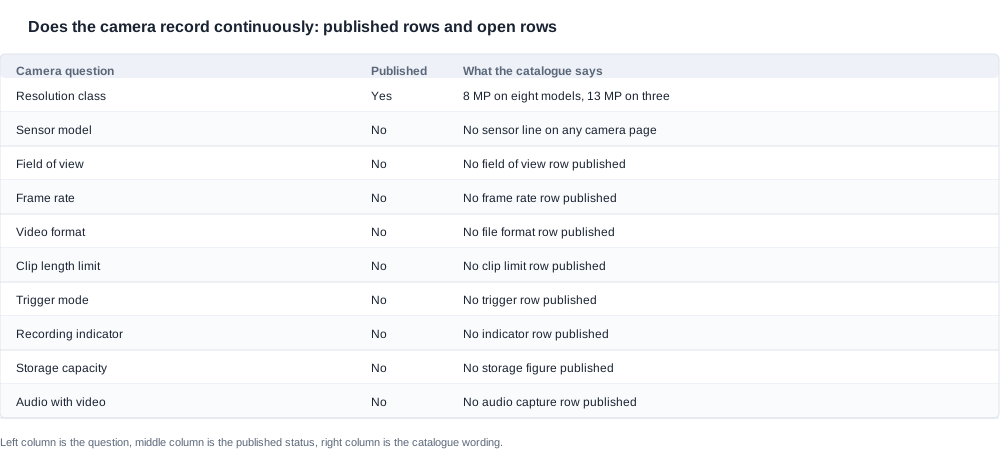
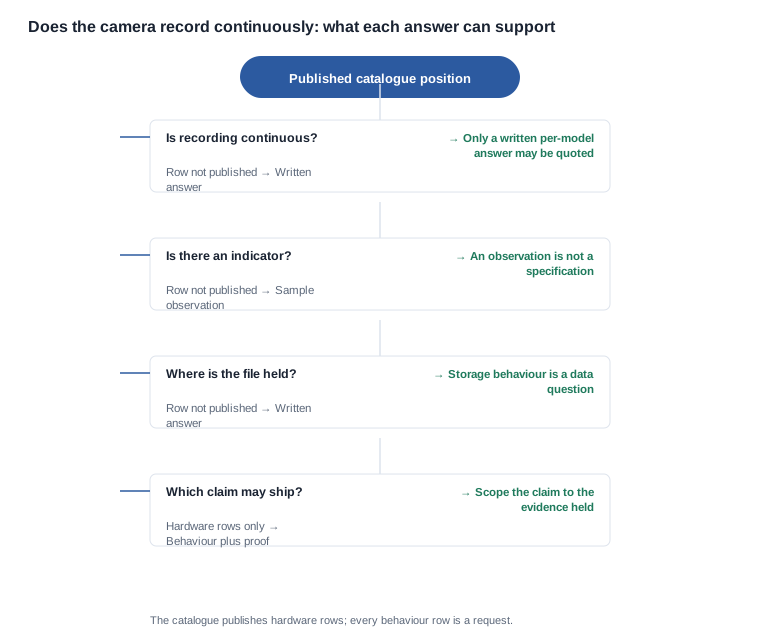
Does the camera record continuously? The catalogue does not say, and the honest position for a sourcing file is that the recording behaviour of every camera model in this range is Not published — not "probably continuous", not "triggered by a button", and not "the opposite of whatever the last supplier told you". What the catalogue does publish is a hardware sheet: a rated runtime, a resolution class, a cell capacity, a charge-time ceiling, a charging method on twenty-four of the twenty-eight published entries, an ingress marking on two models and colour options on two models. Every row that describes what the camera does while it is running — trigger mode, clip length, storage destination, file format, frame rate, indicator behaviour, overwrite rule — sits outside those published rows.
Three parts follow from that, and they are the shape of an answer a procurement file can actually hold. Published: the resolution class per camera model, split into eight models at eight megapixel and three models at thirteen megapixel, with the L1 Pro and the S7, and the L2 Utral in the higher group. Not published: recording behaviour, storage specification, indicator description and data-handling statement, for every one of the eleven camera models. Ask the supplier: a written per-model statement covering trigger mode, clip rule, storage destination and indicator behaviour — obtained before the claim set is written, not after the first container leaves the factory.
A buyer who accepts the default assumption in either direction is accepting an unmanaged cost. Continuous capture creates compliance exposure that lands on the channel rather than on the factory, it consumes the power budget that the published runtime figures are quoted against, and it changes the returns profile of every unit sold. Triggered capture creates a different set of problems: an inaccessible control, an ambiguous indicator, and a listing that promises capture the firmware does not deliver. Neither failure is visible in a datasheet, which is why the question deserves a method rather than an opinion.
Does the camera record continuously: the published row and the blank space
The eleven camera models in this range are the KY06 and the L2 Utral, the S7 and the V06, the L1 Pro and the CY03, the MT6 and the V03, the CY05 and the MT5, and the V03 Pro. Each of their catalogue pages carries a resolution line and nothing else about the camera beyond it: eight megapixel on the V06 and the V03 Pro, the CY03 and the KY06, and the MT5 and the V03, and the MT6 and the CY05; thirteen megapixel on the L1 Pro and the S7, and the L2 Utral. That is the full published camera specification for the range, and the split matters because it is frequently quoted in the wrong shape — a buyer who states the catalogue as seven models at eight megapixel and two at thirteen is working from a miscount, and the correct composition is eight and three.
What a resolution class does and does not settle
A resolution class does three useful things for a shortlist. It places a model in a structural group without asserting anything about price or market tier, which is the only kind of grouping a catalogue sheet can support. It identifies which capture tier a listing may name in plain terms, because the number itself is published and therefore citable. And it gives a verification target, because a buyer receiving a sample can confirm that the unit behaves as a capture device at the published class.
It does not settle anything about the recording itself. The catalogue publishes the resolution class for every camera model and publishes nothing further about the camera beyond it: no sensor model, no field of view, no frame rate, no video format, no stabilisation figure, no low-light rating, no storage capacity and no file format. Resolution describes the size of a single frame. It says nothing about how often frames are captured, how long a clip runs, where the file lands when it is written, or what happens to it when the storage fills. Treating the resolution row as a camera specification is the single most common way a sourcing file acquires a claim it cannot defend, and it is worth stating plainly that a page with a resolution line is not a page with a camera specification.
The rows that do sit on a camera page
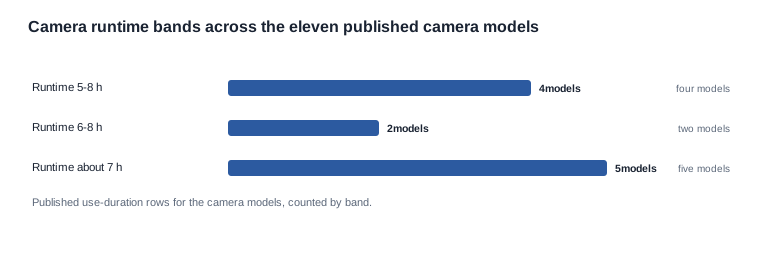
The rest of the sheet is unambiguous, and the useful move for a buyer is to separate the rows that can be quoted from the rows that cannot be quoted at all. Runtime is published for all eleven camera models: a five-to-eight-hour band on the S7 and the V03 Pro, and the V03 and the V06; a six-to-eight-hour band on the KY06 and the MT5; and roughly seven hours on the CY03 and the MT6, and the L2 Utral and the L1 Pro, and the CY05. Charge time is published for every entry in the range as a ceiling of two hours or less. Charging method is published for twenty-four of the twenty-eight entries and is published for none of four camera models: the CY03 and the MT6, and the CY05 and the L1 Pro each carry a case capacity instead — where the page carries a case capacity instead.
That last point has a direct consequence for this question. Four camera models publish a charging-case capacity without publishing a charging method, and the catalogue publishes no firmware version or update policy for any model. Behaviour that depends on software is versioned, and a claim recorded against an unversioned build cannot be re-checked when the next build lands. A sample programme that verifies recording behaviour must record the build identifier alongside the observation, because the catalogue will not supply it.
Why the default assumption is the expensive one
Compliance exposure lands on the channel, not on the factory
The party that carries regulatory exposure for a capture device in a store, a classroom or a workplace is the party that deploys it. A distributor that markets a camera product without knowing whether capture is continuous has sold a compliance problem to its own customers, and the documentation to resolve it will be requested from the distributor, not from the factory that built the box. In a retail or education deployment this becomes a notice, a signage and a consent question that someone has to answer in writing before the product reaches a shelf.
The asymmetry is what makes this a procurement issue rather than a product issue. The factory controls the hardware, but the party that selected the hardware for a deployment carries the duty in front of the customer. That is why the recording question belongs in the request schedule before the purchase order, while the decision is still reversible, rather than in the claim-set review after the first shipment.
The runtime figures cannot be reconciled with a recording claim
The published runtime is a rating, not a test record: the catalogue states a use-duration band without publishing the test condition behind it. A continuous capture is the dominant power draw on any camera device, and a claim of continuous capture therefore cannot be reconciled with a rated figure taken from the same datasheet, because the two describe different operating conditions. Nothing in the published material lets a buyer compute how long a unit records on a full charge, and no camera model publishes a storage capacity that would cap the recording length.
This is the reason a datasheet cannot answer the question, and it is also why a buyer should not be persuaded by a runtime figure presented as evidence. "About seven hours" on the L2 Utral and the CY05, the MT6 and the L1 Pro, and the CY03 is a number from the catalogue. It is not a number about recording, because the catalogue does not say what the device was doing during those hours.
Expectation mismatch becomes a returns and warranty problem
The second failure is quieter than the first. A listing that implies capture on demand, sold into a channel whose customers expect a device that always captures, produces returns that arrive without a technical fault — the unit behaves exactly as specified and still disappoints. Those returns consume reverse-logistics cost, they land in the defect statistics of a channel partner, and they sit against a warranty position the buyer has not yet defined. Any sample programme should therefore include a short script for end users that matches whatever the answer turns out to be, so that the behaviour and the description of the behaviour arrive together.
The five recording architectures a buyer has to be able to distinguish
Buyers who treat this as a binary — continuous or not continuous — end up making a claim that no published row supports, because the possible behaviours divide more finely than two. There are five patterns worth separating, and naming them is not about assigning one to a model; it is about making sure that whichever one turns out to be true is the one the request and the eventual listing both describe. The catalogue publishes no trigger row, so nothing here is a product statement; it is a taxonomy the buyer carries into the request.
Continuous loop capture. The device records without a user action, overwriting as storage fills. A buyer inheriting this pattern inherits three consequences at once: it is the least acceptable pattern for a deployment where people are present, it is the pattern most damaging to the runtime rating, and it makes the indicator question rather than a detail, because a capture that starts without any visible event has to announce itself or it is a privacy failure by construction.
Control-triggered capture. Recording starts and stops from a deliberate action. The critical sub-questions are reachability — whether the control can be operated while the unit is in use — and the indicator, because a trigger that produces no visible state creates both a user error and a consent problem. A listing can describe this pattern cleanly, provided the control is named and the indicator is described.
Event-triggered capture. The device starts on a signal such as motion or a voice keyword, and stops on a timeout. The published material says nothing about event detection, so the buyer has to establish whether the event triggers the recording, the camera, or something else, and what the timeout is. Timeout behaviour is where the operational cost sits: an event-triggered unit with a long timeout behaves like continuous capture for the purposes of consent, even though nobody pressed anything.
Segmented or scheduled capture. The device records in fixed intervals or on a schedule, and files are closed and opened on a boundary. This pattern is the friendliest to a data-handling process, because every file has a known start and end, but it is also the one most sensitive to clock configuration, and a unit with an unset clock produces files whose timestamps cannot be trusted. Ask what the file naming depends on.
Hybrid capture. More than one of the above is available, and the user selects. The decisive question here is what the unit does when the network is unavailable and when storage is exhausted, because a hybrid product can appear to work in a demonstration and fail in a deployment. A fallback that has been designed is a product decision with a cost attached to it, whereas a failure that stays silent turns into a support cost that surfaces later and cannot be planned for.
The pattern that catches out even careful buyers is the one where a capability runs over the local radio link and is then described as though it needed no network. The catalogue publishes a Bluetooth version for fourteen entries and for none of the eleven camera models, so for the camera tier there is not even a radio row to reason from — and where a radio row does exist, a published radio version describes the link between two nearby devices rather than a wide-area path. Any request schedule should carry the local-link question and the wide-area question as two lines, because a single merged line is what produces an offline claim no published row supports.
Building the sample acceptance test around the unknown
The verification method for an unpublished behaviour is a controlled observation, and the discipline is in deciding what must be fixed before the observation starts. What follows is the order that works for a procurement team running a first sample order, and it is deliberately written so that a result can be filed against a model string rather than against a feeling.
Freeze the configuration before the clock starts
Record four things before the unit is switched on: the model string, the configuration within that model, the firmware build identifier if one is displayed or retrievable, and the state of storage. Without those four, an observation is unusable later, because a buyer who cannot say which build produced a result cannot repeat it and cannot tell whether the next shipment behaves the same way. If the build identifier cannot be retrieved, that absence is itself a recordable fact and belongs in the file next to the observation.
The observation log that the datasheet cannot supply
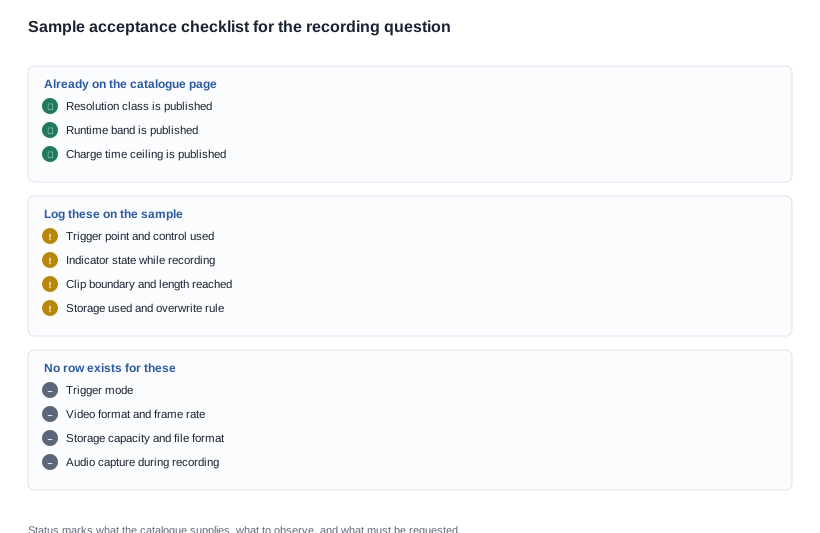
Then run the unit through a fixed script and write down what happens rather than what was expected. The script should cover at least: an idle period long enough to show whether capture starts on its own; a deliberate trigger, and how the trigger was reached; what is visible at the moment of capture and immediately after it stops; how long a single clip ran before it closed; what happened when storage was nearly full; and what the unit did when the wide-area link was removed. Each of these is an observation, and observations are usable evidence in a way that a verbal assurance is not.
Two rules make the log worth keeping. First, write the observation in the past tense with a timestamp, because a claim written later from memory drifts. Second, mark the items the catalogue already covers — resolution class, runtime band, charge-time ceiling — as confirmed from the published sheet, so that the log contains only what the sheet cannot supply and the file stays short enough to be read by the person who will make the claim decision.
What a result does not prove
A single sample proves the behaviour of that unit, on that build, under that configuration, on that day. It does not prove the behaviour of the production unit, and this is where a procurement file most often over-reaches. The correct claim after a successful observation names the configuration that was observed and the build it ran on, and it is written in a way that a later shipment can be checked against. A claim written as a general statement about the model is not supported by one sample, however convincing the sample is.
The request schedule that closes the recording question
Each of the unpublished fact is turned into a request that somebody owns, and every request below is worded so that a reply can be set beside a rival's reply. A request that quotes a named model produces an answer that cannot be lined up with a general enquiry about the range, and the basis on which two suppliers' replies are compared — model string, build, date, signature — should be fixed before the first request goes out, not after the answers start arriving in different formats.
- Trigger mode. Published: nothing; no trigger row appears for any of the eleven camera models. Not published: whether capture is continuous, control-triggered, event-triggered, segmented or hybrid, and which control or event starts it. Ask: for a named model and configuration, the trigger behaviour in one written sentence, and whether it can be configured off.
- Clip boundaries. Published: nothing; no clip-length row appears. Not published: the maximum clip length, whether a clip closes on a timer, on storage pressure, or on a button, and whether the unit records while a call or another capture is active. Ask: the clip rule for a named model, with the value or the behaviour stated plainly.
- Storage destination. Published: nothing; no storage capacity or file-format row appears for any camera model. Not published: whether footage is written to the device, streamed to an application, uploaded automatically, or any combination, and how much is retained. Ask: the storage path in writing for a named model, including the default upload behaviour and whether it can be disabled.
- Indicator behaviour. Published: nothing; the catalogue carries no indicator row for any camera model, and the only published rows for an indicator and button control belong to the AR entry rather than to the camera tier. Not published: whether any visible state accompanies an active capture. Ask: what a user or a bystander sees while capture is active, on a named model.
- Audio capture. Published: nothing; no row states whether audio accompanies the video. Not published: whether ambient sound is recorded, and whether a microphone indicator exists. Ask: the audio capture position for a named model, in writing, because the answer drives the consent wording.
- File format and transfer. Published: nothing; no format row appears. Not published: container and codec, file naming, and whether footage can be exported from the device without the companion application. Ask: the export path and the format, so a channel can decide whether its own tooling can handle the output.
- Update and build policy. Published: no firmware version and no update policy for any model. Not published: how the recording behaviour is delivered to units already in the field, and what a unit that misses an update does. Ask: the update route and the fallback behaviour for a unit left behind.
- Certification of the exact configuration. Published: the catalogue carries no per-model certification row and its text contains no reference to CE, FCC or RoHS. Not published: the certification scope of the specific configuration being ordered. Ask: the written compliance position for the named model and configuration, covering the radio-equipment rules of the European Union, cited as 2014/53/EU, alongside the electromagnetic-compatibility rules numbered 2014/32/EU where they apply.
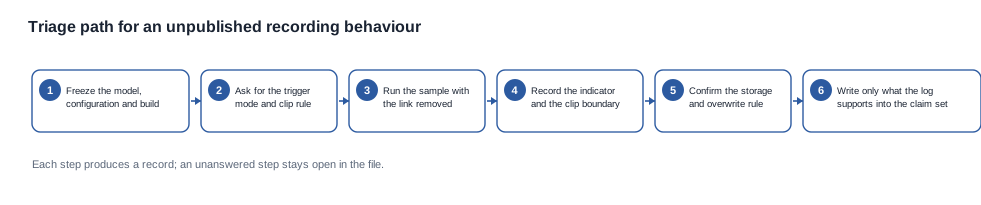
The order matters, because the order in which a request nobody has answered starts to cost money is not the sequence a buyer naturally asks them in. Trigger mode comes first because it decides which models enter the shortlist at all. Storage and indicator come next because they decide what the listing may say. Update policy follows, because it decides whether the claim stays true after the first shipment. Certification scope sits at the end, because it decides which markets the product may be sold into, and it is the request most likely to need a fresh answer for each destination.
Partial answers are worth more than they first appear and should be recorded rather than discarded. An answer that narrows the claim set — capture available only in a particular mode, or only while an application is connected — is still an answer: the product keeps its camera capability, and the listing now describes the behaviour that was actually verified. An answer that arrives as silence is a finding rather than a delay, and the right response is to strike the wording out of the claim set instead of carrying it forward on the expectation that a larger order will resolve it.
What a listing may claim once the answer arrives
The claim set follows the evidence, and the evidence after a completed request schedule has a known shape. A listing may state the resolution class, the runtime band, the charge-time ceiling, the charging method where one is published, the ingress marking on the V06 and the S7, the colour options on the V03 Pro and the V06, and the presence of a charging case where the catalogue publishes one. It may name the model and configuration that a recording behaviour was observed on, provided the build is named alongside it.
It may not state that the camera records continuously, that it records only on demand, that a visible indicator exists, that footage stays on the device, that no upload occurs, or that audio is not captured — not because any of those is impossible, but because the catalogue publishes no row that establishes any of them, and the direction of that negation is the point. The catalogue does not publish a recording requirement; that is not a statement that no requirement exists, but a statement that nobody has written one down, which puts a different weight on the omission for a buyer who has to stand behind the wording later for anyone who has to defend the wording in front of a channel partner.
The three-part structure of the answer is therefore the deliverable, not a preliminary to it. What is published can be quoted today. What is not published has a named request and a named owner. What should be asked has a written form that any supplier can answer without guessing. A sourcing file that holds those three columns is defensible; a sourcing file that holds a guess is not, and the difference between the two is a single question asked at the right point in the programme.
The criteria that tell a closed question from an open one
A sourcing team needs a way to tell a closed question from an open one, and the criteria below are what a due diligence file should apply before anyone writes the claim. How to choose between supplier answers comes down to whether an answer names a model string, a build and a date, because an answer that names none cannot be compared with any other answer and cannot be re-checked later. The questions to ask are the eight requests above, in the order given, and a supplier who answers them out of order has usually answered them without checking.
Two red flags recur in this category. The first is a behavioural description with no model string attached — it describes a product rather than a configuration, and it cannot survive a channel partner asking which unit was tested. The second is a confidence claim in place of a specification: an assurance that recording happens on demand is not what a procurement file can verify, and a buyer should treat it as a request that has been answered in the wrong format.
The total cost of an open question is easy to under-estimate and easy to calculate, because it is the sum of the claim wording that cannot be used, the sample cycles spent looking for a substitute evidence source, and the documentation burden that lands on the channel while the question stays open. Which model a buyer ends up with is therefore often decided by how cleanly the what to ask list can be answered, rather than by the hardware comparison, and the trade-offs between suppliers are usually trade-offs in documentation quality rather than in hardware. Before you order, evaluate that documentation quality against the same checklist for each candidate, assess whether the answers name configurations rather than ranges, and treat the common pitfalls as part of the product risk rather than as paperwork to be finished later. A shortlist built on that basis is a shortlist a buyer can defend.
The specification rows that the resolution class sits inside are collected in the AI camera glasses imaging notes, and the points where a supplier claim usually outruns the sheet are set out in what a camera datasheet leaves open. Incoming inspection steps that catch this class of gap early sit in camera glasses quality control checks, and the deployment questions this raises for staff-facing retail and education programmes are covered in privacy when deploying smart glasses.
Related reading
- The imaging specification rows that a resolution class belongs to — AI camera glasses imaging
- Where a camera datasheet stops and the request schedule begins — resolution options for camera glasses
- Incoming inspection steps for the claims a supplier makes — camera glasses quality checks
- The questions buyers ask most often about this tier — AI camera glasses common questions
- What a similar unanswered software question looks like elsewhere in the range — does the AI feature need internet
Send the model, the deployment environment and whether the listing will make a recording claim, and we will tell you which rows you can quote and which have to be requested.


