
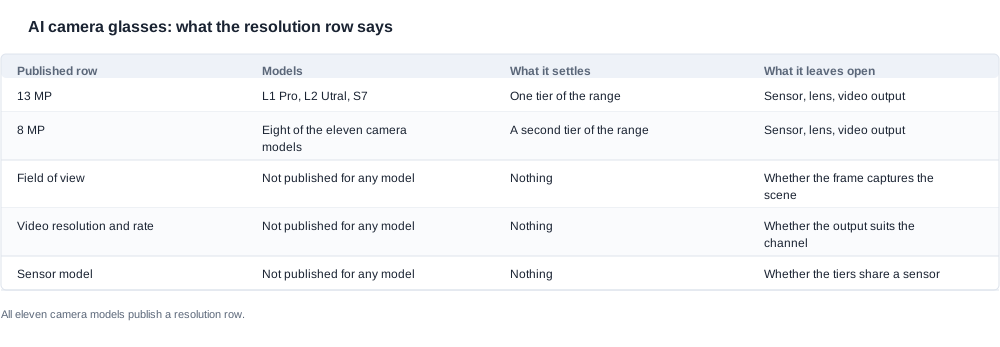
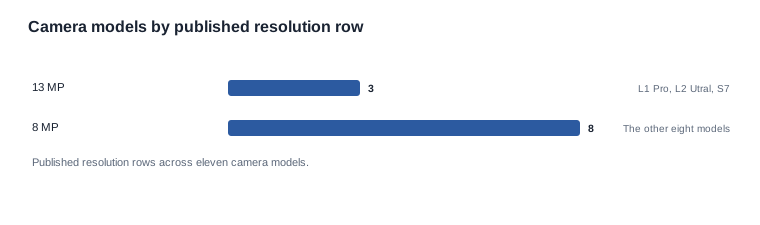
AI camera glasses resolution options reduce, in our published range, to two numbers: a 13 MP row and an 8 MP row. Three camera models publish the first — the S7 and the L2 Utral, and the L1 Pro — and the other eight publish the second. That is the complete resolution structure of the category as our documentation records it, and it is enough to sort a range, to write a comparison sheet and to decide which tier a channel requires. It is not enough to say how good a picture any of them takes, and the title's word "worth" is the place where that distinction has to be handled honestly: a resolution figure is worth exactly what the rows behind it are worth, and in this category most of those rows are unpublished. This article sets out what the resolution row settles, what it leaves open, and what a buyer should ask so that the gap becomes a closed question rather than a marketing assumption.
AI camera glasses resolution options: what the published row settles
A published specification row is a promise about a document, not a promise about a result. Read that way, the resolution row is unusually useful, because it does exactly one thing and does it unambiguously.
What it settles. The resolution tier of a named model. If a buyer has a channel that specifies a resolution figure, then the published row tells the buyer which models can be offered against that requirement and which cannot, without a conversation, a sample or a test. That is a shortlist operation, and it is the operation most buyers actually need.
What it leaves open. Almost everything that would convert the number into a quality claim. No sensor model is published for any model in the range. No field of view is published. No video resolution and no frame rate is published. No capture format, no lens specification and no aperture figure appears anywhere in the documentation. A resolution figure without a sensor behind it is a shelf argument, and the camera imaging notes cover why: two devices can publish the same pixel count and produce materially different images, because the sensor size, the lens and the processing determine more of the result than the count does.
What it therefore cannot do. It cannot support a comparative quality claim between a 13 MP model and an 8 MP model. It cannot support a claim about what a frame contains. It cannot support a claim about video, because no video output is published for any camera model. It cannot support a low-light or indoor claim, because nothing about light handling is published. What it can support is a specification claim: "this model publishes a 13 MP resolution row", which is checkable against a supplier sheet in a single question.
The distinction between those two statements is the whole of the practical argument, and it is worth holding onto because the two get mixed in supplier literature constantly. A specification claim narrows the range and can be acted on today. A quality claim expands the promise and cannot be defended until the underlying rows exist. Buying a range on the second kind of claim means buying on an assumption, and the assumption is the supplier's, not the buyer's.
There is a third thing the resolution row does that is less obvious, and it is the reason it belongs in a procurement file rather than only in a marketing brief. It is a control on substitutions. When a model designation is written onto a purchase order and the resolution row is written alongside it, a unit delivered against a different designation becomes visible at goods-in without any instrument and without any laboratory. That single use is often worth more than the tier itself, because a substitution that reaches the customer is a compliance problem and a substitution caught at the carton is a picking correction.
The two tiers and the models that publish them
The structure is clean enough to write down and use as a reference, and it is worth knowing precisely which model sits in which tier rather than approximately.
The 13 MP group. Three camera models publish a 13 MP resolution row: the L2 Utral and the S7, and the L1 Pro. These three also differ from one another in ways that matter more to a buyer than the resolution tier itself. The L1 Pro publishes a 290 mAh cell, a rated runtime of about seven hours, a charging-case capacity of 1400 mAh and no published charge interface. The L2 Utral publishes the same 290 mAh cell and the same about-seven-hour runtime, but it publishes a Type-C charging interface and a case capacity of 900 mAh or 1400 mAh. The S7 publishes a 260 mAh cell, a five-to-eight-hour runtime band, magnetic charging and no charging-case row, alongside an IP54 ingress rating and a removable inner frame.
The 8 MP group. The other eight camera models publish an 8 MP row: the V03 Pro and the MT6, the V03 and the V06, and the CY05 and the KY06, and the CY03 and the MT5. They divide by everything else. The V03 and the V03 Pro publish 220 mAh cells and five-to-eight-hour runtime bands, with magnetic charging on the V03 and a Type-C port on the V03 Pro. The KY06 publishes 260 mAh and a six-to-eight-hour band with magnetic charging and a case. The MT5 publishes 220 mAh and the same six-to-eight-hour band, also magnetic with a case. The L1 Pro and the CY05, and the CY03 publish 290 mAh and about seven hours, but the CY03 and the CY05 publish an 8 MP row. The MT6 publishes 265 mAh and about seven hours with a 1200 mAh folding case, and it is the only model in the range with a published mass, 158 g for the glasses body excluding that case. The V06 publishes 260 mAh, a five-to-eight-hour band and magnetic charging, with an IP54 rating and a removable inner frame.
Read the two tiers together and the important structural point appears: the resolution tier does not align with any other published row. A 13 MP model can carry a 290 mAh cell or a 260 mAh cell, can have a published case capacity or none, can have a Type-C port or magnetic charging, and can carry an ingress rating or not. The 8 MP group spans the same range of variation. A buyer who expected the resolution tier to be a shorthand for the whole specification would build a range on a false correlation, and the L1 Pro smart glasses specifications and features piece and the MT5 against V03 specification comparison piece both exist to show how two models in the same resolution tier can sit differently on every other row.
That is also the answer to the "worth" question in the title. What a resolution tier is worth to a buyer is a function of what else the buyer needs. If the requirement is a still image for a catalogue page, the tier narrows the candidates and the rest of the specification decides. If the requirement is a video stream, the resolution row is close to irrelevant, because no video output is published for any model and the buyer has to obtain that from the supplier before the tier means anything at all.
Why a resolution figure without a sensor is a shelf argument
The mechanism is worth spelling out, because it explains why the same number appears on very different products and why a buyer comparing two datasheets on that number is comparing two unknown quantities.
A pixel count describes the size of the output, not the quality of it. The variables that determine quality sit either side of the sensor: the lens determines how much light reaches it and how much of the scene fits inside the frame, and the sensor determines how that light is converted, how large the photosites are and how they behave at low light. The processor determines how the result is compressed and rendered. None of those variables is published for any model in this range, and the resolution figure is published for all of them. That is the definition of a figure with a denominator missing.
The practical consequence is that the same resolution figure can appear on a product that captures a wide scene and one that captures a narrow slice, and the narrow one will look like it is cropping the picture to a customer who was expecting the wide one. That is exactly the failure described in the quality-check material for this range: a frame that appears cut down reads to a customer as a fault and to a reviewer as a specification, and neither reading is right. The AI camera glasses competitor landscape piece covers how this argument is used commercially by others in the category, and the AI camera glasses quality checks piece covers the field-of-view consequence from the incoming-inspection side.
There is a second reason the shelf argument persists. The number is easy to compare and easy to remember, while the underlying variables are numerous, conditional and hard to summarise. A buyer working with limited time and a broad range will rationally compare on the one number that both suppliers have printed, and will discover later that the comparison was not meaningful. That is a process failure rather than a technical one, and it is prevented by asking a different question at the start: not "what resolution is this" but "what do I need the output to do, and which row expresses that".
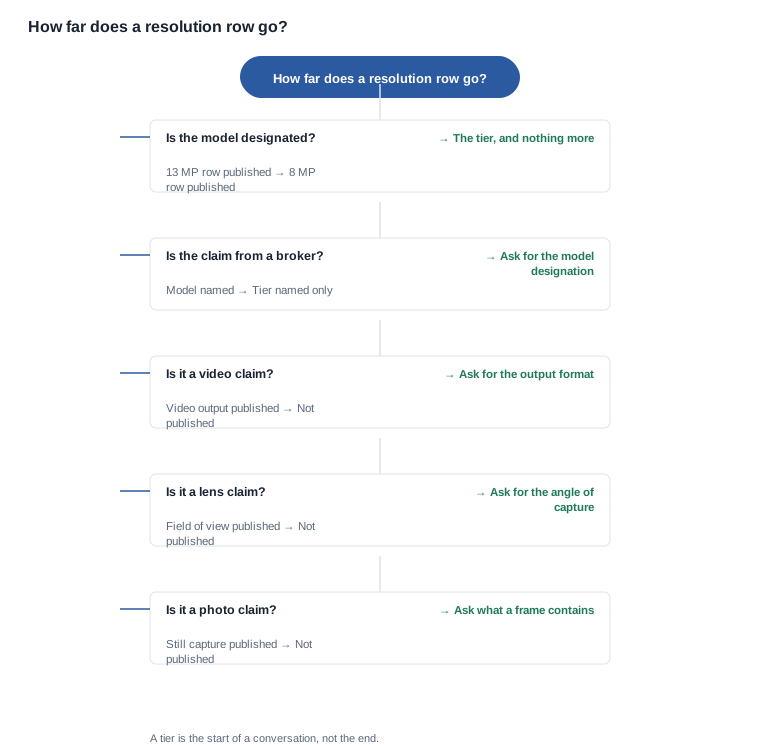
The rules that follow from this are simple to state. Quote the resolution figure with its model designation attached, never on its own. Never write a comparison sentence that ranks two models on the resolution row alone. Never let a resolution figure appear in a customer-facing claim without the wording narrowed to what the row supports. And when a claim needs a sensor, a field of view or a video format, treat it as an open item with a supplier question attached rather than as a detail to be assumed.

The questions a resolution claim forces a buyer to ask
A resolution claim is not a neutral piece of information; it is a trigger for a specific set of questions, and the questions are the same whoever made the claim. These are the questions to ask, and the order matters because the first two determine whether the rest are worth asking.
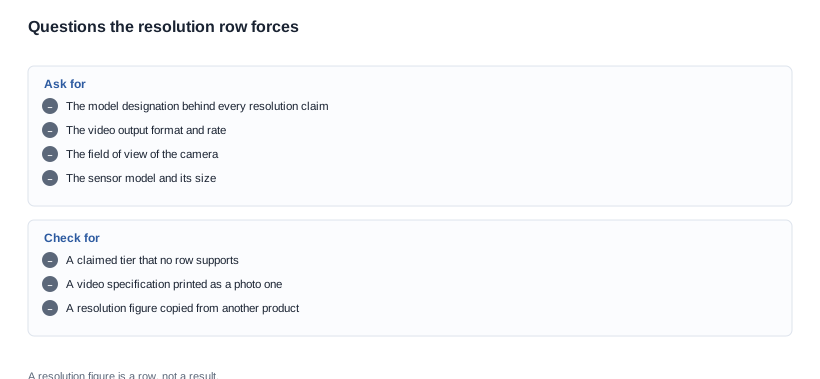
Is the model designated? Ask for the model designation behind the claim. A claim tied to a designation can be checked against the published row; a claim tied only to a tier cannot, because the tier contains several models with materially different electrical rows. This single question eliminates a large share of the claims a buyer will encounter, because a supplier claiming a tier without a model is claiming a configuration rather than a product.
Is the claim about a still capture or a video output? Ask which. The published row is a pixel count on a camera, and no video resolution and no frame rate is published for any model in the range. A supplier who answers "it records video" has answered a different question from the one the specification row covers, and the buyer needs to know which kind of output the requirement is actually about before any figure is meaningful.
What is the sensor model and its size? Ask for it, and treat a refusal to answer as an open item rather than as a reason to abandon the model. The sensor size is the variable that connects the pixel count to low-light behaviour and to the physical size of the imaging module.
What is the field of view? Ask for it with the condition stated, because a horizontal angle measured on a wide format and one measured on a cropped capture are not the same figure. If the supplier will not state it, the buyer has to plan a check on a sample with a reference object in frame, and that has to be written down before the sample arrives.
What does a frame actually contain? Ask for a sample frame under stated conditions. This is the only question that closes the gap between a specification and an expectation, and it is cheap compared with the cost of shipping a range that produces frames nobody expected.
What is the actual output format and size? Ask what the file looks like when it leaves the device, because a capture that stops at a storage limit or is cut to a shorter duration changes what the channel receives without the hardware changing at all.
The question to ask when the answers are incomplete is the same in every case: write the gap down, attach an owner to it, and decide whether the requirement can be met without it. A buyer who does that is not blocked. A buyer who assumes the value is the one most likely to be blocked, because the assumption will not survive an audit.
How a resolution tier should and should not be used in a range
There is a legitimate use for a resolution tier in a range and an illegitimate one, and they are easy to distinguish by asking what the tier is doing.
The legitimate use is filtering. A channel that specifies a minimum resolution figure produces a shortlist immediately, and the shortlist is defensible because every model in it publishes the required row. This is the AI camera glasses which model to pick style of decision, and it is the one the published rows support without help.
The illegitimate use is positioning. A tier is used to imply that the models above it are better, and the implication is unfounded because the models above it differ from the models below in every direction at once: a 13 MP model can have a smaller cell and a shorter runtime band than an 8 MP model, and can lack the charging case and the ingress rating that its neighbour has. A tier built on resolution therefore says nothing coherent about the range as a whole, and a buyer who builds a ladder on it will produce a ladder that is hard to explain to a channel.
The third use is the one that causes the most damage: using the tier as the primary differentiator in the listing. Where a range leads on resolution, the buyer is leading on the one published row that does not correspond to a capability, and the listing copy will have to escalate into capability language that the file does not support. Where that happens, the requirement was probably not a resolution requirement in the first place, and the more useful question is the one that was skipped.
There is a constructive alternative worth putting in place. Instead of a resolution ladder, build the range on the rows where the published structure actually divides the models, which are the accessory position, the charge interface and the rated runtime band. Those three rows correspond to real, checkable differences that a channel can be told about and a customer can experience. The resolution figure then becomes a specification line inside each model rather than the organising idea of the range, which is both more honest and a better selling position, because a range organised on what the models actually do is much easier to describe than a range organised on a pixel count.
The AI camera glasses charging case options piece and the AI camera glasses battery comparison piece cover two of those three rows, and the AI camera glasses buying guide piece covers how the shortlist is built before any of them is discussed with a supplier.
What we publish about resolution, and what we do not
On AI camera glasses resolution options, our position is that the resolution row is a usable specification and an unusable quality claim, and that the two should not be allowed to blur into each other in a buying file. We publish the resolution tier for all eleven camera models — 13 MP for the S7 and the L2 Utral, and the L1 Pro, and 8 MP for the other eight — together with the electrical rows that let a buyer see what separates models inside a tier. We do not publish a sensor model, a field of view, a video resolution, a frame rate, a capture format or a lens specification, because the documentation does not contain them for any model in the range, and because a figure we cannot source is a figure we cannot defend when a channel partner or a customer asks.
The practical instruction follows directly. Use the resolution row to narrow the range and to write specifications. Ask a supplier for the sensor, the field of view and the output format, and treat each answer as a reference to be recorded rather than as a fact to be assumed. Where a requirement genuinely depends on one of those unpublished rows, the honest position is that the requirement is not yet settled, and the right action is a sample protocol written down in advance — not a listing sentence built on a number that describes the output size and nothing else.
Send us the output your channel needs, the models you are considering and the destination markets, and we will tell you which published resolution rows apply to each of them and which of the questions above have to go to the supplier before the requirement is settled.
Related reading
- How the range decision is made — AI camera glasses buying guide
- One 13 MP model in detail — L1 Pro smart glasses specifications and features
- Two models in the same tier — MT5 against V03 specification comparison
- The rows that divide models properly — AI camera glasses battery comparison
- The accessory position — AI camera glasses charging case options
- Why the figure is a shelf argument — camera imaging
- The same argument elsewhere — AI camera glasses competitor landscape


