
AI camera glasses common questions cluster into a small number of families, and the answer to almost all of them has the same three-part shape: what the catalogue publishes, what the catalogue does not publish, and what a buyer should ask a supplier in writing to close the gap. That structure is more useful than a set of answers, because it tells a procurement team which rows can be relied on today and which ones have to become a specification request before an order is placed.
This article works through the questions we are asked most often about our camera range. The catalogue publishes eleven camera models — the L2 Utral, the KY06 and the V06, the MT5, the CY03 and the MT6, the CY05, the V03 Pro and the L1 Pro, the S7 and the V03 — and every answer below is tied either to one of those published rows or to a question we ask a factory on your behalf. Nothing here is an estimate, and where the catalogue is silent we say so rather than filling the space.
AI camera glasses common questions: what the published sheet settles
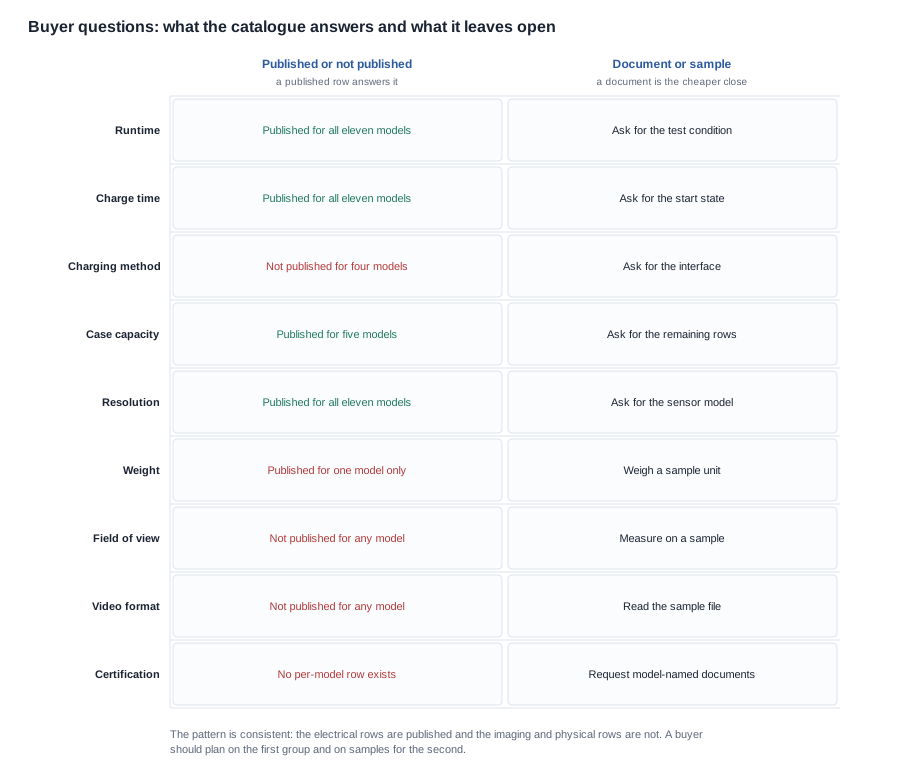
The single most useful thing a buyer can do before contacting any supplier is separate the catalogue into three parts: rows that are published for every model, rows that are published for some models, and rows that are not published at all. Almost every "common question" disappears once a question is placed in the right part.
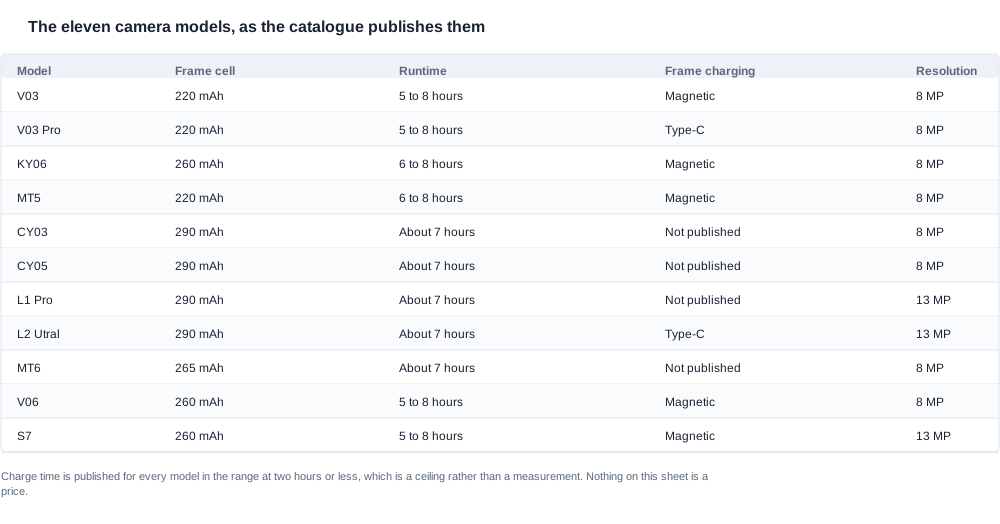
Published for all eleven camera models: the frame cell capacity, the rated runtime, the charge time and the camera resolution tier. These four rows exist for every model in the range, which means they can be compared across the range, against another supplier's sheet, and used to build a shortlist without asking anybody a question.
Published for some models: the charging method, the charging case status and the ingress marking. The charging method is published for seven of the eleven camera models and is absent for four — the L1 Pro and the CY05, and the CY03 and the MT6. The case capacity is published for five models. The IP54 marking appears on the V06 and the S7 and on no other camera model in the range.
Not published for any camera model: the sensor model, the field of view, the video resolution and frame rate, the storage arrangement and transfer path, the touch-control configuration, the frame-only weight, and every certification number. There is also no UN 38.3 summary, and the catalogue text contains no reference to CE, FCC or RoHS.
That three-part split is the answer to the question buyers ask most often, which is how much of this category can be decided before a sample is ordered. The answer is: the electrical and resolution rows can, and the imaging and physical rows cannot.
The questions the published rows answer completely
How many camera models are there, and how do they group? Eleven camera models in the range. They group on the published frame cell: 220 mAh carries the MT5 and the V03, and the V03 Pro; 260 mAh carries the S7 and the V06, and the KY06; 265 mAh carries the MT6 on its own; 290 mAh carries the CY03 and the L2 Utral, and the L1 Pro and the CY05. The tier is the platform, and the platform is what shares the app, the firmware, the accessory family and the documentation scope. The product range overview maps the wider range and the model readiness overview covers where the sharing is actually documented.
What is the resolution split? Eight models publish 8 MP — the CY05 and the KY06, the V06 and the MT5, and the V03 and the MT6, and the V03 Pro and the CY03. Three models publish 13 MP — the L1 Pro and the L2 Utral, and the S7. It is a two-tier structure rather than a spread, and it is the resolution argument a buyer can act on without any further information. The L2 Utral best-for analysis covers what the upper tier is worth commercially, and the camera imaging notes cover why a megapixel figure is a shelf argument rather than a quality one until a sensor model and a field of view are in hand.
What is the runtime? Published for every model in the range, and the published values differ: five to eight hours on the V06 and the V03, and the V03 Pro and the S7; six to eight hours on the KY06 and the MT5; about seven hours on the L2 Utral and the CY03, and the L1 Pro and the CY05, and the MT6. Two readings are worth avoiding. The first is treating a five-to-eight-hour range as a floor — the catalogue publishes a band, not a guarantee. The second is reading about seven hours as "a working day" on a product page, because the published figure carries no test load, no screen state and no ambient temperature.
What is the charge time? Published for every model in the range at two hours or less. That is a ceiling, not a measurement: it is the upper bound the catalogue states, and it comes without a starting state, a termination rule or a charger rating. A buyer who needs to know how long a unit is out of action between shifts has to ask for the test protocol, because the published figure cannot answer it.
How should a buyer use these rows in a supplier meeting? The four rows that are published for every model are the right basis for a due diligence comparison, because they can be compared against another supplier's sheet without any qualification. The useful discipline is to put the same four rows on a single sheet for every supplier, in the same order, before any conversation about a unit price. Two things go wrong when that order is reversed. The first is that a published row and a quoted term get compared to each other, which is a comparison between a fact and an offer and tells you nothing. The second is that the model names drift during the meeting — a supplier says "the Pro", a buyer hears "the Pro", and one of them is thinking of the V03 Pro and the other of the V03. Fixing the designation at the start of the comparison is the cheapest risk control available, and it is the criterion on which the rest of the shortlist depends.
Is a charging case published for every model? No, and this is the question with the most states behind it. Five camera models publish a case capacity — the CY05 and the CY03, and the L1 Pro — each at 1400 mAh, the L2 Utral at 900 or 1400 mAh, and the MT6 in a 1200 mAh foldable case. Two models ship a case with no published capacity, which are the KY06 and the MT5. Four models have no case row at all, which are the S7 and the V03, and the V06 and the V03 Pro, and none of them is published as shipping without a case. The silence there is a question for the supplier, and it is the same question for all four. The charging case options analysis sets out what each of those states does to the parcel and to the freight file.
The questions the published rows do not answer
These are the questions where a buyer should expect to run a test or to ask a factory, and where the honest answer is that the catalogue has not published the conclusion.
What camera is inside the unit? No sensor model, no field of view, no video resolution, no frame rate, no aperture and no stabilisation figure is published for any camera model in this range. The resolution tier is published, and it is a tier rather than a camera. This is the gap that matters most in the category, because the image quality argument a listing makes is an argument the buyer cannot support from any published row.
What does the unit weigh? One figure is published in the entire catalogue: 158 g for the MT6 glasses unit, which includes the battery and the camera and excludes the foldable charging case. No other model publishes a weight, and no model publishes a bare frame weight, so the MT6 figure cannot be borrowed as a typical value for the range. The shipping weight breakdown covers how to establish the number, and the weight comparison across the range explains why the published figure cannot be used as a substitute for the others.
Does the unit record continuously, and where does the file go? The storage arrangement is not published for any model — capacity, container format and the overwrite behaviour when storage fills. Neither is the transfer path from the unit to a phone. Both are ordinary questions with ordinary answers, and both are the kind of gap that a returns desk attributes to a fault when it is really an expectation. The AI camera glasses troubleshooting order treats storage exhaustion as the first check for exactly that reason.
Is there an ingress rating? The V06 and the S7 carry an IP54 marking, with no test report number attached to it in the source, and no other camera model carries a published marking. A marking without a report is a claim to verify rather than a rating to print, and the second digit describes protection against splashing water from any direction rather than immersion. The IP rating testing notes set out the question to put to a laboratory, and the sport water resistance analysis covers what the marking does and does not permit.
What documentation exists for the model I am buying? The catalogue carries a company-level export certification page whose content is images rather than text — ten patent certificates, of which eight are appearance-design patents and two are utility-model patents — and the catalogue text contains no reference to CE, FCC or RoHS. There is no per-model certification row, no certificate number and no UN 38.3 summary for any camera model. The catalogue does not publish the conclusion on this question; the answer has to come from the supplier, per model and per market.
What is the price, the minimum order and the lead time? The catalogue publishes none of them for any camera model. These are quotation items, and the right way to handle them is in the RFQ, where they can be compared and negotiated, rather than in a catalogue table where they cannot. The AI camera glasses price comparison covers the commercial side and the AI camera glasses buying guide covers the category decision that precedes it.
What are the red flags in an answer to any of these questions? Three patterns account for most of the trouble, and all three are visible before an order is placed if the criteria are written down first. The first is an answer that widens in scope: a question about one model produces a statement about the range. Ask again, naming the model, and see whether the answer narrows. The second is a number with no condition attached — a runtime without a test load, a charge time without a starting state, a capacity without a configuration. Numbers without conditions are not comparable, and a comparison built on them fails later rather than sooner. The third is an answer that arrives only after a sample has been paid for. A supplier who can answer a specification question in writing before the sample is a supplier whose file will be useful; a supplier who cannot is telling you that the documentation will not be better after the money has moved.
There is a fourth, quieter, pattern: the trade-off is offered without being stated. "We can do that configuration with the larger case" is a trade-off between the case and the parcel, and it should be recorded as one. The way to handle trade-offs is to write both sides on the same line — what the option gives the customer, what it costs in freight, packaging and documentation — and then let the channel decide which side is worth more. A buyer who notices the trade-off is a buyer who can negotiate it; a buyer who does not will discover it in the freight invoice.
Turning a buyer question into a written specification request
The most common reason a camera glasses programme stalls is not a bad product or a bad supplier. It is a question that stayed a question. "What is the field of view?" is not actionable; "the recorded footage from the sample must frame a walk-through with the wearer and a door frame in the same frame, measured against the reference photograph agreed at the start" is actionable, and it can be accepted or rejected.
The conversion has five steps and they are worth following in order, because each one prevents a different failure.
Write the question as a measurable statement. "How good is the battery?" cannot be accepted or rejected. "The unit must complete a stated session of stated length with no interruption" can. The discipline is the same whether the question is about framing, clip length, transfer time or packed weight.
Split it into the published part and the open part. If a row exists in the catalogue, the published value is the starting point and the open part is only what the row does not cover — the test condition, the measurement method, the configuration. If no row exists, the whole question is open and belongs to the supplier or to a sample test.
Ask the supplier for the open part in writing, naming the exact model. A question sent to a general enquiry address gets a general answer. A question that names the model designation and asks for a number gets a specific one, and the difference in response time is usually what makes the difference in programme time.
Where no written answer exists, run a fixed test on the sample and record the result as your own measurement. The protocol needs a written pass condition, and the result needs to be kept, because it becomes the reference for judging a later lot. This is where the IP rating testing notes pattern applies to every unpublished row in the category.
Attach the protocol to the purchase order as an acceptance condition. A criterion that lives in an email thread is not a criterion that an inspector will apply. A criterion that names the test protocol, the value that counts as a pass and the consequence of a lot that misses it becomes a comparison rather than an argument.
There is a sequencing point here that decides whether the process is cheap or expensive. The questions to ask for the specifications that the catalogue publishes should be asked once, at the start, against every model in the shortlist, because those answers are free and they narrow the field. The questions to ask for the specifications the catalogue does not publish are per-model and are worth asking only for the models that survive. When a buyer sends one long questionnaire to every supplier covering every unpublished row, the replies are slow, the answers are shallow, and the buyer ends up comparing four long documents instead of four shortlists. The better sequence is to narrow on the published rows first, then to ask the hard questions about two or three models, and to ask the questions to ask in a form that a supplier can answer with a number rather than with a paragraph.

What we can and cannot confirm before a sample arrives
We will tell you exactly which of our own documentation supports a claim and which does not, and we would rather say "the catalogue has not published this" than offer a figure we cannot evidence.
We publish the electrical rows and the resolution tier for every camera model, so any claim about cell capacity, runtime, charge time or megapixel tier can be traced to a published row on the model you are buying. We publish the charging method for seven of the eleven and the case capacity for five, so a claim about the in-box contents can be traced for some models and has to be requested for the rest. We publish one weight in the whole catalogue — 158 g for the MT6 glasses unit, excluding its foldable case — and we publish the IP54 marking on the V06 and the S7 with no report number behind it, because no report number has been confirmed to us.
What we will not do is present a megapixel tier as an image quality claim without a sensor model, present the IP54 marking as a tested rating, present a runtime figure as a working day, present a company-level export certification page as a model-level certificate, or quote a weight, a case capacity, a sensor, a certificate number or a price that our documentation does not contain. We publish no MOQ, no lead time, no production capacity, no warranty period and no unit price for any camera model, and we will not estimate them.
The practical test of any supplier in this category is therefore simple to state: ask how to verify the claim, and see whether the answer is a number, a document or a gesture. "How to verify" is the question that separates the suppliers who can be shortlisted from the ones who can only be described. A number can be checked against a register, a document can be read and filed, and a gesture cannot be checked at all. When to press and when to accept a partial answer is a judgement a buyer makes with the channel in mind: a channel that will be audited annually needs the document, and a channel with a short lifecycle can sometimes work from a measured sample if the measurement is written down and attached to the order.
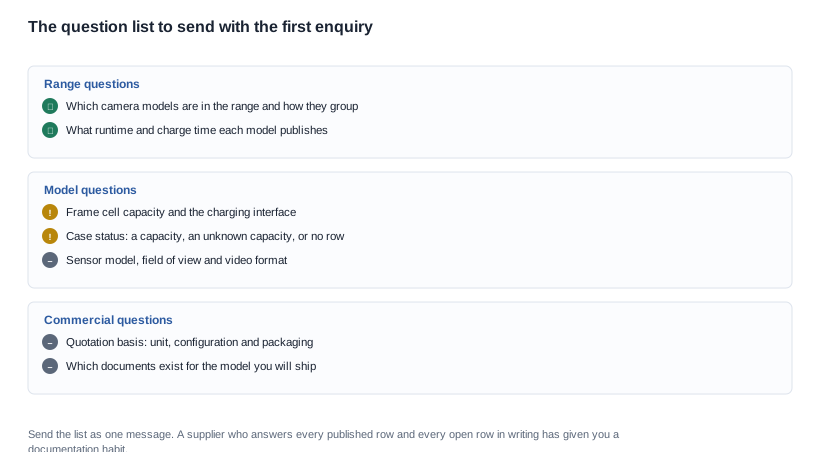
The list below is the practical version of the article. It is a specification request rather than a feature request, and it is what we would send a factory ourselves.
- The camera specification, closed once per platform rather than per order.
- The frame cell capacity, the charging interface and the case status for every model you intend to list.
- A measured packed unit weight for the configuration you will actually ship.
- The ingress evidence for the two models that carry a marking.
- The endurance test condition, asked identically of every supplier so the answers can be compared.
- The documentation position, model by model and market by market.
If you are working through this list, send us the models you are shortlisting and the markets you intend to serve. We will tell you which of these answers our documentation can give today, which need a sample and a written protocol, and which need a factory. The range is at AI camera glasses.
Related reading
- The range-level decision — AI camera glasses buying guide
- The platform structure — OEM ready platforms which models are ready
- The cost drivers — AI camera glasses price comparison
Send us the models you are shortlisting and the markets, and we will tell you which of these answers our documentation can give and which need a sample.


