

AI camera glasses quality checks fail in a predictable way: a check sheet built around a laboratory function test passes most of the units that later come back, because the failures that reach a customer are not laboratory failures. They are a unit in the wrong colour, a case that does not match the configuration ordered, a unit whose charge interface is not the one the channel stocked, a designation that does not match the documents, or a camera that stops recording because it reached a storage limit the documentation never explains. The checks that catch those are documentary and packaging checks, and they can be built directly from published rows. This article sets out which published rows a check sheet can rest on, which checks cannot be closed on receipt at all, and how to design an inspection whose numbers are worth arguing a warranty claim with. We do not publish a defect rate, a yield figure or an inspection result, because our documentation does not contain them.
AI camera glasses quality checks: what can actually be verified on receipt
An incoming inspection is only worth running if its result can change a decision. If every check passes and nothing changes, the check sheet is documentation theatre; the value of a check is that a failure tells you what to do next. So the first question to ask when reviewing any quality sheet is what happens when this line fails, and if the answer is "raise it with the supplier" without a named action, a threshold and a timeline, the line is not yet a check.
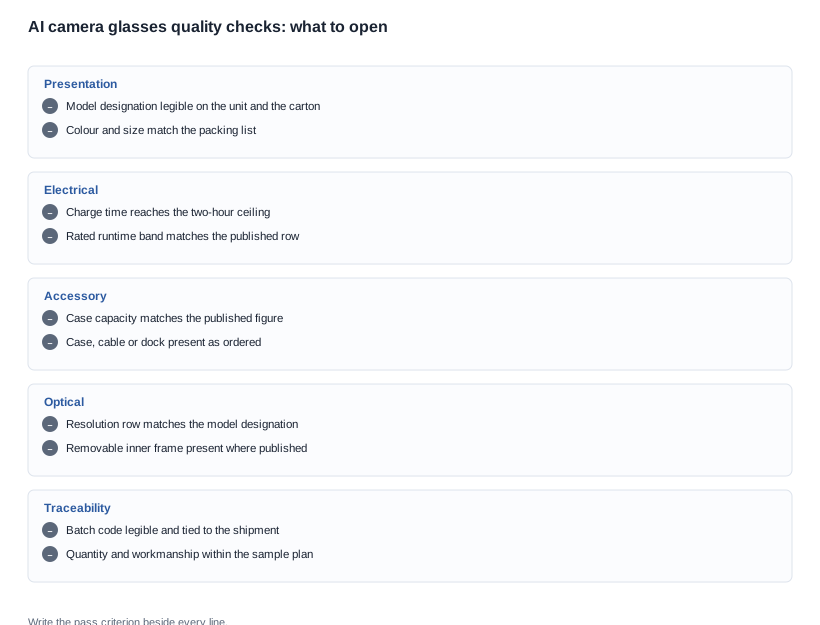
That principle reframes the sheet. The checks worth running on a camera-glasses shipment are the ones whose failure is visible at goods-in and expensive later. They fall into five groups.
Identification. The model designation has to be legible on the unit and on the carton, and it has to match the designation on the purchase order and on the documents that accompany the goods. This is the highest-value check in the sheet, because it is the only one that catches a substitution directly, and a substitution is invisible in every functional test. Our catalogue names eleven camera models — the MT6, the MT5 and the KY06, the V06, the CY05 and the L2 Utral, the V03 Pro, the S7 and the CY03, the V03 and the L1 Pro — and each of those strings is what the packing list, the carton and the file should carry.
The accessory and packaging set. What was ordered has to be in the box: the charging case where a case ships, the cable or the dock matching the published interface position, and the printed material in the language the market requires. This check is cheap and it catches a large share of the complaints that a channel receives as "it does not work", because a unit that arrived without its dock is not a defective unit, it is a mis-shipped one.
The electrical rows. The charge time and the rated runtime are published for every camera model, which means they are testable against a stated criterion rather than against an impression. Charge time is published as two hours or less across the camera range, and it is a ceiling rather than a measured cycle, so the test is whether a unit charges within that ceiling, not whether it charges in some specific number of minutes.
The optical and structural rows. The resolution tier is published per model, and two models in the range publish a removable inner frame, so both are checkable without instruments. Nothing in the range publishes a sensor model, a field of view, a capture format or a frame rate, so no check can be written against those, and no check should pretend otherwise.
Traceability. The batch code has to be legible on the unit and on the carton and has to tie to the shipment. This is the item most often assumed rather than checked, and it is the one a recall depends on entirely, because a recall that cannot be traced to a batch is a recall of everything.

Notice what is absent from that list, and the absence is the point: no sensor comparison, no imaging benchmark, no lens measurement, no frame-rate test, no certification-mark inspection. Those are not useful checks in this category, because the reference values do not exist to compare against, and because a mark on a carton is not a document.
The published rows a check sheet can be built from
Here is the complete set of rows our catalogue publishes for the eleven camera models, expressed as they appear on a check sheet, together with how each one is tested and what a failure of that line tells you.
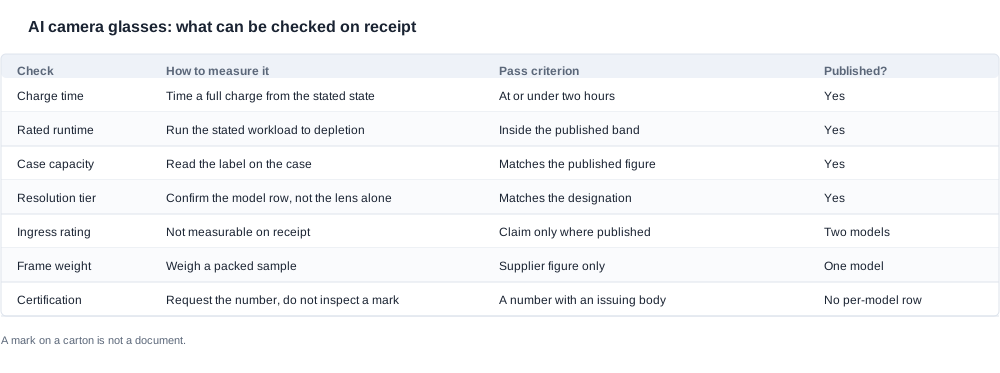
Charge time. Published as two hours or less for every camera model. The test is a timed charge from a stated starting state, and the criterion is that the unit reaches its published ceiling within the agreed conditions. Two cautions apply. The published figure is a ceiling rather than a precise cycle, so a unit that charges in ninety minutes is not a defect and a unit that charges in two hours and ten minutes is. And the published figure carries no starting state or completion criterion of its own, so those two have to be fixed in the check sheet before the first reading, otherwise the result is not comparable with the next lot.
Rated runtime. Published for every camera model in three bands: five to eight hours for the S7 and the V03 Pro, and the V03 and the V06; six to eight hours for the KY06 and the MT5; and about seven hours for the CY05 and the MT6, and the CY03 and the L1 Pro, and the L2 Utral. The test is a runtime run under a stated workload. The criterion is that the unit finishes inside the published band for its model. This is the check that most reliably separates a genuine cell problem from a unit that was simply used differently than the rating assumed, and it is worth the time it takes.
Charging-case capacity. Published for five camera models: the CY03 and the CY05, and the L1 Pro — each at 1400 mAh, the L2 Utral at 900 mAh or 1400 mAh, and the MT6 at 1200 mAh in a folding case. The test is reading the label on the case. The criterion is that it matches the published figure for the model ordered. This is a configuration check disguised as an electrical one, and it is one of the most productive lines in the sheet because the two capacities on the L2 Utral are easy to confuse in a picking list.
Charge interface. Published for seven camera models: magnetic charging on the V06 and the KY06, and the S7 and the V03, and the MT5, and a Type-C port on the V03 Pro and the L2 Utral. Four camera models publish no interface at all — the L1 Pro and the CY03, and the MT6 and the CY05 — and for those four the interface has to be confirmed by the supplier and written onto the check sheet as a stated reference rather than a published one. The test is that the unit matches what the channel has stocked.
Resolution tier. Published as 13 MP for the S7 and the L2 Utral, and the L1 Pro, and 8 MP for the other eight camera models. The test is that the model designation on the unit corresponds to the published row. A buyer should be clear that this verifies the model, not the imaging performance: no sensor model, lens, field of view or capture format is published for any model, so a check sheet cannot carry an imaging criterion without a supplier reference behind it. The camera imaging notes cover why a resolution figure is a shelf argument rather than a performance result.
Ingress rating. Published at IP54 for the V06 and the S7 only, and for no other model in the range. There is no test for this on receipt, and there should not be one; what the row supports is a claims check on the carton, the insert and the listing, ensuring that no wording asserts dust or water behaviour for the nine camera models that publish nothing.
Mass. Published at 158 g for the MT6 glasses body, excluding its folding charging case, and for no other model. There is nothing to inspect here; the row exists so that a buyer knows exactly which figure exists and what it excludes.
That is the whole of the checkable set. It is shorter than most check sheets in this category, and that is the point: a sheet of twenty lines where ten cannot be closed is a sheet that gets skipped under delivery pressure.
Where the check sheet has to record an open item instead of a result
Some of the most valuable lines on a check sheet are lines that record the absence of a reference rather than the presence of a pass. A sheet that contains only passes tells the reader nothing about what was not measurable, and a warranty conversation six months later will turn on exactly those unmeasurable items.
Storage behaviour. No camera model in the range publishes a storage rule — not a capacity, not a limit, not the behaviour when a limit is reached. This matters more than it sounds, because a camera that stops recording when its storage fills presents identically to a camera with a fault. A support team with no published rule has no reference for what normal behaviour is, and will either replace units that were working correctly or accept a fault claim it cannot refute. The resolution is to obtain the behaviour from the supplier in writing and put it on the check sheet as a reference line, and then to decide deliberately whether it also goes into the product documentation.
Reset and recovery sequences. No camera model publishes a reset procedure. A recovery sequence is a support-cost item: it decides how many units come back to the factory and how many are resolved on a call, and it belongs in the manual rather than in the knowledge of one support agent. Asking the supplier for it is one line in an email and it changes the size of the returns pile.
Weight and packaging figures. No packed weight, no carton dimension and no master carton figure is published for any model. These are measured, not inspected, and the measurement belongs to the shipment rather than to the unit — which is why the AI camera glasses bulk ordering piece covers where the packed measurement sits in a production sequence, and the AI camera glasses shipping weight piece covers why the catalogue cannot supply it.
Certification documents. There is no per-model certification row in our catalogue; the company-level export certification page carries images rather than text, and the catalogue text contains no reference to CE, FCC or RoHS. A check sheet therefore cannot verify certification at goods-in. What it can do is record the document reference against each shipment, so that the question "does this file cover this unit" has an answer on the sheet rather than in someone's memory. The export documentation checklist piece covers the markings that cannot change.
Recording these as open items has a second benefit that a buyer only appreciates later: a sheet that lists the gaps is a specification of what to ask the supplier before the next order, and the list grows shorter each time it is acted on.

How to design the inspection so the numbers mean something
A check sheet produces numbers, and numbers only mean something if the sample plan and the acceptance rule were written before the first unit was opened. Four design decisions determine whether an inspection result can be used. The failure rate that matters commercially is the one you can defend, and a rate you cannot defend is not usable in a negotiation, a claim or a channel review. The checklist below is what turns a sheet of observations into a number with a denominator behind it.
Decide the sample before you start. Whether the inspection examines every unit or a defined sample is a decision about where the defect sits. A presentation or packaging defect is visible on the outside and is found by looking at units; an electrical or imaging defect may be distributed through the lot and is found by testing units. The rule that generalises is that whatever you sample, the sample must be able to detect the failure class you care about, and the failure classes are not equally detectable. A sample that checks only the carton of a lot with a known charge-interface problem will not find the problem.
State what one failure means. "Non-conforming" is not a rule. Does one failure stop the shipment, trigger a second sample, or get recorded and allowed through? The acceptance rule has to be written before the first reading, because a rule written afterwards is a rule that has already been missed. This is where the kids smart glasses quality checks piece and the sport smart glasses quality checks piece cover the same structure for different product types, and where the sport fit and sizing analysis piece explains why the size and interchangeability questions dominate a returns problem in one category but not in this one.
Keep the results. A check sheet without retained results is an event, not a system. What a buyer needs after three orders is a failure rate with a denominator: units received, units inspected, units failed, by batch code, by failure class. That is the only artefact that lets a buyer argue a warranty claim, and it is also the only artefact that lets a buyer tell a real quality change from ordinary variation. The OEM ready warranty setup piece covers why the failure list has to exist before the first order rather than after it.
Separate what the supplier owns from what the channel owns. The questions to ask before you order a programme are worth putting in one list, and they are shorter than a buyer expects: which lines are verified before dispatch and which on arrival; what the sample size is per shipment; what one failure of each class does; which reference values the supplier will supply in writing; and who keeps the retained results. Those five answers determine whether the inspection is a control or an observation, and they are the answers a buyer should ask when comparing two suppliers on quality rather than on unit price.
The inspection can be split into a supplier-side check performed before dispatch and a channel-side check on arrival, and the two should not be the same list. The supplier can measure a packed sample on the line; the channel can only open what arrives. Where a line sits on both sides, state that it is verified twice and on what basis, or the two results will disagree and neither will be usable.

What a defect classification should settle before the first order
The last piece of the quality system is the classification of what a failure means, and it is the piece that connects the inspection to the commercial agreement. A sheet that counts failures without a classification produces a number that cannot be acted on.
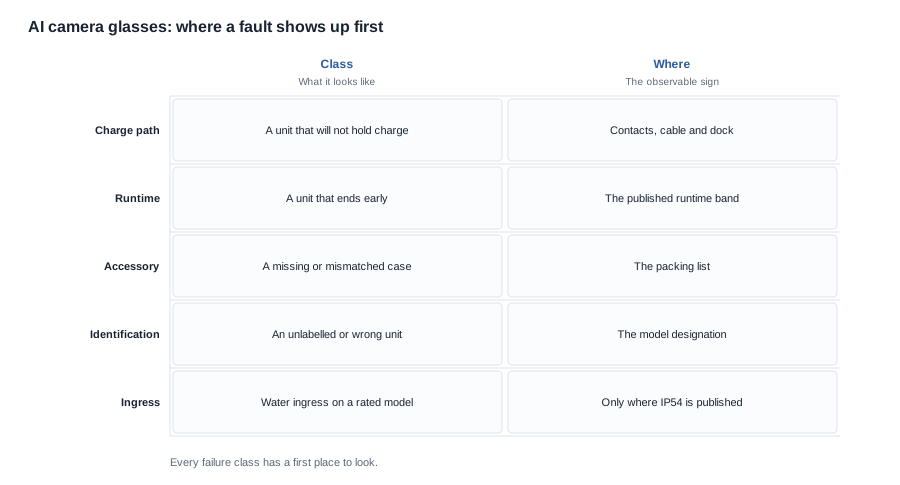
Four classes cover most of what a camera-glasses programme produces, and the classes are distinguished by cause rather than by symptom.
Identification defects — wrong designation, missing or unreadable marking, wrong colour against the packing list. The cause is a picking or labelling problem. The remedy is at goods-in, before the carton leaves the warehouse, and the effect if it is missed is that the unit cannot be matched to its documentation.
Configuration defects — a case that does not match the configuration, an accessory that does not match the published interface, an insert in the wrong language. The cause is the programme's configuration count exceeding what the operation tracks. The remedy is a configuration check against the published rows, and the prevention is the change-control clause discussed elsewhere in this category.
Accessory and contact defects — a unit that will not take a charge on the interface the channel stocked. The cause is the contact or the accessory rather than the electronics. The remedy is a charge-path test on the interface, and the effect is a support call from a customer who believes the product is broken.
Function and endurance defects — a unit that does not record, or that ends its run well inside the published runtime band. The cause is the cell, the camera or the electronics. These are the defects that belong in the warranty agreement, and they are the ones the inspection can only characterise rather than diagnose, which is why the runtime band and the published reference for the storage behaviour are the two most valuable documents a buyer can hold.
The classification should also settle the escalation path and the timeframe for each class, and it is the right place to negotiate rather than the wrong one to discover. A defect class with no written escalation path will be handled the way the loudest return happens to be handled that week, and the total cost of that inconsistency lands on the warranty line of a contract that never mentioned it. Where the supplier is willing to commit to a classification, a threshold and a response time, that is a due diligence answer and it belongs in the agreement rather than in a separate side letter.
because the cost of each class differs by an order of magnitude. A mis-shipped case is a picking correction. An endurance failure is a batch question that may involve a larger population of units than the one in front of you. And the AI camera glasses troubleshooting piece covers the order in which a support team should work through a returned unit, because the cheap checks should come first.
A first-shipment quality walkthrough, and our published position
The following is a hypothetical walkthrough, written to show the decision sequence rather than to report a result from a client project.
Assume a distributor taking delivery of a first shipment of camera glasses into a two-country channel. The distributor has no quality staff and intends to inspect every carton and a sample of units, with a target of getting the units onto the shelf inside a week.
The distributor's first step is to write the acceptance rule before the shipment arrives, and to split the sheet into a supplier-side section and a channel-side section. The supplier-side section covers the packed measurement on a scale, the master carton dimensions and quantity, and a batch code applied before dispatch. The channel-side section covers the carton and unit designation, the accessory set, the charge interface, the case label, the printed material and the language.
The second step is to turn the published rows into criteria. The distributor writes the charge ceiling and the runtime band per model onto the sheet, and for the four camera models that publish no charge interface, it records the interface confirmed by the supplier as a stated reference. For the storage behaviour and the reset sequence, it adds a line that reads "reference pending" rather than omitting them, which makes the two open items visible on the document that travels with the programme.
The third step is to decide the sample. Because the known risk in this shipment is accessory and configuration error rather than a distributed electronics fault, the distributor samples units rather than cartons for the electrical checks, and inspects every carton for presentation. It also decides in advance that a single identification failure stops the shipment, because a substitution is the one defect class that cannot be caught downstream.
The fourth step is to retain the results against the batch code, and to agree with the supplier that the batch code is applied before dispatch rather than on arrival, so that a fault found in the second shipment can be traced back to a production window.
The result is a short sheet, a clear acceptance rule, two named open items and a rate that will still be usable in a warranty conversation a year later.
On AI camera glasses quality checks, our position is that the failure rate in this category is decided by identification, configuration and accessory handling rather than by the electronics, and that a check sheet written around laboratory function testing will pass most of the units that come back. We publish the electrical rows, the resolution tiers, the case capacities, the interface positions, the ingress rating for the two models that carry one, and the mass for the single model that carries it. We do not publish a defect rate, a yield figure, a sensor model, a field of view, a capture format, a frame rate, a storage rule, a reset procedure, a packed weight or a certificate number, because the documentation does not contain them, and a check sheet built on invented references is worse than one with named gaps. The AI camera glasses quality checks set out the same ground in full.
The trade-offs are worth naming plainly, because they are real: a longer inspection catches more defect classes and adds handling cost; a shorter one accepts more downstream cost; a written reference from a supplier closes a gap and adds a dependency on that supplier staying in the programme. None of those trade-offs is resolved by inspecting harder, and all of them are resolved by deciding what the inspection is for. Before you order a first shipment, decide whether the inspection exists to release goods into stock or to build the record you will need later, because a sheet built for the first purpose will not produce the second.
Send us the model designations, the configurations and the destination markets, and we will tell you which published rows each configuration can be checked against and which lines will have to be recorded as open items until a supplier supplies the reference.
Related reading
- The troubleshooting order — AI camera glasses troubleshooting
- The production sequence — AI camera glasses bulk ordering
- Building the support agreement — OEM ready platforms warranty setup
- The markings that cannot change — OEM ready platforms export documentation
- The comparable structure for another category — kids smart glasses quality checks
- The comparable structure for a sport category — sport smart glasses quality checks


