

The G07 and the D11 are the one genuinely distinct pair inside the audio range, because they do not differ on the same dimension the way the other near-twins do. The G07 is a two-cell, magnetically charged frame with an ultra-slim detachable temple. The D11 is a single-cell, Type-C charged frame with a published surround-sound descriptor and no accessory row. A price gap between them should therefore follow one of those two stories — serviceability and shape on one side, parcel simplicity on the other — and should not follow the endurance figures, which were not taken under one protocol and cannot carry a commercial decision.
What a buyer needs from a supplier is narrower than a recommendation. We do not publish unit prices, so this page does not tell you which model costs less or which tier to launch first. It tells you which published rows each model can defend, which rows neither can, and what has to be attached to a quotation so that a price gap survives review by a finance team, a channel manager and a compliance lead.
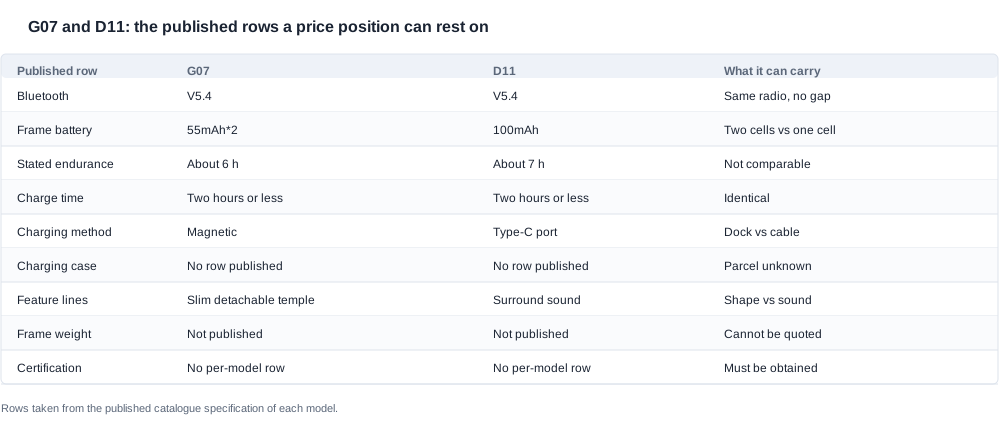
G07 and D11: the two claims a price gap can rest on
The published rows, and what each one can carry
Two models are only comparable once you know which rows are doing the work. These are the rows our catalogue publishes for both of them, and the honest limit of each.
| Published row | G07 | D11 | What it can carry in a price position |
|---|---|---|---|
| Bluetooth version | V5.4 | V5.4 | The same radio, so no compatibility argument can be built here |
| Frame battery | 55mAh*2 | 100mAh | Two cells against one — an architecture difference, not a size difference |
| Stated endurance | About 6 h | About 7 h | Not comparable across the range; unusable as a price argument |
| Charge time | Two hours or less | Two hours or less | Identical, so it cannot separate the tiers |
| Charging method | Magnetic | Type-C port | A dock in the parcel against a cable |
| Charging case | No row published | No row published | Neither parcel cost can be planned from the catalogue |
| Published feature lines | Slim and detachable temple | Surround sound, long endurance | Shape and service against two audio labels |
| Frame weight | Not published | Not published | Neither model can be quoted on weight |
| Certification numbers | Not published | Not published | Neither model can be quoted on certification |
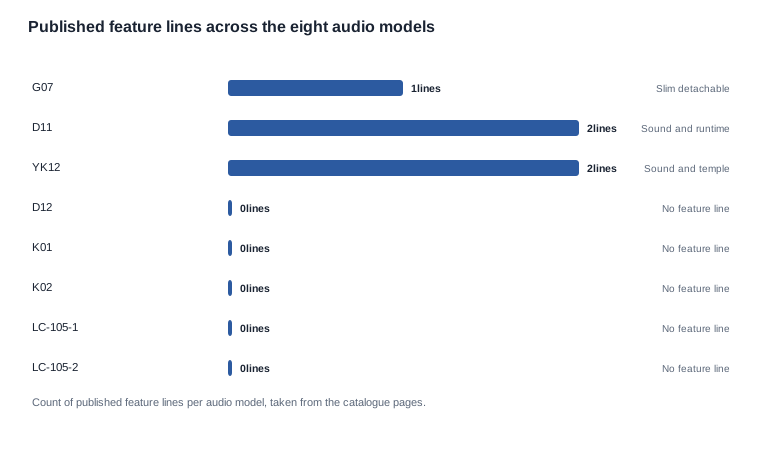
The claim the G07 can carry
The G07's distinguishing published row is a detachable, ultra-slim temple, and it is worth separating the two things that row actually buys a brand.
The first is serviceability. In an open-ear frame the temple is the part exposed to impact, to being sat on, and to being caught in a bag strap. When the temple detaches, a damaged arm becomes a replacement part rather than a written-off unit, and a distributor handling returns can stock spares instead of scrapping the whole product. That is a measurable change to returns cost per unit, and it gives a channel a reason to prefer one model over another that it can actually defend.
The second is recognition. A category where most frames look alike gets differentiated by packaging and by a sticker, and a competitor can copy both within a week. A visibly different silhouette is the one shelf differentiator that travels with the product itself.
What the G07's row does not buy is a quantified advantage. The catalogue publishes no weight for the G07, so the ultra-slim description has no number behind it, and the design argument has to be made on what a buyer can see rather than on a measurement nobody has published. The row is real; the figure that would substantiate it is absent.
The claim the D11 can carry
The D11's story is about simplicity and about what arrives in the box. It publishes a single 100 mAh cell rather than a pair, charges over a Type-C port, and therefore does not imply a charging dock in the parcel. It also publishes a surround-sound descriptor and a long-endurance descriptor, which gives a product page two features to write about.
For a brand whose channel is a marketplace listing with a tight specification block, the D11's published rows are unusually clean: one cell, one interface, one cable, one radio version. There is no dock to bundle, no second configuration to explain, and no accessory to photograph.
The weakness is that the same cleanliness leaves little to differentiate on. The surround-sound row is a label rather than an acoustic specification — no driver size, no frequency response, no microphone pickup figure is published — and the long-endurance descriptor sits beside an endurance figure that has no test condition attached to it. The charging case capacity, which is what would let a buyer model the parcel, is not published for the D11 either.
The claims neither model can carry
Three claims are unavailable to both, and they are the three that most often appear in a comparison written by someone who has not seen the catalogue.
Weight. Neither model publishes a frame weight. A tier cannot be positioned on lightness without a figure. The only weight published anywhere in our catalogue belongs to a different platform — the MT6 at 158 g, which is the weight of that camera model's eyewear body including its battery and its camera and excluding its foldable charging case, and which cannot stand in for an audio frame.
Case capacity and packed weight. Neither the G07 nor the D11 publishes a charging-case row. A freight model, a carton plan and a per-unit landed cost cannot be built from the catalogue on this pair.
Certification. What our catalogue holds for export certification is one page at company level, and it holds pictures rather than typed text; the catalogue text names no CE, FCC or RoHS, and no model-level certification row is published anywhere. Any destination-market certification position for the G07 or the D11 is a document you have to obtain, not a line you can cite.

Where the range documentation stops and the negotiation begins
Endurance figures are not comparable across this range
The G07 rates about six hours and the D11 about seven, on different architectures with different cell counts. That gap invites a straightforward reading — more energy, more time — and the reading is tempting because it happens to point in the direction a price ladder would like.
It does not survive contact with the rest of the range. The same 55mAh*2 twin-cell configuration appears on the LC-105 pair, which publishes about eight hours, while the G07 and the YK12 publish about six on the same cell size. A two-hour spread on an identical published cell configuration means the figures were not taken under one protocol, so the difference between the G07's six and the D11's seven tells you about the measurement rather than about the product.
Exclude the endurance row from the price argument. If endurance has to be a priced differentiator, the route to it is to require a stated test condition from the supplier for each model — the same condition, in the same words — and only then compare. That request is one line in an email and it is the highest-value question in this comparison.
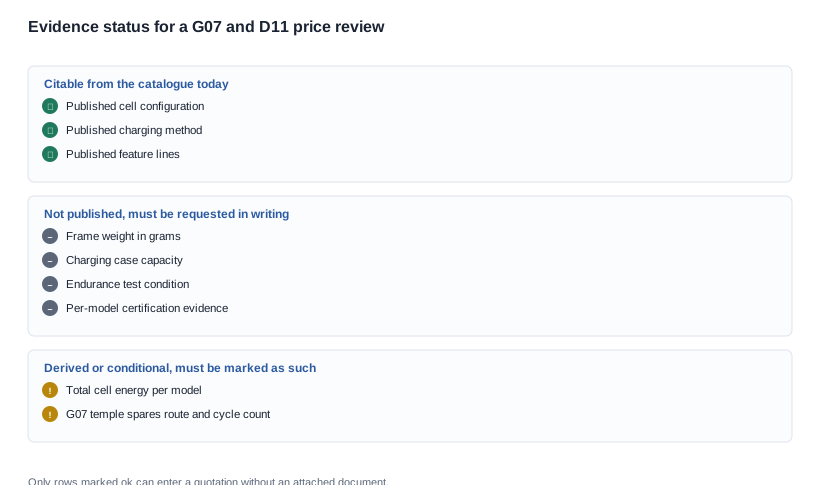
The rows that reach the customer
Two of the published differences are invisible on a specification table and very visible in a delivered unit.
The charging method is one. A magnetically charged frame implies a dock in the parcel for anyone who wants to charge away from a socket, and a dock is a second object that has to be described, packed, counted and priced into the carton. A Type-C frame implies a cable. Whether a dock ships with the G07, what it costs, and whether a channel can sell it as a volume accessory are all open questions, and they belong in the quotation rather than in marketing copy.
The frame treatment is the other. A detachable temple implies a spares business — replacement temples have to be orderable, stocked, priced and eventually manufactured. The cycle count of the joint, the connector design and the replacement route are not published for the G07, and all three determine whether a repair promise is a promise or a slogan.
What to write into a quotation so the gap survives review
A price gap between two models fails review when the supporting claim is a preference. It survives when the claim is a documented row plus an attached document. Three lines belong in the quotation for each model:
- The configuration and the published rows that apply to it — the cell configuration, the charging method, the radio version and the published feature rows, each quoted as it appears in the catalogue.
- The condition attached to any endurance figure — either the agreed test condition, or an explicit statement that no condition has been agreed and that the figure will not be used as a differentiator.
- The open items, named — weight, case capacity, packed unit weight, certification position per market, and the temple spares route for the G07. A named open item is a procurement action. An unnamed one is a dispute waiting to happen at inspection.


Negotiating the G07 and D11 gap: what each side can be asked to cover
The G07 side asks for a spares business, not a discount
The G07's commercially distinctive claim is serviceability, and a serviceability claim costs money to honour. Before that claim is priced into a tier, three numbers have to exist, and none of them is published: how many times the temple joint survives a cycle test, what a replacement temple costs at your quantity, and how long the supplier will hold spares available. A brand that lists a repair promise without those three numbers is committing to a cost it has not sized.
That changes what the negotiation is about. You are not negotiating a discount on a frame; you are negotiating a standing order for parts, a lead time on those parts, and a stated replacement price that a channel can put on an after-sales page. A G07 tier that carries a genuine spares arrangement is worth more than a G07 tier without one, and the difference between those two is larger than any unit-price movement a buyer is likely to chase.
The D11 side asks for something simpler and cheaper: a clean single-box proposition with no dock to explain. The negotiating priorities there are packaging efficiency and the minimum order quantity on the accessory set, because a dock that has to be counted, stocked and shipped with every unit is a working capital cost that does not appear in the unit price at all.
Which terms move, and which do not
There is a set of terms that respond to volume and to how the order is structured, and a set that is fixed by the process rather than by the negotiation.
Terms that respond to the order structure. Unit price at volume tiers, the split of a first order across delivery dates, the accessory set and its own minimum order quantities, packaging specification, payment nodes tied to inspection rather than to dispatch, the warranty period with a stated response time, and the terms of a pilot order. These move with volume and with the confidence a buyer is willing to show.
Terms fixed by the process. Certification cost and its timeline, which follow the testing body rather than the negotiation. Tooling, which is frequently amortised across an initial order while certification cost sits per product family — ask which of the two you are being quoted, because the two are often bundled into a single line that hides which is which.
The line that is fixed for the G07 but not for the D11. A dock is an accessory for the magnetically charged frame and a cable is not, so the accessory position is structurally different between the two models. That is a design decision that reaches the landed cost, and it should be priced as a structural difference rather than discovered later as an operational surprise.
What belongs in the agreement
Five items should be written into the agreement for this pair, and each one is a published row or a document reference rather than a general intention:
- The published rows of the exact configuration ordered, referenced to the catalogue page rather than restated in prose.
- The endurance figure and its test condition, or the explicit statement that the figure carries no condition and will not be used to differentiate.
- The G07 temple arrangement — detachability, cycle count, replacement route and replacement price — where the G07 is in scope.
- The charging method and the accessory set that ships in the carton, with the packed unit weight to be confirmed at inspection.
- The warranty period with a stated response, and the returns process for a damaged temple where the G07 is in scope.
What should be left out of the agreement, because it cannot be supported, is any weight figure, any case capacity, any certification number, and any endurance claim without its condition.
The verification sequence, in the order that wastes the least time
Verification on this pair is cheap if it runs in the right order and expensive if it runs in the wrong one.
Start with the two documents that settle the comparison — the endurance test condition for each model, asked in identical words in the same message, and the charging case and packed unit weight for each. Both are single requests and both change what the rest of the evaluation is worth.
Then weigh and measure samples of both. Frame weight, temple length, lens width, bridge width. This is the row that predicts a return rate, it is absent on both sides of the comparison, and it is the cheapest item on any list.
Then test the temple joint on the G07 — cycle it to a stated count, confirm the connector survives, and confirm that a replacement temple can actually be ordered. A detachable temple without a replacement route is a design feature with a service problem attached.
Then settle certification per model per market, in writing, because the catalogue carries no per-model certification row for either of them.
Only then fix the price gap. Every one of the earlier steps either changes a number or changes a claim. Doing the price conversation first means doing it twice.
Five failure modes this comparison produces
The endurance figure set the price. Symptom: the model with the longer quoted figure was given the higher tier, and the field result does not match the table. Root cause: a figure with no condition was treated as a comparable measurement. Prevention: set the row aside until the conditions are documented, and require the condition in writing if endurance is central to the proposition.
The ultra-slim description was read as a weight. Symptom: a listing implies a lightweight product, returns arrive, and the channel carries the cost. Root cause: a design word was read as a measurement. Prevention: weigh the samples and quote your own figure, or quote no weight at all.
The dock was discovered after the order. Symptom: the packed weight and the freight class were wrong, and the landed cost moved after the price was agreed. Root cause: the accessory set was never quoted as part of the configuration. Prevention: ask for the charging method, the case question and the packed unit weight in the same request as the unit price.
The detachable temple was sold as a repair promise. Symptom: a damaged arm cannot be replaced at the stated price, and the channel absorbs it. Root cause: user-replaceable and factory-only were never distinguished. Prevention: ask the cycle count, the connector and the replacement route, and price the answer.
The certification position was assumed from the company page. Symptom: a market-access file is opened late and the shipment waits. Root cause: a company-level export certification page was read as a per-model guarantee. Prevention: request per-model certification evidence for the destinations in scope, and treat the absence of a catalogue row as an open item.

How we price the G07 against the D11, and what we will not claim
These two models should be sold on their respective stories rather than presented as a two-option specification range, and any price gap between them should follow a claim the buyer can verify from a document. We will not present the surround-sound descriptor as an acoustic specification, we will not present either endurance figure as a working day, and we will not quote a weight, a case capacity or a certificate number that our documentation does not contain.
We also do not publish unit prices, so we will not tell you which tier is cheaper. What we will do is narrow the decision to the rows that matter for your channel and name the evidence still outstanding for each of them. The published G07 specification list and the published D11 specification list are the honest baselines for the two models, the audio range charging options piece covers what the charging method does to a parcel, and the battery comparison method covers the endurance condition in detail.
Six questions to close before the price gap is agreed
- The endurance test condition for each model, asked in identical words.
- The charging case capacity for each, and whether a dock exists for the D11 or a cable is the only in-box item.
- Frame weight and dimensions for both, measured on samples.
- The G07 detachable mechanism: cycle count, connector design and replacement route.
- The acoustic and microphone specification for the D11, and for the G07.
- The certification position for each model in each destination market.
Related reading
- The published rows for the G07 — G07 smart glasses specifications and features
- The published rows for the D11 — D11 smart glasses specifications and features
- The accessory numbers — Bluetooth audio glasses charging options
- Choosing across the wider range — Bluetooth audio glasses which model to pick
Send us the channel, the two price bands and the markets, and we will tell you which claim each tier should be sold on.


