

An open-ear audio product has two supply chains, and a sample session only shows you one of them at a time. The output chain is what the wearer receives: the driver, the acoustic opening in the frame, and the level that escapes into the room. The input chain is what the far end of a call receives: the microphone, the sound path around it, and the noise that competes with the wearer's voice. A product can be excellent on one chain and unusable on the other, and the sample will usually show you the better one. So test them separately, write two pass lines, and remember that the output chain decides what your listing is allowed to say while the input chain decides whether the product can be sold for calls at all. If you are qualifying a supplier, the four figures you need from them are a leakage level at a stated distance, a first-attempt intelligibility rate at a stated noise level, a runtime under a condition you wrote down, and a seal result across more than one head.
Open ear audio glasses: two chains, one sample
The ninety-minute sample session and the two results inside it
Testing an open-ear audio product on a sample unit takes about ninety minutes and produces four numbers that a procurement file can actually use. The reason a sample is not a formality in this category is that the published specification does not contain the fields that decide the purchase. There is no leakage figure, no microphone specification, no runtime test condition, and no frame weight for any model in the range. What is published per model is the Bluetooth version, the cell configuration, the charging interface, the rated runtime, the charge time and the structural features — which is a good set of rows for a catalogue and a useless set of rows for a purchase decision.
The rule that makes the session worth running is that every result has to be written down with its conditions, because a comparison without conditions is not a comparison.
The reader here is a brand product manager, a sourcing buyer or a channel buyer with a sample on the desk and a decision to make. The specific difficulty is that the sample will sound fine, because a sample is tested by one person in a quiet room, and the customer will use it in a street. The buyer's task is to convert a positive impression into an acceptance criteria set that a colleague could re-run, and to separate the two results that matter commercially — whether the far end of a call can hear the wearer, and whether the device is private enough to be sold as if it were.
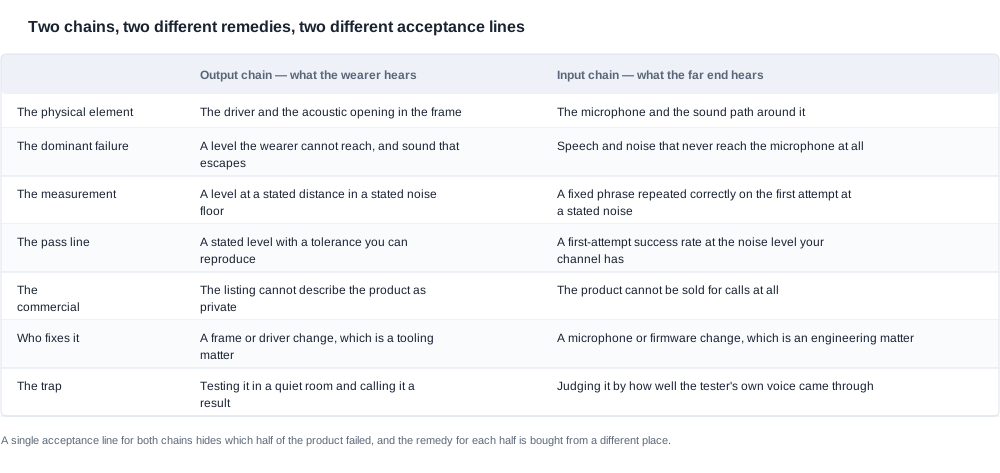
The table above is the whole argument of this article in one grid. The two chains fail for different reasons, they need different measurements, their pass lines look nothing alike, and — this is the part that matters commercially — the remedy for each is bought from a different place. A driver or frame problem is a tooling matter. A microphone or firmware problem is an engineering matter. A buyer who writes one acceptance line for both has guaranteed that the failure will be argued about as a single issue, and it will be argued about as a single issue because the contract does not have two lines in it.
Why leakage is a copy decision before it is an acoustic one
Leakage is the measurement with the largest commercial consequence in this category and the one most often skipped. It is also the measurement that determines what the listing copy is allowed to say, so it has to happen before the copy is written rather than after the first complaint arrives.
The reason it is skipped is that it is awkward. It requires a stated distance, a stated noise floor, a stated volume setting, and a device to measure with — and a buyer without a sound meter substitutes a subjective judgement, which is exactly the kind of result that cannot be used in a contract or defended to a platform reviewer. A subjective "it seems loud" is a feeling about one session. A level with its conditions attached is a specification.
The second reason it gets skipped is a confusion that is worth naming explicitly. Leakage and the output level are different quantities, and they move in opposite directions on the same hardware. A louder output escapes the frame more. A well-sealed frame leaks less at the same output. A product can therefore have a high output and a low leak, or a low output and a high leak, and the two numbers are set by different design decisions. A buyer who measures one and assumes the other will draw a conclusion the product does not support, and that is the failure mode that produces a listing which promises privacy and a customer who says they can hear it across a café.
The practical rule is that the leakage figure and the output figure have to be taken together, at the same volume setting, in the same session, and both have to carry their conditions.
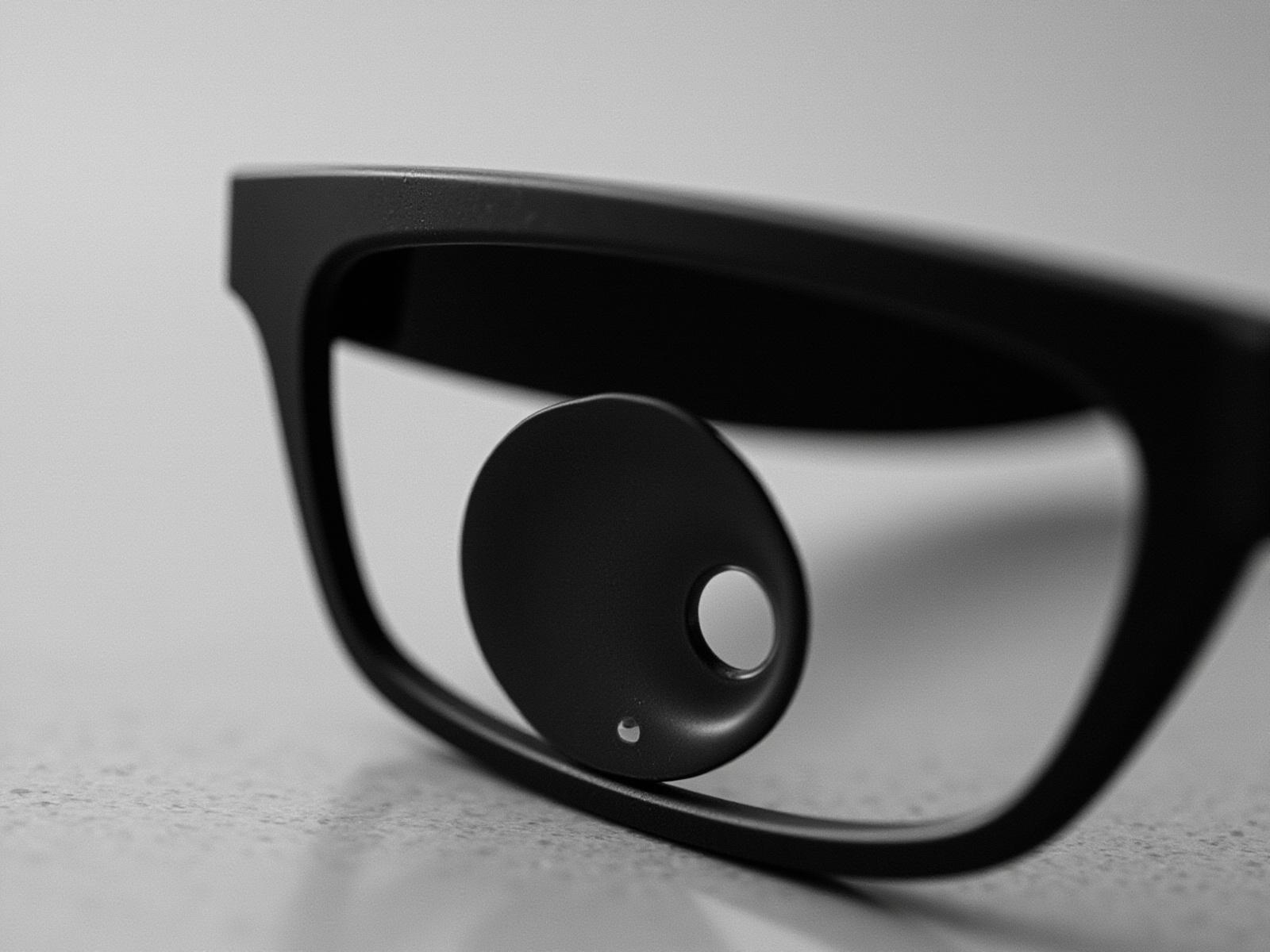
The buying task: splitting a call into two separate acceptances
The input path and the seal
The call test is split by direction, because the two paths fail for different reasons and because a single-session test that does not split them produces a result nobody can act on.
For the output path, check the level the wearer receives across more than one head, for a full working day, with both the level and the seal checked at the end of it. The seal varies across face shapes, and it determines both the level the wearer receives and the leakage — which means a single-head test measures the tester rather than the product. For the input path, run the same fixed phrase in a quiet room and then at a defined background level, and judge the result on whether the far end repeats the phrase on the first attempt. Every microphone works in a quiet room, so the quiet-room result is a sanity check and the noisy-room result is the decision.
The fit and seal test is the one buyers tend to compress, and it is the one that produces the late complaints. The complaint that matters in this category arrives after weeks, because the first few hours are comfortable for almost any frame and the pressure only establishes itself once the wearer has stopped thinking about the device. A full working day is the shortest test that can reveal it.
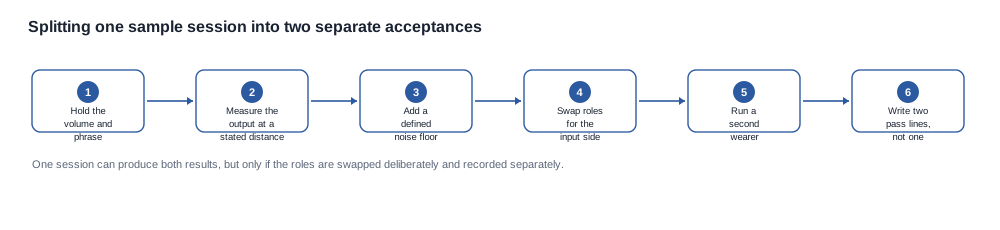
The six steps in that flow are the whole session, and the deliberate part is step four. A single session can produce both results, but only if the roles are swapped explicitly and recorded separately, and only if the same phrase, the same volume and the same distance are held constant across the swap. A test where the tester speaks and then listens produces two anecdotes rather than one measurement.
What the session has to produce, and in what order
Step one fixes the setup. The volume level, the distance, the background noise level, the phrase, the number of attempts and the receiving device. A test whose conditions are chosen after the results are visible is a test whose results will be argued about.
Step two measures the output. The level at the stated distance, in the stated noise floor, at the stated volume setting, on more than one head.
Step three adds a defined noise floor. The quiet room is a reference point, not a result. The figure that matters is the one taken at the noise level the channel actually has.
Step four swaps the roles for the input side. The same fixed phrase, the same device, the far end's first-attempt success recorded rather than the tester's impression.
Step five repeats on a second head. One head is one head, and the seal across face shapes is a variable the buyer is buying whether or not they know it.
Step six writes two pass lines, not one. A level with its tolerance, and a first-attempt success rate at a named noise level. Two lines means two remedies, two owners, and two items in the purchase order.
The output chain, and the thresholds that decide what the listing may say
The output side: what to fix when the wearer cannot hear
The output side is the half that the buyer can measure without laboratory equipment, provided a sound meter is available, and it is the half that decides the copy.
The threshold for the level the wearer receives is a figure at the stated volume setting with a tolerance the buyer can reproduce, not a subjective "clear enough". A tolerance of a couple of decibels is what makes it a specification; an open tolerance makes it an observation. Across more than one head, this figure will spread, and the spread is the number that predicts whether a customer can hear it.
The threshold for leakage is a level at a stated distance, in a stated noise floor, with the volume setting recorded. The distance matters more than the method, because leakage falls steeply with distance and a figure quoted at a favourable distance is not comparable with one quoted at an unfavourable one.
The threshold for the volume range the firmware exposes is simply that the range is documented. A product whose maximum volume is not published cannot be described in a way that survives a customer complaint about maximum volume, and the range also decides whether the output chain survives a noisy environment at all.
The remedy when the output side fails is where the two chains diverge. A level the wearer cannot reach is usually a driver, an amplifier or a frame geometry problem, and the first two are engineering changes and the third is a tooling change. A leakage problem that is not solved by the volume range is a frame geometry problem, which means it is expensive and slow, and it is the reason the leakage figure has to be taken on the sample rather than after the first article.
The input chain, and the thresholds that decide whether a call works
The input side: what to fix when the far end cannot hear
The input side is the half that decides whether the product can be sold for the use a buyer has in mind, and it is the half that is usually skipped because it requires somebody else to listen.
The threshold for intelligibility is a first-attempt success rate at a stated background level, judged by the far end repeating the phrase, not by the tester deciding whether it sounded clear. A tester who knows the phrase being spoken will forgive a lot, and a person on the other end of a call who did not know it will not.
The threshold for the microphone arrangement is a written description of how the microphone is positioned and how it is isolated from the output path. In an open-ear product the speaker and the microphone are physically close together, and the amount of the wearer's own audio that leaks back into the microphone is a design outcome rather than an accident. A supplier who can describe the arrangement has done the engineering; a supplier who says "it has noise cancellation" has named a feature.
The threshold for behaviour on a poor connection is what the product does when the far end is on a weak link — whether it degrades gracefully, whether it drops the call, and whether the wearer gets any indication at all. A call product that fails silently produces a support contact rather than a return, and a support contact is cheaper than a return but it is not free.
The remedy when the input side fails is an engineering matter rather than a tooling matter in most cases: a microphone change, a firmware change to the noise handling, or a positioning change that the frame geometry can absorb. That is good news for a buyer, because engineering changes are cheaper and faster than tooling changes, and the distinction matters when the two chains fail at once and someone has to decide which one to open first.
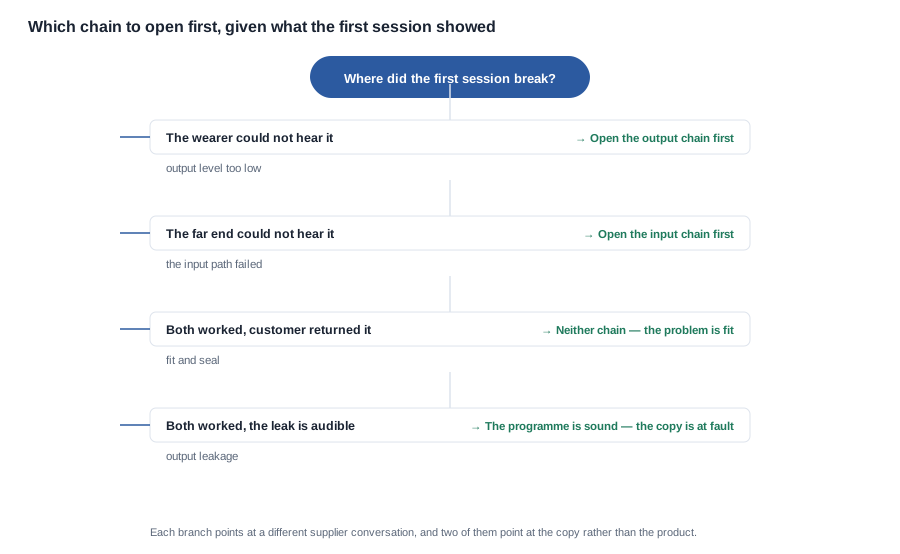
The decision chart is the practical use of splitting the two chains. Each branch points at a different supplier conversation, and two of the four point at the listing rather than at the product.
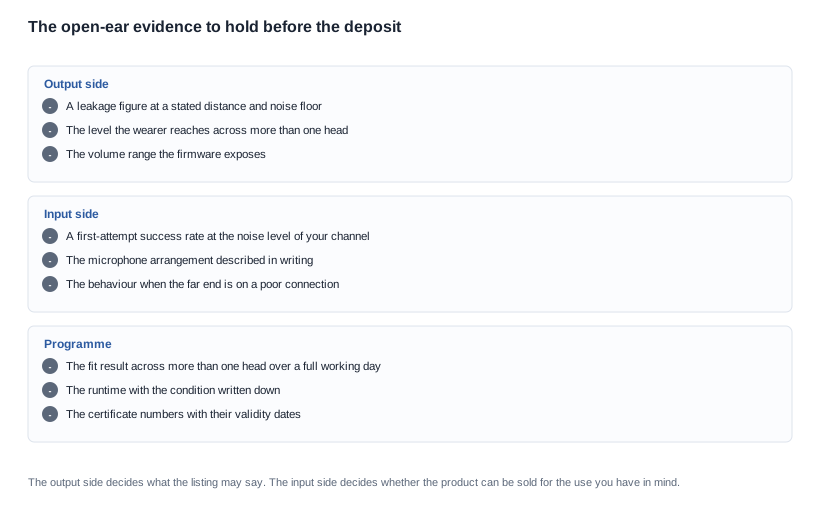
The checklist above is the file a procurement team should have at the point where the sample order is signed, and it is arranged by chain because the evidence is. Six items sit on the output side, three on the input side and three on the programme itself. The output items are the ones that decide the listing copy, the input items decide whether the call use case exists, and the programme items are what keeps both of them honest across a production run rather than a single sample.
On the output side, the leakage figure at a stated distance and noise floor comes first, because it is the item most often missing and the one that constrains the copy. The level the wearer reaches across more than one head comes second, and the volume range the firmware exposes comes third.
On the input side, the first-attempt success rate at the noise level of your own channel is the item that decides the product. The microphone arrangement in writing and the behaviour on a poor far-end connection follow it.
On the programme, the seal result across more than one head over a full working day, the runtime with its condition written down, and the certificate numbers with their validity dates.
Where a two-chain product fails commercially
The listing says the product is private and the customer can hear it across a room. The symptom is a review or a return that describes the product as loud. The root cause is that the leakage figure was never taken, so the copy was written from the word "open-ear" rather than from a measurement. The prevention is to take the figure on the sample and write the copy from the number, including the distance it was taken at.
The product works for music and fails for calls. The symptom is a return cluster from a channel that bought the product for calls. The root cause is that the quiet-room result was treated as the result. The prevention is to run the intelligibility test at a stated background level and to write the workload beside the figure.
The sample was excellent and the customer returned the product after a month. The symptom is a return with a description that says it was uncomfortable. The root cause is usually the seal across face shapes, and the single-head test cannot see it. The prevention is a full working day on more than one head, with the seal checked at the end of it.
Two units of the same model behave differently and nobody notices. The symptom is an incoming inspection that passes on a sample and fails on a lot. The root cause is that one unit was tested. The prevention is two units per model and a written incoming inspection criterion carrying the two pass lines.
The product is sold for calls and the listing implies it works anywhere. The symptom is a complaint from a customer in a noisy environment, followed by a review. The root cause is that the degraded behaviour was never specified. The prevention is to write what the product does when the far end is on a poor connection, and to put it in the leaflet.
A frame geometry problem was found after tooling. The symptom is a schedule slip that nobody can explain, because the finding was described as an acoustic issue. The root cause is that a leakage or seal problem was opened at the engineering level when the remedy was a tooling change. The prevention is to use the two-chain split from the first session, so that a frame-level finding is identified as a frame-level finding while there is still time to change it.
A worked scenario: a brand specifying an open-ear call range
This is a hypothetical scenario rather than a client project, and it is written to show the decision sequence rather than to report a result.
Assume a European brand building a call-focused open-ear line for a channel that includes warehouse and field-service customers, with two colourways and three target markets. The binding constraint is that the brand's previous open-ear line generated returns that were attributed to comfort, and the brand now suspects the seal rather than the electronics.
The exposure is written down first. Two environments: a desk and a warehouse floor. That gives one quiet reference and one defined noise floor, and it tells the buyer immediately that the warehouse floor is the one that decides the product.
The document request goes out in parallel. The brand asks for the leakage figure at a stated distance, the microphone arrangement in writing, the runtime with its condition, and the model designation. The supplier has the runtime and the designation. The leakage figure and the microphone arrangement are "not published", which is normal in this category and which the brand treats as a programme task rather than a disqualification.
The sample session runs with the roles swapped. On the desk, at a fixed volume, the output is measured at a stated distance and the far end repeats a fixed phrase. On the warehouse floor, the same phrase is used at the stated noise level and the first-attempt rate is recorded. The output passes comfortably; the input chain passes in the quiet room and fails roughly half the time in the warehouse.
The right chain is opened. The failure is on the input side, and the supplier's answer is that the microphone arrangement can be changed without touching the frame tooling. That is the good answer: it is an engineering change, not a tooling change, and it can be made before the first article.
The copy is written from the numbers. The brand states what the product does in a noisy environment, in terms the measurement supports, and does not claim the product is private because the leakage figure is still open. The listing says the product is designed for calls in a workplace environment, and the support script says the same thing.
The negotiation is about the inspection rule, not the unit price. The brand asks for the two pass lines to be written into the purchase order as incoming inspection criteria, which costs the supplier a small amount per lot and gives the brand the ability to refuse a lot that drifts.
The result is a programme with two acceptance lines, a copy that matches the evidence, and an engineering change made before tooling. The decisive decisions were all made in one ninety-minute session with two people in it, and none of them was about the volume.
Where the open-ear programme loses its margin
The margin in this category leaks in four specific places, and each of them is negotiable if it is known and expensive if it is not.
The count of configurations is the real unit price. Two colours with two seals and two charging interfaces is a combination count, not a unit count, and the per-configuration minimum is where a negotiation actually moves. Buyers who negotiate on units alone give away the number that matters.
The inspection rule is a running cost, and it is worth pricing. A criterion that applies to every incoming lot is a cost on every delivery, while a criterion on a sample is a cost on the programme. Which one you take is a trade-off between the risk of a drifting lot and the cost of inspection, and it should be decided deliberately.
A second sample round is a reasonable ask here. The published specification in this category is thin, so a single round rarely closes the programme. Whether the supplier funds a second round for the leakage and intelligibility tests is worth asking, because the alternative is a longer programme and a bigger risk carried on your own schedule.
The split delivery against a staged payment is worth more here than a price reduction. Consistency is unproven in this category at the start of a programme, so splitting the first run into two deliveries against a payment milestone is a way to buy information before the second half of the order is committed.
Open ear audio glasses: what is published and what is not
Stated plainly: we publish the cell configuration, the charging interface, the Bluetooth version, the charge time, the rated runtime and the structural feature rows exactly as the catalogue states them, and we publish the absence of leakage, microphone and sizing data with the same prominence. We will not present a typical performance figure for the category, and we will not convert a rated runtime into a usable one by applying an assumed efficiency.
Across the catalogue, the published Bluetooth rows are specific: the K01 and K02 audio glasses state 5.3, and LC-105-1 and YK12, D12 and the D11, and G07 and LC-105-2 state 5.4. The D17 and ZH12 publish a charge time of about one hour rather than the two hours published more widely. Charging cases in the range appear at 900 mAh, 1200 mAh and 1400 mAh. We publish one unit weight in the whole catalogue, 158 g for the MT6, and no open-ear model publishes one.
What we will do is take a sample report and tell you which measurements are comparable, which conditions are missing, and what has to be added before the results can be written into a purchase order as acceptance criteria. The technology background is at open-ear audio technology, the production-side procedure is at open-ear audio quality control, the terminology is at the open-ear audio glossary, and the procurement form of this protocol is at the procurement checklist.
Four actions before the open-ear sample session
Split your acceptance criteria in two before the samples arrive. A level with its tolerance for the output chain, and a first-attempt success rate at a named noise level for the input chain. Two lines means two remedies, and the criteria to hold are the ones your own protocol produces.
Ask for the microphone arrangement in writing. A description of the arrangement and the isolation from the output path tells you whether the supplier has done the engineering or has named a feature.
Check the documentation track in parallel. The procedure at sample evaluation, the register at certification checklist and the shipping gate at battery transport all have to be closed before the deposit, and none of them waits for the acoustic results.
Send us the model, the environment and the channel. We will tell you which of the four measurements decides the project for that combination, which published rows apply, and which results have to be confirmed on a production unit before you commit to a volume. For clause language go to contract terms, and for the commercial structure of a first order go to pricing.
Related reading
- The technology context — open-ear audio technology
- The production-side procedure — open-ear audio quality control
- The terminology — open-ear audio glossary
- The procurement form of this protocol — procurement checklist
Tell us the model and the environment, and we will say which measurements decide the project and what to write into the inspection criteria.


