
Smart glasses for security: the models a shortlist must start from
The conclusion a security channel can act on
The question a security deployment has to answer, in a debrief, on a Tuesday, is whether a piece of evidence exists. If the answer is "the device was on, I think", the evidence is worthless, and the cost of that answer is not the footage but the whole chain around it. So the training programme for a shift team is not a device programme; it is a programme for producing a record that somebody else can rely on, and for keeping the device in a state where it can produce one.
Smart glasses for security narrows faster than buyers expect, and the narrowing is worth stating before anything else. Eleven camera models are published, and only three of them publish a 13 MP camera: the S7 and the L2 Utral, and the L1 Pro. The other eight publish 8 MP. Of the three in the 13 MP tier, exactly one also publishes an ingress marking, because the IP54 marking in this catalogue belongs to the V06 and the S7 and to no other model. So a security shortlist built on the resolution class and on the environment is one model deep, and a shortlist built on the resolution class alone is three models deep. Either way it is a shortlist, and it is a much smaller commercial decision than a camera category suggests.
The second conclusion is a limit rather than an opportunity. A resolution class does not describe a record. The catalogue publishes no video resolution, no frame rate, no field of view, no sensor row, no storage capacity, no overwrite behaviour and no recording behaviour for any model — all of these are absent from every page of the catalogue, not merely from the camera pages. A security channel therefore cannot claim what a recording will look like from our rows, and a training programme that pretends otherwise will teach a team to expect an image quality the documentation does not promise.
Who is buying, and what the evidence chain has to survive
The reader is a brand-side buyer, a channel buyer or an e-commerce seller assembling a security line: a distributor stocking a uniform supplier, a reseller building a package for a facilities contractor, or a brand owner opening a security category. The situation is usually a quotation to compare, a contract to win, or a fleet to roll out across sites, and in each case the same question sits underneath: what does the device have to be able to prove, and which rows in the documentation support that proof.
The fear underneath it is not a bad price. It is a fleet rollout in which two thirds of the team never received the session, followed by a debrief in which nobody can say whether the device was recording. That is not a device fault and it cannot be fixed by a warranty; it is a programme fault, and it is fixed by a procedure that leaves a record at every step.
Two things have to arrive before the session can be designed. The first is the recording purpose, because a device deployed for patrol observation and a device deployed for incident capture are different products with different documentation requirements and different market-access questions. The second is the rotation pattern, because a session delivered once reaches part of a shift team and leaves the rest to inherit a device nobody showed them, and a procedure that only some of the team can perform is not a procedure.
The four things a shift team is taught
The four behaviours below are the whole of the session, and each one exists to protect a specific point in the evidence chain rather than to demonstrate a feature.
| Taught | What it prevents | What it rests on |
|---|---|---|
| How to start, stop and confirm a recording | The debrief where nobody can say whether it was running | The recording controls, and a stated confirmation step |
| How to check the device before a shift | The shift that ends with a flat device and no record | The published interface and charge time, and the contact check |
| How to wipe the lens and the contacts | The evidence that is unusable because it was smeared or the device would not charge | A specified item, because the lens material and the coating are not published |
| What may be recorded, and what happens to the file | The recording nobody had the right to make, and the file nobody can find | A written policy the session repeats, not a rule the team improvises |
The recording confirmation is the habit that makes the evidence chain work, and it is the one most often left out. A device that may be recording at any time has to be operated so that its state is verifiable rather than assumed, and because the storage capacity, the overwrite behaviour and the notification at the limit are not published for any model, the state has to be one the team can see for themselves. The behaviour is a procedure, and the procedure belongs to the buyer. The related question is at how do I start and stop recording, and the charge side is at charging for security.
The rows an evidence specification can and cannot be built from
The resolution tier and the one model that combines it with a marking
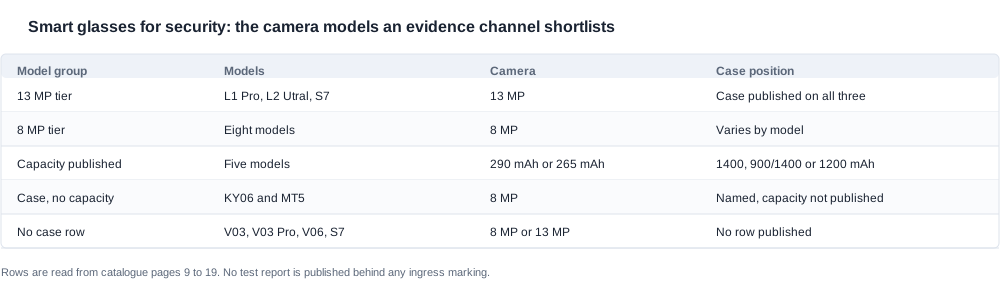
The table above sets out the camera models an evidence channel actually compares, and the case column is the one that changes the fleet cost. Five camera models publish a charging-case capacity: 1400 mAh on the CY05 and the CY03, and the L1 Pro, 900 or 1400 mAh as a configuration choice on the L2 Utral, and 1200 mAh in the MT6's foldable case. Two more, the KY06 and the MT5, name a case without publishing its capacity. Four publish no charging-case row at all: the V03 Pro and the V03, and the V06 and the S7.
For a security fleet this is a base-stock decision rather than a per-device one. A device issued with a case travels with the device and returns with it, which means one case per device and a second lithium cell to declare for every unit in the shipment. A device issued without a case travels with a charging cable and returns to a dock at the base, which means a dock per shift team rather than a case per device, and it means the field of view of the day is limited by how many docks there are. Neither is wrong, but they are different fleet budgets, and a buyer who does not decide at quotation stage discovers it at deployment.
The charging interface decides that budget as much as the case does. Magnetic charging is published on seventeen models across the range and Type C on seven, while four camera models — the L1 Pro and the CY03, and the CY05 and the MT6 — publish no charging method at all even though their case capacities are published. For a fleet whose most common configuration is one of those four, the dock standard cannot be ordered until the interface arrives in writing.
The rows that describe the record, and none of them are published
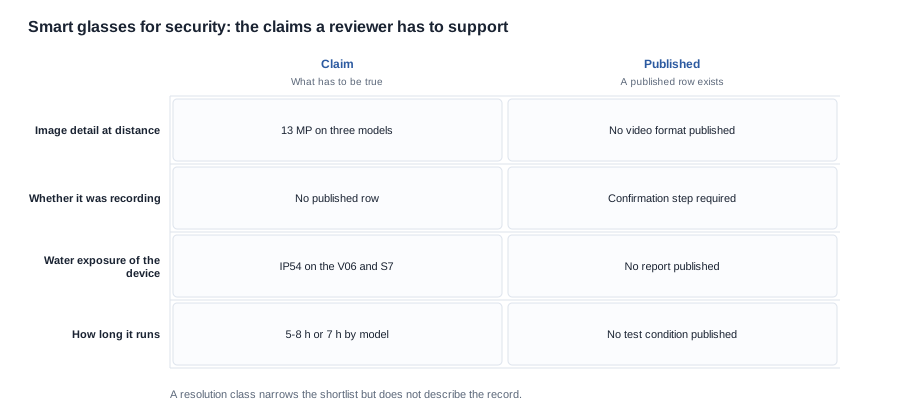
The matrix above is the honest summary of an evidence specification. Each row is a claim a reviewer might have to support, and the second column shows how little the catalogue can say about any of them. Image detail narrows to three models and stops at a resolution class. Whether the device was recording has no published row at all. Water exposure narrows to two models with a marking and no report behind it. Runtime narrows to a band with no test condition attached.
That combination has a direct consequence for how a security channel should be built. If the file quality is the deciding factor, the channel can buy the 13 MP tier and then has to request the video format, because the resolution class and the video format are different facts and only one of them is published. If the recording state is the deciding factor — and in most incident workflows it is — then the decisive investment is not the model at all but the confirmation procedure, the file handling path and the log that links a device to a shift.
What the catalogue does publish for this range is worth stating plainly as well. The camera models publish the resolution class, the charging interface where it is published, the cell capacity, the rated runtime, the charge time, and the structural features that appear on their pages: a removable inner frame on the V06 and the S7, a remote capture control on the D17 and the ZH12, colour counts, and the case capacities listed above. What it does not publish, for any model, is the frame material, the lens material, the coating, the hinge specification, the per-model unit weight beyond the single 158 g whole-unit figure for the MT6, the field of view, the video specification, the operating temperature range, the cycle life rating, the runtime test condition, or the Bluetooth version of any camera model. There is also no per-model certification row anywhere in the catalogue, and the catalogue text carries no CE, FCC, RoHS, REACH or UN38.3 marking at all.
Verifying the evidence chain before a device is issued
The request that settles the recording behaviour
Verification in this category is a document exercise with one physical exercise attached, and the document part fits into a single request if it is written narrowly enough.
- Ask for the recording controls per model — which control starts a capture, which stops it, and what state the device shows while it is running.
- Ask for the storage capacity, the overwrite behaviour and what happens at the limit, since a file that is silently overwritten is the failure a reviewer discovers last.
- Ask for the video resolution, the frame rate and the field of view per model, so a file-quality expectation can be set from a document rather than from a resolution class.
- Ask for the transfer path and the file naming convention, because a file nobody can find is the same outcome as a file nobody recorded.
- Ask for the ingress position in writing for the chosen model, together with the test report behind it, including the report identifier.
- Ask for the charging method per model where it is not published, and for the dock standard that follows from it.
- Ask for the certification scope for each destination market, per model. A device that records people is a different regulatory object from a device that records a product, and the catalogue does not settle it for you.
- Ask for the model designation table, the certificate register references and the agreed incoming inspection criteria, so a returned unit can be traced and a damaged unit can be triaged.
The order matters more here than anywhere else in the range. Start with the rows that have to be true before production begins — the recording behaviour, the video format and the market-access scope — and work backwards to the commercial terms, because a term negotiated against a configuration that later changes is a misunderstanding with an invoice attached.
The pre-shift card and the handover procedure
Shift teams have the worst training conditions in this category. They work in rotation, so a session delivered once reaches part of the team and the rest inherit a device they have never been shown. The output therefore has to be physical and it has to be repeatable by whoever is on the issue point, including a person who is not an engineer.
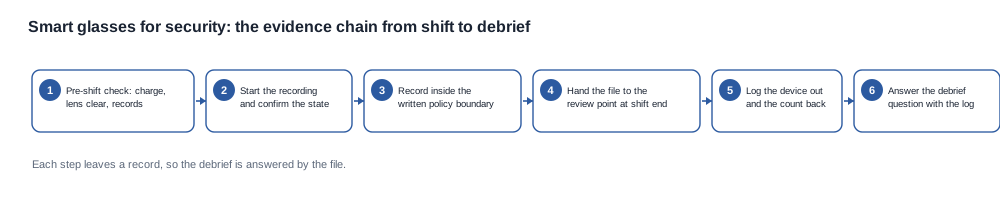
The chain above is the sequence the card has to make unambiguous, and the last step is the one that decides whether the deployment is defensible: the debrief question is answered by the log and the file, not by recollection. That is why the count and the log belong on the same card as the recording confirmation, and why a device that does not come back has to be recorded as a loss rather than quietly reissued.
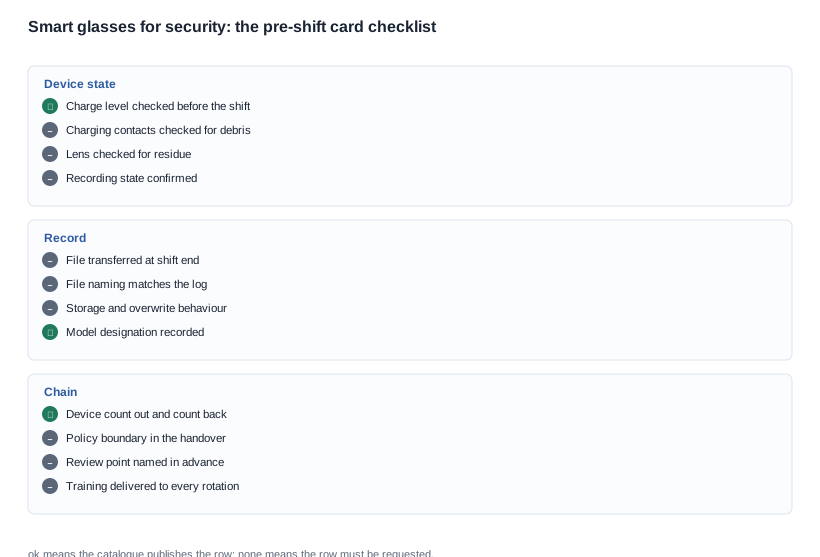
The checklist above groups the card by what each group protects. The device-state group fails as a missing record, the record group fails as an unusable file, and the chain group fails as an unanswerable debrief. Three of the twelve items rest on published rows and can be written today; the rest have to be requested, which is exactly why the request should be sent before the purchase order rather than after the first shift.
Where a security deployment goes wrong
The failures below reach a buyer as a surprise, and each is written as a symptom, a root cause and a control.
A device session with no recording policy. The team learns the controls and not what may be filmed, and the gap is filled by improvisation in the field. Control: the policy is the first item in the session and the handover procedure repeats it.
No confirmation step. The debrief becomes a matter of recollection and the evidence becomes unusable regardless of how good the footage was. Control: a stated state check that the team can verify for themselves.
A pre-shift check that is only a charge check. A charged device with a smeared lens and a dirty contact still produces nothing, and each of those is a thirty-second step that is cheap to include and expensive to omit. Control: charge, lens and record, in that order.
A waterproof claim taught by a trainer. Only the V06 and the S7 publish an ingress marking and no report is published behind it, so a patrol in the rain is the customer who tests the claim. Control: the card states which model carries the marking and that no report is published.
Training delivered once to a rotating team. Two thirds of the team never had the session, and the procedure therefore exists only in one person's head. Control: the card is the trainer, and the session is delivered per rotation.
A long session that does not fit between shifts. Anything that does not fit does not happen. Control: the session is the length of the pre-shift check, and the card carries the rest.

What a security programme costs commercially
Four terms a security channel can still move
Four terms in a security programme carry real room, and all four sit outside the unit price. The first is whether the supplier runs the pre-shift training and reviews the card and the handover procedure before the units ship, so that the criteria the session teaches are the same criteria the incoming inspection uses. A card written by the factory and never checked against the rows teaches a team to expect an image quality the documentation does not promise, and that is replicated across every unit in the shipment.
The second is whether the storage behaviour is configurable, which matters when the recording policy is a contract term rather than an operating preference. The third is whether the case is issued per device or held at the base, and for a fleet this is usually a decision to exclude the case, with the dock count following from it. The fourth is the consumable set: a cleaning item and a contact item are the cheapest evidence-quality improvement available in this category, because a smeared lens and a dirty contact produce nothing at all, and both are measured in cents per unit.
There is also a specific request worth making about a refurbishment partner. If the channel refurbishes units rather than discarding them, the supplier's willingness to train that partner on the condition list is worth more than a unit-price concession, because it is the difference between a recovery rate and a scrap rate on a fleet that has already been paid for once.
What a security channel cannot move
Three costs are not negotiation targets. The camera hardware, the cell and the charging interface, and therefore the pre-shift routine, are fixed for a given model. The certification cost and lead time move with the schedule and with whoever runs the test for the destination market for the destination market and are incurred once per product family rather than per unit. And tooling is a one-time cost that should be quoted as a separate line and amortised across the order, because a quotation that folds tooling into the unit price hides both its size and the point at which it stops being payable.
The deployment side of the contract is where the money is, though, and it is worth putting the training programme into it explicitly: the number of sessions per rotation, the number of cards issued, the cost of the pre-shift check time, and the review point that receives the file. Those four lines are usually missing from a quotation in this category, and they are the lines that determine the total cost of a security deployment. The clause language is at contract terms, and the commercial structure of a first order is at pricing.
What we publish for security, and what we will not claim
Here, we publish the rows a buyer can order from and we will not fill the gaps with industry averages. For this range that means the resolution class and the split between the eight 8 MP models and the three 13 MP models, the cell capacities, the charge times, the rated runtimes, the charging interface where it is published, the structural features that are published, the colour counts and the case capacities where they are published — five camera models carry a published capacity, two more name a case without publishing one, and four publish no case row at all.
What we do not publish, and will not estimate: the sensor, the video resolution, the frame rate, the field of view, the storage capacity, the overwrite behaviour, the recording behaviour, the frame material, the lens material, the coating, the hinge specification, the per-model unit weight beyond the single 158 g whole-unit figure for the MT6, the operating temperature range, the cycle life rating, the runtime test condition and the Bluetooth version of any camera model. We will not state that any product in our range is tested to IP54, because no test report is published behind that marking, and we will not extend the marking beyond the V06 and the S7. And we will not describe a recording quality for any model, because the rows that would describe one are not published.
What we will do is take the recording purpose, the shift length, the rotation pattern, the fleet size and the markets, and tell you which models the published rows support, which rows have to be requested before the order, and what the pre-shift card has to say. Send us the deployment shape and the contract terms you are working to, and we will return the four behaviours the session has to cover and the documents to request before a deposit.
Related reading
- How the scenario opens — smart glasses for security
- The field behaviour — security real-world experience
- The charging routine — charging for security
- The buying-side list — security buying checklist
- The deployment-specific thread — security legal considerations
Tell us the shift length, the rotation pattern and the recording purpose, and we will say which four things the session has to cover.


