

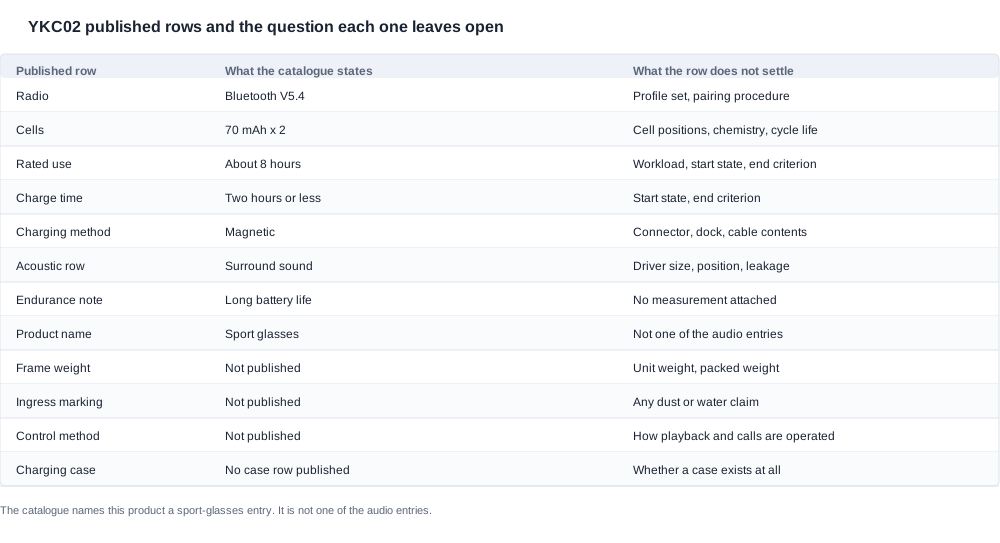
The YKC02 is named 运动眼镜 in our catalogue, which is a sport-glasses entry and not one of the entries we name as audio glasses, and it carries a Surround Sound feature row alongside that name. Our catalogue gives this model Bluetooth V5.4 and a two-cell 70 mAh arrangement; the charge method is magnetic, the ceiling on charging is two hours, the rated use is around eight hours, and the feature notes are a surround-sound row and a long-endurance note. What none of that gives a procurement team is the number a sport frame is actually bought on: the weight, the retention and the lens. Our catalogue publishes no frame weight for this model, no retention figure, no lens material, no ingress marking and no control method, and a channel that files this product under audio on the strength of the surround-sound row will find that the two categories are not interchangeable on any of those points.
YKC02 smart glasses how to use: a sport frame whose stability is unpublished
A product named for sport is bought on the basis of three things: how securely it stays on the head, what the lens is made of, and how much it weighs. A buyer who asks a supplier for a sport frame expects to receive those three numbers, and in this case the catalogue publishes none of them. There is no weight in grams, no temple length, no nose-pad specification, no adjustment range, no retention figure, no lens material, no tint, no coating and no statement about whether the frame is intended to be used with a prescription insert. The YKC02 is named for the use and the catalogue publishes the electrical envelope in full, which is an unusual combination and it is worth understanding why before a buyer builds a listing on it.
The most likely reason is that the sport entries in this catalogue are positioned by configuration rather than by measurement, and the buyer should read them that way. A surround-sound row and a long-endurance note are configuration descriptors: they say what the product is built to do, and they say nothing about how well it does it. A buyer who writes "surround sound" in a listing is repeating the catalogue. A buyer who writes "full surround sound" or "immersive sound" has added a comparative adjective that the catalogue does not carry, and it is exactly that kind of adjective that turns a configuration row into an unverifiable performance claim in a customer review.
The operating routine follows from the same place. For a product whose stability is unpublished, the routine is not a sequence of user actions; it is a positioning and securing routine whose criteria the buyer has to write. The frame goes on, the temples are adjusted to whatever the head presents, and the question is whether it stays there for the length of a session and through the movement the session involves. Because the frame carries audio in the temples, there is a second positioning question as well: where the sound source has to sit relative to the ear for the surround-sound configuration to produce the result the row names. Neither of those questions is answered by a published figure, and both of them are answered in about ten minutes on a sample order.
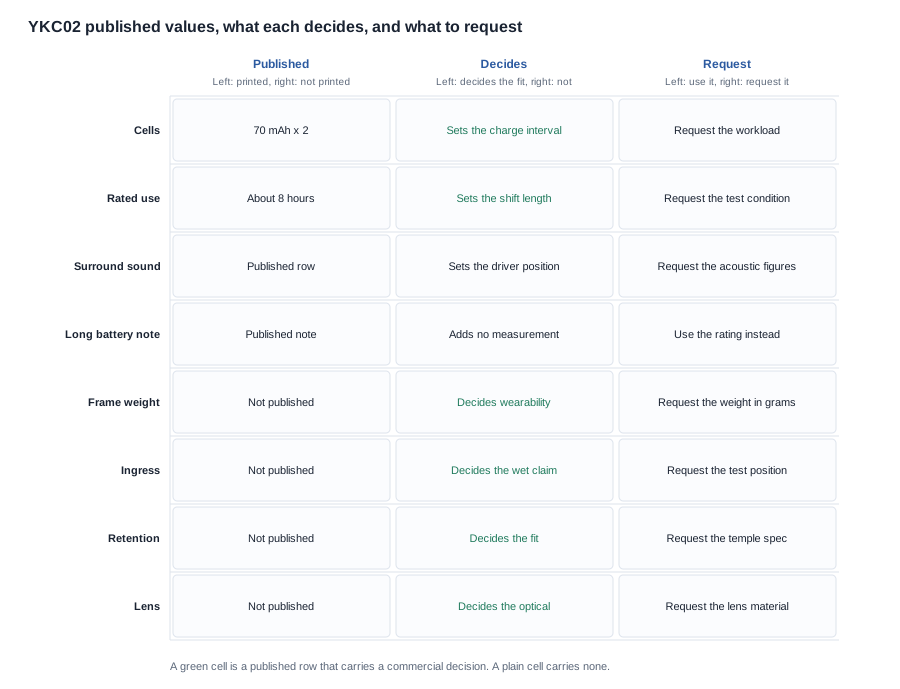
The endurance figures are the part of this model that a buyer can use immediately, and they need to be read carefully because there are two of them and they are different kinds of statement. The catalogue publishes a rated use of approximately eight hours, and it also publishes a long-endurance note. The first of the two is a quantitative rating, and nothing in the catalogue states what the workload was, where the test began or where it was judged to end. The second is a qualitative descriptor with no number attached. A listing should use the first, in the form the catalogue prints it, and should not use the second as if it were a second measurement. Two endurance statements where one is a rating and one is a phrase is a common source of over-claiming in this category, and the discipline that avoids it is simply to quote the number and leave the phrase out.
The cell configuration deserves a note of its own, because two different cell arrangements in this catalogue share the 70 mAh figure. This model publishes 70 mAh × 2 — two cells, with the count published alongside the value. The catalogue publishes the cell value and the cell count rather than a single total, and a buyer who converts that into a combined number is producing a derived figure that the catalogue does not state. A derived total is fine in an internal capacity comparison as long as it is labelled as derived, and it is not fine in a listing, where it will be read as a published specification. Separately, the 70 mAh value appears elsewhere in the catalogue on a single-cell configuration, which is a different arrangement entirely and a good example of why the count matters as much as the value.

What the YKC02 publishes: two cells, a surround-sound row and a qualitative endurance note
Every row in the table pairs a published figure with the gap beside it, and for this model the pattern is unusual enough to be worth reading twice. The electrical rows are complete: a radio version, a cell configuration, a charge-time ceiling, a rated use and a charging method. The feature rows are two, and both of them are descriptors rather than measurements. A surround-sound row says the frame produces a surround-sound configuration. A long-endurance note says the frame is built for long use. Neither row carries a number, and neither can be converted into one.
That combination produces the central risk in this model's listing: a buyer who writes "eight hours of battery life" is quoting a published rating, and a buyer who writes "long battery life" is repeating a catalogue phrase, and a buyer who writes both has put a number and a phrase next to each other as though they were independent confirmations. They are not. The rating is the only endurance statement with a quantity attached, and the phrase adds nothing to it. A listing should carry the rating with its condition, or carry nothing.
The cell configuration deserves careful handling for the same reason. The catalogue publishes 70 mAh × 2 — the value and the count. It does not publish a total, and a total is a derived figure that belongs in an internal capacity comparison labelled as derived, not in a product listing where it will be read as a published specification. The same 70 mAh value appears elsewhere in the catalogue on a single-cell configuration, so the count is doing real work in this comparison: two cells in a frame of this type and one cell in the other are different arrangements, with different weight implications, different charge-current behaviour and different transport treatment. Any comparison that carries only the value across between the two will produce a wrong answer.
The charging method is magnetic, and this puts the model in the largest group in the catalogue: seventeen of the twenty-eight models charge magnetically, seven charge over Type-C, and four publish no charging method at all. For this model the published method is magnetic, and the operational consequence is the one described in the general range guidance: the frame has to reach a magnetic interface, so a deployment needs a defined charging point, and the accessory that reaches it is a specific part rather than a generic cable. Whether a case ships with this model is not something the catalogue answers, so the contents of the box have to be established before an accessory programme is planned.
The radio version is V5.4, and that is worth noting in a different way from the other models in the audio group. The published radio version is one of the few rows in this catalogue that a buyer can put straight into a technical file, and it is the row that supports the broader range guidance on radio documentation.
The published set for this model is collected in YKC02 smart glasses specifications and features, the certification questions in YKC02 smart glasses certification status, the range comparison in YKC02 smart glasses how it compares, and the commercial framing in YKC02 smart glasses value for money.

Retention, lens and weight: the three YKC02 measurements a sport frame is bought on
A sport frame is bought on three numbers, and this model publishes none of them, so the procurement conversation has to convert from a specification conversation into a measurement conversation. The three are the weight of the frame as shipped, the retention of the frame on the head, and the lens. Each has a test that a buyer can run on a sample order in under an hour, and each has a reason it matters more on a sport frame than on a general one.
The weight is the first, and the reason it is missing is worth noting. Our catalogue publishes a weight for exactly one model in the whole range, and it is not this one. A buyer reading this model will find no gram figure at all, and there is no comparative figure to borrow from a neighbouring product, which means the only route to a number is to ask the supplier or to weigh a sample. Weight matters on a sport frame for a straightforward reason: it is the number that determines whether the product can be worn for two hours, whether it is acceptable with a helmet, and whether the endurance rating is spent on audio rather than on the mass of the frame. A channel that cannot state a weight cannot put the frame into a comparison against a competitor that can, and a product page that omits the weight reads as though something is being avoided.
The retention is the second, and it is where a sport frame differs most from a general one. Retention is a combination of temple tension, nose-pad geometry, temple length and the total mass, and the catalogue publishes none of the four. What a buyer can do is define the test: the frame is fitted, the wearer performs the movements the deployment involves, and the frame's position is checked at the end and at intervals during. The acceptance criterion should be written before the sample arrives, and it should be a position rather than a feeling, because a position can be measured and photographed and a feeling can only be argued about. A frame that has moved is a frame that has failed, and a buyer who has not defined the acceptable movement in advance will find the argument at the first customer complaint.
The lens is the third, and it is the one with the widest commercial consequences. The catalogue publishes no lens material, no tint, no coating, no ultraviolet statement and no indication of whether the frame accepts a prescription insert. For a product named for sport, the lens is a large part of the proposition, and a buyer who writes "sport lenses" in a listing has written a category rather than a specification. A buyer who wants to sell it into a segment where the lens matters has to obtain the material and the tint, and has to obtain the prescription position, because a channel that can offer a prescription service on a sport frame has a materially different proposition from one that cannot.
There is a fourth measurement that is not on the list but belongs on it, and it is specific to this model: where the sound source has to sit for the surround-sound configuration to produce the result the row names. A temple that is wide enough to carry a driver is not automatically positioned correctly on a given head, and a frame that is positioned for retention may be positioned differently for sound. The two requirements have to be reconciled on the sample, and a buyer who has not thought about that will discover the conflict in the field.

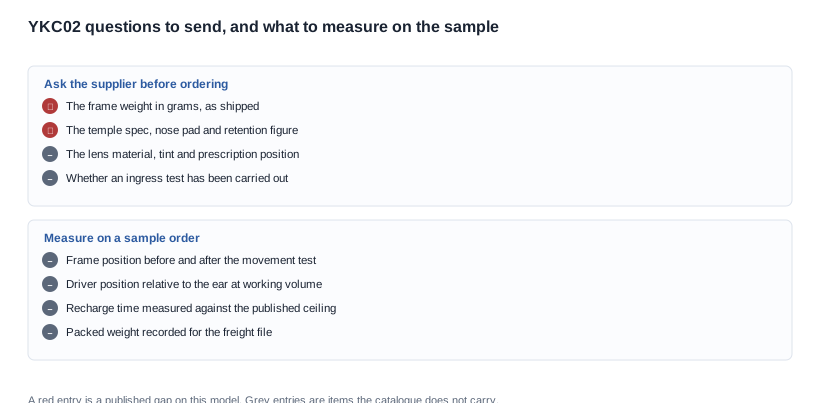
The routine above is the order in which these four things have to be tested, and it is not an arbitrary order. Position first, because the position determines the acoustic result and the retention result simultaneously, and the two cannot be optimised independently. Retention second, because it is the criterion that fails a unit. Weight third, because it is a measurement rather than a trial. Lens last, because the lens specification is a document request rather than something a sample can settle on its own.
The YKC02 ingress question on a product named for sport
The catalogue names this product 运动眼镜, and our catalogue carries an ingress marking on only two of the twenty-eight models it covers. This model is not one of them. That fact has to be handled carefully in both directions: a listing must not claim a protection the catalogue does not publish for this product, and a buyer must not quietly assume the absence is a mistake either. It is a publication decision, and the honest formulation is that our catalogue publishes no ingress marking for the YKC02, so the ingress position has to come from the supplier.
That is an uncomfortable answer for a product whose name points at outdoor use, and it is exactly the answer a buyer needs to be able to give a customer. A question like "can I wear these in the rain" is the first question a retailer receives about anything named for sport, and there are two defensible answers. The first is that the product carries a published marking with a documented test behind it, in which case the answer is precise and can be given in a sentence. The second is that the marking has not been published, in which case the answer is that the question is open and the buyer is not going to invent a position to fill it. The second answer is less comfortable and considerably more defensible than a claim that turns out to be unsupported.
The supplier request that follows from this is narrow and cheap to make. Ask whether an ingress test has been carried out on this model, and if so for which configuration, with what standard, and with what report. A supplier who has tested it will produce a report; a supplier who has not will say so, and that answer is itself useful because it tells the buyer that the product has to be positioned for conditions rather than protected against them. Either answer changes the channel material, the return policy and the way the product is described in a listing, which is why it belongs near the front of a buyer's enquiry list rather than at the end of a technical file.
The point is worth making in a slightly wider frame, because the temptation to claim an ingress rating for a sport product is one of the most common errors in this category and it is an error that is invisible in a listing and expensive in a return. A published marking is a specific engineering claim about a specific configuration, and it is not a category entitlement. Two models in this catalogue carry one, and the difference between those two and the rest is that the other twenty-six have no marking to claim at all. A buyer who writes a marking onto a product that does not have one creates a customer expectation that no test can support, and the failure arrives as a product complaint rather than as a documentation complaint.
That is the whole of the ingress position for this model: a request, not a claim, and a supplier answer that the channel can then act on.
The YKC02 selection file: what a buyer can and cannot put in a listing
The criteria for the rows a YKC02 buyer requests
- The frame weight in grams, as shipped, and the weight of any accessory supplied with it.
- The temple specification, the nose-pad geometry, the adjustment range and the measured retention on a stated head size.
- The lens material, the tint, the coating and the ultraviolet position, and whether a prescription insert is supported.
- The surround-sound configuration in detail, including the driver position relative to the ear and any published acoustic figures.
- The call-handling behaviour, whether an incoming call interrupts playback, and what action accepts and ends a call.
- The control method for playback, since our catalogue publishes no touch row for any model.
- The workload, start state and end criterion behind the approximately eight-hour rated use, and the basis of the long-endurance note.
- The start state and the completion criterion behind the two-hour-or-less ceiling.
- The ingress position: whether a test has been carried out, against which standard, and for which configuration.
- The box contents, the radio version confirmation and the per-model conformity documentation.
Two cells in one frame change the way a compliance file has to be written, and this model is a two-cell product. Our catalogue attaches no CE, FCC or RoHS marking to this model, and it attaches none to any other product either; there is no certification line for an individual model anywhere in it, and the export-certification page is made of images rather than extractable text, so the technical file and the declaration of conformity both have to be asked for. Where a radio reaches the European market, the Radio Equipment Directive (EU) 2014/53/EU is the instrument that applies, and Bluetooth membership is settled by an independent lookup in the member database. The set point is this: a frame carrying two 70 mAh cells is one product, and the documentation has to describe it as one product rather than as a frame plus a loose cell. That means the test summaries for both cells are named in the same file and the configuration description covers the assembled frame. A supplier offering a file for a single-cell build of a related product has not offered a file for this one, and the gap shows up at a market surveillance check rather than in the warehouse.
The boundaries of the published rows on this model
Our catalogue carries five specification rows and two feature notes for this product, and nothing here extends them into a weight, a retention figure, a lens specification, an acoustic figure, a control method, an ingress position, a runtime test method or a certification claim. We also do not place this product in the audio range, because our catalogue names it a sport-glasses entry and the two categories are not interchangeable on any of the missing rows — a channel that files it under audio on the strength of the surround-sound row will find that it has inherited a set of questions it has not answered. The range comparison for this model is in the range-level selection guidance for sport products, and the published configuration and the items it omits are separated in the pages linked above. When a buyer builds a shortlist around this product, the four numbers that decide it are the ones a supplier has to measure: the weight, the retention, the lens and the ingress position. Until those four are in the file, the model can be compared on published rows but it cannot be selected on them, and the checklist a due-diligence exercise needs is short precisely because the catalogue has already told us what is missing.
What the published rows do support is a coherent position for a channel that sells into active and outdoor segments rather than into general everyday use. A near eight-hour rating, a long-endurance note, magnetic charging, a surround-sound configuration and a two-cell arrangement describe a product built for sustained use, and a buyer who can add the weight, the retention and the lens from the supplier has a listing that a competitor cannot undercut with a configuration phrase.
If the YKC02 is on your shortlist, send us the deployment, the movement the frame has to survive, the setting it will be used in, plus the copy you intend to publish. Once we have your copy, we will mark the lines that a published row already carries, the ones that need a measurement or a document from the supplier, and the ones we would leave out rather than hedge. Ask first, and the shortlist you arrive at will be one you can defend.


