

A factory audit has one job: to establish whether the supplier's process can hold the specification when nobody from the buying side is watching. It is not a tour, and the difference between the two is the difference between an afternoon and a finding. A tour produces a warm impression and a capability document. A verification produces a list of the things that would have to go wrong for you to receive a bad order, and every item on that list is traceable to a process step you can check again later.
The reason this matters in smart glasses specifically is that a surprising amount of the product's behaviour is decided by combinations rather than by components. A unit that will not charge in the case is not a defective cell and not a defective case; it is a case-to-unit match that was never tested as a match. A unit that runs short is not necessarily a weak cell; it is a cell from a different configuration than the one that was ordered. Both of those are process questions, and a process question cannot be answered by examining a finished unit.

Smart glasses factory audit: what the visit is actually for
The buyer and the decision the visit supports
The reader is a procurement manager at the brand, a channel buyer or an importer who is deciding whether to spend a day and a travel budget on a site visit, or to place the order without one. The anxiety underneath the question is not a bad price. It is a delivery that arrives different from the approved sample, a documentation route that stops the goods at a border, or a first shipment that turns into a returns problem nobody priced.
Three things are being managed at once. The first is the schedule, because the visit has to happen early enough to change something; an audit two weeks before despatch is a piece of evidence and not a control. The second is the specification, because the audit is the only place a buyer can see whether the factory is actually building the configuration it has agreed to build, and this category has enough unpublished rows that the gap between a catalogue model and a production build is a genuine question. The third is the counterparty, because a factory that can answer inconvenient questions calmly is a better counterparty than one that cannot, and the buyer learns this in a way that no document tells them.
There is also a cost side that argues for doing the visit properly rather than skipping it. The cost of a process problem discovered after a programme has launched is an order of magnitude higher than the cost of a day: a returned lot, a reschedule, a revision of the listing, and a channel conversation. The cost of the visit is one day of travel, one day of the supplier's engineers, and the buyer's own time. That comparison is usually easy to make.
What the published data means for an audit
The catalogue publishes a lot that an audit can use, and the way it publishes it shapes the questions worth asking on site.
Published and checkable on the floor: the resolution tier, for all eleven camera models; the cell capacity and cell count; the charging method on twenty-four of the twenty-eight models; the charging case option; the colour availability; the ingress marking on the two models that carry it; and the one published weight, the MT6 glasses body at 158 g including its 265 mAh cell and its camera and excluding the 1200 mAh folding charging case, whose own weight is not published.
Not published, and therefore a question for the floor rather than a check against public data: tolerances, defect rates, cycle life ratings, certificate numbers, ingress test report numbers, acoustic measurements and thresholds, sensor models, and the weight of every model except the MT6. Capacity, line count and production lead times are not published either, so the only way to know the real number for the line that will build your order is to be shown it.
Two of these gaps deserve a specific question on site. The charging method is not published for four camera models, so for those four the audit has to establish from the line itself which connector the order is being built with. The ingress marking is published on two models as a catalogue annotation with no report number behind it, so the audit has to establish whether the factory holds a test report for that marking or whether the marking is a catalogue-level statement. These are the two places where a buyer's public data runs out and the floor has to take over.
The route, walked in the right order
Start at the incoming gate and finish at despatch
The order of the walk is the difference between a verification and a visit. The route has a natural direction — parts in, product out — and a walk that follows it in both directions is what produces evidence.
Start at the incoming gate. Ask which production steps the audit covered and which were not walked, then compare that against the production route the supplier gave you in the quotation. The gap between the written scope and the full route is the most useful output of the first conversation of the day. An audit that covered assembly and skipped incoming inspection has told you the answer to the question it was supposed to answer.
Trace one purchased component forwards. Pick a part that is critical to the configuration — a cell, a case, a lens assembly — and follow it from the delivery note through incoming inspection into the line. The question is how it was accepted, not where it was stored.
Watch one critical measurement being taken. Not a description of it, the measurement itself, on the instrument that will be used on your units. Then ask for the calibration status of that instrument.
Follow one finished unit backwards to its lot. Take a unit from the end of the line and walk it backwards: carton, work station, batch, incoming lot, component lot.
Close at despatch. Packing, labelling, the lot mark on the carton, and the retained samples. A factory that keeps a retained sample from every lot has a traceability culture; a factory that keeps none has a traceability system only on paper.
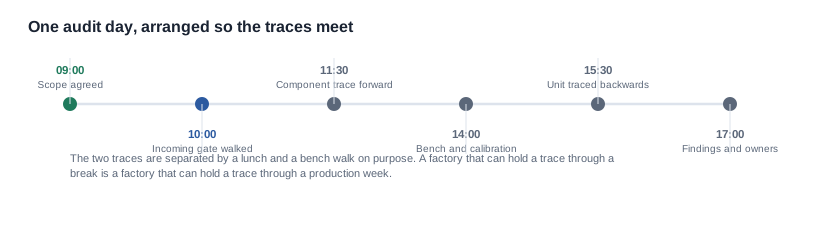
The two traces — one component forwards, one unit backwards — should be separated by a walk and a bench check rather than done back to back. Two separate demonstrations are not a trace; the evidence is that the two meet. A factory that can hold a trace through a break is a factory that can hold a trace through a production week.
The evidence to collect at each station
What settles each station, and what is only reassurance
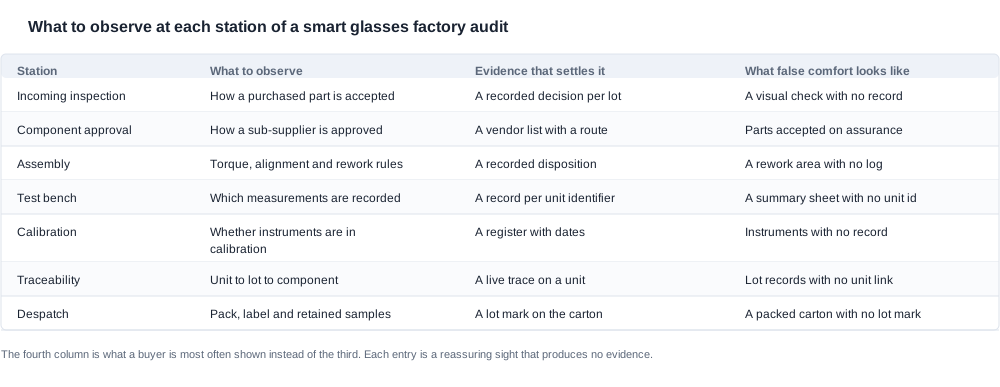
The table below states, for each station of the route, what to observe, the evidence that settles it, and the sight that is often shown instead of the evidence. The third column is the one to insist on, and the fourth is the one to be careful of, because each of those sights is a perfectly normal feature of a working factory and none of them is proof of anything.
| Station | What to observe | Evidence that settles it | The sight that proves nothing |
|---|---|---|---|
| Incoming inspection | How a purchased part is accepted | A recorded decision per lot | A visual check with no record |
| Component approval | How a sub-supplier is approved | A vendor list with a route | Parts accepted on assurance |
| Assembly | Torque, alignment and rework rules | A recorded disposition | A rework area with no log |
| Test bench | Which measurements are recorded | A record per unit identifier | A summary sheet with no unit id |
| Calibration | Whether instruments are in calibration | A register with dates | Instruments with no record |
| Traceability | Unit to lot to component | A live trace on a unit | Lot records with no unit link |
| Despatch | Pack, label and retained samples | A lot mark on the carton | A packed carton with no lot mark |
Two rows carry more weight than the others in this category, and the reason is specific.
The test bench row. The catalogue publishes a resolution tier, a cell capacity, a runtime band and a charge time for the camera models, which means there are published values a bench result can be compared against. But it publishes no sensor model, no acoustic measurement and no threshold, which means most of the bench measurements a factory takes are against internal limits that the buyer has never seen. The audit question is therefore not "what do you measure" but "where is the limit written, and who signed it". A bench that records a result per unit identifier is a bench whose history is usable; a bench that produces a summary sheet for a batch is a bench whose history is a claim.
The calibration row. This is the row where the greatest number of audits fail, and the failure is almost always administrative rather than technical: the instruments are calibrated, the certificates exist, and nobody has connected them to the list of instruments actually used on the line. The audit question is to take the instrument the factory uses for the critical measurement, ask for its certificate, and then ask for the list of instruments in the measurement plan. If the certificate belongs to an instrument that is not on that list, the measurement plan is out of date, and the measurement plan is the document that decides what a defect is.
The four failures that reach a buyer as a surprise
The audit that never reached the incoming gate. A walk of the assembly line gave a good impression and said nothing about where bad parts enter. Control: require the walk to start at incoming inspection and follow the route to despatch.
The trace that ended at the carton. Lot records existed for components but did not link to the finished unit. Control: ask for a live trace of a finished unit and require a defined link between the unit and its lot.
The concession nobody logged. Non-conforming units were re-worked or used without a recorded disposition. Control: ask for the non-conformance log and the concession approval route, and check that both exist as documents rather than as a practice.
The audit that was a tour. The visit produced a warm impression and no process evidence. Control: insist on a written scope, a documented walk, and a corrective action list with owners and dates.
These four are the classic pitfalls in this category, and they share a shape: each of them produces a reassuring impression and no document. A buyer who has been shown a factory does not have a process; a buyer who has been shown a process has a factory. The distinction is the whole value of the visit, and it is why the four controls above are all documentary rather than observational.
None of these is a reason to change supplier. Each is a line to write into the order, and each is far cheaper than the version where the programme discovers it after the money has been spent.

The questions that separate a process from a brochure
The inconvenient ones, and the order to ask them
The order of the questions matters more than their number, because each one should be asked after the previous one has been answered on the floor rather than in a meeting room.
- Ask for the audit scope before the visit, in writing, and compare it with the production route. A review that skips this is a review of the wrong document.
- Follow one finished unit backwards and one purchased component forwards. The two traces meeting is the evidence.
- Ask the question whose answer is inconvenient for the supplier. The useful ones concern what happens when a test fails, who signs off a concession, and what the line does when the incoming component does not match.
- Ask for the corrective actions from previous audits and whether they were verified closed. A supplier that shows only the closed actions is telling you that the open ones are the interesting part.
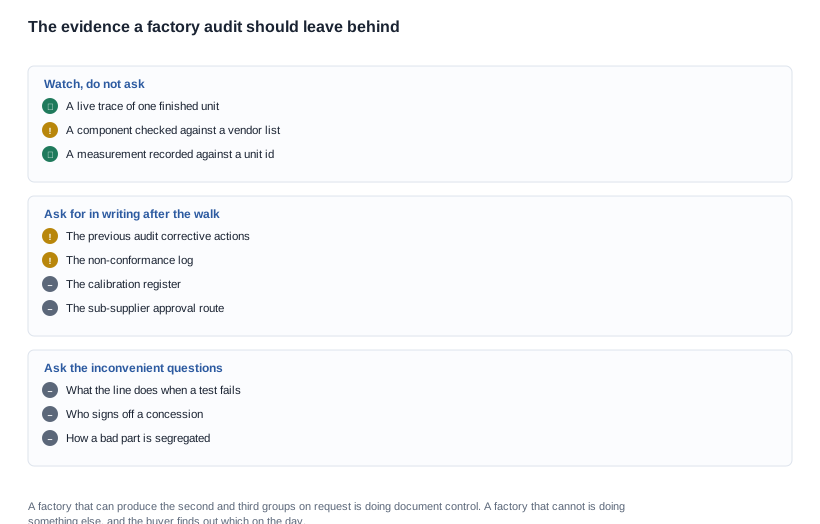
Four questions in this order are enough to establish which quotation is complete. A comparison between suppliers only works when both have answered the same questions, and in this category most do not, because the questions are about the supplier's own process and a supplier with a brochure has no answer to them.
What to take away from the day
The output of a factory audit is not a report. It is three things, and each of them has a specific use afterwards.
A findings list with owners and dates, which becomes part of the order. Every item on it should be convertible into a clause: a corrective action requirement, a right to re-audit, a notification route for a sub-supplier change, a notice of a process change, or a link between the audit findings and the incoming acceptance rule.
A document request list, which is the list of things the factory could not produce on the day. That list is the most informative thing the buyer leaves with, because it separates what the factory does from what the factory claims to do. A factory that produces everything asked for has a document control system; a factory that produces nothing has a capability document and a visitor-friendly tour.
A priced list of what the audit bought, in the form of questions answered. A pre-shipment inspection bought as a formality is an expense without a control, and the way to tell the difference is to ask what it is for. If the answer is "to confirm the goods are as ordered", that is a control. If the answer is "to release the shipment", that is a signature.
The criteria for comparing two audit outcomes
Two suppliers can both welcome a visit and produce completely different sets of findings, and the comparison only works if both were asked the same questions. These are the criteria worth scoring, and they are weighted deliberately towards evidence rather than towards impressions.
- Scope coverage. Which steps of the production route were walked, stated as a list rather than as a description. Completion: every step either observed or explicitly listed as unvisited.
- Live traceability. Whether a finished unit was traced back to its components during the visit, or whether a trace was described. Completion: a trace performed in front of the buyer.
- Measurement records. Whether bench results are recorded against a unit identifier. Completion: a sample of records carrying identifiers.
- Calibration linkage. Whether the instruments named in the measurement plan hold current certificates. Completion: the plan and the certificates side by side.
- Non-conformance handling. Whether a disposition log exists and who signs a concession. Completion: a log and a named role.
- Document production. Which of the requested documents were produced on the day. Completion: a list with the missing items named.
Scored against those six criteria, a supplier that answered five of them is a different kind of counterparty from one that answered two, and the price difference between them is usually smaller than the exposure difference between them. That is the arithmetic a buyer is making when deciding which audit report to trust.
The trade-offs a visit involves are real and worth being explicit about. A visit costs a day of the supplier's engineering time, and some of that time comes out of the capacity the supplier is selling. A buyer who arrives with a long checklist is partly buying a slower delivery, and the supplier's willingness to absorb that cost is itself a signal: a supplier who treats an audit as normal work is a supplier whose process can be audited, and one who treats it as an intrusion is telling you something about the process as well.
Before you order, the practical checklist is short. Ask for the configuration string and the measurement plan. Ask for the calibration register and the non-conformance log. Ask for a retained sample from each of the last two lots. And ask which single step of the route is furthest from a recorded decision. Four requests, and the fourth produces more information per minute spent than the other three together, because it asks the factory to do its own assessment rather than to present one.
The red flags worth naming are specific rather than atmospheric. An audit pack that arrives pre-written, before the visit. A scope that stops precisely where the process gets complicated. A traceability demonstration that ends at the carton. A measurement plan with no written limits, or limits that are not anywhere the operator can reach. And a supplier that is visibly uncomfortable by one particular question — because that is usually the question worth asking a second time.

When a visit is worth the day, and when it is not
Four positions, and what each one calls for
Not every programme needs a trip, and spending a day on a first-order trial with a low-value exposure is a poor trade. The decision turns on what the visit would settle that nothing else would.
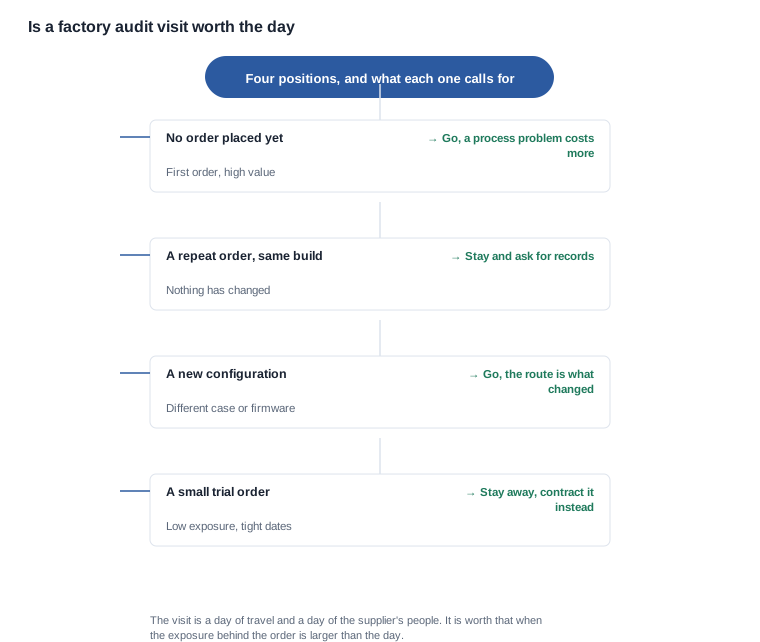
A first order with a high value is the case for going. There is no process history, no reference production run and no evidence of any kind, so the audit is the only source of information available, and a process problem found on day one is a schedule adjustment while a process problem found on day one of production is a write-off.
A repeat order on the same build is the case for staying away, provided the factory produces the records the last visit established it had. Nothing has changed, so a visit would produce the same result at a new cost. The substitute is a document request: the calibration register, the non-conformance log for the last run, and the lot records for the last delivery, with a spot check of one unit against them.
A new configuration is the case for going, because the route is what changed. A new case option, a new colourway, a new firmware build or a new destination market can each change a station on the route without changing the product description at all. This is the case where the published configuration options matter most, because the number of things that have changed is usually larger than the buyer expects.
A small trial order is the case for staying away and putting the controls into the contract instead: the acceptance rule, the change-notification clause, the retained sample requirement and the right to re-audit. The trial order is the mechanism that produces the evidence, and the contract is what makes the evidence usable.
What the visit costs, and what it buys
A first audit is usually free and is almost always worth doing before a first order. Additional audits and pre-shipment inspections are usually charged, and the question to ask is what each buys, because a pre-shipment inspection bought as a formality is an expense without a control. A second audit is worth paying for when the first one produced findings, because the purpose of the second is to check closure rather than to walk it again.
The commercial framing matters too. A supplier that accepts the five clauses listed above has accepted that its process is a shared risk, and the cost of that acceptance is usually visible in the price. A supplier that declines them has not necessarily refused a burden — it may simply not have the process behind them, and the useful question is then whether the process behind the refusal is sound, not whether the clause will be accepted. Where the answer is no, the right response is not a long negotiation; it is a narrower first order with tighter controls.
A visit reasoned through, and where Cynrin stands
An audit day, reasoned through
The day described below is a constructed one. No client and no production order is claimed; the camera model with its charging case, the European destination, the sizeable first order and the supplier's pre-written audit pack are all assumed, so that the order of the walk and the findings it produces can be followed.
The scenario: a brand is opening a programme with a new supplier for a camera model with a charging case, into a European market. The order is large enough to matter and the exposure is high, so a visit is being considered. The supplier has sent a capability document, a company-level statement about export certification, and a set of photographs.
The first conversation is about scope, and it is where the visit earns its cost. The supplier's written scope covers final assembly and packing. The production route has seven steps, and two of them are not in the scope: incoming inspection and the test bench. The buyer asks for the scope to be extended to cover both, and the reason given is access to a sub-supplier's area and to a measurement plan that is still being revised.
That answer is informative, and it is not a refusal. A sub-supplier's area is not walkable, so the component trace has to happen by another route — asking for the incoming inspection records and the component approval list, and testing whether the records are per lot and per decision rather than per week. A measurement plan under revision is a normal condition in a first programme, and it is also the reason the bench questions come first on the schedule rather than after lunch.
The component trace forward then produces a finding. The cell on the line is from a supplier that appears on the approved list, but the case is not, because the case is a new part for this programme and its approval is still pending. That is a normal state of affairs on a first order and it is also exactly the substitution that a first programme cannot afford to have arrive unannounced, which is why the change-notification clause moves to the front of the list of things to settle.
The bench check produces a second finding. The instrument used for the runtime measurement has a current certificate, but it is not on the measurement plan, and the plan names an instrument that is used on another line. The measurement itself is being recorded against a unit identifier, which is the good news; the limit is the bad news, because the limit is internal and unpublished, and it happens to be the limit the buyer would have chosen. The buyer's position is straightforward: the published runtime band for the model is the reference, and a supplier that measures against a tighter internal limit is welcome to keep the internal limit and to record the result against the published band as well.
The unit traced backwards from the end of the line reaches a lot, and the lot reaches a delivery note, and the delivery note reaches a date. The link is manual rather than electronic, which is a fact worth recording rather than a failure worth stopping for. At despatch, the cartons carry a lot mark, and the factory holds retained samples from the two most recent lots.
The outcome of the day is therefore a findings list with five items, a document request with four entries, and a priced list of what was bought. The first order proceeds, with a narrower configuration than the buyer had planned, because the case approval was not complete, and with the acceptance rule written against the published rows rather than against the internal limits.
The factory-side rows we can evidence
Concretely, the published material on the factory side is the part of the specification we can stand behind, and the rest is a question for the supplier's own file. We publish what our documentation states, we mark the rows that are open, and we will not fill an open row with a typical figure from a supplier's general data. A buyer who builds a claim on an estimate finds the error in the field rather than in the quotation, and the correction runs to more than the question did.
The rows our published data does settle are these: the resolution tier on each of the eleven camera models, the cell capacity and cell count on every model, the charging method on twenty-four of the twenty-eight models, the case options, the colour availability, the runtime bands, the ingress marking on the two models that carry it, and the one published weight — the MT6 glasses body at 158 g including its 265 mAh cell and its camera and excluding the 1200 mAh folding charging case, whose own weight is not published.
What we will not do is quote a process capability from a photograph, or fill a specification gap with a number that cannot be traced to a document. What we will do is take a use case, a configuration and a market, and tell you which parts are settled, which are open, and which have to come from a sub-supplier rather than from the main floor.
The audit documentation framework is at factory audit and verification, the clauses that connect an audit to the commercial relationship are at contract terms, and the product range the audit is run against is at AI camera glasses.
The action to take now. Send the models, the quantities and the target market, and we will tell you which configurations exist, which of them are open on the published data, and what an audit on that configuration would need to settle before the first order is released. A visit is worth the day when it settles something a document cannot, and the cheapest way to find that out is to decide before the trip rather than after it.
Related reading
Send the configuration, the quantity and the market, and we will say which parts of the audit are settled and which are yours.


