

Around an ingress rating there is a vocabulary of claims, and almost every word in it is a description rather than a specification. IP rating smart glasses manufacturer claims is a read that sorts that vocabulary, identifies the phrase that causes the most damage, and gives a sequence for checking any of them against the document behind it.
The sorting principle is simple enough to apply in a meeting. If a claim cannot be falsified by a defined procedure, it is a description, and descriptions belong in a marketing position rather than in a specification. A code with a report number behind it is the only testable claim in the set. Everything around it — waterproof, water resistant, splash proof, dust proof, fully sealed, military grade, rugged — has to be judged against what the code actually excludes, and the interesting part is that none of them is false in the way a fabricated rating is false. They are all wider, which is a slower failure and a more expensive one.
The boundary we hold: we publish the code and not the phrases, and this is the correct order of priority. In our catalogue the IP54 marking appears on the V06 and the S7, as an annotation, with no third-party test report number, no standard, no test condition, no sample size and no laboratory behind it, because the company has not confirmed them to us. No other model in the range carries a published rating.
IP rating claims: nineteen paraphrases, one testable code
The short answer, and the test that sorts them
Every claim in this category answers the same question in a different way: what happens if a customer checks it? If the answer is that the customer will test the product and the product will pass, the claim is testable, and it belongs in a specification. If the answer is that the customer will read the sentence and act on it, the claim is a description, and it belongs in marketing copy — where it creates an obligation that nobody in the supply chain intends to honour.
That distinction is worth more than it sounds, because descriptions have a shelf life and specifications do not. A description travels: it gets copied from a catalogue into a listing, from a listing into a comparison table, from a comparison table into a review, and from a review into the buyer's expectation. A specification stays where it was written and can be checked, corrected or withdrawn without consequence. The whole commercial risk in this category comes from descriptions travelling.
There is a second-order effect that buyers underestimate. Once a range carries an adjective rather than a code, the adjective attaches itself to the other models. A listing that says "waterproof" beside one SKU establishes, for the reader, a category expectation that the other SKUs in the same range do not meet — and the complaints then arrive against products that nobody claimed were waterproof. The claim was published about one product and consumed as a range-level promise.
The buyer reading a supplier's own ingress copy
The person doing this reading is usually comparing two or three suppliers' ingress claims for a listing or a technical file, and is holding the marketing material, a target market list and a channel plan. What they will not be holding is the report, and they will not know to ask for it, because the claim reads as complete. A copy that says "IP54 rated, tested to international standards" reads like the end of the conversation.
The reason to ask for the report anyway is that the claim and the report are different documents with different scopes, and the gap between them is where the buyer's exposure lives. A supplier with a report can narrow their marketing to what the report says, because they know where the edges are. A supplier without one is relying on the reader's imagination, and the reader's imagination is not a commercial strategy.
What the buyer is actually trying to avoid
Two inconsistent claims on the same page. "Waterproof and IP54" in the same product block is the classic version of this, and it is a promise the code does not support. The customer who acts on the promise is entitled to complain, and the complaint will be about the copy rather than about the product, because the copy is the thing that made the promise.
A claim that describes a design rather than a test. "Fully sealed" states a design intent. "IP54" states a measurement of a configuration. The two can coexist in the same factory and mean completely different things, which is why the document question has to be asked of the claim rather than of the factory.
A claim made on a model that does not carry the marking. A rating quoted for a sibling model is the second most common failure after the paraphrase, and it is the one that tends to survive review because the model names look similar in a catalogue.
A claim that cannot survive the customer's own test. In the outdoor channel the customer is the person who tests the product in the rain, and a claim wider than the evidence produces a return with a photograph attached to it.

The vocabulary manufacturers use around an ingress marking
The claim set, and what each phrase costs
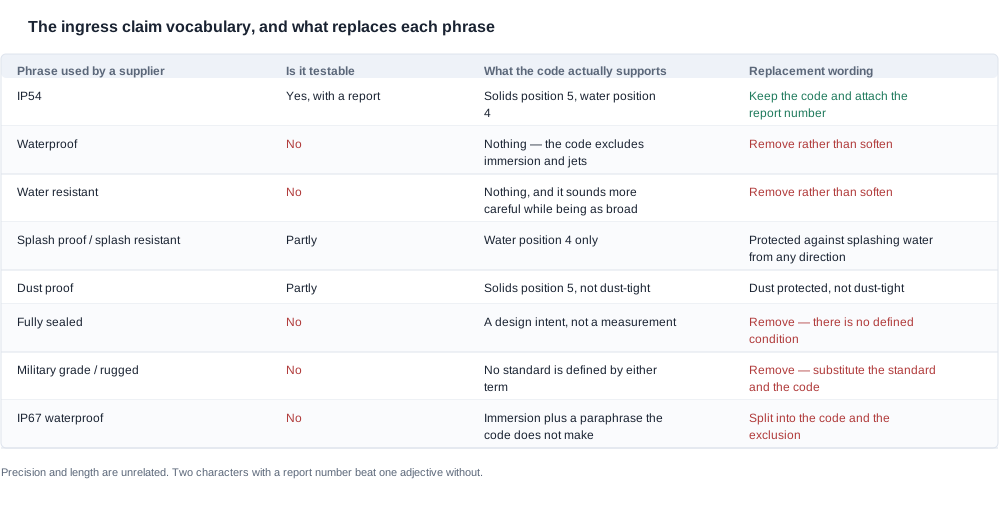
The table below is the working vocabulary. The third column is the one that matters, because it is the column that decides whether the phrase can stay on a page or has to be replaced. What to ask the supplier is in the fourth position throughout, and the honest answer to most of these rows is a document rather than a confirmation.
| Phrase in supplier copy | Is it testable | What the code actually supports | What to ask instead |
|---|---|---|---|
| IP54 | Yes, with a report behind it | Solids position 5, water position 4 | The report number, the standard, the edition, the date |
| Waterproof | No | Nothing — the code excludes immersion and jets | Remove it rather than soften it |
| Water resistant | No | Nothing, and it sounds more careful while being exactly as broad | Remove it rather than soften it |
| Splash proof, splash resistant | Partly | The water position of 4 only | Protected against splashing water from any direction |
| Dust proof | Partly | Solids position 5, which is dust protected and not dust-tight | Dust protected, not dust-tight |
| Fully sealed | No | A design intent, not a measurement | The standard and the tested configuration |
| Military grade, rugged | No | No standard is defined by either term | The standard and the code, or nothing |
| IP67 waterproof | No | Immersion, plus a paraphrase the code does not make | Split into the code and the exclusion |
| Built to survive | No | Nothing | The specific mechanical test, if one exists |
| Tested to IP standards | No | Nothing — it names no standard and no level | Which standard, which edition, which level |
| Checked every batch | No, as written | A frequency without a method or a record | The method, the frequency and the sample count |
The row that causes the most damage is "water resistant". "Waterproof" is at least obviously absolute, and an editor or a reviewer can catch it. "Water resistant" sits in the middle of a register where readers assume a positive claim, and it survives more review stages than it should, because it does not look like an over-claim.
The row that survives the longest is "tested to IP standards". It contains a real verb and a real reference to a real standard, and yet it establishes nothing, because it names neither the standard's edition nor the level nor the configuration. It is worth treating as a document request in the same way as a bare code.
The three levels of claim, and who each one is for
Claims sit at three levels, and a buyer needs to know which level each surface is operating at before approving it.
The first level is the document level: the code, the standard, the report number and the model list. This is the only level a compliance reviewer, a retailer or a broker will accept, and it is the only level that can be filed. The second level is the paraphrase level: the plain-language rendering of the code, written so that a customer can act on it accurately. This is the level the product page and the retail listing should operate at, and it is where most of the actual communication happens. The third level is the aspiration level: fully sealed, military grade, rugged, built to survive. This level has no defined condition, so it can never be defended, and it should not appear on a surface a customer can act on.
The mistake that shows up in practice is not usually the presence of the third level. It is the third level sitting next to the first level on the same surface, where the reader takes the stronger of the two.
Why the length of a word is not the strength of a claim
Two characters and a report number beat one adjective and no document, and the reason is not rhetoric. It is that the code names a procedure and the adjective names a feeling. "IP54" tells a buyer that somebody ran a defined test on a defined configuration and can be asked about it. "Waterproof" tells a buyer nothing except that the writer wanted to reassure them, and a customer who wants to be reassured will test it instead.
The practical consequence for procurement is that claims have to be reviewed at the surface where they will be read, not at the surface where they were written. A manufacturer's catalogue copy is often careful and a retail listing built from it is often not, because the listing writer took the adjectives and dropped the conditions.
The claim audit: what each phrase has to be replaced with
Running the audit on a page
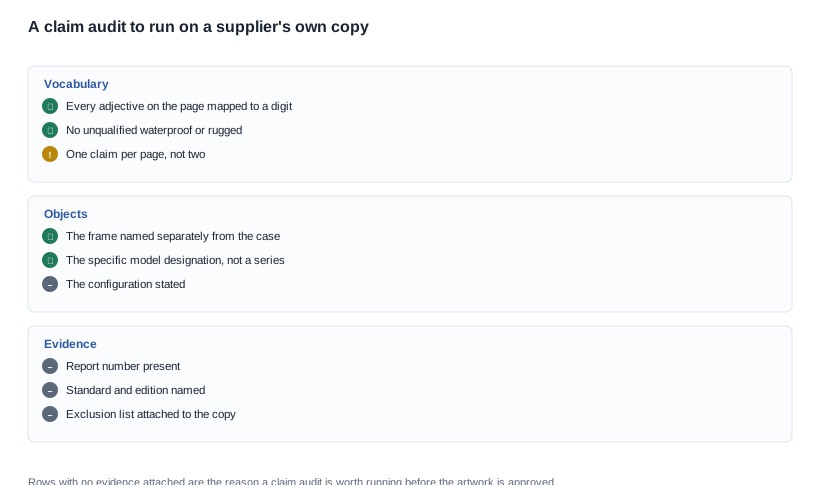
The audit below is a checklist that can be run on any supplier's own copy before the quotation is answered. The criteria are deliberately narrow: the audit is about whether each phrase is anchored to a document, not about whether the product is good.
| Audit area | The check | Pass line |
|---|---|---|
| Vocabulary | Every adjective on the page mapped to a digit | Each adjective resolves to a specific position |
| Vocabulary | No unqualified waterproof, water resistant or rugged | Removed, or replaced with the code in words |
| Vocabulary | One claim per page, not two | The paraphrase and the code agree or only one appears |
| Objects | The frame named separately from the charging case | Two objects, two answers |
| Objects | The exact model designation, not a series name | The designation that appears on the report |
| Objects | The tested configuration stated | Ports, contacts and interfaces |
| Evidence | Report number, standard and edition present | Checkable by a third party later |
| Evidence | The exclusion list attached to the copy | Not filed separately from the copy |
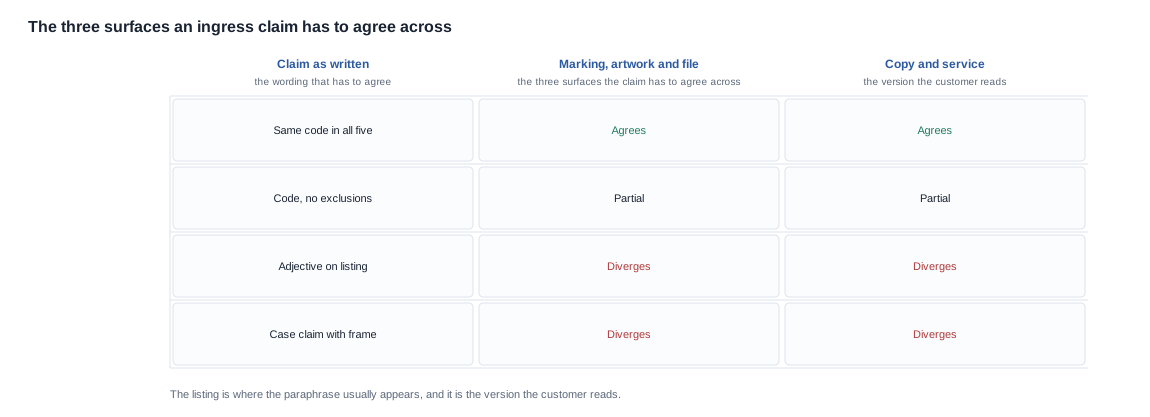
| Consistency | The same code on device, packaging, documentation and listing | All four agree |
The decision that has to be made for each claim
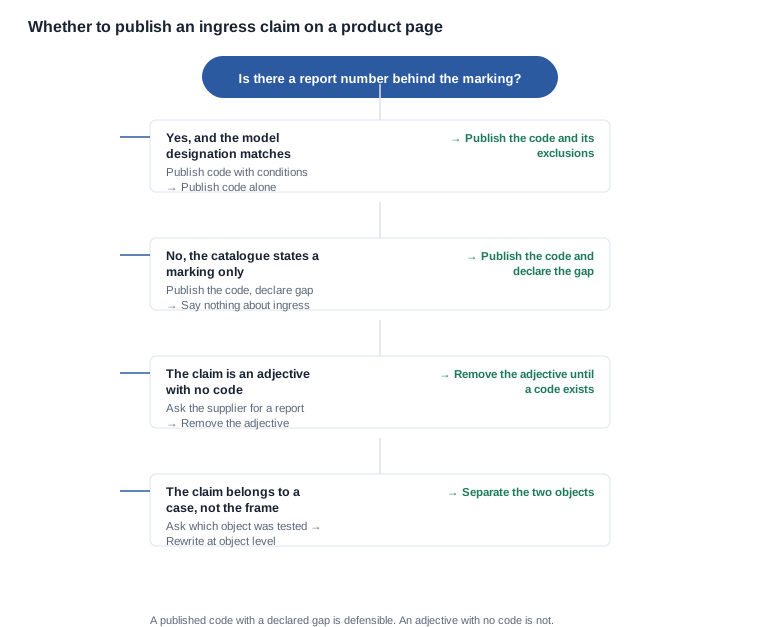
Auditing produces a list, and a list is not a decision. For each phrase that fails the audit there is one of four outcomes, and the outcomes are not interchangeable.
If a report exists and the model designation matches, the phrase is replaced with the code and its conditions, and the report number is attached. If no report exists but the catalogue states a marking, the code is published together with a declared gap, which is a defensible position and an honest one. If the phrase is an adjective with no code behind it, it is removed until a code exists, because an adjective cannot be narrowed into accuracy — "water resistant" is exactly as unanchored as "waterproof" while sounding more careful. And if the claim belongs to a different object from the one being described, it is rewritten at object level or removed.
The removal case deserves one more sentence because it is the one buyers resist. When an adjective is removed, the product does not become worse and the listing does not become weaker; it becomes accurate. The measurement of whether a listing is working is not how many adjectives it carries, it is how few disputes it generates. A narrow claim generates fewer disputes and converts fewer customers into complainants, because a customer who has read an accurate claim has made an informed decision.
The decision, and the thresholds inside it
The thresholds worth fixing in a claim audit are all about scope rather than about wording. Which object was tested. Which model designation the document names. Which configuration was fitted on the sample. What the code excludes. What the document's validity dates are. Whether the phrase appears on a surface the customer can act on.
There is one threshold that is commercial rather than documentary, and it is the one most often missed. A claim that describes the factory's design intent — fully sealed, sealed to the core — describes a property of every unit the factory makes. A claim that states a code describes a property of a tested configuration. These two have different exposure profiles, and the second is the one a buyer's file can hold.

Checking a claim against the document behind it
Five checks, and the order that makes them cheap
Verifying a claim runs in a fixed order, and the order is chosen so that the cheapest disqualifying check comes first.
The first check is on the copy alone, before any question is asked. Run the audit on the text as written and list the signals. A claim that fails here is either rewritten or removed, and that decision does not depend on any document, which is why it can be taken immediately. The second check is to ask for the report number, the standard, the edition and the date, in that order, in one email. The third is to resolve the number in the issuing body's register and confirm the model designation, the covered functions and the validity date, which takes minutes and is the highest-yield check in the category.
The fourth check is to compare the three documents against each other: the device marking, the documentation and the packaging artwork. Where they disagree, the packaging is usually the outlier, because the packaging was approved first and reused longest. The fifth check is the one that closes the loop: read the exclusion list and check the retail listing wording against it, line by line, with the listing author present if possible. That last step is where the paraphrase is usually found, because the paraphrase is usually written by someone who did not read the report.
What to ask, and what a complete answer looks like
The question set is short, and the value is in asking all of it in one message rather than in the individual questions. Which of these claims are backed by a document and which are descriptions? If there is a code, what is the report number, the standard, the edition and the date? Which configuration was tested, including the battery and the case? Is the code the same on the device, in the documentation and on the packaging? How is the rating held in production, and is there a reference unit and a test frequency? And what does the retail listing wording say, and is it consistent with the code.
A complete answer to that set is a supplier who can be audited. A partial answer is a supplier with a document for one part of the range. An evasive answer is a supplier whose claims are descriptions, and the criteria to apply at that point are commercial: narrow the claim to what they will evidence, or price the gap, or find another supplier.
The production control, which is the difference between a claim and a process
The last element worth separating is the production control. A reference unit, a defined test frequency and a known seal material are what keep a type test true on the tenth thousand unit. A supplier who has them has a process; a supplier who does not has a result. For a buyer with a repeat-order intention, this is often a more important question than the report number itself, because the report describes what happened once and the production control describes what will keep happening.
Asking for the reference unit specifically is the move that reveals the difference, because a supplier without one cannot offer it, and a supplier with one will send it.

Five ways a paraphrased claim becomes a commercial dispute
A page says waterproof and the customer returns the unit after rain. The symptom is a return with a complaint attached that describes the product as broken. The root cause is that two claims sat on one page and only one of them was testable, and they did not agree. The prevention is one claim per page, and the claim is the code with its conditions.
The claim is quoted from a sibling model. The symptom is a customs query or a marketplace rejection, because the document names a different model than the goods. The root cause is that equivalence was assumed from similarity. The prevention is to ask which model designations the report names and to make the exact designation a condition of the purchase order.
The code on the box does not match the code in the documentation. The symptom is a listing correction, or a refusal, in a channel where the packaging artwork was frozen first. The root cause is that the packaging was designed before the documentation was updated. The prevention is to check the three documents against each other before approving the artwork, which is a ten-minute job at the right moment and a reprint at the wrong one.
The claim is fine in year one and the returns start in year three. The symptom is a slow drift in the return rate with no cluster to investigate. The root cause is that no production control was established, so a substitution or a process change went unnoticed. The prevention is to ask for the reference unit and the test frequency, and to require the test result on incoming lots.
A technical file contains a phrase rather than a code. The symptom is a reviewer's comment asking which document supports the wording. The root cause is that the phrase was copied from a marketing page into the file. The prevention is to go through the file and replace every phrase with the code and its conditions, then attach the exclusion list to the same page.
One claim per surface, and what we will and will not print
The commercial terms that apply to a claim-led programme
Where the claim is the differentiator, the commercial negotiation is about evidence rather than about units. The per-variant cost of a documentation-only change is usually negotiable, because no hardware is touched. The number of units per variant is negotiable, and more so on a repeat order. Delivery splitting against a documentation-review milestone is often granted more easily than a price concession, because it moves the risk onto the review rather than onto the shipment.
Payment node structure is the term with the most weight here. A deposit, a balance on inspection before shipment, and a retention held against the documentation package protect the buyer on the failure that costs most in this category, which is a product that arrives with a marking nobody can evidence. What is not negotiable is the certification cost and certification time, which are a per-configuration cost and a laboratory queue respectively. A one-off charge spread across the first order is what the tooling line is, so two answers are needed: how far the amortisation runs, and where the tooling and the sealing tooling stand once the programme is discontinued. And the seal itself is not negotiable: a supplier who will not change the seal material, the seal geometry or the port design is telling you the ingress performance is fixed.
One term is specific to claims rather than to qualification. If the copy is the differentiator, the artwork approval is a commercial milestone rather than an administrative one, and the artwork round count should be negotiated explicitly rather than assumed. It is also worth agreeing, before the first proof, who owns the final wording and what happens if the supplier's marketing team reinstates an adjective the buyer has removed.
A worked scenario: an online channel auditing three supplier listings
This is a hypothetical case rather than a client project, and it is included to show how a claim audit changes a shortlist.
Assume an online channel buyer reviewing three suppliers' sport eyewear listings, each of which carries an ingress claim of some kind. The first says "IP54 rated, tested to international standards". The second says "IP54 — dust protected, splash protected, not for immersion". The third says "fully sealed, military grade, waterproof".
The first claim fails on vocabulary but may pass on evidence, because "IP54 rated" at least names a code and the supplier can be asked for a report number. The second claim passes the vocabulary check on its face, and the remaining question is whether the report number, the standard and the model list hold up. The third claim fails outright: it carries two undefinable terms and one absolute term, and it names no code, so there is no document to ask for and nothing to narrow the claim to.
The result is a shortlist of two rather than three, and — more usefully — a decision made on criteria rather than on price. The buyer then runs the document check on the two remaining suppliers and finds that one report names a model list that does not include the channel buyer's own private-label configuration, while the other does. That turns a marketing question into a procurement question, which is where it belongs, and it happens before a purchase order rather than after a customs query.
The commercial conclusion is that the cheapest supplier was never the cheapest. The claim audit cost one afternoon and one email, and it removed a supplier whose copy would have generated the returns.
What we publish, and what we will not print
Concretely, a claim is worth what its evidence is worth, and the only honest way to publish an ingress claim is as a code with its conditions. We publish the IP54 marking on the V06 and the S7 exactly as the catalogue states it, we publish no rating where none is stated, and we will not describe a splash-protected product as waterproof, rain-capable or immersible.
We will also be candid that our own claim has the same shape of limitation. We publish the marking because the catalogue states it, and we publish the absence of the report number with the same prominence, because a buyer who is checking claims should be able to check ours too.
What we can do is tell you which of a supplier's claims are anchored to a document and which are descriptions, and how each paraphrase changes the product's exposure. The background is under IP ratings and durability, the verification procedure is in how to measure and verify an IP rating, the screening list is in IP rating red flags, and the range is sport smart glasses.
Four things to do with a supplier's copy this week
Run the vocabulary audit on the page as written, before you ask anything, and mark every adjective that does not resolve to a digit. That list is the set of phrases to remove, and it can be produced without any document at all.
Send the six-question set in a single message, and treat a partial answer as an answer about a partial range. Check the three surfaces — device, documentation, packaging — against each other rather than against your notes. And decide, per surface, whether the claim is a code with conditions or nothing at all.
Where the claim-reading method comes from
Send us a supplier's ingress copy and we will tell you which parts of it are anchored to a document.


