

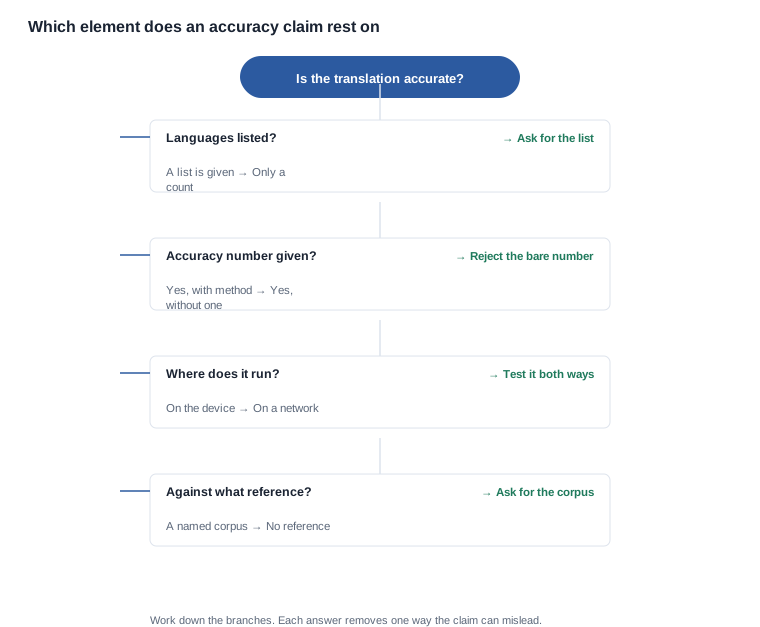
"Is the translation accurate" cannot be answered with a percentage, and the reason is not that the percentage is unavailable but that the word accuracy does not name a measurable thing on its own. It hides at least five separate questions inside it: which languages, in which direction, using which pipeline, judged against which reference, and under which conditions. Two products can both be described as accurate and be entirely different products, and the difference between them lives in those five answers rather than in a single number. The catalogue publishes nothing about any of the five, which is the central fact of this article — but the catalogue does publish something adjacent that is regularly mistaken for a translation specification, and separating the two is the useful part.
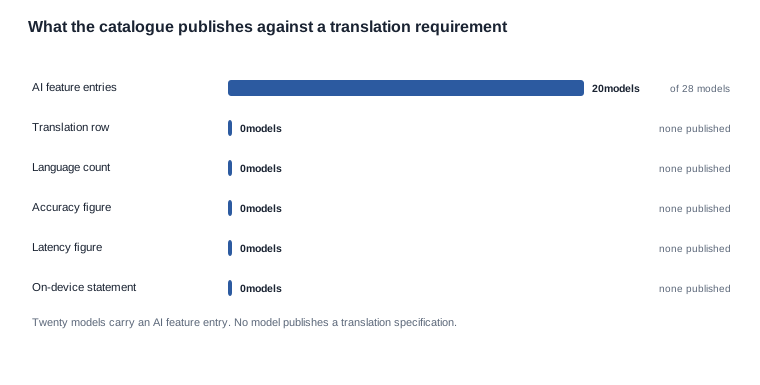
That adjacent fact is the AI feature entry count. Twenty of the twenty-eight models in this range carry AI feature entries, and the presence of an AI entry tells a buyer that the model is positioned into the AI category of the catalogue. It does not tell a buyer which languages the model handles, whether it works on speech or on text, whether it runs on the device or over a network, how long it takes, or how well it does. Nothing in the catalogue connects an AI entry to a translation row, and no model in the range publishes a translation row at all.
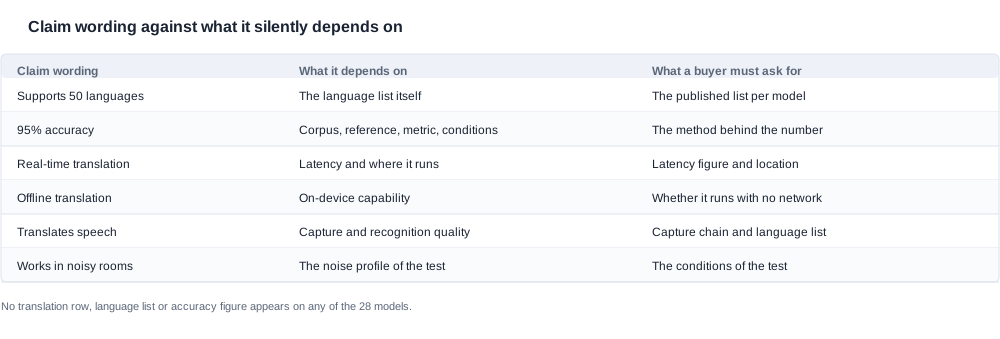
is the translation accurate: what the catalogue publishes, and what it does not
The catalogue text contains no translation specification for any model. There is no language list and no language count, no statement of whether the models handle speech, text or both, no recognition model, no translation model, no indication of whether processing happens on the device or remotely, no latency figure, no accuracy percentage, no benchmark name, no evaluation corpus and no reference set. The pages that carry an AI entry carry it alongside the standard rows — a cell, a charge ceiling, a runtime band, a charging method and, on some pages, a Bluetooth version — and nothing that a buyer could use to evaluate a translation claim.
Two details in the range make this worth spelling out rather than leaving as an omission. The first is that the entry count and the capability are genuinely different things. A buyer reading a catalogue that says twenty models carry AI features is reading a statement about how the range is organised, not about what those models can do. The second is that the absence of a translation row is not unusual in this category — an audio or camera product page publishes hardware rows, and translation is usually documented in the software section rather than on the product page — which is exactly why a buyer should ask for it rather than assume it is missing from the supplier's knowledge.
There is a third point about what the range does publish, and it bears directly on how a translation programme has to be specified. The catalogue publishes a Bluetooth version for the eight audio models — 5.3 on the K01 and the K02, and 5.4 on the D12 and the YK12, the D11 and the G07, and the LC-105-1 and the LC-105-2 — and publishes none for the eleven camera models. It publishes a cell, a charge ceiling and a runtime band for all twenty-eight. It publishes a resolution class for the eleven camera models and an ingress marking for the V06 and the S7. None of these rows says anything about a translation capability, and none of them is a substitute for one.

Why an AI feature entry is not a translation specification
The AI feature entry count is the most quoted structural fact about this range and the most frequently over-read. Twenty of the twenty-eight models carry an AI feature entry. What that number describes is a catalogue organisation: the range is split between entries that carry an AI feature line and entries that do not, and the ones that do not include the three children's models and the three entries without a stock keeping unit. It is a statement about how the products have been positioned, and it is published without any description of what the feature does.
Four inferences are routinely drawn from it, and none of them holds. That an AI feature is a translation feature does not hold, because no model publishes a translation row and no model publishes a language list. That the twenty models share one implementation does not hold either — the catalogue publishes no firmware structure, no shared platform statement and no common feature list, so a buyer should treat each model's behaviour as its own until the supplier says otherwise in writing. That the AI feature requires a network does not hold, because the catalogue publishes nothing about where processing runs. And that the AI feature is the reason to buy does not hold, because the catalogue gives no basis for comparing an entry that carries one against an entry that does not.
What this means operationally is that the AI feature count can structure a shortlist but cannot qualify a model. A buyer who wants translation in the product has two separate work items: a capability work item, which is the six-item request set below, and a commercial work item, which is the device, the connectivity and the operating arrangement that will carry it. The first is a document request; the second is the same decision every connected product carries. Treating them as one item is how a programme ends up with a capability question answered by a category count, and how a listing ends up claiming a capability nobody has tested.
There is a further consequence for the requirement brief, and it is worth putting in writing at the front of the file. Because the catalogue publishes no translation specification and no per-model feature description, the requirement cannot be written as "support the AI features of the model". It has to be written as the five elements below, each with a value and a source, which makes the brief longer and considerably more useful. A brief written this way also has the advantage of being answerable by a supplier who has never seen the catalogue, which is exactly the supplier a buyer wants to be able to compare against.
The five elements that an accuracy claim rests on
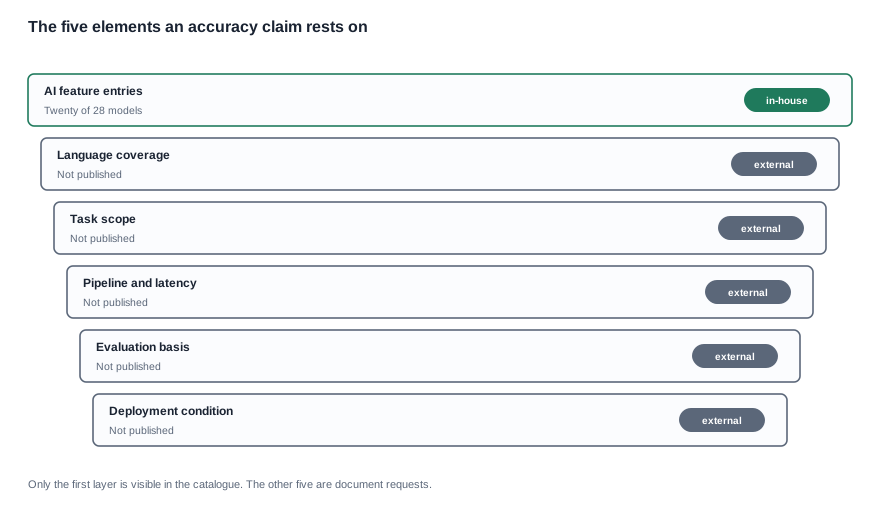
The reason an accuracy number cannot be quoted on a page is that it is meaningless without the five elements underneath it. These are the elements, and each one is a question to a supplier rather than a number to look up.
-
Language coverage. Which languages are handled, in which direction, and whether the list is symmetric. A claim of "supports fifty languages" is meaningless without the list, because the list is what tells a buyer whether the pair their programme needs is on it. The catalogue publishes no language count and no language list for any model, so this element has no published answer at all, and a supplier who quotes a count should be asked for the list and for the direction each language works in.
-
The scope of the task. What is being translated and how the result is delivered: speech to speech, speech to text, text to speech, or text. A speech-to-speech pipeline and a speech-to-text pipeline differ by a stage, and that stage carries its own accuracy behaviour, its own latency and its own file handling. A programme that needs one cannot be evaluated on the performance of the other, and a supplier who says "it translates" has not said which of them is on offer.
-
The pipeline itself. Which recognition and translation systems are used, where the processing runs, and what the latency is. This is where the on-device versus network question belongs, and it is a commercial question as much as a technical one — a network-dependent feature behaves differently in a market with poor connectivity, and a buyer shipping into several markets cannot write one claim that holds in all of them.
-
The evaluation basis. The corpus the system was tested against, the reference used to judge it, the metric applied, the number of samples and the conditions under which they were collected. An accuracy percentage without these five is a number with no meaning, and the request is straightforward to make: any percentage a supplier offers should arrive with the corpus and the metric attached. A supplier who cannot supply them is not withholding a commercial secret, because an evaluation corpus is a description of a test rather than an implementation detail.
-
The deployment condition. Accent, background noise, domain vocabulary, network quality and the proficiency of the person speaking. This is the element that separates a demonstration from a deployment, and it is the element that a procurement team most often forgets to write down. The accuracy of a quiet, native-speaker reading from a script in a treated room is a property of the test, and the same system in a noisy street with a domain vocabulary will behave differently in ways that no published figure predicts.
The five elements in one view:
| Element of an accuracy claim | The question a buyer must ask | Published status |
|---|---|---|
| Language coverage | Which languages, in which direction | No list and no count |
| Task scope | Speech to speech, or speech to text | No statement either way |
| Recognition and translation pipeline | What runs where, and how slowly | Undescribed |
| Evaluation basis | Which corpus, reference and metric | No figure and no method |
| Deployment condition | Which noise, accent and vocabulary | Undescribed |
The five elements are also the reason that a competitor comparison is usually a comparison of claims rather than of systems. When two product pages both say accurate and neither says against what, the comparison establishes nothing, and a buyer who treats the marketing line as a specification will discover the difference in the field rather than in the evaluation.

How to ask for an accuracy answer that can be filed
The request set is short, and it is the same set regardless of which model is being evaluated. Six items close the five elements.
The language list, per model, with direction. This is a single sheet and it closes element one entirely.
A statement of the task scope, so that speech-to-speech and speech-to-text are not being compared. It closes element two and prevents the most common category error in translation comparisons.
A pipeline description, stating where the processing runs and what the latency is, with the network dependence made explicit. It closes element three and it is the item that a buyer with several destination markets most needs, because it determines whether the feature is viable in each of them.
The evaluation basis, attached to any accuracy figure offered. If no figure is offered, the request is for a test protocol and a metric that the buyer accepts, which is a stronger position than a borrowed number because it is written before the sample arrives.
A deployment profile, stating the conditions under which the feature is expected to work: noise, accent, vocabulary and network. It closes element five and it is the line that converts a feature into a requirement.
A re-test commitment, stating what happens if the feature does not perform as claimed in the buyer's own conditions. It is the commercial term that attaches to element four, and without it the evaluation is advice rather than a control.
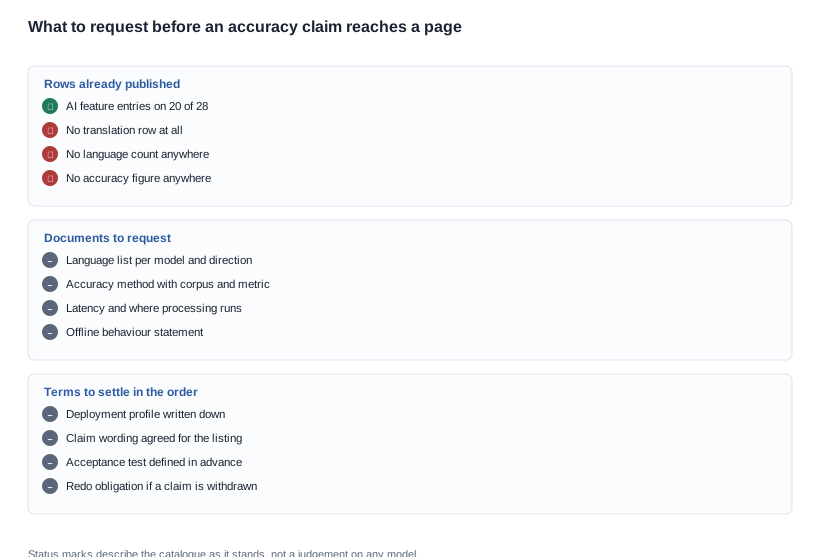
The quality of the answers is itself worth assessing, because the request set above produces very different results depending on what comes back. The best answer is a language list with directions, a stated task scope, a pipeline description that says where processing runs, and an evaluation basis attached to any figure offered. That answer lets a buyer decide, before a sample arrives, whether the feature is even in scope for the programme. The ordinary answer gives the language list and the task scope and stops, which still settles the two elements that most often disqualify a model. The poor answer gives a count of languages and a percentage with nothing attached, which settles nothing and has to be returned with the specific question that was missed.
A buyer who has to return an answer twice should record what was missing, because the missing item is usually the one the supplier does not consider part of the product. Asking for a corpus for an accuracy figure is a request about methodology, and a supplier who has never been asked for one may not have one. That does not make the answer unacceptable, but it does mean the accuracy claim has to be reclassified from a specification to an assertion, and the listing has to be written accordingly. Reclassifying early is cheap. Reclassifying after a launch is a withdrawal.

What an unsupported accuracy claim costs a programme
The commercial argument for doing this properly is worth setting out, because the cost of a wrong accuracy claim is not distributed evenly across a business. The direct costs are familiar: returns, support contacts, the reputational effect of a claim that was publicly made and then withdrawn. Two indirect costs are larger and less often counted.
The first is the cost of a shortlist that had to be redone. If a model is selected because an accuracy figure was accepted without a method, and the figure turns out to describe a test the buyer would not have run, the selection has to be reopened — and reopening a shortlist at the stage where samples have been ordered and evaluated is the most expensive kind of reopening, because the cost of the evaluation is already sunk.
The second is the cost of a listing that cannot be defended. Channel partners and marketplace reviewers ask for substantiation, and a claim without a method cannot be substantiated on request. The result is usually not a rejection but a downgrade — the claim is removed, the listing is rewritten, and the sales material that referenced it has to be withdrawn too. That is a cost spread across every unit already listed, and it is invisible in the unit economics until it happens.
Both of these costs are avoided by the same action: deciding, before the sample round, what evidence a claim requires. That is a total cost decision rather than a technical one, and it is the reason the six-item request set belongs in the requirement brief rather than in a late-stage email to a supplier whose evaluation has already been paid for.
Two of those six are worth pulling out for a moment. The deployment profile is the one buyers skip most often, and skipping it produces the most expensive failure mode in this category: a feature that performs in a demonstration and fails in a market, with the discovery happening after launch rather than during evaluation. The re-test commitment is the one that separates a supplier conversation from a contract, because without a stated consequence the evaluation result is advisory. Together they convert a question that has no answer into a term that has one.
There is a further point about the relationship between translation and the rest of the catalogue. A translation workflow in a wearable almost always depends on the capture chain and on file handling — on whether the microphone picks the speech up, on the format the recording is written in, and on how the file is then moved and processed. Neither the capture chain nor the file handling is published in this range: no model publishes a microphone row, a sample rate, a bit depth, a file format or a storage capacity. A buyer who is evaluating translation as a standalone feature should evaluate it as a standalone feature, and a buyer who is evaluating it as part of a recording workflow should be aware that the two halves of that workflow have separate evidence positions.
is the translation accurate: what belongs in the order
The written answer to this question has three parts.
What the catalogue publishes is an AI feature entry on twenty of the twenty-eight models, alongside the standard rows: cell, charge ceiling, runtime band, charging method, and a Bluetooth version on the eight audio models. What it does not publish is any translation row, language list, language count, task scope, recognition or translation model, latency figure, accuracy figure, benchmark, corpus or reference set on any model in the range. We do not publish a translation specification for any model, and a buyer who has been shown an accuracy number without its evaluation basis should treat it as a marketing line until the basis is supplied.
What to ask is the six-item request set above, and to write the deployment profile and the re-test commitment into the order rather than leaving them in the correspondence.
The order should also carry one further sentence that is rarely included and that a buyer will be glad to have later: what happens to the listing if the feature is withdrawn, deferred or found not to meet the acceptance test. In a category where a claim rests on a software behaviour rather than on a physical specification, the withdrawal path is a commercial risk rather than a technical one, and it is much cheaper to agree the wording of it in advance than to negotiate it after a feature has been advertised and then changed. The wording is not complicated. It is a matter of stating whether the page changes, whether the material changes, and on what timescale.
The position worth holding is that the question was never really asking for a number. Accuracy is a relationship between a system and a condition, and the condition is what a buyer controls and what a supplier cannot see. A buyer who specifies the condition gets an answer they can defend, and a buyer who asks for a percentage gets a figure that belongs to somebody else's test. The AI features page covers the category, how to choose on AI features covers the selection side, how to measure AI features covers the evaluation question, how to compare AI features covers the comparison question, and does the AI feature need internet covers the network dependence in detail.
Related reading
- Selecting on AI capability: how to choose smart glasses on AI features.
- Evaluating an AI claim: how to measure smart glasses AI features.
- Comparing two AI implementations: how to compare smart glasses AI features.
- The network dependency that changes the answer: does the AI feature need internet.
- The same questions answered for the camera family: AI camera glasses common questions.
Specify the condition and the answer becomes fileable; ask for a percentage and the answer belongs to somebody else's test.


