

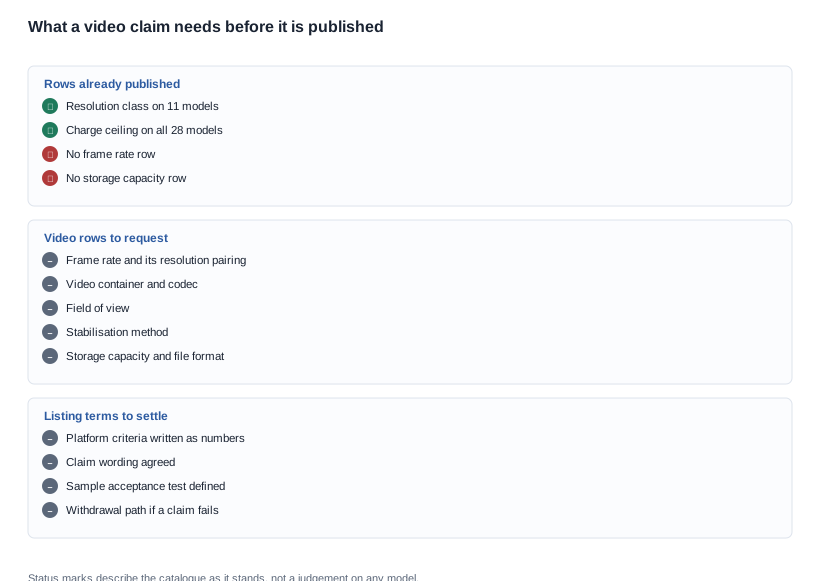
"Is the video quality good enough for social media" is answered in the catalogue by a number that belongs to a different question. Eleven models in this range publish a camera specification, and that specification is a still-image resolution class: eight megapixels on the CY05 and the MT6, the V06 and the MT5, and the V03 Pro and the CY03, and the V03 and the KY06, and thirteen megapixels on the L2 Utral and the S7, and the L1 Pro. Nothing on any of those eleven pages describes a moving image. There is no frame rate, no video resolution, no field of view, no container format, no codec, no stabilisation statement, no low-light performance figure, no sensor model and no storage capacity on any camera model in the range.
So the honest answer to this question is a distinction rather than a verdict. A resolution class supports statements about still images and does not support statements about video. A social-media programme has requirements, and those requirements are defined by the platform's own technical criteria plus the buyer's own editorial standards — neither of which appears in this catalogue and one of which changes over time. What the catalogue can do is tell a buyer which models are worth evaluating, which specification lines are publishable today, and exactly which video rows have to be requested before any video claim goes on a page.
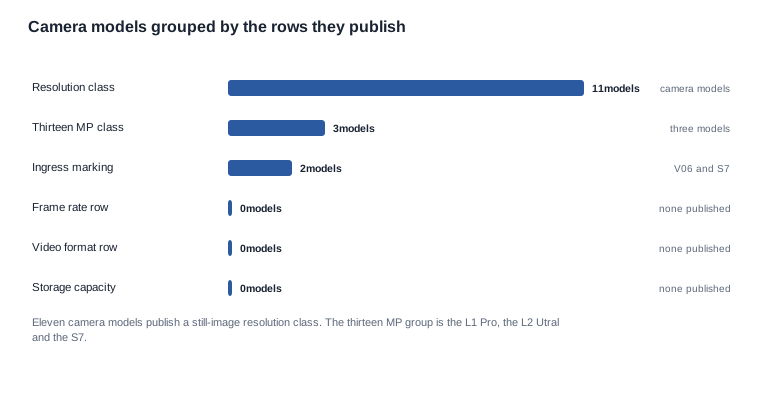
is the video quality good enough for social media: the published camera rows
There are eleven camera models and each publishes a resolution class. Eight of them publish eight megapixels: the CY05 and the KY06, the MT5 and the V06, and the V03 Pro and the MT6, and the V03 and the CY03. Three publish thirteen megapixels: the S7 and the L2 Utral, and the L1 Pro, with the S7 page carrying the thirteen-megapixel line in its own wording. The resolution class is the entire camera specification. It is a genuine published fact and a useful one for sorting, and it is a fact about still capture.
Beyond it, the eleven models publish the standard rows that every model in the range publishes. Cell values for the camera family fall into four: 220 mAh on the V03 Pro and the MT5, and the V03; 260 mAh on the V06 and the S7, and the KY06; 265 mAh on the MT6; and 290 mAh on the CY05 and the L1 Pro, and the L2 Utral and the CY03. Runtime bands are three: five to eight hours on the S7 and the V03 Pro, and the V06 and the V03; six to eight hours on the KY06 and the MT5; and about seven hours on the MT6 and the L2 Utral, the L1 Pro and the CY03, and the CY05. Charge time is two hours or less on all of them, and none of them publishes the starting state of charge or the point at which charging is treated as complete.
The three thirteen-megapixel models are worth pulling out because they are not a uniform group. The L1 Pro publishes a 290 mAh cell, a runtime of about seven hours, no charging method row and a 1400 mAh charging case. The L2 Utral publishes the same 290 mAh cell and the same runtime band, a Type-C charging interface, and a charging-case row carrying two capacities, 900 mAh and 1400 mAh, alongside two variant names that the catalogue does not tie to either capacity. The S7 publishes a 260 mAh cell, a runtime band of five to eight hours, magnetic charging, an ergonomic design line, a removable inner frame line and the IP54 marking. So the same published resolution class covers a model with no published charging method, a model with two published case capacities and an unstated variant correspondence, and a model with an ingress marking. A buyer comparing them on the published resolution class is comparing one field out of a dozen, and the other eleven differ.
Charging splits three ways across the camera family, and the split matters for a content workflow because it decides whether a unit can be topped up between sessions. Magnetic charging is published on five camera models — the V03 and the MT5, the V06 and the S7, and the KY06. Type-C is published on two — the V03 Pro and the L2 Utral. Four publish no charging method row at all: the CY05 and the MT6, and the CY03 and the L1 Pro, all four of which do publish a charging-case capacity, 1400 mAh for the first three and a 1200 mAh folding case for the MT6.
Two camera models publish additional rows that matter to a social-media programme for reasons other than optics. The V06 and the S7 both publish an ergonomic design line and a removable inner frame line, and both carry the IP54 marking, and they are the only two models in the whole range with that marking. The V06 publishes four colour options and the V03 Pro publishes three, and they are the only models in the range whose colour options are published at all.
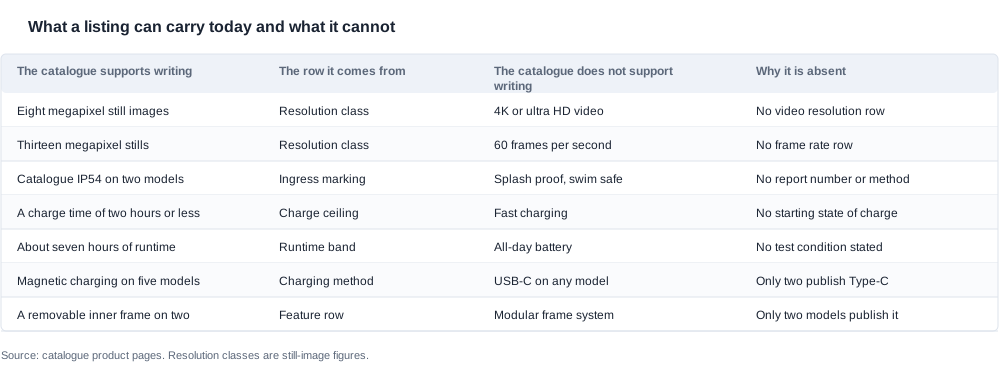
What a listing can carry today, and what it cannot
| The catalogue supports writing | The row it comes from | The catalogue does not support writing | Why it is absent |
|---|---|---|---|
| Eight megapixel still images | Resolution class | 4K or ultra HD video | No video resolution row |
| Thirteen megapixel still images | Resolution class | 60 frames per second | No frame rate row |
| A catalogue IP54 marking on the V06 and the S7 | Ingress marking | Splash proof, swim safe, tested | No report number or method |
| A charge time of two hours or less | Charge ceiling | Fast charging | No starting state of charge |
| About seven hours of runtime | Runtime band | All-day battery | No test condition stated |
| Magnetic charging on five models | Charging method | USB-C on any model | Only two publish Type-C |
| A removable inner frame on two models | Feature row | Modular frame system | Only two models publish it |
That table is the working answer to the question, and it is a two-part answer rather than a verdict. The left column is what a page can say today without qualification. The right column is the set of statements buyers most often want to make about a social-media product, and every one of them needs a document that the catalogue does not carry.
There is one point worth making about the resolution classes themselves, because the comparison they invite is a false one. A higher still-image resolution class does not imply a better video, and a lower one does not imply a worse one. The resolution class is a sensor-output figure; video quality is a function of frame rate, video resolution, codec, field of view, stabilisation, colour rendering and low-light behaviour, and the catalogue publishes none of those for any model. Ranking the eleven camera models by their published resolution class produces a list that is ordered for still capture and tells a buyer nothing about the moving image.

What a social-media programme actually requires of the device
The word social media hides a second question inside it, and the second question is the one a requirement brief should answer first. A programme does not have one output target; it has several, and they are not the same. Content published to a feed, content published as a short clip, and content published as a live or long-form piece have different constraints, and the constraints are set by the platforms themselves rather than by the device. A buyer therefore needs a written list of the platforms in scope and the current technical criteria for each, obtained directly from the platform and dated, because those criteria move and a requirement written from memory is a requirement that will be wrong.
Two consequences follow from writing that list down. The first is that the six video rows can be requested against targets rather than in the abstract — a frame rate question means something when the target says what frame rate the platform expects and at what resolution. The second is that the device's own published rows become relevant in a way they are not for a generic camera question. Storage matters when a clip has a maximum length. The runtime band matters when a shoot day has a fixed number of hours. The charging method matters when a unit has to be topped up between takes rather than overnight. The ingress marking matters when the shoot is outdoors. None of these rows tells a buyer anything about the moving image, and all of them affect whether the moving image is usable in the programme.
There is a framing question as well, and it belongs in the same brief. The catalogue publishes no orientation, mounting or framing row for any camera model, so a programme that publishes vertical content cannot be assessed from the published data. The removable inner frame published on the V06 and the S7 is the closest thing to a framing statement in the range, and it is a statement about the front of the frame rather than about how a clip is composed. The honest position is that framing is a request, and a request that costs nothing to make while it is cheap to make.
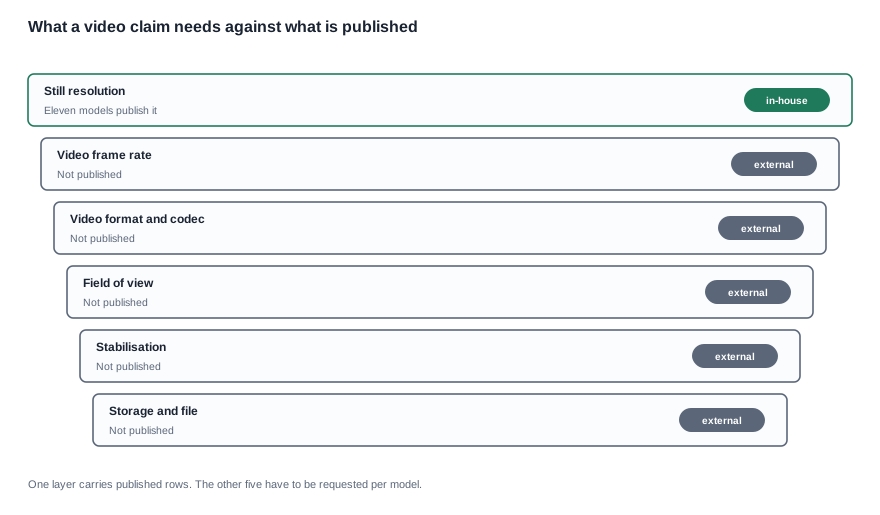
Six video rows to request before promising anything
The request list is the same length whichever model is being evaluated, and the order matters because some rows settle the question before the others are asked.
- Frame rate, and the resolution it is paired with. A frame rate quoted without a resolution is a half-answer, because the same number behaves differently at two different output resolutions. Ask for the pairing the device actually produces, not the maximum of either figure.
- The video container and the codec. Whether the device writes a standard container, which codec it uses, and whether the platform accepts them without transcoding. This is the row most likely to change a programme decision and the one most often assumed rather than checked.
- The field of view. The catalogue publishes no field of view for any model, and it determines what the frame contains. It also determines what can be cropped afterwards, which is the difference between a clip that can be edited to a vertical format and one that cannot.
- The stabilisation method, if any. Whether stabilisation exists, whether it is optical or electronic, and whether it applies in every recording mode. A page that says stabilised without saying which kind is making a claim the buyer cannot verify.
- Storage capacity and file format. No model in the range publishes either. This is the row that decides how long a recording can run before it stops, and a programme that promises a session length needs it.
- The low-light performance basis. Whether a figure exists, how it was measured and in what conditions. For a social-media programme that shoots outdoors in the evening, this is the row that determines whether the camera models are usable at all.
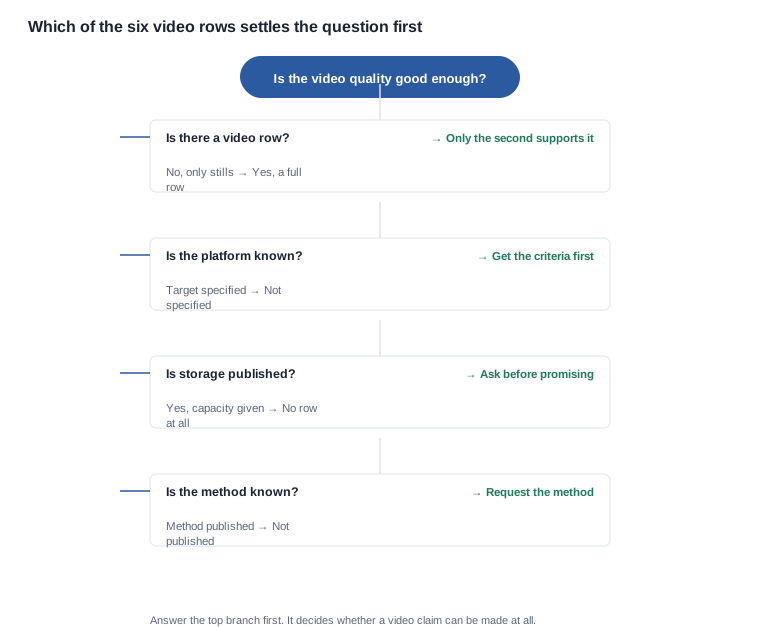
The requests above are worth separating into two groups by who normally has the answer. Rows one to three are engineering facts that the supplier should hold without any special effort. Rows five and six are measurement results that may require a test. Row four is a design statement that either exists or does not. A buyer who sends the six requests as one list and receives answers to four of them has still gained a lot, because the two unanswered rows are then known to be gaps rather than oversights.
There is also a criteria question that belongs before any of the six, and it is not one the catalogue can answer. The standard a programme must meet comes from the platform the content is published to, and those standards are set outside the product, change over time, and differ between platforms. A buyer should obtain the current criteria from the platform directly and write the applicable ones into the requirement brief as numbers — output resolution, maximum duration, maximum file size, container and codec. Once that is written down, the six requests become answerable against a target rather than against an opinion, and the shortlist can be built on the published rows that already exist.
How to write a listing that a reviewer can check
The commercial reason to write a listing this way is straightforward. A listing that carries only claims the catalogue supports can be defended without preparation when a channel partner or a marketplace reviewer asks for substantiation, and it survives being copied into a second market with a different reviewer. A listing that carries a video claim cannot be defended without a document that the buyer may or may not have requested.
Three writing rules follow from the published rows. First, a resolution class is a still-image figure, so it should appear with a still-image phrase rather than next to a video claim. Second, the charge ceiling should be written as a ceiling — two hours or less — and the runtime as the band the catalogue publishes, because neither figure carries a test condition and a page that upgrades a band into a promise is making a claim the buyer cannot support. Third, an ingress marking should be attributed as a catalogue marking and kept attached to the model that carries it, since it exists on two camera models and neither of them publishes a remote shutter row.
There is one more writing rule that is specific to this question, and it prevents the most common error. A buyer who has the platform criteria in writing can tell at a glance which of the platform's requirements the published rows already meet and which of them have to be evidenced. A platform requirement that the published rows already satisfy — a maximum duration, a maximum file size, an output resolution that the still-image class comfortably exceeds — is a requirement that needs no work at all, and it belongs in the brief as a confirmed item rather than as an open one. The requirements that do need work are the ones that map onto the six missing video rows, and the brief should say so explicitly. That is what turns a vague requirement into a due diligence plan with a budget attached to it.
The commercial question underneath all three is a total cost one. A narrow listing does not reduce the quality of the product; it reduces the number of claims that can be challenged. A listing with four supportable claims and no documents behind them is worth less than a listing with twelve claims and a file behind each one, and the difference shows up in the first difficult review rather than in the first order. Buyers who brief their listing writer from the published rows, rather than from the competitor set, get a page that can be signed off internally without a round trip to the supplier.
is the video quality good enough for social media: the acceptance terms
The written answer to this question has three parts.
What the catalogue publishes is a resolution class for eleven camera models — eight megapixels on eight of them and thirteen megapixels on three — plus cell, charge ceiling, runtime band, charging method, an ingress marking on the V06 and the S7, a removable inner frame on those same two models, colour options on the V03 Pro and the V06, and a charging-case capacity on five camera models. What it does not publish is any frame rate, video resolution, field of view, container format, codec, stabilisation statement, low-light figure, sensor model, storage capacity or file format. We do not publish a video specification for any model in the range, and the resolution class is a still-image figure.
What to ask is the platform criteria written down as numbers, the six video rows, and the acceptance terms that attach to them: what is measured, under what conditions, on how many units, and what happens when a unit falls outside.
Two of those acceptance terms deserve a sentence each, because they are the ones that get dropped. The sampling rule has to state whether the criterion applies to every unit or to a sample drawn from a batch, because the two are very different commercial instruments and the difference has to be agreed before the order rather than after it. And the remedy sentence has to state what happens when a unit falls outside — rework, a revision of the published claim, a credit, or a rejection — because a criterion without a stated consequence is a preference, and a preference does not survive a dispute with a supplier. Both of those sentences cost nothing to write and both of them are the difference between a test and a control.
The position to hold on this is that the question contains two halves that the catalogue answers unevenly. The still-image half is fully answered on eleven models and can be used on a page today. The video half is not answered anywhere, and a buyer who treats the published resolution class as evidence of video performance is reading a figure about a different output. The camera range note covers the models themselves, camera resolution options covers the resolution classes, how to choose on camera technology covers the selection side, does the camera record continuously covers the capture behaviour, and camera quality checks covers what a quality inspection should look at.
Related reading
- The resolution classes in detail: camera resolution options.
- Selecting on camera technology: how to choose smart glasses camera technology.
- The programme this question comes from: AI camera glasses for social media.
- Capture behaviour behind a video claim: does the camera record continuously.
- What a quality inspection covers: AI camera glasses quality checks.
Separate the still-image figure from the moving image, request the six video rows, and the question stops being a comparison and becomes a specification.


