
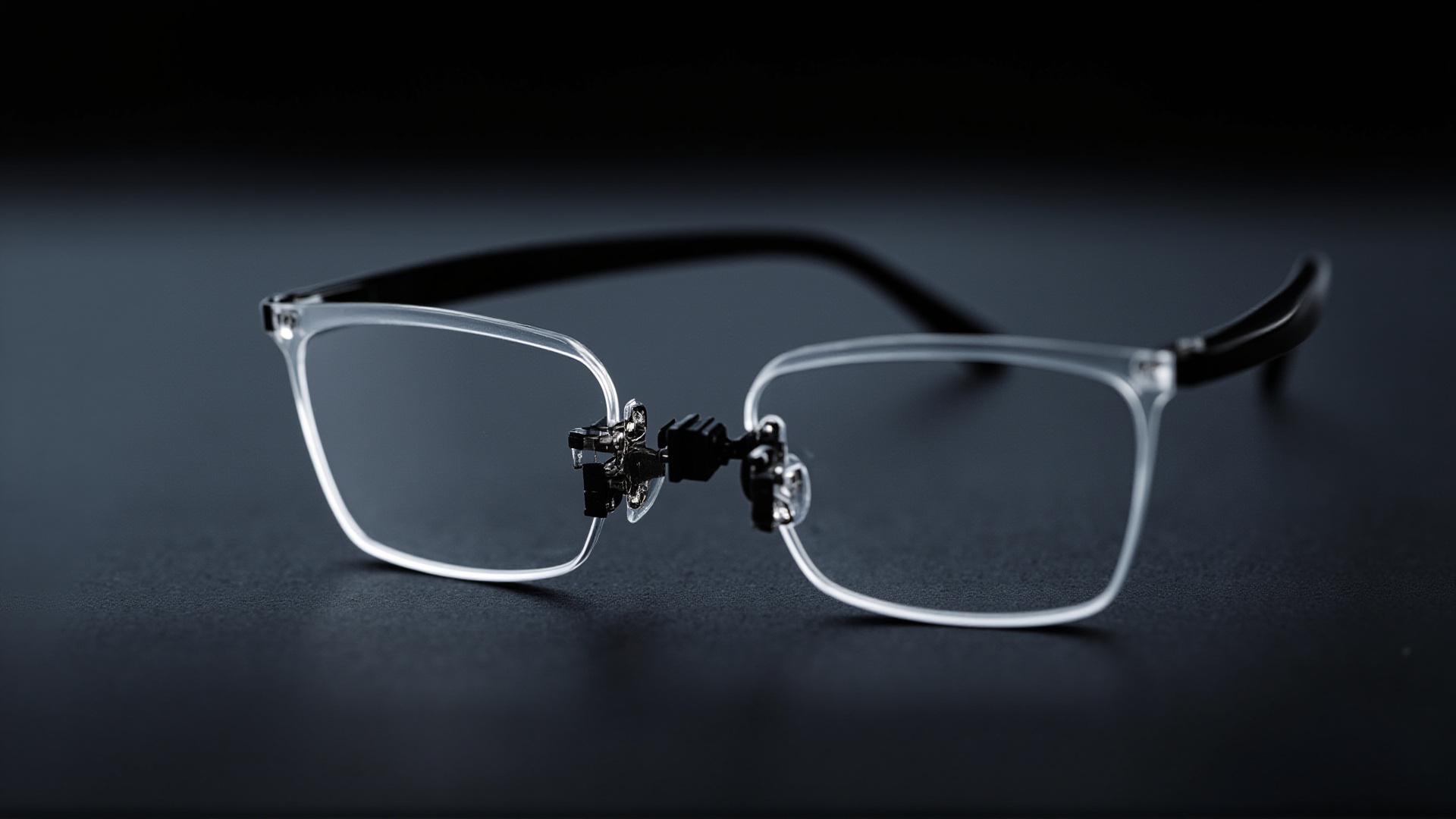
AI camera glasses for social media is the application most often claimed for camera glasses and the one where the documentation gaps bite hardest, because a creator will test the product in an afternoon and decide in an afternoon. That is not a criticism of creators; it is a scheduling fact with a procurement consequence. If the answer to the test arrives after the launch date, the test has not helped, and the sample order has become a sunk cost rather than a decision point.
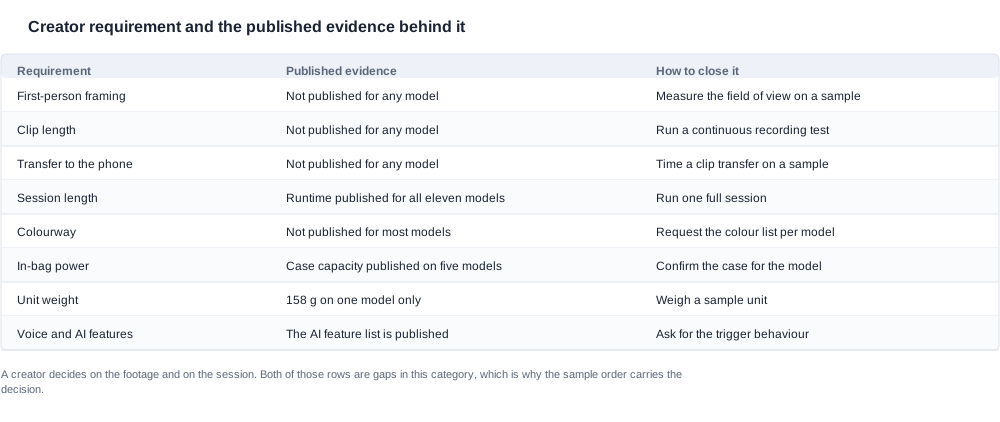
So the requirement list below is ordered the way a creator's own workflow tests it, and almost every row on it is unanswered in the published material. That is not a reason to avoid the category. It is the first-order list: what to specify, what to sample, what to measure and what to put in writing before a unit is bought.
Our catalogue publishes eleven camera models — the L1 Pro, the V06 and the V03, the S7, the KY06 and the CY05, the V03 Pro, the MT6 and the MT5, the CY03 and the L2 Utral — and the published rows are useful for the parts of the list they cover and silent on the rest.
AI camera glasses for social media: the first-order list
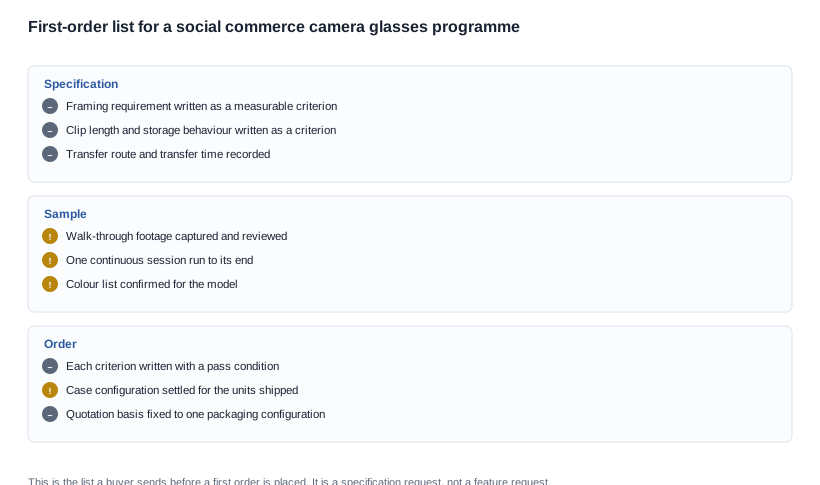
The list is a first-order list in the literal sense. It is what has to be settled before the first order is placed, and it is grouped by who settles it: the supplier, the sample, or the buyer's own decision.
The supplier settles four items. The camera specification, closed once per platform rather than per order — the sensor model, the field of view, the video resolution and frame rate, and the low-light behaviour, none of which our catalogue publishes for any model. The charging interface, published for seven of the eleven camera models and absent for the CY03 and the MT6, and the L1 Pro and the CY05. The case status, which exists in four states: a published capacity on five models, a case with no published capacity on the KY06 and the MT5, no case row at all on the V06 and the V03, and the S7, and an explicit no-case statement on the V03 Pro. And the colour list, published for most models in name only — a colourway is visible in the creator's own content, so the list is a selling point and it has to be settled before the material is produced.
The sample settles five items. First-person framing, measured on a walk-through rather than on a static scene. Clip length and the storage behaviour when the storage fills. The transfer path and the time it takes to move a clip. The unit weight, which is published for exactly one model in the range — 158 g for the MT6 glasses unit, including the battery and the camera and excluding the foldable case. And one continuous session run to its end, which tests the power row and the case row together.
The buyer settles three items. The acceptance criteria, written with pass conditions so that a later lot can be judged the same way. The first-order quantity, which is a commercial judgement about forecast risk rather than a specification question. And the listing proposition, which is where the published rows and the measured results have to be reconciled into something that can be published.
The AI camera glasses buying guide covers the category decision that comes before all of this, and the which model to pick piece covers the range-level reasoning.
The ordering of the list is the part that is easy to get wrong. A buyer who treats the supplier items, the sample items and the buyer items as one undifferentiated checklist will discover halfway through that the four supplier questions were never answered, because they sat at the bottom of a long list and the sample was ordered in the meantime. The four supplier questions have a lead time of their own — a written answer naming the model takes days, not hours — so they should be sent at the same time as the sample order, not after it. The reverse mistake is to send a long questionnaire to every model in the range, which returns slow and shallow answers and produces a comparison of four long documents rather than four shortlists. Narrow on the published rows first, ask the hard questions about two or three models, and ask them in a form that can be answered with a number.
The requirements a creator tests, in the order they test them
A creator evaluating a first-person camera does not test it in the order a specification sheet is laid out. They test it in the order the failures become obvious, and the order is consistent enough to plan against.
First, framing. The creator shoots a walk-through, plays it back and decides whether the product works. The field of view decides that, and no model in this range publishes one. A narrow field of view produces a crop that does not read as a person's view, and the creator concludes that the product is bad rather than that the specification is missing. Test it on a sample with a walk-through, because that is the only test that settles it. The camera imaging notes cover why the field of view is the number that matters most here.
Second, clip length. How much can be recorded before something stops, and what happens when it stops. The storage arrangement is not published for any model — capacity, container format and overwrite behaviour — and storage exhaustion is one of the most common causes of a returned camera product, because it is indistinguishable from a fault. The AI camera glasses troubleshooting order treats it as the first check for exactly that reason.
Third, transfer speed. Getting the file off the device and onto a phone is where a creator actually loses time, and no transfer path is published for any model. Cable, wireless link or application, and how long a clip takes to move, decide whether the product gets used twice or once.
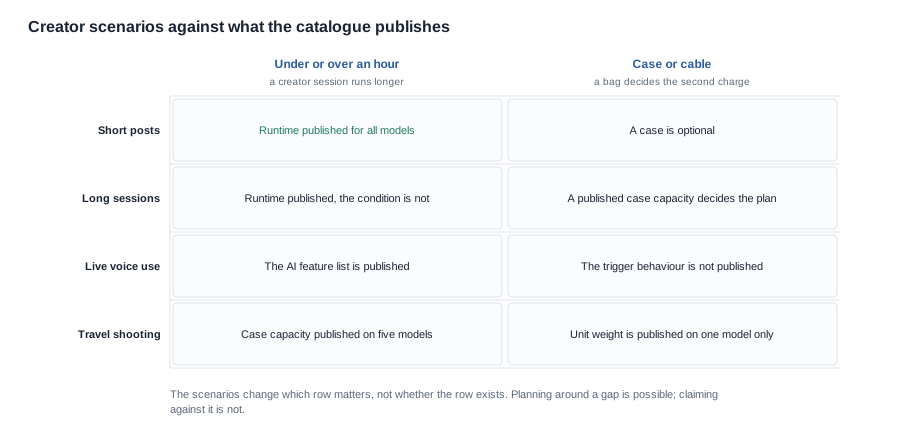
Fourth, session length. How long the unit runs before it stops, which is where the published runtime row is the starting point rather than the answer: 5 to 8 hours on the V03 and the S7, and the V03 Pro and the V06; 6 to 8 hours on the KY06 and the MT5; and about 7 hours on the L2 Utral and the CY05, and the L1 Pro and the MT6, and the CY03. No test load or screen state is published with any of them.
Fifth, colour. It appears in the creator's own content, and a model with no published colour list needs that list established before it is promoted.
Sixth, in-bag power. The product lives in a bag between shoots, and the 1400 mAh case on the L2 Utral and the L1 Pro, and the CY05 and the CY03 is what makes that routine work. The case is also a second lithium cell in every unit, which changes the parcel. The charging case options analysis covers the trade-off, and the AI camera glasses for e-commerce piece covers the commercial side of the same application.
Seventh, unit weight. Only the MT6 publishes a weight in this range, at 158 g, and it is a different model with a different cell and a foldable case. The weight comparison across the range explains what happens to a portability claim and a freight class without it.
Eighth, voice and AI assistance. The feature list is published across this family, and it is the part a creator can evaluate from a product page. The behaviour behind it is not: the trigger conditions, the behaviour in background noise and the behaviour under continuous use are all unspecified. The entry level options analysis covers the structural grouping of the range and the AI camera glasses competitor landscape piece covers how to screen a supplier sheet against the published rows.
The requirements the published rows cannot answer
Seven of the eight requirements above have no published row behind them, and the pattern is consistent enough to plan around: the electrical rows are published and the imaging and physical rows are not.
What our catalogue does publish, for all eleven camera models: the frame cell capacity, the rated runtime, the charge time at two hours or less, and the resolution tier. For seven of the eleven it also publishes the charging method, and for five of the eleven the case capacity. For one model it publishes the unit weight, and for two it publishes the ingress marking at IP54 with no report number attached in the source.
What it does not publish, for any camera model: the sensor model, the field of view, the video resolution and frame rate, the aperture, the stabilisation behaviour, the low-light performance, the storage arrangement and overwrite behaviour, the transfer path, the touch-control configuration, the unit weight for ten of the eleven, the case weight and dimensions, the packed weight, the colour list for most models, and every certification number.
The consequence for a first-order plan is straightforward. The rows that are published belong in the shortlist; the rows that are not belong in the sample programme. A buyer who builds a shortlist on the published rows can narrow eleven models to two or three without a single conversation with a factory. A buyer who then writes a sample programme for those two or three has a document that a supplier can quote against and an order that can be judged against, which is a very different position from one that has spent a month asking questions in email.
Two of the gaps are worth singling out because they change the order of operations rather than just adding a line.
The storage gap sits upstream of the clip-length gap. If a creator cannot retrieve the footage, the session was lost regardless of how good it was, so the transfer path has to be tested before the clip-length question becomes interesting. Asking the supplier to describe the transfer route in writing first will often tell you the clip-length behaviour as a side effect.
The weight gap sits upstream of the packaging gap. A unit that is heavier than expected changes the carton, the parcel and the freight, and the packed weight has to be measured in the shipping configuration rather than estimated. The AI camera glasses shipping weight piece covers how to establish it.
Running the sample order so the answer arrives before the launch
The social-commerce constraint that no other channel has is the launch date. A project channel can run a sample programme over a quarter. A social channel has a content calendar, and the sample has to land inside it. That single fact changes how the sample programme should be designed.
Step one: work backwards from the launch, not forwards from the order. Put the launch date in the plan first, then count back the time needed for the sample to arrive, for the test session to be run, for the results to be written up, for the criteria to be agreed with the supplier and for the balance of the order to be released. In a category where the decisive rows are unpublished, that test session is the longest item in the chain, and it is the one that is usually forgotten when the calendar is drawn.
Step two: ask the creator to write down the one shot that has to work. Everything else in the sample programme can be generic; this cannot. A single named shot, with its framing, its length, its light and the file that comes out of it, is the specification the sample has to satisfy. A sample programme without it produces footage that nobody can compare against anything.
Step three: send the sample with the accessories the creator will actually use. If the proposition involves shooting away from a socket, the sample goes with the case; if the proposition is a short-form walk-through, it does not need one. The point is that the sample has to test the configuration being ordered, because the accessories change the session as much as the unit does.
Step four: run the shot, record the result, and keep the file. The reference file is what a later lot is judged against, and it is also what a supplier needs in order to argue about a defect with evidence rather than with recollection.
Step five: ask the supplier for the rows that would replace the test. Some of the eight requirements may have a document behind them even though our catalogue does not publish one. Ask once, in writing, naming the model, and the answer converts a test into a specification for every future lot.
Step six: write the criterion into the order. The purchase order is the document that carries the commitment, and a criterion with a protocol, a pass condition and a rejection consequence becomes a comparison rather than an argument.

The commercial terms are settled against this plan rather than before it. Our catalogue publishes no minimum order quantity, no lead time, no unit price, no production capacity and no warranty period for any camera model, and the OEM ready platforms sample before bulk notes cover the stage where the sample programme and the order are set up together. The commercial question that a first order in this category raises is the quantity: a first order sized for a launch carries forecast risk that a first order sized for a test does not, and the trade-off between the two is a decision about the channel's confidence in its own content rather than about the product.
Two commercial points belong in the same conversation as the launch calendar, and both are decided earlier than a buyer expects.
The first is the packaging configuration, because a sample ordered in one configuration and a production lot in another is a variant the factory has to approve again, and in this category the packaging decision is entangled with the case decision and therefore with the freight and the transport documentation. Settle the configuration before the sample is ordered, not after the test results come back, because a configuration change after the test invalidates the test.
The second is the second channel. A first order in this category is usually followed by a second one that adds a model rather than a volume, and the models differ on rows that matter: two carry the ingress marking and nine do not, five publish a case capacity and six do not, four publish a charging interface and seven do not. A buyer who plans the second channel at the same time as the first has one packaging route and one documentation set to maintain; a buyer who discovers the second channel later has two of everything. The published rows are the best available guide to which second model is the cheapest to support.
The line between a creator proposition and a published specification
We will tell you exactly which parts of a creator proposition the published rows support, and which parts have to be measured before anyone publishes them.
What our catalogue publishes for the eleven camera models: the frame cell capacity, the rated runtime as a band or as a single value, the charge time at two hours or less for every camera model, the resolution tier with its 8 MP and 13 MP split, the charging method for seven of the eleven, the case position in all four of its states, the IP54 marking on the V06 and the S7 with no report number behind it, and one unit weight in the range at 158 g for the MT6 glasses unit excluding its foldable case.
What we will not write on a creator-facing page, or on a procurement page: that the resolution tier is an image quality figure, that the runtime rating is a session, that an IP54 marking is a tested rating, that a company-level export certification page covers a model, or that a charge time of two hours or less means under two hours. Nor will we present a supplier's sample footage as evidence of a specification, because a sample is one unit on one afternoon and a specification is a row that a factory will be held to.
We publish no market size, no market share, no sales ranking and no competitor comparison for this category, and the competitor landscape piece is about how to run a screen against published rows rather than about who is in the category. What a buyer needs to defend is a proposition and a document set, and neither of those depends on knowing anything about the other suppliers.
The requirement list in this article is also published in short form as AI camera glasses for social media, and the shorter requirement set in the entry level options analysis covers the structural grouping the list sits on. Send us the launch window, the models you are weighing, the destination markets and the one shot that has to work, and we will tell you which published rows bear on it, which requirements have to be settled on a sample, and what to ask the factory before the first order is placed. The range is at AI camera glasses.
Related reading
- The categorisation — AI camera glasses buying guide
- The imaging background — camera imaging
- The same programme in a different channel — AI camera glasses for ecommerce
Send us the launch window and the one shot that has to work, and we will tell you which requirements need a sample and which are already published.


