
The K02 publishes two 90 mAh cells, a charge time of two hours or less and about 8 hours of stated endurance. That is the largest total energy configuration published for any of the eight audio models — the two cells totalling 180 mAh, which is a derived figure rather than a published one, since the catalogue publishes the cell value and the cell count separately. The complication is that the K01 publishes exactly the same three rows, and that the eight-hour figure appears on six models across four different cell configurations. So the K02's battery story cannot separate it from its sibling, and the hours cannot be used to rank it against the range.
One clarification belongs at the front, because it is the kind of thing a comparison table gets wrong by omission. The K02's advantage is the largest total energy in the audio range, not the largest single cell. The D11 and the D12 each publish a single 100 mAh cell, and the bone-conduction model publishes 200 mAh in one cell, so anyone quoting the K02 as the catalogue's largest cell is misreading the published rows. What the K02 publishes that its audio siblings do not is two 90 mAh cells side by side.
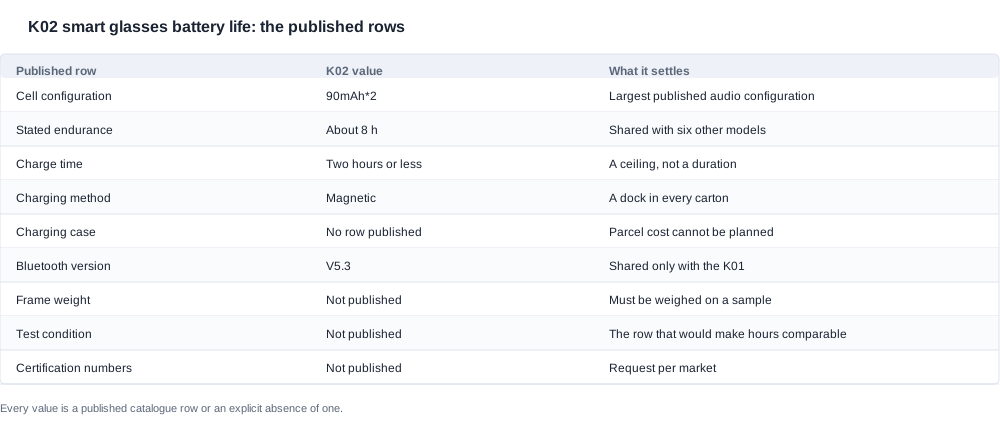
What the K02 battery row contains and what it does not
The published rows, read exactly
| Published row | K02 value | What it settles |
|---|---|---|
| Cell configuration | 90mAh*2 | The largest published total energy in the audio range |
| Stated endurance | About 8 h | Shared with five other models in the catalogue |
| Charge time | Two hours or less | A ceiling, not a duration |
| Charging method | Magnetic | A dock in every carton |
| Charging case | No row published | The parcel cost cannot be planned from the catalogue |
| Bluetooth version | V5.3 | Shared with the K01 and with no other model |
| Frame weight | Not published | Must be weighed on a sample |
| Test condition behind the endurance row | Not published | The row that would make the hours comparable |
| Certification numbers | Not published | Must be requested per market |
The catalogue publishes the cell value and the cell count, so the K02's row reads 90mAh*2. When the two are added for analysis, the result has to be marked as derived — "two cells totalling 180 mAh" — because a bare total in a specification table reads as an official figure and this one is not.
Why the eight-hour figure cannot rank the range
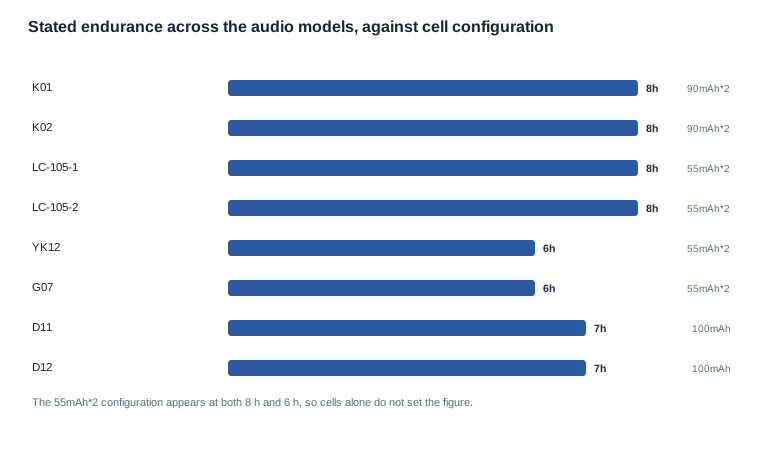
The decisive evidence sits in the same row of the same table. The LC-105 pair publishes 55mAh2 and about 8 hours. The G07 and the YK12 publish 55mAh2 and about 6 hours. Identical published cell configurations, a two-hour spread in the stated endurance.
That single pair of facts removes capacity as an explanation, and it does so inside the audio range alone — no cross-category inference is needed. What remains is that the endurance figures were not taken under one protocol, or that the frames differ in ways the catalogue does not publish, such as amplifier efficiency or firmware power management.
Outside the audio range the spread widens further. The YKC02 publishes 70mAh*2 and about 8 hours. The ZH12 publishes a single 100 mAh cell and about 8 hours. The D11 and the D12 publish 100 mAh and about 7 hours. The D17 publishes 115 mAh and about 7 hours. Six models publish about 8 hours on four different cell configurations, and the two models that publish about 6 hours sit on a configuration that also produces about 8 hours elsewhere. The hours are a family-wide label rather than a measurement of any one frame.
The how to compare battery life method covers the question to ask, and the audio range battery picture sets out the full grid across the catalogue.
What a buyer may and may not claim from this row
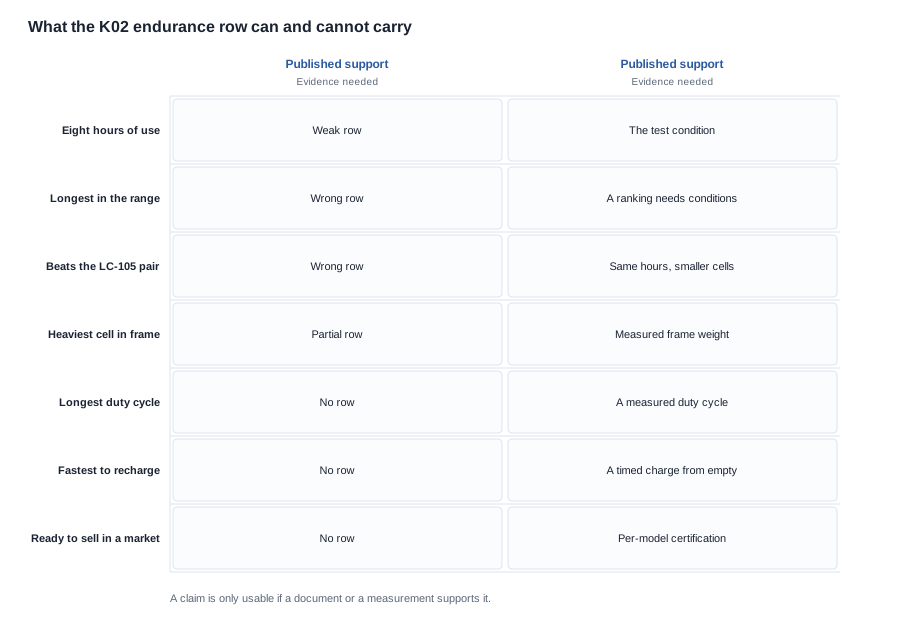
The practical consequence is that a claim has to be traceable to either a published row or a measurement. The K02's cell configuration supports a claim about energy in the frame. Its endurance row supports a claim about a stated figure and nothing more, until a test condition is documented.
Claims that look reasonable and are not supported include ranking the K02 against the LC-105 pair on hours, describing eight hours as a working day, asserting a longest duty cycle, and treating a two-hour-or-less charge ceiling as a charge time. Each of those needs something the catalogue does not contain.
The one sibling that shares every published row
The K01 publishes 90mAh*2, about 8 hours, two hours or less, magnetic charging and V5.3 — the same five rows as the K02. The catalogue does not state what separates them, and that absence is itself the finding for a buyer comparing the two.
That is the same kind of unclosed published-row gap that appears elsewhere in this catalogue, where two models carry identical specifications and the documentation does not record a difference. The honest treatment is the same too: do not manufacture a difference that the catalogue does not publish, and ask for it in writing instead. The K02 versus K01 specification comparison works through what the possible answers would mean for a range.
One published row does sit outside the battery discussion and is worth noting for a buyer who has to plan a range: V5.3 appears on the K01 and the K02 and on no other model in the catalogue. Every other audio model publishes V5.4. That is a real structural fact about the pair, and it is a radio-version consideration rather than a battery one — but it belongs in the same file, because a range decision made on the battery row will not catch it.

What the two-cell configuration actually implies
An architecture question the row does not answer
Two 90 mAh cells in the temples is a different internal arrangement from the single 100 mAh cell the D11 and the D12 publish, and the difference reaches further than the arithmetic. It decides how the frame balances front to back, where the battery mass sits relative to the ear, and how the audio hardware is positioned.
None of that is published. The catalogue gives the cell value and the cell count and stops. So a buyer who wants to describe the K02 as a balanced frame, or as a frame with the mass distributed across both temples, is making an inference from the row rather than from a measurement — and the same inference that says "the weight is spread out" also says "there is more weight here than on a single-cell model."
The question to ask is how the cells are distributed and what the measured frame weight turns out to be. Both are one line in an email and one afternoon with a scale.
The weight question follows from the cell question
A larger cell configuration tends to mean more mass in the frame, or a different internal balance, and neither is published for the K02 or for any audio model in the catalogue. The single published frame weight in the whole catalogue belongs to the MT6, a camera model, and it cannot stand in for an audio frame — its eyewear body carries a 265 mAh cell and a camera, which is a different proposition entirely.
That matters more for the K02 than it does for a lighter audio model, because the K02's cell configuration is the largest in its range and the inference "more energy, therefore a light frame" is exactly the inference that fails hardest here. The weight comparison across the audio range sets out why the one published figure cannot be borrowed across platforms.
The commercial reason to care is that the same number does three jobs at once. It predicts the comfort complaint rate, it sets the packed unit weight, and through the packed weight it drives the freight class and the shipping cost. A buyer who treats the weight as a comfort detail will find it again in the logistics budget.
What the endurance figure can be used for in a duty cycle
Because the endurance row has no test condition, it cannot be converted into a shift plan directly. What a buyer can do is use it as the starting point for a measurement rather than as an input to a schedule.
- Obtain the test condition for the K02 in writing, including whether the Bluetooth link was active during the measurement and what volume was set.
- Confirm whether the measured sample was the production configuration rather than a prototype build.
- Run the application the product is actually sold for — continuous playback, a call loop, a mixed session — and record how long the frame lasts in each case.
- Compare the measured figures against the published eight hours and note the gap, because that gap is the real endurance of the product the customer will receive.
- Size any scheduling commitment on the measured figure with a margin, not on the published one.
Step four is the one that catches most surprises. The published figure and the field figure are different numbers describing different things, and only the second one belongs in a duty cycle.
The charging side, and the dock in every carton
The charge-time ceiling and the three things it omits
The K02 publishes a charge time of two hours or less, which is a real published row and a usable one — provided a buyer understands what it leaves out. There is no published starting state, so it is not established whether the two hours assumes an empty battery or a partially charged one. There is no published completion criterion, so it is not established at what point the charge is considered finished. And there is no published figure for how long the dock itself takes to recharge.
None of those three gaps is unusual for the category, and all three matter to anyone scheduling charging around the product. A device that reaches the ceiling from empty behaves differently from one that reaches it from a partial charge, and two models can both satisfy "two hours or less" while finishing their charges at different states.
The wording matters too. "Two hours or less" is a ceiling that permits exactly two hours, which is not the same claim as a charge that completes inside two hours. Our catalogue publishes the ceiling, so our copy has to quote the ceiling.
The charging case row that does not exist
The K02 charges magnetically, and a magnetically charging frame implies a dock or a case in the box. Our catalogue publishes no charging-case row for the K02 — no capacity, no interface, no charge time, no weight.
That silence has a direct commercial consequence, because the dock is a second object in every carton. It has to be counted, packed, protected against the frame being seated incorrectly, and counted again at the warehouse. It has a weight of its own that goes into the packed unit weight, which drives the freight class and the transport documentation. And it has a failure mode the frame does not have: a dock that stops holding a charge properly makes the frame look defective, so the return arrives against the product rather than against the accessory.
A buyer cannot build a landed-cost model for the K02 from the catalogue, because the accessory that ships in every unit is unquantified. The charging options analysis covers the accessory economics across the range, and the shipping weight breakdown covers the parcel arithmetic on the models where case capacities are published.
The contrast with the Type-C models
The D11 and the D12 charge over a Type-C port, so they imply a cable in the box rather than a dock. That is a genuine structural difference in the delivered parcel, and it is a commercial advantage of a different model rather than of the K02.
There is a second-order effect worth pricing. A cable is a consumable the customer can replace from any supplier. A magnetic dock is a model-specific accessory that has to come from the same source as the frame, and a channel that loses docks needs them replenished against a supplier minimum order quantity rather than bought locally at a low cost. The dock is a working capital item and a returns driver, and neither of those shows up in a unit price comparison.
A buyer running the K02 alongside a Type-C model should therefore model the accessory chain as part of the product, not as packaging. That means asking three things in the first round of questions: whether a spare dock is available at the buyer's quantity, at what price, and with what lead time.

Checking the K02 endurance figure before it goes on a page
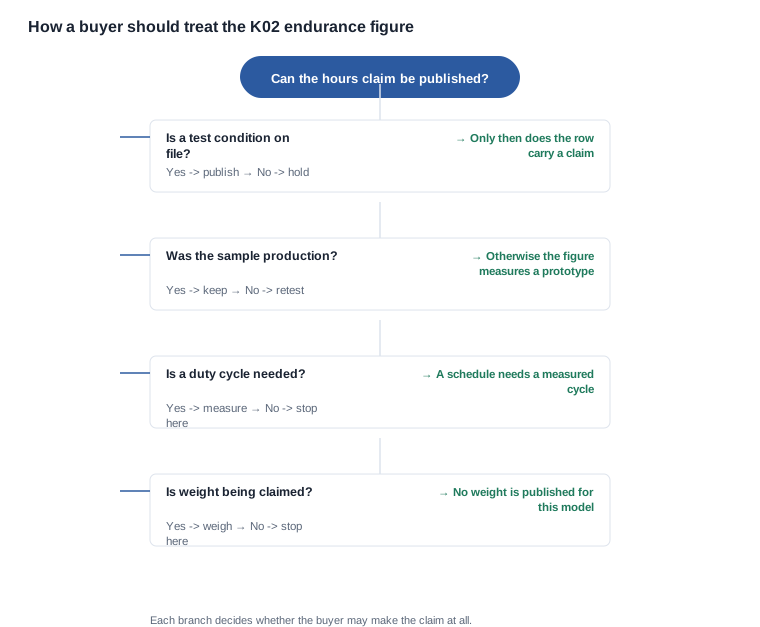
The decision path for an hours claim
There is a short sequence of questions here, and the value of running them in order is that each one either unlocks the next or closes the claim entirely.
Is there a test condition on file? If yes, the endurance row can carry a claim once the condition is stated alongside it. If no, the claim is held — not deleted, held, because a condition may be obtainable and the figure is still the published one.
Was the measured sample the production configuration? If not, the figure describes something other than the product the customer receives, and it has to be re-measured.
Is a duty cycle actually needed? For a channel that sells the product as audio playback in short sessions, the published figure may be sufficient with its condition attached. For a fleet that schedules around the battery, a measured duty cycle is required and the published row is only the starting point.
Is a weight claim being made? If yes, the frames have to be weighed. No audio model in this catalogue publishes a frame weight, so this is always a measurement and never a citation.
The evidence to hold before the figure goes on a page
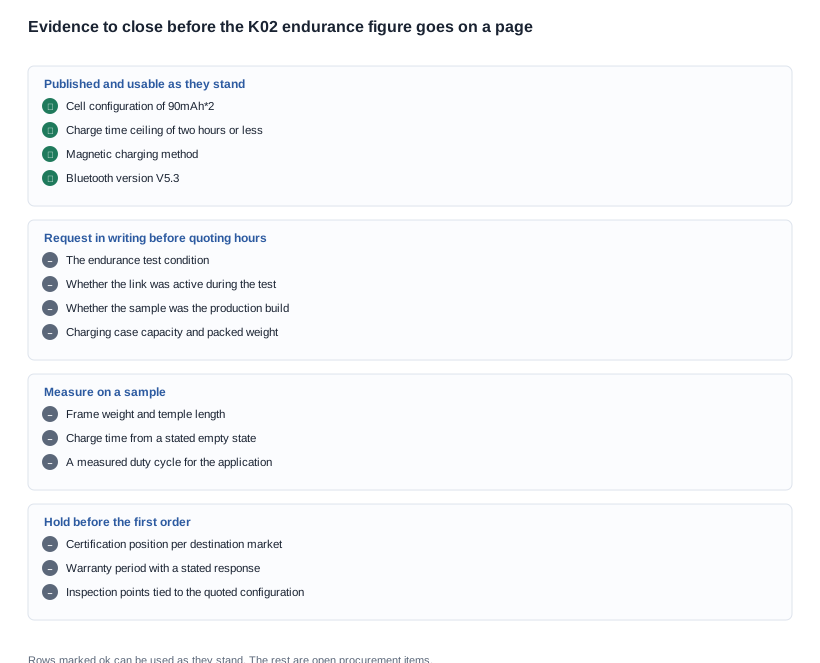
Fourteen items sit on that list, and the order in which they are closed matters because two of them carry external lead times.
Request in writing, in one message. The endurance test condition; whether the Bluetooth link was active during the measurement; whether the sample was the production build; and the charging case capacity together with the packed unit weight. None of these needs a sample in hand, and together they decide whether the published row is usable and what the parcel will cost.
Measure on a sample. Frame weight and temple length; a timed charge from a stated empty state; and a measured duty cycle for the application the product is actually sold for.
Hold before the first order. The certification position per destination market; the warranty period with a stated response; and the inspection points tied to the exact quoted configuration. On that last one — our catalogue carries a company-level export certification page whose content is images rather than text, and the catalogue text contains no reference to CE, FCC or RoHS. There is no per-model certification row for the K02, so the documents that name it are a request with a lead time, and they should be requested at the start rather than discovered at the border. The conformity framework a buyer works within for radio equipment is the Radio Equipment Directive (EU) 2014/53/EU, with EMC governed separately under 2014/32/EU — but the framework is the buyer's obligation to satisfy, and nothing in our catalogue supplies the evidence for it.
How to select this model against the rest of the range
A buyer running a shortlist will find that the battery row rarely decides it, and the questions below are the ones that do. They are worth working through in this order because each one eliminates a possibility rather than adding a preference.
Does the channel need a documented runtime at all? If the product is bought for music in a single session, the published ceiling may be sufficient with its condition attached, and the buyer can stop there. If the product is bought for a workday, a shift, or a duty cycle, the answer is no — a measured cycle is required, and the published figure is only the starting point.
Does the proposition rest on energy in the frame? Then the K02's cell configuration is the published row to build on, and it is a strong one: 90mAh*2 is the largest total energy published for any of the eight audio models. But it cannot be turned into a runtime claim without the condition, and it cannot be turned into a ranking claim at all.
Is a dock acceptable in the proposition? A magnetically charging frame means a proprietary accessory in every unit. If the channel wants a simple cable, the K02 is the wrong model in this group and the Type-C models are the ones to evaluate — that is a structural difference in the delivered parcel, and it is a legitimate reason to prefer a different model.
Is there a second designation in the plan? The K01 publishes the same rows. Before you evaluate a range that carries both, find out in writing what separates them, because the answer decides whether you are commissioning one artwork set or two.
What does the total cost of the accessory chain look like over a year? The unit price is the smallest variable. The dock minimum order quantity, the spare dock price, the dock lead time and the returns driven by docking failures are larger, and none of them appears in a unit price comparison. Ask for the accessory terms before you score the models.
A shortlist built this way produces a decision with reasons attached, which is the only kind a procurement file survives.
What to measure on the sample, in the order that saves time
Weigh the frame first. It is the fastest measurement and it answers the question that follows everything else, because the weight also determines the packed unit weight and the freight class.
Then time a charge from a stated starting point. Not from whatever state the sample happens to be in, and not to the ceiling — to the point where the frame reports itself full. That produces a number a buyer can schedule against, which the published ceiling is not.
Then run the real duty cycle. If the product is sold for calls, run calls. If it is sold for continuous audio, run continuous audio. If it is sold for both, run both, because the second one is always worse than the first and a channel that promised the first will get returns about the second.
Then check the dock. Seat and lift the frame from the dock repeatedly, and check the frame for a clean contact after a number of cycles. A dock that is unreliable in the hand is a dock that generates returns, and it is far cheaper to find out on one sample than on a shipment.

Five failure modes this battery story produces
The eight hours became a working day. Symptom: a customer expects a full shift and gets less, and the channel carries the complaint. Root cause: a stated endurance figure with no test condition was read as a duration of use. Prevention: attach the condition to the figure, and size any schedule on a measured duty cycle.
The K02 was ranked against the LC-105 pair. Symptom: the K02 is described as having a longer battery than a model with a third of its energy, and a customer who compares the two specification pages notices. Root cause: the ranking was built on hours without noticing that the same 55mAh*2 configuration publishes both eight hours and six hours elsewhere. Prevention: do not publish a ranking on the endurance row until conditions exist for every model in the comparison.
A weight was inferred from the cell configuration. Symptom: the listing implies a light frame, and returns arrive. Root cause: a larger cell was read as a lighter product. Prevention: weigh the sample and quote the figure, or quote no weight at all.
The dock was left out of the parcel model. Symptom: the landed cost moves after the price is agreed, or the warehouse discovers that every unit needs an accessory nobody counted. Root cause: the frame was quoted while the frame and the dock were shipped. Prevention: put the packed unit weight, dock included, into the agreement, and ask for the spare dock terms in the first round.
The K01 and the K02 were treated as different products. Symptom: a range carries two product pages, two artwork sets and two packaging structures for what the catalogue shows as one configuration. Root cause: a model name was read as a product difference. Prevention: get the difference in writing before commissioning either artwork set, and treat an answer that comes back as "none" as a reason to run one model.
The commercial terms this battery position has to survive
The battery row is the easiest thing to write about and the hardest thing to defend, which means the commercial conversation should be built around what is measurable rather than what is quotable.
Terms that respond to the order. Unit price and volume tiers, the accessory set with its own minimum order quantities, packaging specification, delivery splitting, payment nodes tied to inspection, the warranty period with a stated response, and the terms of a pilot order.
The term this product specifically needs. Because the dock ships in every unit, the minimum order quantity on the complete delivered configuration — frame plus dock — is the number that governs how small a replenishment order the channel can place. Quoting the frame minimum alone is how a buyer ends up believing it can reorder in tens when the real constraint is in hundreds.
Two lines that do not move with volume. Certification cost and its timeline follow the process and the testing body, and are per product family rather than per order. Tooling is frequently amortised across a first order instead, so ask which of the two is being quoted — the two are often bundled into a single line that hides which one carries the volume.
What the agreement should carry. The published rows for the configuration ordered, with the cell configuration written as the catalogue writes it; the endurance figure together with its condition once established; the charging method and the in-box accessory set; the packed unit weight confirmed at inspection; the certification position per market; and the warranty period with a stated response.
What must be left out. Any ranking of the K02 against another model on hours; any working-day claim; any weight, dimension or case capacity that was not measured or supplied in writing; and any certificate number that our documentation does not contain.
Where CYNRIN stands on the K02 battery row
The K02's energy configuration is the largest published for the audio range and it has to be published carefully, because the same rating appears on models with a third of the capacity and the test conditions are absent. We will publish the figures that are documented, we will not present the eight hours as a guaranteed working day, we will not rank it against the LC-105 pair, and we will not quote a weight, a case capacity or a certificate number that the documentation does not contain.
We will also say plainly that the K01 publishes the same rows, and that the catalogue records no difference between them. A difference that we cannot evidence is not a difference we will assert, and a buyer who needs the two models to differ should ask for it in writing rather than accept an inference.
The published K02 specification list is the honest baseline, the K02 how it compares piece sets the model against the rest of the range, and the K02 against the K01 comparison covers the row that closes the pair.
Five things to close before the endurance figure goes on a product page
- The endurance test condition, and whether the Bluetooth link was active during the measurement.
- Whether the measured sample was the production configuration.
- The charging case capacity, and whether a dock ships in the carton at all.
- The measured frame weight, the temple length, and the packed unit weight with the dock.
- The certification position for the K02 in each destination market.
Related reading
- The specifications this model publishes — K02 smart glasses specifications and features
- Why it makes commercial sense — K02 smart glasses value for money
- The range-wide battery picture — AI camera glasses battery comparison
- How the accessories price out — Bluetooth audio glasses charging options
- The measurement question — Bluetooth audio glasses weight comparison
Send us the expected daily use and the application, and we will tell you which published figures apply and which have to be measured on a sample.


