

The K02's published specification is five rows: Bluetooth V5.3, a cell configuration of 90mAh*2, a charge time of two hours or less, about eight hours of stated endurance, and magnetic charging. It publishes no feature line at all, and it publishes no weight, no dimension, no acoustic figure, no ingress rating and no certificate number. Explaining those rows properly — what each one licenses a buyer to write, and what it forbids — is more useful than any longer description of a product that has no feature line to describe.
Three of the five rows are easy to over-read, and each over-reading has a commercial cost. A charge ceiling is not a charging time. A stated endurance is not a working day. A cell value multiplied by a cell count is a derived number, not a published one. Get those three right and the rest of the K02 specification is straightforward: it is the largest published cell configuration in the audio range, on the older of the two radio generations published there, with a charging method that carries its own accessory consequence.
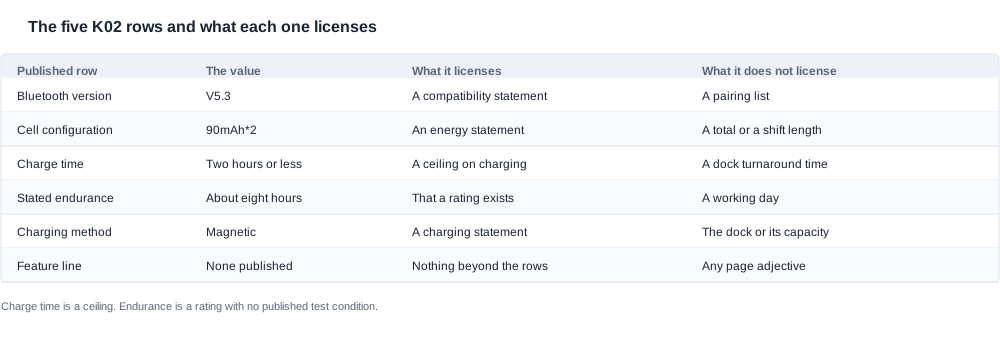
The five rows the K02 publishes, and how to read each one
What the catalogue states, verbatim
Reproduced exactly as the catalogue carries them: Bluetooth version V5.3. Cell configuration 90mAh*2. Charge time, two hours or less. Stated use, about eight hours. Charging method, magnetic.
That is the complete published position for the K02, and no sixth row exists for it anywhere in the catalogue. The K02 limitations analysis works through what the absence of those rows means for a channel, and the K01 buyer review checklist applies the same reading to the model the K02 most closely resembles.
A specification sheet is a set of commitments, and a buyer should treat it as a contract draft rather than a description. The test of whether a row has been read correctly is simple: can you state, in one sentence, what the row allows you to promise and what it does not?
The difference between a value, a ceiling and a rating
The three categories appear side by side in these five rows and they behave differently in a procurement file.
A value is a measured or specified quantity: V5.3, 90mAh*2, magnetic charging. It is stated, it is checkable against a document, and it is stable across units. A ceiling is an upper bound: the charge time of two hours or less. It says the charge completes within two hours and no longer; it does not say how long it takes, and it does not say from what state of charge. A rating is a figure attached to a test that the catalogue does not describe: about eight hours of stated use. It tells you a number exists and nothing about the conditions that produce it.
Conflating them is where specification disputes start. A ceiling is often quoted as if it were a value, and a rating is often quoted as if it were a measurement. Both conversions add an assertion the supplier never made, and both are discovered eventually, usually by a customer rather than by the buyer.
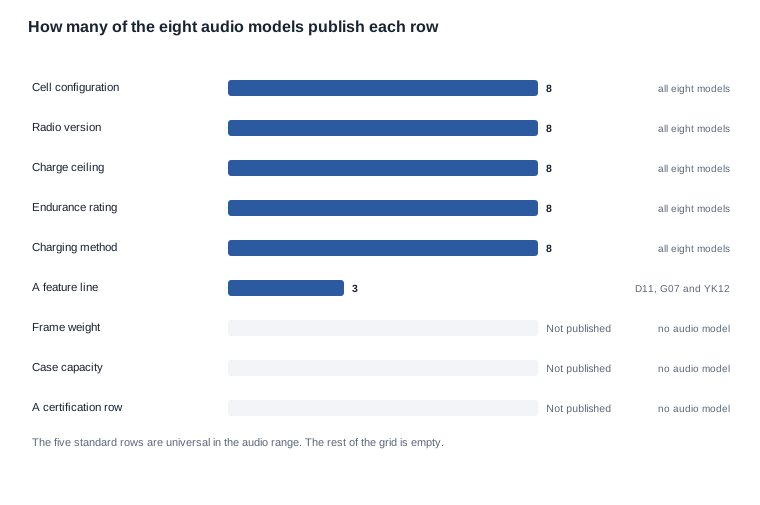

Cell configuration: 90mAh*2 and the difference between published and derived
What two ninety milliamp-hour cells do and do not mean
The K02 publishes 90mAh2, and no other audio model publishes a larger cell figure. That places it above the G07 and the LC-105-2, and the LC-105-1 and the YK12, which publish 55mAh2, and above the D11 and the D12, which publish a single 100 mAh cell.
What the row licenses is an energy statement: this configuration carries two ninety milliamp-hour cells. What it does not license is a runtime, a shift length or a comparison with any other product's runtime. Those follow from how the energy is used, not from how much of it is present, and the catalogue publishes nothing about how it is used.
The row also matters commercially in a way that has nothing to do with the customer. Cell count and cell value are part of the bill of materials, so the configuration tells a buyer something about what the unit costs to build and how the battery is assembled. That is worth knowing when comparing two quotations, because it explains part of the difference between them — and it is the kind of item that belongs in a technical file rather than in a product page.
Why the total has to be labelled as derived
Multiplying 90 by two produces 180 milliamp-hours. That number is arithmetic, not publication. The catalogue publishes a cell value and a cell count; the total is the reader's own derivation.
The distinction has to survive contact with a business document. A derived total written into a specification annex without a marker becomes, three stages later, the figure a supplier quotes back to the buyer, then the figure on a product page, then a claim that nobody can trace to the catalogue. Every document that carries it should say which kind of number it is: "90mAh*2 as published, deriving to 180 mAh in total."
That habit is not fussy for its own sake. It is the difference between a technical file that survives an audit and one that cannot be explained. The how to compare battery life method applies the same discipline to endurance figures, where the gap between published and derived is wider.
Charge time: a ceiling of two hours or less, and what it cannot be used for
The ceiling is not a measurement
The K02 publishes a charge time of two hours or less. Two hours or less is a ceiling: the charge completes within two hours, and the catalogue does not state whether it takes ten minutes, one hour or the full two.
Three things are missing from the row, and all three matter for a deployment that schedules charging around a device. There is no starting state of charge — a charge from empty is a different job from a charge from a quarter full, and the catalogue does not say which one the ceiling refers to. There is no termination criterion — the catalogue does not define what "charged" means for the purpose of that two hours. And there is no cell count interaction, because a paired-cell configuration raises the question of how the two cells are balanced and whether they charge together or in sequence.
None of that makes the row wrong. It makes it a bound rather than a figure, and a bound is what a buyer should write down.
What a charge cycle needs in order to be planned
A buyer who needs to size a charging station, a dock count or a turnaround window cannot use the ceiling. Three measurements turn the bound into a plan, and all three come from a sample rather than from a supplier's marketing.
Time a full cycle from a stated starting point. Record the state of charge at the start, the state at the end and the elapsed time. The elapsed time is the number that can be scheduled; the ceiling is the number that can be quoted.
Record the terminal behaviour. What does the unit do at the end of the charge — does it indicate completion, does it stop drawing current, does it require a manual disconnect? A charging counterpart that has to be unplugged by hand is an operational cost in a stockroom even when the elapsed time is short.
Test a partial charge. If the deployment model involves topping up between shifts rather than a full cycle, the time to reach a usable state from a partial one is the number that matters, and it is not derivable from a ceiling.
The Bluetooth audio glasses charging options page covers the accessory side of this, and the OEM ready model readiness overview covers how a platform gets specified for a channel programme.
Stated endurance of about eight hours, and the condition that is missing
The spread that proves the ratings are not comparable
The K02 publishes about eight hours of stated use. The LC-105-1 and the LC-105-2 publish the same figure on 55mAh2. The D11 and the D12 publish about seven hours on a single 100 mAh cell. The G07 and the YK12 publish about six hours on 55mAh2.
Read as a scale, that produces a contradiction. The LC-105-1 and the G07 publish the same cell configuration and differ by two hours. Two hours of spread on an identical published configuration is the signature of a measurement convention rather than a product property, and no test condition is published for any of these models.
So the K02's eight-hour figure cannot be used to plan a duty cycle, to promise a working day to a customer, to differentiate against the G07, or to justify a price. What it does establish is that a rating exists and what the number happens to be. The how to compare battery life method sets out the conditions a buyer should require before the figure is allowed to influence anything.
How to obtain a condition instead of borrowing a number
Ask for the condition in one message, in the same words, for every model being compared: the volume level, the codec, the sample rate, the pairing count, the ambient conditions and the state of charge at the start of the test. A supplier who has one protocol will answer for every model at once. A supplier who does not has one rating per model, and the numbers will not be comparable across the range — which is a fact about the comparison rather than about any single model.
Where the condition cannot be obtained, run it. A sample order, a scripted protocol and a fixed starting state produce a number the buyer owns, and a number the buyer owns can be quoted with a source attached. The AI feature notes cover the software side of what a configuration claims, and the customisation path for this platform covers the programme a channel builds on top of a published configuration.

The charging and radio rows, and the features the catalogue does not list
Magnetic charging and the counterpart it requires
The K02 publishes magnetic charging. In the audio range, six models publish magnetic charging and two publish Type-C, and that distinction is not only electrical.
Magnetic charging implies a proprietary counterpart. It has to be sourced, stocked, replaced and shipped, and a channel that carries magnetic models carries an accessory SKU per model family. It also creates a failure mode a cable does not: a lost or damaged dock is a unit that cannot be recharged, rather than a unit that needs a new cable. The customisation path for this platform covers what a packaging programme has to settle about the in-box accessory set, and the bluetooth audio glasses charging options page sets out the two approaches side by side.
The catalogue publishes the charging method and does not publish the counterpart's specification, the case capacity or the packed unit weight. That last figure determines freight and therefore a landed cost, which makes it a commercial input rather than a cosmetic detail.
Why there is no feature line to explain
Three audio models publish a feature line: the D11 with surround sound and a long-battery-life descriptor, the G07 with an ultra-slim detachable temple, the YK12 with surround sound and a slim temple. The K02 publishes none, and neither do the D12 and the K01, and the LC-105-2 and the LC-105-1.
So "features" for this model means the five specification rows plus the things a buyer has to establish for themselves. There is no touch-control row anywhere in the catalogue, no acoustic descriptor, no microphone specification and no ingress rating for the K02 or for any other audio model. Those are not features the model lacks — they are rows the catalogue does not carry, and they have to come from the supplier or from a sample.
The K02 versus K01 specification comparison shows how sharp this becomes with the closest model: two pages with identical published rows and no feature line on either.
Turning the specification into a written acceptance clause
What goes into the annex, and in what form
A specification that stays on a product page cannot be enforced. The published rows belong in an annex that names the exact configuration ordered, and each entry needs four things: the value, the source it came from, the date it was established and the condition it was established under.

Written that way, the annex separates cleanly into three blocks. The catalogue block holds the five published rows, quoted as published. The evidence block holds everything measured or supplied — frame weight, dimensions, packed weight, a timed charge cycle, a recorded microphone pickup — each with its method and date. The conditional block holds everything that remains unresolved, stated as unresolved, so that nobody later reads a silence as an agreement.
What the clause has to prevent
Three failures, and each has a clause that prevents it.
The silent upgrade. A different cell configuration or a different radio module ships in the unit, and the published rows no longer describe what the channel is selling. The prevention is a clause binding the order to the configuration in the annex, with any change requiring written approval before shipment rather than after delivery.
The undocumented substitution. A component is changed for cost reasons and no one tells the buyer. The prevention is a clause requiring the supplier to state which published rows remain accurate after any change, so that a substitution either keeps the specification or triggers a conversation.
The inherited figure. A number that was never measured reaches a specification annex through a copy from another model or another project. The prevention is the source rule: every value in the annex carries a named source and a date, and a value with no source is removed rather than carried.
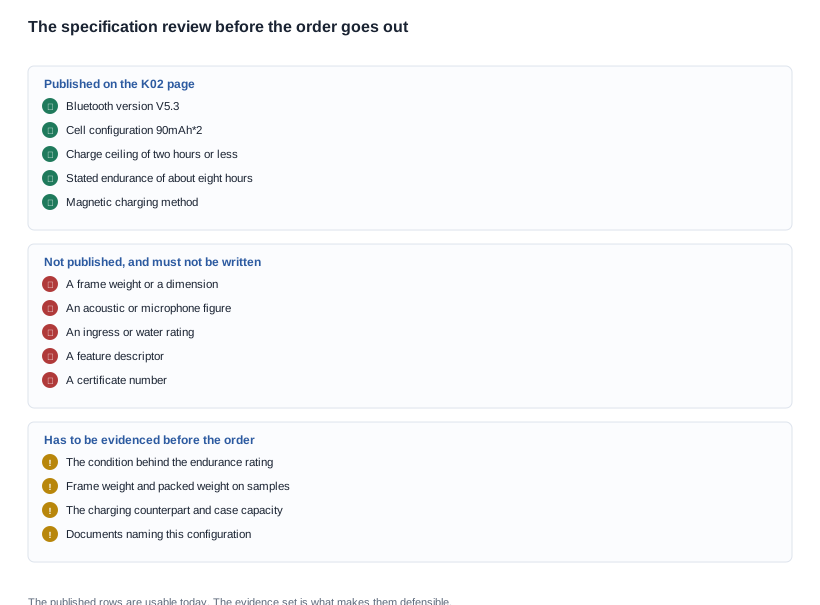
The commercial terms the specification has to sit beside
A specification annex binds the product. It does not bind the order. Around it sit the terms that decide whether the order is a good one for the business, and each one belongs to a different party and a different timetable.
The minimum order quantity and the lead time belong to the supplier and cannot be inferred from a specification. Neither can the production capacity behind a delivery date, which is the number a buyer should ask about when a date looks optimistic. The warranty period and the response time attached to it belong in the agreement as a duration and a remedy, not as a general assurance. Packaging has to be specified as a deliverable, because packaging is what determines the packed unit weight, the freight cost and the damage rate in transit. Tooling is a cost with its own amortisation, and it should be identified separately from certification cost so that a buyer can see which is which.
The OEM ready model readiness overview covers how a platform moves from a catalogue row into a programme with terms attached, and the AI feature notes cover the software side of what a configuration is claiming.
Three ways a specification dispute reaches the customer
The substitution. A component changes for cost reasons, the published rows no longer describe the unit, and the channel discovers it in a customer review rather than in a change notice. The root cause is that nothing in the agreement binds the order to the annex. The prevention is the configuration clause, and the supplier's obligation to state which rows remain accurate after any change.
The inherited figure. A value that was never measured reaches the annex and then the page, usually because it was copied from a previous project or another model. The root cause is that the annex records values without sources. The prevention is the source rule, applied strictly enough that a value without a named source and a date is removed rather than carried forward.
The truncated promise. A ceiling or a rating is quoted as a value, the copy says "under two hours" or "a full working day", and the field result contradicts the page. The root cause is that the copy was written from the number rather than from the row. The prevention is a copy brief that quotes the row itself — "a charge time of two hours or less", "about eight hours of stated use" — rather than the number on its own.
The questions to ask before the order is released
- What test condition sits behind the published endurance figure for this configuration?
- What does the frame weigh, measured on samples, and what are the packed dimensions?
- What does a full charge take from a stated starting state, and what is the terminal behaviour?
- What microphone pickup does the configuration produce in a representative environment?
- Which documents name this configuration for our destination markets?
- How does a change to any published row get communicated before shipment?
We publish the five rows for the K02 because they are the complete, checkable position we can support. We do not publish a weight, a dimension, an acoustic figure, an ingress rating or a certificate number, and we would rather say so than print a figure no document supports. What we will do is quote against a specified quantity and configuration, and state which configurations exist and which do not.
Related reading
- The K02 against the range — K02 smart glasses how it compares
- What the catalogue does not publish — K02 smart glasses limitations
- The closest comparison available — K02 smart glasses versus K01
- The range overview — Bluetooth audio glasses
Send us the configuration, the quantity and the destination market, and we will tell you which rows already answer it and which have to be evidenced.


