

K02 smart glasses vs D12 price positioning cannot be settled from a catalogue page, because the catalogue publishes no price, no price tier and no unit price for any model in the range. What it does publish is a fixed set of rows per model, and those rows are enough to tell a procurement team which cost lines move when a selection changes from one model to the other. So the comparison in this article is built on what is published, and on the questions that have to be put in writing before one quotation can be judged against another.
The two audio models and what separates them
Both models sit inside the same group of eight audio glasses, and the group is small enough to be read in full: the K01 and the YK12, the D11 and the K02, the LC-105-2 and the G07, and the D12 and the LC-105-1. All eight of them publish the same five rows — cell configuration, endurance, charge time, charging method and Bluetooth version — and the whole of the difference between this pair is contained in those five lines.
Two pages inside the group of eight
The K02 page prints five rows and nothing further: 90mAh*2 cells, an endurance rating of about 8 h, a charge time of two hours or less, magnetic charging and Bluetooth V5.3. The D12 page prints the same five rows in the same order: a single 100 mAh cell, an endurance rating of about 7 h, a charge time of two hours or less, Type-C charging and Bluetooth V5.4.
Neither page carries a feature line. Across the eight audio models, five publish no feature row at all — the LC-105-1 and the K01, the D12 and the LC-105-2, and the K02 — while three do: the D11 with a surround-sound line and a long-endurance line, the G07 with a slim and detachable temple line, and the YK12 with surround sound and a slim temple line. Because both models in this comparison sit inside the first group, neither of them can carry a named audio feature in a listing, and that is a structural fact about the catalogue rather than a shortcoming of one product.
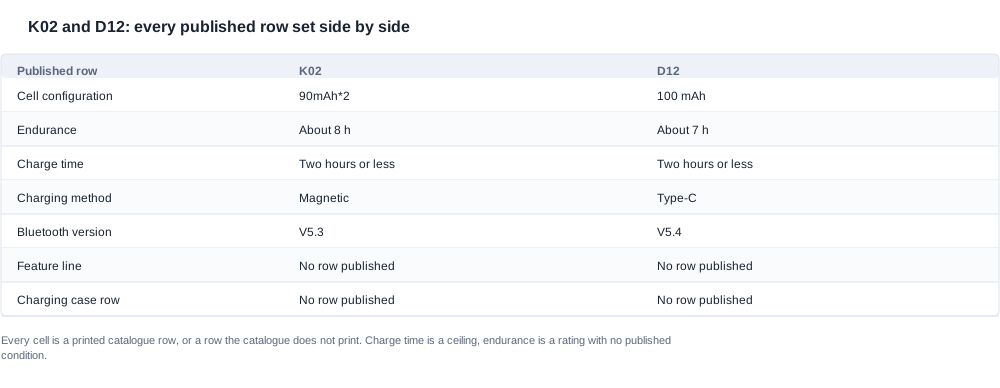
Two further absences are shared across the whole audio group, and they matter for any cost line a buyer tries to build. The catalogue publishes no charging-case row for any of the eight, so what ships in the box is a quotation item rather than a published fact. The catalogue also publishes no ingress-protection row for any of the eight; the only ingress marking anywhere in the catalogue is IP54, and it appears on the V06 and the S7 alone.
The four rows on which the pair differs
Read across the two pages, four of the five rows are identical and four are not. Charge time is the identical row: two hours or less on both models, which is a ceiling rather than a measured cycle, and the ceiling does not settle anything about a shift schedule until the start state and the end criterion are supplied.
The four differences are cell configuration, endurance, charging method and radio version, and they are not of equal commercial weight. The charging method and the cell configuration are supply-chain decisions that a buyer makes before a quotation is even requested. The endurance row is a published rating without a published test condition. The radio version is a compatibility statement, and the catalogue publishes no codec list, no multi-device behaviour and no connection test for any of the eight.
That gives a buyer a clean separation to work with. Anything in this comparison that cannot be traced back to one of these four rows is not a difference between the two models; it is a difference in the buyer's own requirements.
What the catalogue publishes about price
Nothing. And the difference between publishing nothing and publishing a negative result is the single most important thing to understand before a quotation is requested.
What the catalogue does not publish
The catalogue publishes no price, no price tier, no unit price, no minimum order quantity, no production capacity, no lead time, no warranty term and no certificate number. It publishes no frame weight, no dimensions, no sensor specification, no storage detail and no per-model certification row. The catalogue text contains no mention of CE, FCC or RoHS, and the only compliance framework that can be written down for an audio model is the Radio Equipment Directive (EU) 2014/53/EU together with EMC 2014/32/EU. The single weight figure anywhere in the catalogue is 158 g, and it belongs to the MT6 eyewear body, a camera model; it cannot be carried across to an audio model for a weight comparison.
Why an unpublished row is not a missing product
The correct way to write each of those absences is that the catalogue does not publish them. A catalogue row that is not printed is a documentation fact, and it says nothing about what the product does, what it contains or what a supplier could quote. An unpublished charging-case row does not mean the model carries no case in the box; it means the case, if there is one, has to be established in writing before it can be planned. An unpublished certification row does not mean the model is uncertified; it means the scope of any document a supplier offers has to be checked against the exact model designation and the destination market, because a document that names one model is not evidence about another.
This distinction is the reason the catalogue cannot be used to build a price positioning on its own. The catalogue positions nothing. It publishes the physical and electrical rows, and every commercial conclusion sits on top of those rows rather than inside them. A price tier, a unit price, a margin and a landed cost are all outputs of a quotation process, and the inputs that make two quotations comparable are the published rows plus the answers a supplier gives in writing.
The practical consequence for a procurement team is that the correct deliverable at this stage is not a price comparison but a comparison worksheet: the published rows, the rows that are not published, the requirement each published row serves, and the written request that closes each gap. That worksheet is what a quotation can then be judged against, and it is what this article builds for the two models.
A sourcing team that treats the catalogue as a completed due diligence file will find at the audit stage that the published rows were never evidence of anything except the published rows. What the order actually rests on is the factory answers, the sample results, the certificate register and the packing list — none of which appear in a catalogue page, and all of which a bulk order quotation has to be built around.

Building the comparison the quotation has to answer
A comparison that a quotation can answer is built in a fixed order, and the order matters more than the format. Fix the requirements, map each one to a published row or to a written answer, put the same questions to every supplier in the same form, rebuild both quotations on the same scope, and only then read the two answers against each other.
Five steps for a defensible comparison
- Fix the requirement set before any quotation is read. Write down the charging standard the channel already runs on, the endurance window the working pattern needs, whether a named audio feature is required, what the parcel must contain, the documentation the destination market expects and the volume the programme is being planned around. A requirement that is not written down before the quotation arrives will be settled by whatever the quotation happens to say.
- Map each requirement to a published row or to a written answer. Where a published row answers it, the row is already the specification and can be copied into the technical file. Where nothing published answers it, the requirement becomes a question with an owner and a date attached.
- Ask every supplier the same questions in the same words. Two questions asked in two different forms produce two incomparable answers, and the difference between the answers then looks like a difference between the products when it is only a difference between the forms.
- Rebuild both quotations on the same scope. Accessory content, packaging, artwork, documentation and freight belong inside both totals, or the two figures describe two different jobs and cannot be compared.
- Compare the answers line by line, and keep the refusals. A supplier who declines to answer a question has produced an answer, and it belongs in the worksheet as a refusal rather than being quietly dropped.
The worksheet the two models have to be read against
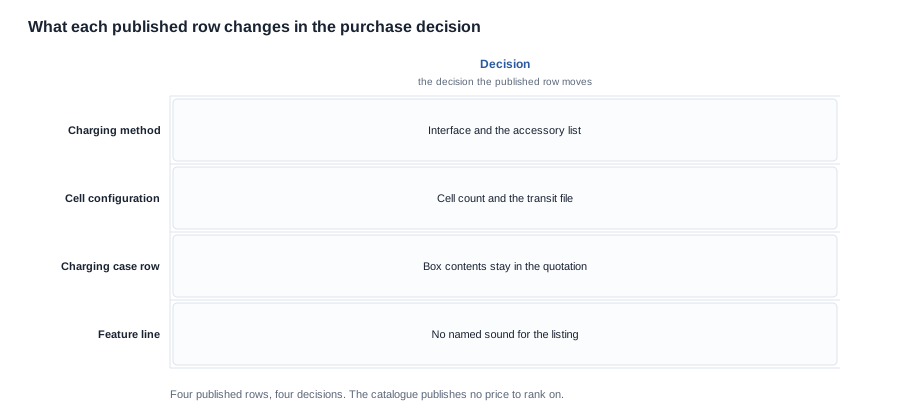
The matrix above reduces the worksheet to one step: a published row, and the purchasing decision it changes. An interface row decides what the customer must own and what goes in the box. A cell row decides the pack, the assembly and the transit file. A missing case row keeps the accessory content inside the quotation. A missing feature line removes the option of selling on a named sound.
| Requirement | What the K02 publishes | What the D12 publishes | What to put in writing | Which line it moves |
|---|---|---|---|---|
| Charging interface | Magnetic | Type-C | Whether a dock ships, and in which markets | Parcel, accessory list, instructions |
| Cell configuration | 90mAh*2 | 100 mAh | Cell make, cycle life and matched-cell handling | Bill of materials, packing, transit file |
| Endurance | About 8 h | About 7 h | Start state, volume level, radio state | Listing copy, returns allowance |
| Charge time | Two hours or less | Two hours or less | Start state, end criterion, input current | Depot scheduling, copy |
| Radio version | V5.3 | V5.4 | Stored device count, firmware scope | Support load, return reasons |
| Feature line | No row published | No row published | Whether a sound descriptor can be written at all | Copy claim, positioning |
| Charging case | No row published | No row published | Case contents and quantity per model | Parcel, accessory list |
| Ingress rating | No row published | No row published | Rating, standard used, report reference | Retail environment, claim |
| Certification | No per-model row | No per-model row | Document scope naming each model | Market access, risk management |
| Frame weight | Not published | Not published | Net weight per model, measured or declared | Freight, packaging |
| Unit price, MOQ, lead time, warranty | Not published | Not published | Written quotation on the scope agreed above | The comparison itself |
The criteria in that sheet are what a shortlist is judged against, and the trade-off between them belongs to the buyer rather than to a ranking we publish. The three red flags in a request of this kind are familiar: a unit price that arrives without a scope attached to it, an endurance figure with no condition behind it, and a document that names the model family instead of the model designation.
The questions that have to go out in writing
The request is short, and short requests get answered. These are the lines a buyer sends, with the model name in the subject and the date on the answer.
- For each model separately, what is the net frame weight in grams, and is the figure measured or declared with the cell fitted?
- For each model separately, what are the start state, the volume level, the radio state and the audio profile behind the published endurance figure?
- For each model separately, what are the start state, the end criterion and the input current behind the charge-time ceiling?
- For each model separately, is a charging dock or a cable included in the box, and is the accessory part number the same across the programme?
- For each model separately, how many devices can be stored, and what happens on an incoming call from a second device?
- For each model separately, which documents name that exact model designation, which standard each document covers, and what the market access position is for the destination country.
- For each model separately, what is the unit price at your volume tiers, and what is the minimum order quantity per model and per colour.
- For each model separately, what is the standard lead time from deposit to shipment, the monthly production capacity, the warranty term and the sample order terms.
- For both models together, what is the packing list per carton, and what is the change-control rule if a model, a cell or an accessory is substituted after the order is placed.
Those answers are the comparison. Without them, a buyer has two sets of identical published rows and no basis on which to choose, and the choice will be made by whoever answers first rather than by whoever answers in writing. Verify each answer against the model designation it names before it enters the technical file, and keep the answers of both models in one place, so that incoming quality control can check the goods against a single sheet rather than against two supplier memories.
Where the two models separate on cost
Cost does not follow from the catalogue, but it does follow from the rows once each row is read as a decision rather than as a number. Four published differences produce four separate cost lines, and they are worth separating because each one is negotiated on a different document.
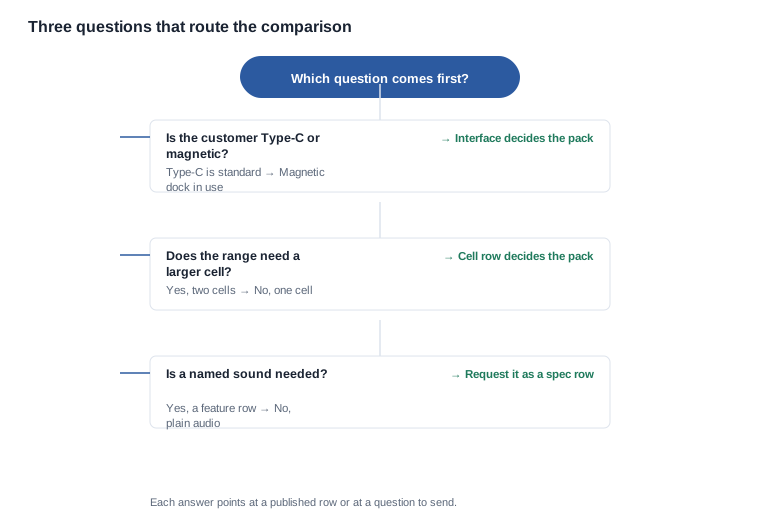
The interface, the cell and the radio
Charging method. A magnetic interface asks the customer to own a dock. That dock has to be sourced, packed, stocked or sold, and the catalogue publishes no row describing it for either model, so the accessory content is a quotation line that has to be written out. A Type-C interface asks the customer to own a cable, which most customers already have, and it means the customer can charge from a laptop or a power bank. The cost difference between the two routes is a packaging and accessory difference that the supplier can quote once the scope is fixed, and it is not a specification difference that a buyer can settle from the catalogue.
Cell configuration. The K02 publishes two 90 mAh cells, one per temple; the D12 publishes a single 100 mAh cell. In derived terms the D12's cell is roughly three-fifths of what the two K02 cells carry together, so the two configurations are not interchangeable in the supply chain even though they sit within one hour of each other on the published endurance row. A two-cell pack means two power paths, two contacts, a docking accessory and a lithium-battery transit file that has to describe the cell count and the quantity, with the UN38.3 summary naming the cells actually fitted; a single-cell pack keeps one service path and one pair of contacts to inspect. That difference reaches packing volume, freight, incoming inspection and the aftersales route, and it is the reason a buyer cannot treat the two models as one order split across two colours.
Radio version. V5.3 against V5.4 is one generation apart and it settles almost nothing about cost. It tells a buyer which Bluetooth specification each radio was built against; it does not tell a buyer how many devices a unit stores, how it behaves with a second device, or how the radio load affects the published endurance figure. Put into commercial terms, the radio row belongs in the support and returns discussion rather than in the landed-cost build.
The endurance hour that cannot be priced
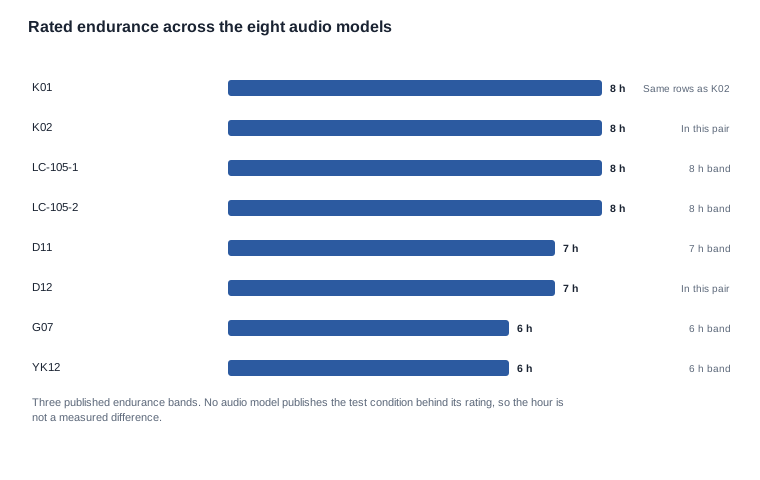
The endurance difference between about 8 h and about 7 h is the number most likely to reach a listing page, and it is the one that cannot be carried into a cost line as published. Six models across the catalogue publish about 8 h — the LC-105-2 and the K01, and the LC-105-1 and the K02 from the audio group, the YKC02 sport model and the ZH12 sport model — and they span four different cell configurations. Not one of those six publishes how the figure was produced: no start state, no volume level, no radio state, no audio profile.
That makes the hour a difference between two unpublished test procedures rather than a measured advantage, and it makes the questions on the chart above the right way to spend a sourcing round. If the customer is already running a Type-C standard, the interface question is answered before any comparison of the two models begins, and the cell question then decides whether a two-cell pack is worth the accessory and transit work it creates. If a named sound is required for the listing, neither model can carry it on a published row, and the acoustic requirement has to be written as a specification request rather than assumed from a model name.
The two questions that remain are the ones a buyer should never skip: whether the channel's own constraints already settle the choice, and what evidence is required before the answer becomes a deliverable rather than a preference.
The K02 versus D12 price positioning
The defensible position on this pair is a structural one. The K02 is the two-cell magnetic configuration with the longer published endurance rating; the D12 is the single-cell Type-C configuration with the newer radio generation. That is the whole of the published difference between them, and it is the whole of what can be said about positioning without a published price.
What cannot be said is equally important. There is no price tier for either model, because the catalogue publishes no price and no tier, and a tier derived from unpublished numbers would be a guess with a table around it. There is no claim that one model carries more value than the other. There is no claim that a longer published endurance rating earns a higher ticket, because the condition behind that rating is not published for either model. And there is no feature-led proposition, because neither model publishes a feature row.
The boundary of what we publish for this pair
The line we hold on this pair is narrow and deliberate. We will publish every row the catalogue prints for either model, in the form the catalogue prints it, and we will not turn a cell count into a capacity total without marking that total as a derived figure. We will not rank these two models, we will not divide them into price tiers, and we will not quote a unit price, a minimum order quantity, a lead time, a production capacity or a certificate number, because the catalogue publishes none of those for either model and we do not hold them either. Our position on price positioning for this pair is that the catalogue contains no figure that could carry one, so the positioning has to be produced by the quotation and by the written answers behind it.
What we will do is take the interface your channel already runs on, the accessory you intend to ship in the box, the target market, the volume and the requirement the listing has to satisfy, and tell you which published rows keep the K02 in scope, which published rows keep the D12 in scope, and which of the questions on the worksheet are still open for each model.
A structural position rather than a price tier
A positioning that a buyer can defend in a channel review has three parts. First, the published rows, copied exactly as the catalogue prints them, with cell values kept in their published form rather than converted into totals. Second, the structural reading of those rows: two cells against one, magnetic against Type-C, V5.3 against V5.4, about 8 h against about 7 h. Third, the open rows, listed with an owner and a date, covering frame weight, acoustic behaviour, accessory contents, per-model certification scope and every commercial term that the catalogue does not publish.
The price positioning then comes out of the quotation, applied to that structure. It cannot come out of the catalogue, because the catalogue contains no number that could carry it.
The worksheet that replaces a published price
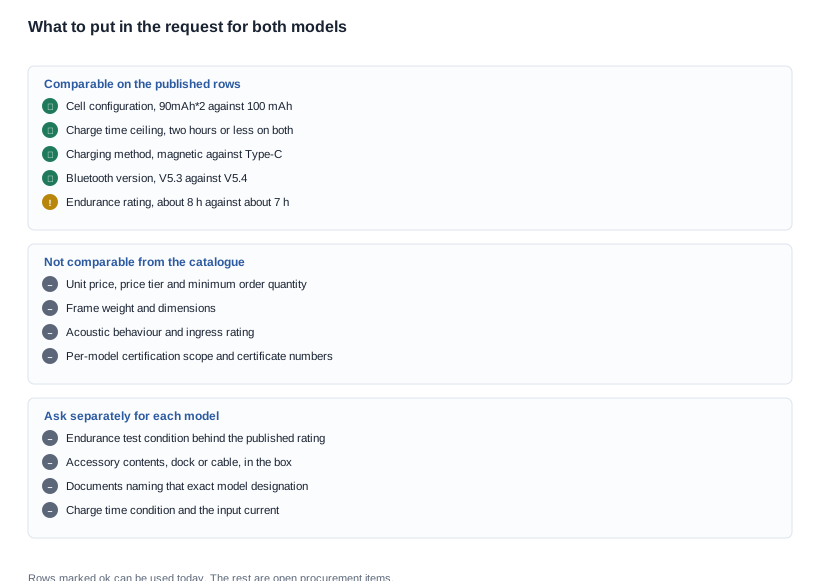
The checklist above is the version to send. Rows that are comparable go into the technical file as published, copied identically for both models, with no negotiation attached because there is nothing to negotiate. Rows that are not comparable from the catalogue are marked as open items rather than filled with an assumption, and the request for each one goes out in the same wording to every supplier. Rows that must be asked separately — the accessory contents, the endurance condition, the documents naming each exact model — are tracked one by one, because an item covered for one model and skipped for the other is where a comparison quietly stops being a comparison.
Two operational points close the loop. Ask both suppliers for a bulk order quotation on the same scope, with the accessory content, the documentation and the packing list named inside it, and treat a unit price that arrives without that scope as incomplete rather than as low. And keep the answer set in one dated file, so that the second quotation round starts from evidence rather than from memory.
For a buyer who wants the selection method rather than the specification detail, D12 versus K02 sets out the constraint-first way to work this pair, and the K02 against the K01 covers the two models that publish rows identical to the K02's own, which is worth knowing before a programme places both on the same shelf. The interface decision itself is worked through in the charging options for the audio range, and the rows that stay blank for the K02 are collected in the K02 limitations so that the open items on the checklist are not re-discovered from scratch. The K02 buyer review checklist covers the sample pass that closes the measurement side of those items.
Related reading
- The same pair, worked as a selection method — D12 versus K02
- The twin whose published rows match the K02's exactly — K02 versus K01
- The interface decision in detail — charging options for the audio range
- The rows this comparison leaves open — K02 limitations
- The range both models belong to — Bluetooth audio glasses
For the K02 against the D12, the price positioning is not in the catalogue at all; it is in the four published rows that decide which quotation line moves, and in the written answers that close everything the catalogue leaves open.


