
The K02 arrives with a short published row and a long list of things nobody has written down. For this model the catalogue states Bluetooth V5.3, 90mAh*2 cells, a charge ceiling of two hours or less, a runtime label of roughly eight hours and magnetic charging — and then it stops. There is no frame weight for the K02, no acoustic figure, no ingress marking and no certification line. This k02 smart glasses buyer review checklist turns that silence into six checks a procurement team can run before a purchase order is signed, and it puts model identity at the front because the K01 and the K02 publish exactly the same rows.
Each check on the K02 below is written in the same three-part form: what the catalogue already publishes for this model, what it does not publish, and which decision the answer unlocks. Where a figure exists but carries no test condition, the entry says so instead of presenting the number as a working promise, because a label that cannot be reproduced cannot be defended to a customer who tests it.
The K02 is one of eight audio models in the range, and the shape of its published row is typical of the group: enough to identify the class of product, not enough to write a specification against. A buyer who closes the six checks below ends up with a purchase order that names the model, states the condition behind the runtime label, fixes the charging method, attaches the document set and defines the acceptance thresholds — the parts that decide whether a shipment can be accepted or only received.
The K02 review checklist and why it starts with identity
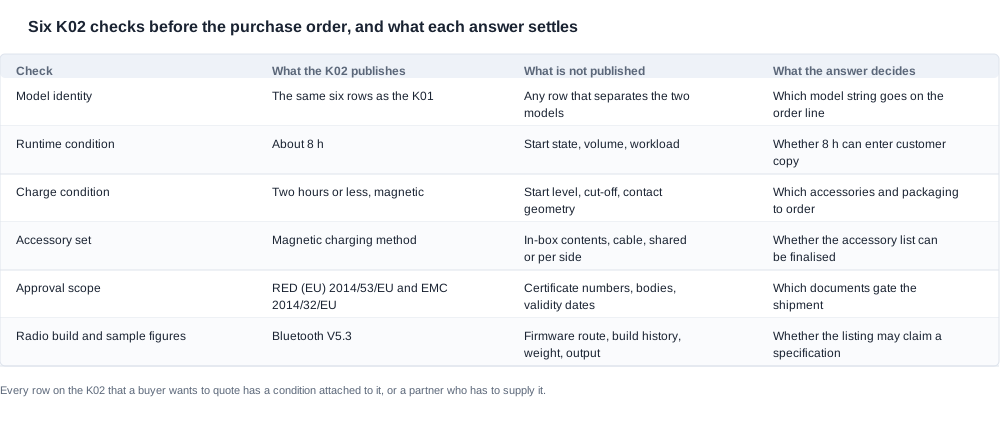
Six checks are enough for the K02 because the catalogue row is short and the gaps are specific rather than general. A generic incoming-inspection list would ask for weight, sound pressure, battery chemistry and drop resistance, but for this model most of those answers do not exist anywhere, and asking for them in the abstract produces a supplier reply full of adjectives rather than numbers. The six checks below ask instead for what a supplier can actually produce: the model string on the unit, the runtime condition behind the label, the charge condition behind the ceiling, the radio build, the accessory set the magnetic method implies, and the approvals that apply to the K02 in your destination market.
Identity comes first for the K02 because everything downstream depends on which of two near-identical models is in your hand. The K01 and the K02 publish the same cell configuration, the same runtime label, the same charge ceiling, the same charging method and the same radio generation, and neither carries a feature row in the catalogue. If a sample that arrives turns out to be filled with the K01 while your specification, your accessory list and your listing copy were written against the K02, then every measurement you take describes hardware you did not order, and a measurement set collected across the batch will be internally inconsistent for a reason that has nothing to do with build quality. The identity check is therefore not paperwork; it is the precondition for the other five being meaningful.
The K02 review sequence also has to decide what is measured per unit and what is measured per run. A model string is a per-unit fact and should be recorded for every unit that enters your warehouse, ideally photographed next to the serial number you keep for warranty. A charge time measured on one unit from a run describes the process at best and the individual unit at worst. Keeping the two apart costs nothing at the start and saves an argument later, because a defect rate computed across a batch that mixed two models is not a defect rate for either of them.
Read the K02 table as a request list rather than as a test protocol. Rows one to three — model identity, the runtime condition and the charge condition — are answered in writing by the supplier before the order is placed, because each of them changes what the order itself should say. Row four, the accessory set, is answered in writing too, but by the packaging or accessory owner rather than by the sales contact. Row five comes from the certification owner, because the approval scope decides which markets the goods may enter. Row six mixes supplier answers with a measurement you make on the sample, because the K02 publishes no acoustic figure and no weight at all, so no document can supply them and only a sample can.
The six K02 checks also fall into two groups by deadline, and the grouping decides when a purchase order can move. The checklist diagram sorts the same six checks into what has to be closed before the order is placed and what can be advanced alongside the order, with the sample measurement carrying the second group.
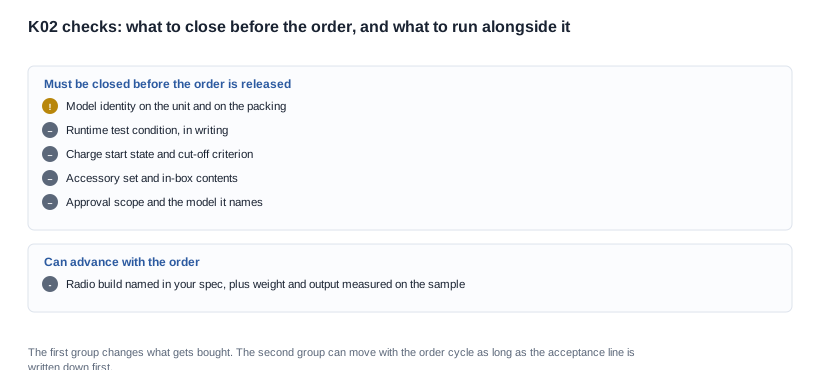
Nothing in the first K02 group can be repaired after the goods are made, because each of those items changes the specification itself: the model you are buying, the condition attached to the runtime label, the condition attached to the charge ceiling, the accessory set in the box and the approvals behind the unit. The second group is manageable during the order cycle, provided the acceptance thresholds are written down before the sample arrives — otherwise a measurement produces a number without a pass mark, and a number without a pass mark cannot be used against a supplier. One useful way to make this concrete for the K02: the OEM-ready quality consistency approach treats the first measured spread as the tolerance proposal for the next run, which is how a checklist becomes a standing control rather than a one-off exercise.
The six K02 checks also decide how the evidence is stored, and that decision is cheap to make early. A record sheet with four columns — model string, runtime condition, charge condition and approval scope — turns a supplier conversation into a file that the next buyer, the warehouse and the claims desk can all read. The same sheet lets an acceptance inspector work from a document rather than from a recollection, and it is what makes a defect claim defensible months later, when the person who took the measurement has moved on to another job.
Six checks also fit inside a single working session if the sample arrives before the order is released. The identity check takes minutes per unit, the runtime and charge conditions are written questions that can go out the same day, and the acoustic and weight measurements take an afternoon with a scale, a playback source and a stopwatch. The order in which the checks are run matters in only one respect: identity has to be settled before anything is measured, because a measurement taken on the wrong model is worse than no measurement, since it looks like evidence.

Identity: the K01 and the K02 publish the same rows
The K01 and the K02 are indistinguishable on the published sheet. Both are listed with 90mAh*2 cells, a runtime label of roughly eight hours, a charge ceiling of two hours or less, magnetic charging and Bluetooth V5.3, and neither carries a feature row. The catalogue publishes no row that separates them, and this article does not invent one — a buyer who has been told that the K02 is the newer or the better of the two has been told something the published data does not support.
| Published row | K01 | K02 |
|---|---|---|
| Cell configuration | 90mAh*2 | 90mAh*2 |
| Runtime label | ~8 h | ~8 h |
| Charge ceiling | ≤2 h | ≤2 h |
| Charging method | Magnetic | Magnetic |
| Bluetooth generation | V5.3 | V5.3 |
| Feature row | Not published | Not published |
The table above is the entire published identity of the K01 and the K02, and that has direct commercial consequences. If your channel plan runs one SKU, the choice between the K01 and the K02 should be made on grounds the catalogue does record — availability, packaging, private-label treatment, the accessory set you are actually assembling — and not on a perceived specification gap. The K01 specification note covers the rows the K01 publishes, and the model-to-model comparisons across the audio group, such as K02 versus D11 and K02 versus G07, show the same discipline: each comparison names the rows that differ and leaves the rest open.
Keeping the K01 or moving to the K02 therefore lands on cost lines and document lines rather than on specification lines. The decision diagram below traces that call to the items it actually touches.
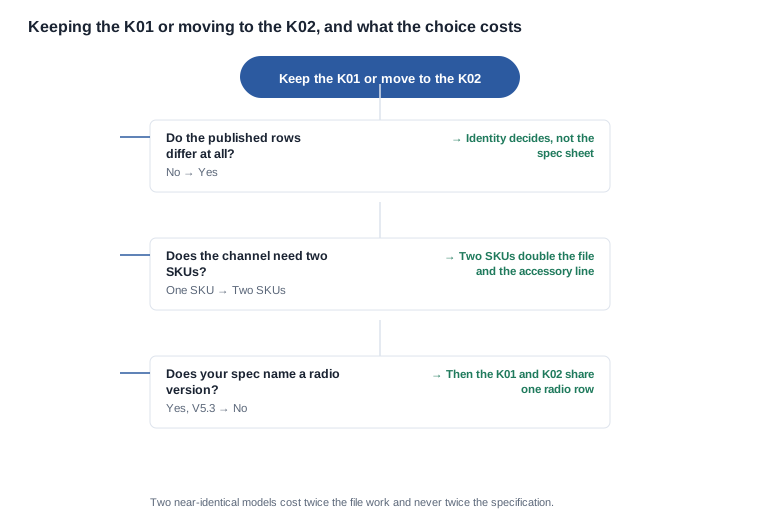
A single-SKU decision keeps the accessory programme, the listing copy and the support scripts on one model, which removes an entire category of file work from the launch. A two-SKU decision doubles the SKU count, the accessory line and the document set, and it earns that cost only if your channel can genuinely position two near-identical products. For that reason the K01-versus-K02 question should be settled with your own commercial structure in view: the range overview in smart eyewear range mixing categories covers when running similar models side by side pays, and OEM-ready inventory planning covers the stock side of the same call.
What a K02 buyer must not do is let the identity question stay open until the goods are produced. The K01 and the K02 differ in no published row, so nothing on a datasheet will tell you which one arrived; the model string printed on the unit and on the packing is the only evidence available, and the catalogue's model strings are written without hyphens — MT5 and V03, MT6 and CY03, and CY05 and KY06 all appear that way — so read the string exactly as printed rather than reformatting it. Record it per unit, photograph it, and tie it to the serial record you keep for warranty, because the first time identity is disputed it is usually at the returns desk and usually about a unit that came out of one pallet.
The audio models around the K02 are documented individually, and the same discipline applies to this model: the K02 common questions note and the K02 limitations note both work from published rows and name what a listing may and may not say. Working from published rows is not caution for its own sake. In a market where several near-identical products sit under different names, the listings that survive scrutiny are the ones that state exactly what the supplier confirmed and nothing more.

Radio and endurance: two K02 rows you cannot quote without conditions
The radio row for the K02 is V5.3, and that single fact needs context before you put it in a specification. Across the eight audio models in the range — the G07 and the K01, the LC-105-2 and the D11, the D12 and the YK12, and the LC-105-1 and the K02 — the K01 and the K02 are the only two models listed on V5.3, and they are the only V5.3 models anywhere in the catalogue; the remaining six audio models are listed on V5.4. If your own specification names a radio generation, the K02 row is checkable and worth checking, because a mismatch at this level is invisible on the packing and obvious to a user pairing for the first time. The catalogue publishes nothing else about the radio build: no pairing range, no firmware update route, no statement about whether both sides of a pair run the same build, and no version history. Anything beyond "V5.3" on a K02 comparison sheet came from somewhere other than the catalogue.
The endurance row for the K02 is weaker still, and this is the check most likely to produce a dispute. The K02 is one of six models in the whole range that carry the roughly eight-hour label — the K01 and the YKC02, the LC-105-2 and the ZH12, and the K02 and the LC-105-1 — and those six models span four different cell configurations: 90mAh2, 55mAh2, 70mAh*2 and a single 100 mAh cell. The same label therefore sits on hardware with materially different battery volume, and not one of the six publishes the test condition behind it: no start state, no playback volume, no streaming or codec state, no ambient condition, no statement of whether the figure describes one side or both. The consequences are strict and practical. The roughly eight-hour figure cannot be used as a working-hour promise for the K02, it cannot be used to rank the K02 against the other models that carry the same label, and it cannot be reproduced by your own team without a protocol in hand. Comparing the K02 with the LC-105-2 battery and charging note is useful precisely because that comparison states the shared condition instead of implying a gap.
The 55mAh*2 tier shows how the same catalogue handles one cell configuration with different wording, and a K02 comparison has to quote it carefully. Within that tier the published endurance range is roughly six to eight hours: the LC-105-1 and the LC-105-2 are written at about eight hours, while the G07 and the YK12 are written at about six hours. A buyer working across cell configurations will compare the K02's ninety-cell configuration against those four models, but the G07 and the YK12 must be quoted at about six hours, never at about eight. A comparison sheet that quietly rounds them up is wrong on exactly the row where the catalogue was precise, and it is the kind of error that survives until a customer returns the product.
The six models carrying the roughly eight-hour label are spread across the catalogue in a way that makes the label useless for ranking them. The K01 and the K02 are the 90mAh2 pair, the LC-105-1 and the LC-105-2 sit in the 55mAh2 tier, and the remaining two, the YKC02 and the ZH12, carry the 70mAh*2 and the 100 mAh configurations between them. One label, four configurations, two product families, and no test condition published on any of the six. The label also appears on no camera model, so it is not even a range-wide convention that happens to be imprecise — it is a row that six models share and the catalogue has never defined. The charge ceiling behaves the opposite way: every audio model publishes two hours or less, which makes it a class convention rather than a differentiator, and it still carries no start state and no end criterion.
The layers diagram sets out how the information on the K02 divides, and it is the fastest way to see which parts of a product page you can write today and which parts are waiting on a document.
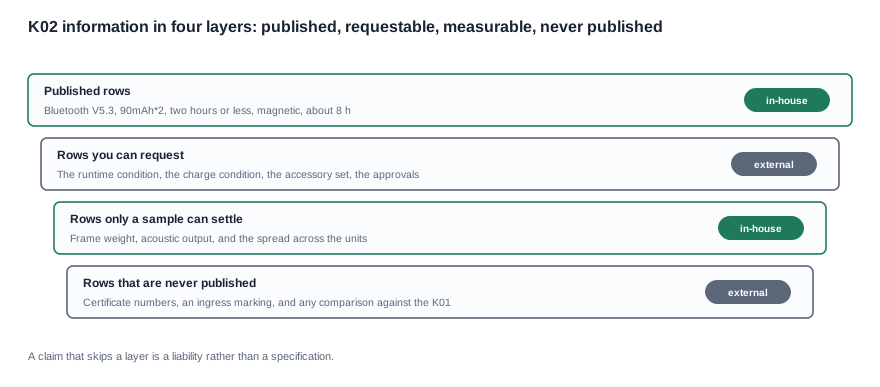
The fourth layer is the one that protects a K02 listing. For this model, no certificate numbers, no issuing bodies, no validity periods and no covered-model schedules are published, and the same is true of every audio model in the range. The two regulatory references that do appear are framework-level only: the Radio Equipment Directive, (EU) 2014/53/EU, and the EMC Directive, 2014/32/EU. A K02 product page can therefore say that the product falls under those frameworks; it cannot say it holds a specific certificate, because no such row exists to quote. The D11 certification status note and the Bluetooth audio glasses certification note set out the same distinction in detail for the surrounding models.
Two more rows belong to the never-published layer for the K02. No audio model in the range publishes a weight, so the only public weight in the catalogue, 158 g, belongs to the MT6 camera glasses and cannot be borrowed for an audio listing. And no ingress rating exists for the K02: IP54 is published for the V06 and the S7 only. Neither figure nor marking can be carried over, and neither should appear in your copy for this model.
The same discipline applies to the description of what the K02 does, because only three of the eight audio models carry a feature label at all. The D11 is described with surround sound and long-endurance labels, the G07 with ultra-slim construction and detachable temples, and the YK12 with surround sound and slim temple labels. The D12 and the K01, the LC-105-2 and the LC-105-1, and the K02 carry no feature row, so a K02 description has to be built from what the buyer can verify — the radio version, the cell configuration, the charge method — rather than from a feature phrase that would need a measurement behind it. The K02 battery life note handles the runtime label in detail, and the audio range picking guide in Bluetooth audio glasses model picking is where the K02 sits against the other seven.

Accessories: what the K02 magnetic method word does not settle
The charging method for the K02 is published as magnetic, and that one word is a method label rather than a specification. It tells you the contact is magnetic and nothing else: it does not tell you the geometry of the contact, whether the contact is exposed or recessed, whether the cable that comes with the unit terminates in a proprietary puck or a standard lead, whether charging is per side or through a shared base, or what is actually in the box for either side. The full treatment of what the magnetic label leaves open sits in the K02 charging options note, and this section deliberately does not repeat it; here the magnetic word matters for a narrower reason, which is that it determines who has to answer before the order is placed.
A magnetic method also puts the K02 in a different accessory programme from the rest of the audio group. Six models in the range charge magnetically — the K02 and the K01, the LC-105-2 and the G07, and the YK12 and the LC-105-1 — while Type-C is published for exactly one pair, the D11 and the D12. A channel that already handles Type-C accessories does not automatically hold the right leads, cradles, counter stock or packaging inserts for a magnetic K02, and that difference has to be planned rather than discovered at packing time. The audio group publishes no charging-case row either, so nothing about a case can be read in either direction for the K02 from the catalogue; the case capacities that are published belong to camera models and do not transfer. The Bluetooth audio glasses packaging options note covers the box and insert side, and the camera-side equivalents in AI camera glasses packaging options show how the same question is answered for a different product group.
Three parties hold the answers you need for the K02, and each one owns a different part of the request. The accessory or packaging owner supplies the contact geometry, the cable configuration and the in-box contents for this model. The quality engineer supplies the charging protocol — the start state, the charge criterion and the acceptable deviation on a single side — and is also the person who can confirm what a magnetic contact is expected to do when a unit seats imperfectly. The certification owner supplies which approvals apply to the K02 in your destination market and the test reports behind them. Asking all three in one message to a general enquiry address is the most common reason a K02 order stalls, because the question is split across three roles and each role will answer only its own part. The OEM-ready customization depth note covers what a factory can and cannot vary at this level, which is useful context when you are deciding whether to ask for a specific accessory or accept the standard one.
The questions to answer before the K02 purchase order is placed
For the K02, the sequence below runs from the printed model string through the accessory programme and the certification file to the warranty and acceptance language, and each step has a precondition a buyer can actually satisfy.

The K02 questions themselves, in the order that avoids rework, are these.
- Which model does this order fill? The K01 and the K02 publish the same rows, so the answer has to come from the model string on the unit and the packing, confirmed in writing before the order is released.
- What protocol sits behind the roughly eight-hour label for the K02? Start state, playback volume, streaming or codec state and whether the figure covers one side or both — without this the number cannot be used in customer-facing copy.
- What is the charge condition behind the two-hour ceiling for the K02? Start level, cut-off criterion and the expected behaviour when a magnetic contact seats imperfectly.
- Which radio build ships in the K02? The catalogue states V5.3 for this model and for the K01 only, so confirm the build against the version your own specification names.
- What accessory set travels with the K02? Contact geometry, cable termination, per-side or shared charging and in-box contents, because the magnetic label settles none of it.
- Which approvals apply to the K02 in the destination market? The catalogue publishes only the framework references, (EU) 2014/53/EU and 2014/32/EU, so the model-specific coverage and the supporting test reports must come from the supplier.
- What is the measured acoustic output of the K02 sample? No figure and no feature row exist for the K02, so your measurement sets the description you can print.
- What is the frame weight of the K02 as built? Nothing in the catalogue publishes a weight for any audio model, and the 158 g figure belongs to the MT6 camera glasses, so it cannot be used here.
- Which defect categories will the warranty line accept? Agree them from the sample measurement and the supplier's explanation, so the first run's spread becomes the tolerance proposal for the next one.
Those nine K02 questions close the six checks. The first six belong in the written purchase-order specification, because each of them changes what is being bought; the last three belong in the acceptance document, because each of them depends on a measurement the sample provides. Keeping them in two documents rather than one is what stops an unresolved item from travelling quietly into the shipment and surfacing later as a return reason. The D11 buyer review checklist and the LC-105-2 buyer review checklist show the same two-document split on neighbouring models, and the range-level guide in Bluetooth audio glasses model picking is the place to compare the K02 against the rest of the audio group before you commit to a single SKU.
The order in which the three owners answer the K02 questions also matters, and it is not the order a buyer usually writes them in. Identity and the runtime and charge conditions come from the supplier's product side, because they describe what the K02 is. The accessory set comes from the packaging side, because it describes what the customer receives. The approvals come from the certification side, because they describe what can legally be shipped and claimed. Bundling all three into one request to a general contact is what produces a partial answer, and a partial answer is what turns into a specification gap once the order is already in production.
The realistic outcome of the six written K02 questions is partial, and the way a partial answer is handled decides how much of the checklist you actually get. A supplier who confirms the model string and the accessory list but declines to state the runtime condition has still moved the order forward on two of the six; the runtime question stays open, which means the roughly eight-hour label cannot go into the listing copy for this run and has to come out of the draft wherever it was written in. Treating a missing answer as an implied yes is what puts an unusable number on a product page, and it is far harder to withdraw later than to leave out now.
Answers that arrive in an email thread are not part of the order, because nothing in a thread changes when the goods are made. Each K02 answer has to land in a document that names the model, and that document has to be referenced from the purchase-order line. The model string, the runtime condition, the charge condition and the accessory list belong in the specification; the acoustic measurement, the frame weight and the accepted defect categories belong in the acceptance document; the approval scope belongs in both, because it decides which markets the shipment can enter.
The K02 rows support one conclusion, and we state it rather than leaving it implied: we do not treat the roughly eight-hour label as a working-hour promise, we do not carry the 158 g figure from the MT6 across to an audio listing, and we do not treat a framework reference as a certificate. A buyer who accepts those three refusals will end up with a shorter product page and a shorter returns rate, and that is a better trade than the alternative.
For the K02 specifically, send the identity, runtime-condition, charge-condition and accessory questions as one written request before the purchase order is drafted, and keep the answers attached to the specification rather than in a separate email thread.
Related reading
- The charging method in detail — K02 charging options
- The published K01 rows — K01 specifications
- Runtime labels across the range — K02 battery life
- The same review structure on a neighbouring model — D11 buyer review checklist


